Showing posts with label Heroes. Show all posts

Wednesday, October 19, 2016

How Does It Feel...to Note Bob Dylan Winning the Nobel Prize in Literature? The Answer My Friend....

Last Thursday, October 13, amid the endless churn of Facebook News Feed items about Donald Trump, and within a year where breaking news about famous musicians has all too frequently revealed their passings, came an unexpected but welcome tidbit:

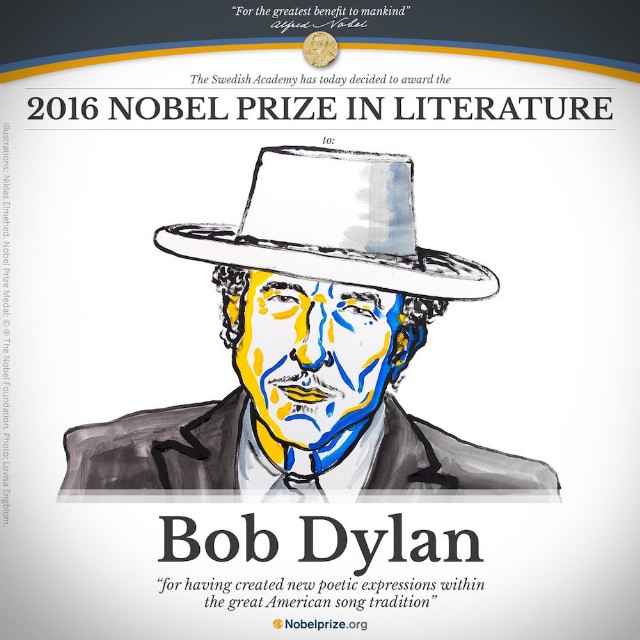
Bob Dylan won the Nobel Prize in Literature.

Although Dylan, now 75 and born Robert Zimmerman in Duluth, Minnesota, wrote a well-received memoir--Chronicles, Volume 1--he is, of course, principally a singer and songwriter.

And in announcing the Nobel Prize, the Swedish Academy proclaimed his selection was "for having created new poetic expressions within the great American song tradition."

Without thinking about it too deeply, at first blush this news sounded like reason to celebrate (without actually celebrating).

Although Dylan undoubtedly has millions of more fervent fans, who know his catalog much more deeply and who possibly followed him first-hand as he became a cultural icon in the 1960s, I hold him in extremely high esteem and consider myself a considerable fan.

You can easily find much more in-depth and astute appreciations of Bob Dylan--in awarding him the Presidential Medal of Freedom in 2012, President Obama aptly said, ""There is not a bigger giant in the history of American music."--than I will attempt here, but of all the ways to explain his genius and his impact on music, culture, society and more, my favorite is a paraphrasing of something I once heard said about his 1965 song, "Like A Rolling Stone."

Although Dylan had already created indelible masterpieces in a folk musical vein--including "Blowin' in the Wind," "Masters of War," "The Times They Are a-Changing," etc., etc.--with rather strident social commentary, "Like a Rolling Stone" was a 6+ minute single (among the longest ever at that time) with sophisticated lyrics, electric guitars and an organ solo.

Its release came just days before the infamous "Dylan Goes Electric" set at the Newport Folk Festival, and represented Dylan's first foray into rock 'n roll.

I don't know where credit is due for pointing this out to me, but before "Like a Rolling Stone" rock music--even by the Beatles, Stones, Beach Boys, Kinks and other legendary visionaries--was almost exclusively the dominion of short songs, mostly about love, cars, surfing and nothing too serious.

It was only after "Like a Rolling Stone"--with the caveat that the Byrds had released their hit, rock-tinged cover of Dylan's "Mr. Tambourine Man" earlier in 1965--that rock songs became longer, more commentative and/or political, with John Lennon's "Nowhere Man" first taking the Beatles in this direction and others soon to follow.

So although the latter-day state of his singing voice--think Cookie Monster, and it was never dulcet to begin with--has left me a bit disappointed in his concerts this century (the most recent I saw, in Nov. 2014, actually wasn't too bad), my regard for his talent, genius, impact and influence couldn't be much greater.

And while I would take it as a given that every year the Nobel Prize in Literature--which seems only to be awarded to living writers and usually honoring a lifetime of work (rather than a specific one)--is chosen by the Swedish Academy numerous deserving choices are passed over, my knee jerk reaction to the news about Dylan was along the lines of "That's damn cool." (It came the same day I was already celebrating the 75th birthday of another legendary American rock songwriter, Paul Simon, prompting me to draft this list of the greatest living practitioners.)

Obviously, with the internet constantly flooded with zillions of freely-offered opinions, and often complaints, on any topic, it wasn't hard to imagine dissension over Dylan's Nobel selection, but I hadn't noticed any until I saw a Tweet by Hamilton-creator Lin-Manuel Miranda--himself a brilliant (song)writer--jabbing at novelists who were presumably condemning the choice.


I subsequently saw articles such as this one, which noted positive reactions by musicians and authors, but also some derision, notably by the latter. The most vicious slam I noted came from Scottish novelist Irvine Welsh (Trainspotting).


Then over the weekend, my friend Ken--a literature buff but also a believer in the cultural importance of groundbreaking rock 'n roll such as Dylan's--asked if I was going to write a Seth Saith post about the Nobel Prize, seeming to suggest that he found the selection askew. Despite stipulating to Dylan's inarguable genius and import, he didn't feel Bob merited a "literature" award.

I disagreed, but not particularly vociferously, and with various other matters at hand--the wedding of Ken's son, my birthday, the Chicago Cubs in the playoffs, the last week of my current work assignment--I wasn't planning to pontificate about the matter in writing.

But with time to do so, and no theater or concert reviews to pen, it would appear that I have decided to.

Even though I really don't care that much about it. Nor seemingly does Dylan, who at last report hadn't returned any calls or emails from the Nobel committee in the wake of his win.

Although through this blog I've published a couple million words over the past several years and consider myself a writer, I don't consider myself an author. I've never written a book nor can identify with writers on that level, so don't really have a dog in this fight. I certainly can't argue this from the standpoint of those who have seen their--or their brethren's--chances to win a Nobel Prize diminished or corrupted.

But giving it a bit more thought, here's what I'm thinking:

• Given that Dylan won the Nobel Prize in Literature, which in 1901 began being awarded annually to an author from any country who has, in the words of the will of Alfred Nobel, produced "in the field of literature the most outstanding work in an ideal direction" [Wikipedia], I imagine the word "Literature" may be much of the issue in Ken's mind and others'. Typically when I think of literature, I think of Dickens and Hugo, Steinbeck and Hemingway.

In other words, novelists.

But Dictionary.com defines literature as: writings in which expression and form, in connection with ideas of permanent and universal interest, are characteristic or essential features, as poetry, novels, history, biography, and essays.

And indeed, a look at past recipients of the Nobel Prize in Literature shows that along with novels, laureates have included a good smattering of poets, essayists, historians, essayists, playwrights and short story writers.

I don't believe it particularly brazen, controversial or even original to describe Dylan's song lyrics as brilliantly poetic--heck, the Swedish Academy's proclamation that he "created new poetic expressions within the great American song tradition" seems rather inarguable--and if poets such as William Yeats, T.S. Eliot, Pablo Neruda and Seamus Heaney have won the Nobel Prize in Literature, why not Bob Dylan?

• And if Bob Dylan, why not Paul McCartney, Paul Simon, Leonard Cohen, Stephen Sondheim, Jerry Herman, Brian Wilson, Neil Young, Lin-Manuel Miranda and myriad other songwriters?

Yet while I feel all of these--though LMM sometime down the road--would be worthy choices, I also understand the perspective of traditionalists loathe to see the Nobel Prize in Literature venture away from primarily honoring those who write words sans music. (Though it does seem strange that journalists and non-fiction authors have been excluded.)

Theoretically it would seem there should be a Nobel Prize in Arts that could more widely--but also narrowly--honor songwriters, musicians, screenwriters, directors, actors, etc., but the fact is that there isn't. So this is a prize that honors writers, of many ilks, and anyone who doesn't consider Bob Dylan a great and important one is both a Luddite and a lummox.

• Not only do I feel Bob Dylan warrants the current honor, but speaking only for myself while imagining others may have done likewise, his winning the 2016 Nobel Prize in Literature prompted me to look up past winners. I'm sure it bespeaks my ignorance, but of the past 10 recipients--Svetlana Alexievich, Patrick Modiano, Alice Munro, Mo Yan, Tomas Tranströmer, Mario Vargas Llosa, Herta Müller, J. M. G. Le Clézio, Doris Lessing, Orhan Pamuk--only Munro and Lessing are names I knew, and I haven't read any of their works.

I realize it can be a thin line between wanting to remain culturally relevant in the social media age and seeming to pander in the name of publicity, but I can't condemn the Nobel organization for bestowing a rock star--albeit an aging one likely not on the lips of today's teenagers--with its Literature prize.

In going in a non-traditional direction, which I think it fine to do occasionally if not regularly, Nobel probably shined a greater spotlight on its traditional honorees than another deserving-but-perhaps-esoteric choice would have engendered.

And if Bob Dylan doesn't show up at the Nobel Prize ceremony to accept his honor--or even if he does--good for him.

Either way, the author of lines such as:

She was married when we first met Soon to be divorced 
I helped her out of a jam I guess 
But I used a little too much force
(from "Tangled Up in Blue")

...and myriad other brilliant observations, insights, rhymes, etc., seems, to me, perfectly deserving of the Nobel Prize in Literature.

And if you disagree, so be it.

But while I could keep prattling on, as usual Bob says it best, albeit from a song he wrote 52 years ago:


Come writers and critics 
Who prophesize with your pen 
And keep your eyes wide 
The chance won't come again 
And don't speak too soon 
For the wheel's still in spin 
And there's no telling who that it's naming 
For the loser now will be later to win 
'Cause the times they are a-changing

Saturday, July 09, 2016

The Hottest Show, the Coolest Guy: On 'Hamilton' and Lin-Manuel Miranda, as he exits the show on Broadway tonight

Since the turn of the century, I have rather vociferously attended musicals, seeing more than 500 performances, including over 150 Broadway in Chicago presentations downtown. These have included the hottest touring shows and several pre-Broadway World Premieres.

On 17 visits to New York City and 8 to London, I have seen—always on my own dime—about 50 more, including several shows that were among the hottest of their given year on Broadway or the West End.

The Producers (with Nathan Lane & Matthew Broderick), Wicked (with Kristen Chenoweth and Idina Menzel), The Boy from Oz (with Hugh Jackman, who I also saw in the play A Steady Rain with Daniel Craig), Nine (with Antonio Banderas), original casts of Avenue Q, Billy Elliot, Thoroughly Modern Millie, Mary PoppinsSpamalot, Spring Awakening, In the Heights, The 25th Putnam County Spelling Bee, Kinky Boots, The Book of Mormon and more. Cats in the last few weeks of its record-breaking 18-year run; Cabaret with Alan Cumming on its final Saturday night performance.

Besides those already named, I have seen legendary names of stage and screen in shows in NYC, London, Chicago and Los Angeles: Denzel Washington, Whoopi Goldberg, Billy Crystal, Patti LuPone, Chita Rivera, John Lithgow, Jason Alexander, Kelsey Grammer and many more, including dozens of Tony winners.

Beyond theater, I’ve seen most of the biggest rock artists several times—Paul McCartney, The Rolling Stones, Bruce Springsteen, U2, Pearl Jam, The Who, Radiohead, Prince, Madonna, etc., etc., etc.—and famous names in the idioms of jazz, blues, opera, classical, ballet, dance, comedy, magic and more.

I will be seeing Adele at Chicago's United Center on Sunday, after a sold out show by Peter Gabriel & Sting there on Saturday, and Duran Duran at Ravinia on Friday.

The reason I prattle on like this is to establish the credibility and wherewithal to say the following:

Hamilton is the hottest live entertainment event of my lifetime. 

Yes, a biographical musical about a U.S. founding father who adorns the $10 bill despite never being president, featuring a multi-racial cast devoid of marquee names--excepting, one hopes by now, its primary creator, Lin-Manuel Miranda, who is leaving the Broadway production after tonight's show--who mix hip-hop with show tunes, has become not only the thteatrical phenomenon of 2015-2016, but the most consistently exorbitant ticket I have ever noted.

On StubHub, tickets for Saturday evening's performance at the Richard Rodgers Theatre in New York--Miranda's last as Alexander Hamilton--start at $2,000 each and go up to $30,000.

And even just next Wednesday's matinee--without Miranda--would seemingly cost at least $500 per seat (including StubHub fees).

To give you a sense of comparison, in August 2011, just two months after The Book of Mormon won a boatload of Tony Awards, was the hottest Broadway show in years and the hardest ticket I had yet come across, I paid $300 thru StubHub for a seat in the second row of the mezzanine for a Saturday evening performance in a theater 20% smaller than the Rodgers (the Eugene O'Neill).

Along with a 2003 concert by Bruce Springsteen & the E Street Band at the smallish Boardwalk Hall in Atlantic City, New Jersey--his home state--and a seat for the notorious Game 6 of the NLDS in 2003, when the Cubs blew their shot at the pennant, that's the most I've ever spent for a ticket to anything. (By a wide margin.)

Mind you, if the hot-but-cooled Cubs should happen to make it to the World Series this year, I imagine a single seat would start at $3,000, but that would be for--at most--four games (and likely not a deciding one) once in nearly an eternity.

Not a musical that plays 416 shows per year on Broadway--and will be coming to Chicago in September.

So no, I haven't seen Hamilton.

If I wanted to pony up, I might have had a chance when the show was still Off-Broadway at New York's Public Theatre when I last was in the Big Apple in March 2015, but even then all the Box Office tickets were sold out for every show and the aftermarket was relatively sky high. Plus, I saw four shows I really wanted to, including Cumming and Sienna Miller in Cabaret.

Last summer, my friend and Broadway in Chicago co-subscriber, Paolo, went to New York on a business trip soon after Hamilton had transferred to Broadway. He asked me what he should see, and I told him about the raves and buzz Hamilton--which was then still in previews--had gotten Off-Broadway.

Through associates, Paolo was able to get a pair of tickets--each priced far higher than what I had paid for Book of Mormon--and reported that it was as phenomenal and groundbreaking as the hype alluded. Like me, he's seen hundreds of musicals, and ranked Hamilton among his top 5.

Certainly I was a bit envious, but given my intermittent employment I couldn't really justify another trip to New York, let alone a Hamilton ticket at scalpers' prices (and unlike every other show named above save for The Book of Mormon, finding something through Ticketmaster, Telecharge, BroadwayBox.com or the TKTS Booth doesn't seem an option, even for a single seat in the nosebleeds).

But if not getting to see Lin-Manuel Miranda in Hamilton on Broadway is the worst thing that ever happens to me, even just in a superfluous, entertainment spectator milieu, I'll be an extremely happy man.

Especially as I saw him on Broadway in his Tony-winning first musical--written when he was attending Wesleyan University--In the Heights, which I loved and perceive as being groundbreaking in many of the ways for which Hamilton is being credited.

Based in the Washington Heights section of Manhattan, where Manuel grew up, In the Heights brilliantly brought rap & hip-hop into the Broadway vernacular, while fusing new beats with more traditional musical theater sounds and stylings.

With Manuel--born in NYC to Puerto Rican parents--starring as a small shop owner named Usnavi, the show featured a heavily Hispanic cast and changed the look and feel of Broadway musicals, particularly blockbuster ones.

So I've been calling LMM a genius since 2008, long before he even began writing the music, lyrics and book for Hamilton, based on his having read the 2004 Alexander Hamilton biography by Ron Chernow.

Though I can't say I much loved Bring It On: The Musical, on which Miranda collaborated with Tom Kitt and Amanda Green, even though the songs he was responsible for were among the show's highlights.

But I can't wait to see Hamilton in its Chicago run, the first outside New York and expected to go at least 2 years once it starts on September 27.

And though lines circled the block downtown where the PrivateBank Theatre stands (I'll always refer to it primarily as the Shubert) and hopeful buyers clogged Ticketmaster for hours when the first 6 months of shows in Chicago went on-sale a few weeks ago--selling out entirely--I had a ticket reserved since February as a longstanding Broadway in Chicago subscriber.

In fact, if prorated as part of the $132 I spent to renew a 5-show subscription series (in the upper balcony), I will see Hamilton on October 4 for just over two Hamiltons and a Lincoln.

But in part just to see if I could, though also with expectations that I'd want to see Hamilton at least twice, I bought a lowest-price-level, face value ticket on Ticketmaster for a Saturday matinee in March during the mad rush of the on-sale.

Given that every Chicago performance listed on StubHub seems to start around $400, this too seems like a bargain.

And while Lin-Manuel Miranda has hinted that he might show up onstage in Chicago to cover a cast member absence, my regard for him is not any less in assuming I won't ever see him in this unprecedented success of a musical he has created.

Or even if I happen not to be as blown away by Hamilton as I expect to be.

For with caveat upon caveat about how perceptions of celebrities and others we don't actually know are just that, perceptions, I will also say this:

Lin-Manuel Miranda seems to be not just one of the most talented people in our midst, but truly one of the coolest.

I will not spend the next five paragraphs pontificating on the various connotations of "cool," nor continue to provide disclaimers about how famous folks may not really be what they seem. But in my world right now, based on an unscientific combination of their personas, the quality of their craft, their social enlightment, the way they sound in interviews and/or social media, and just their overall being, the coolest people I can think of--besides, of course, friends and family--are:

- Bruce Springsteen
- Keith Richards
- Joe Maddon
- Denzel Washington
- Stephen Sondheim

The late, great David Bowie had been on that shortlist, for reasons I tried to include in my tribute after his passing in January, and Lin-Manuel Miranda has now been for awhile.

If you're familiar with him, his creations, his personality and--among many other things--his voracious but brilliant, benevolent, funny and often moving use of Twitter, you likely understand what I'm getting at.

And if you're not, a few words from me isn't going to properly elucidate you.

But if nothing else, follow @Lin-Manuel on Twitter.

I am not a big Twitter user, mainly taking a gander when there is major breaking news, including the passing of celebrities I admire.

But Lin-Manuel Miranda seems to utilize it better than anyone else I've noticed, providing pictures of famous folks who have come to see Hamilton, glimpses into his many passions beyond his own musicals--sports, video games, movies, etc.--and some of the most compelling and touching commentary on the death of heroes or the terribly tragic events that keep happening all too often.

(Lin-Manuel's 652K Twitter followers means many people have become aware of him--the tally was about a third of that not too long ago--but compared to Justin Bieber and Kim Kardashian having over 84 million and 46 million respectively, it seems almost criminal.)

Also, although it didn't tell me too much I didn't already know, you should read the recent Rolling Stone cover story on Miranda, which marked the first time I'm aware of that a Broadway star (or composer) made the RS cover.

I really liked Lin-Manuel's answer to the first interview question--by writer Mark Binelli--about his "biggest secret dream of what Hamilton could do":
"Honestly, my secret dream has already happened: I hoped the hip-hop community would embrace the show. Pretty much all of my other dreams had already come true on the last show. With In the Heights, I went from being a substitute teacher to being a writer, from not having a career in this world to having one. I don't think anything will ever touch that."
So, even with the humongous success of Hamilton, its creator remains extremely down to earth, and though he admits to having a healthy ego, he just seems genuinely, well, cool.

And for me, he's a prime example to contradict any sense some might have that my support for Bernie Sanders and derision for the consequences of Wall Street and the corporatocracy run amok means that I "hate the rich" and am simply envious of anyone who succeeds.

A full rebuttal to that line of thinking would require a lifelong dissertation, but my aversion is to criminal malfeasance on Wall St., sociopathic accumulation, tax avoidance and other aspects of egregious income inequality that has those with multiple mansions almost actively trying to further deprive those starving, sleeping on streets or otherwise struggling to get by.

Not a disdain for seeing people who work hard and achieve much enjoy the fruits of their labor--to whatever extent.

The Rolling Stone article posits that Hamilton could surpass $1 billion in ticket sales in New York alone. If all of that went directly to Lin-Manuel Miranda, I couldn't be happier for him.

As he noted, before In The Heights, he was a substitute teacher. And in creating Hamilton, it's not like he was crafting crass Hollywood franchise fodder. I try not to be a moron and yet I'm pretty sure I'd have no interest in watching even an hourlong PBS documentary on the life of Alexander Hamilton.

The fact that Lin-Manuel Miranda turned such a subject matter into the hottest live entertainment event of our times--though so far just in New York and soon Chicago--bespeaks his genius.

And don't forget, besides pricey premium tickets sold by Hamilton's producers, all those $2,000+ StubHub listings are enriching scalpers and speculators, not Miranda.

To learn more about the show itself, you can listen to the Hamilton original cast recording on Spotify and read the lyrics on the Atlantic Records website for the album. I've done both but not too deeply yet, so my appreciation is probably a bit more secondhand for the genius of Miranda's conceit, lyrics, mixture of hip-hop & showtune constructs and the distinct rapping and/or singing style he crafted for each of Hamilton's real-life characters.

So sure, I'll always be a bit wistful that I didn't get to see Lin-Manuel Miranda in Hamilton on Broadway--also leaving the show after tonight are Leslie Odom, Jr., who plays Alexander Hamilton's nemesis, Aaron Burr, and Phillipa Soo, who was Hamilton's wife Eliza--but look forward to following whatever he does next. (All I've heard about is his starring in a movie sequel to Mary Poppins, a few years off.)

I know a few friends besides Paolo who have seen the show on Broadway, and several others who have gotten tickets for Chicago.

If you haven't, in either case, be aware that a small but substantial allotment of prime seats to Hamilton are put on sale for just $10 to every performance in New York, and will be in the Windy City.

Also shared in this revelatory interview with Hamilton producer Jeffrey Seller by Chicago Tribune theater critic Chris Jones is that thousands of students, including many from lower-income, inner city households, have seen or will be seeing the show.

Just that so many young people will be introduced to the wonders of musical theater in itself warms my heart immensely. And merely for creating such an ecumenical show, Lin-Manuel Miranda deserves all the plaudits coming his way.

The ticket lottery I spoke of has been conducted digitally at times--and probably will be in Chicago--but in seasonal weather it has been an in-person lottery at the Richard Rodgers Theater on 46th Street in Manhattan, drawing hundreds, perhaps thousands, hours prior to each Hamilton performance.

And further proving just how cool Lin-Manuel Miranda is, every Wednesday he has put on a free and often amazing #Ham4Ham performance for the crowds gathered outside for the lottery, accompanied by cast mates, Broadway luminaries, etc. You can see these on YouTube and through the Hamilton website, and should get even more of a sense that he's just a guy who loves life and appreciates his good fortune. 

So with tremendous appreciation for what he has created--onstage and beyond--and who he appears to be, along with a tip of my cap as he takes his final bow for now, I'll conclude this tribute with a few of my favorite #Ham4Ham clips.

Monday, January 11, 2016

"In the event that this fantastic voyage should turn to erosion" -- On the Eternally Extraordinary David Bowie

David Bowie, Rosemont Theater, January 2004. Photo Credit unknown.
David Bowie just seemed like the coolest guy.

I don't mean because he was a legendary rock star, whose musical brilliance ran far deeper than I initially, or even long, knew--as I wrote about in a tribute for his 64th birthday (and reposted on his 65th).

And though my regard for his ceaseless and visionary creativity--as documented in the David Bowie Is exhibit I saw in both 2013 and 2014 and reviewed here--knows no bounds, and was reiterated just last Friday on his 69th birthday, when he released a brilliant new album, Blackstar, only 2 days before he would succumb to cancer, which means he devoted his dying days to new artistic life, this isn't really what I'm referencing.

Sure, Bowie fused art and theater and fashion and visual imagery and alternative personas into popular music like no one before him, and his shape-shifting personas of Ziggy Stardust, Aladdin Sane, the Thin White Duke and more made it cool to appreciate, admire, accept and embrace weirdness and outlandishness and gayness and androgyny and bisexuality and theatricality and alienation and misfits and Muppets and interracial marriage and restlessness and uncertainty and reinvention and searching for one's true self, perhaps behind disguises.

Not only was he one of my favorite musical artists of all-time--and second favorite solo act behind just Bruce Springsteen--but he acted on Broadway and in movies, bridging multiple mediums like few ever have. And forever inspired by his high school art teacher, who happened to be Peter Frampton's father, Bowie oversaw every aspect of his multifaceted presence, from concert stage designs & fashions to album covers to music videos, including his staggering way of saying goodbye, "Lazarus,"  released just last Thursday.

Somehow this immortal artist was able to forestall his death--said to have come after 18 months of bravely battling cancer, though other ill health rumors have existed with Bowie living largely outside the limelight for nearly 10 years--until he could foretell it in a new song & video, have his first official theatrical creation (also titled Lazarus) open off-Broadway and celebrate his 69th birthday with the release of a rather adventurous, highly acclaimed new album.

Long wondering "How and where is Bowie?" after a 2004 heart attack curtailed his touring career, I was ecstatically astounded on his 66th birthday in 2013 when--with no advance warning in the age of social media--he released his first song in 10 years, "Where Are We Now?" and announced a new album, The Next Day, which I would name my favorite of that year.

So while I've long had an uneasy notion that the man who fell to Earth might not be long for it, just Friday I was again reveling in a new David Bowie album, with thoughts that his appearing in the "Lazarus" video meant that he must be doing relatively well.

Sadly I was wrong.

Unable to readily fall asleep last night, I found myself checking Facebook at 1:15am and could not believe the news that rendered the Golden Globes fashion and gossip crap even triter than it had been a few hours earlier.

To paraphrase Bowie's great 1971 song, "Life on Mars"--a favorite along with about 100 others, from the well-known ("Rebel Rebel," "Changes") to the obscure ("Joe the Lion," 1964's "Liza Jane" when he was still known as Davie Jones)--I hoped I was "walking in a sunken dream."

But I wasn't.

After listening to several songs, reading tributes, shedding tears and finally falling asleep, I awoke to find it still true.

The "Starman," Ziggy Stardust, Aladdin Sane, the Thin White Duke, etc., etc., but most of all, David Bowie--or perhaps David Jones--is gone, at least from our mortal world.

"Planet Earth is blue and there is nothing I can do,"--as Bowie sang on his first hit, "Space Oddity"--and as I posted on Facebook earlier:
Bowie was singular. We will never see anyone like him again. He was Elvis and Picasso and Bertold Brecht rolled into one, and I think the world senses a loss of genius that won't be replaced.

Like Elvis, Dylan and the Beatles--and maybe even more so--he essentially influenced everyone who came after.
When Elvis and John Lennon died, I hadn't yet developed the esteem I have now for Bowie. Other celeb deaths have hit me hard; Kurt Cobain certainly, and Philip Seymour Hoffman and Robin Williams, even Michael Jackson and Whitney Houston. But those all involved a sense of regret; here the sorrow is solely based on appreciation, and both are deep.
But all of this doesn't explain why David Bowie just seemed like the coolest guy.

Nor does his being among the first musicians to champion Bruce Springsteen (with early covers of "Growin' Up" and "It's Hard to Be a Saint in the City") or introduce me and much of the world to Stevie Ray Vaughan (who played on the Let's Dance album) or hung out with Andy Warhol and Lou Reed or lived with Iggy Pop or gave "All the Young Dudes" to Mott the Hoople or worked with Jim Henson or acted with Catherine Deneuve or married Angie and Iman or slept with Mick Jagger or made great, understated albums late in his career like Heathen and Reality and The Next Day and Blackstar that didn't try to replicate the AOR glories of his youth.

While my fandom will forever run deep, I am not extolling David Bowie because I  first came to own ChangesOneBowie on vinyl by the age of 12 or because his show at Dodger Stadium in 1990 was the first concert I attended after moving to L.A.--I still rue missing chances to see Bowie in '83 and '87--or because after seeing him in January 2004 at the relatively intimate Rosemont Theatre, I went again to the next show and then again when he came to Milwaukee that May.

No, while the music and visual stylings and acting and overall artistry of David Bowie has long enriched my life and forever will, what I'll remember most is, more literally, just how cool he seemed.

Onstage at the Rosemont Theatre, where I attended in awe of one of the world's greatest--and purportedly richest--rock stars, a visionary, a genius, a man who had cloaked himself in numerous personas and essentially defined "edgy," Bowie came off as gracious, warm, affable and comfortable in his own skin as any performer I've ever seen. 

And I've seen thousands.

There was no pretense, no pandering, no smugness, no megalomania, obvious ego or star affectations.

There was just David Bowie engagingly addressing the audience as if he were in a living room with friends.

And just happened to be the coolest guy you ever would want to know.
---

"I, I will be king
And you, you will be queen
Though nothing will drive them away
We can be heroes, just for one day
We can be us, just for one day"

-- From "Heroes," by one of mine
    David Bowie, Jan. 8, 1947-Jan. 10, 2016

(Blog title quote from "Fantastic Voyage," 1979)
---

 Here's a full David Bowie concert from New York in late 2003, just a month before I saw him twice in Rosemont and found him tremendously personable:

Tuesday, June 16, 2015

Our Cup Runneth Over, Again: A Self-Centered Appreciation of the Chicago Blackhawks

Congratulations to the Chicago Blackhawks.

And thank you.

Not just for beating the Tampa Bay Lightning to win the 2015 Stanley Cup, or for giving Chicago its third hockey championship in six seasons.

Certainly, I applaud, admire and appreciate the Hawks' players, coaches and front office for an accomplishment Deadspin notes is ever more amazing in the days of the NHL salary cap.

That the team has been able to retain 7 key players from the 2010 Cup champions--Jonathan Toews, Patrick Kane, Duncan Keith, Patrick Sharp, Marian Hossa, Brent Seabrook and Niklas Hjalmarsson--and augment them with a mostly revolving cast of players that helped to deliver two more titles is far more impressive than it may initially seem.

And now, at least one of the magnificent "Hat Trick Seven"--which doesn't include role player Bryan Bickell or star goalie Corey Crawford, who played just 1 game with the team in 2009-10--will supposedly be gone before next season, possibly along with other fan favorites. 

So I tip my own hat to the new, old and future constitution of a roster that has given Chicago sports bragging rights in a way not seen since the Michael Jordan Bulls (with due respect to the 2005 White Sox).

While also saying thank you to the Blackhawks for saving me from one moral dilemma and exonerating me from another.

See, I have tickets to a concert on Wednesday night--same as the potential Game 7--by Paul Weller, an artist I've long enjoyed and who doesn't tour America all that often.

I'm honestly not sure what I would have decided up against it on Wednesday--and imagine many of the 35,000 Chicagoans with Mumford & Sons tickets may have faced a similar dilemma--but appreciate the Hawks taking the quandary off my hands.

Especially as I theoretically would have chosen the concert.

After having missed the entire 2013 Stanley Cup Finals due to a trip to Europe.

At this point, I will defer to anyone who claims to be a more avid Blackhawks fan than me, and won't even deny being a bit of a bandwagon jumper. Still, I consider myself a pretty fervent follower rather than someone who only kind of cares.

I never played hockey, and as a fan it was definitely 4th among the major sports for me growing up. Unlike the Bulls, I never attended any Hawks games in the old Chicago Stadium.

Yet I'll never forget being in the 4th row of the United Center for a 1995 Conference Finals game against the Red Wings--the Hawks lost in double overtime--and averaged 2 regular season home games annually during the 1999-2008 span when the team generally sucked.

So I cared enough about the Blackhawks to get myself a ticket to their first playoff game in 2009--just their second postseason appearance in 11 years--and will never forget not seeing Martin Havlat's game-winner just seconds into overtime due to a woman next to me fiddling about in handing me back my binoculars.

And I was lucky enough to buy--through Ticketmaster for $105 + fees--a ticket to Game 1 of the 2010 Stanley Cup Finals, in which the Hawks beat the Flyers 6-5 en route to a 4 games to 2 win.

Face value for the same seat in 2015 was $335, so I've been priced out of the Finals, but I have a nice setup at home that allows me to watch television projected across the entirety of a living room wall. During this run, my mom and sister Allison have joined me for most games, with other friends for a few, for action truly larger than life.

While I've admittedly not watched all that many regular season games, I'd estimate having seen every Blackhawks playoff game of the 7-years-running "Toews-Kane-Q Era" not precluded by a pre-existing conflict.

Such as going to Europe in 2013, centered around seeing Bruce Springsteen & the E Street Band at Wembley Stadium in London on June 15--while also getting to Krakow, Vienna, Budapest and Paris--so rescheduling the trip wasn't really an option I ever considered.

I was back in London on June 24, 2013, and upon checking out of my hotel in the wee hours of the next morning to head home, checked the Chicago Tribune website to learn of the Hawks' miraculous 2-goals-in-17-seconds Game 6 Cup-clinching win, which probably happened less than an hour earlier.

On one hand, I obviously wished I could have seen this--and technically, had I searched for the right London pub and stayed up all night, possibly could have--but in addition to being thrilled for the Blackhawks rather than wishing for a watchable Game 7, I felt quite content with the choice I had made.

Yet something--relatively minor, but undeniably present--stuck in my craw about that, convinced that my Hawks cred was forever tarnished.

So, while delighted to take in the entire Blackhawks playoff run of 2015--with a Game 4 of the Finals conflict divinely intervened on my behalf when Robert Plant got laryngitis and postponed his June 10 concert--I was acutely aware that my Paul Weller ticket (purchased long before the Finals schedule was determined, let alone the Hawks qualifying) fell on June 17, as would (if necessary) Game 7.

Forget that I've seen Weller four times, including just last September at Riot Fest, and that his setlists now seemingly only include one song--at best--from The Jam, his great band of yore that I truly love, more than his stellar solo oeuvre.

He's a cherished favorite, I have tickets with a friend and I would have rued missing the show.

So I'm not sure I would have.

Though as much as hating myself for missing the game, the thought of being at Belmont & Sheffield--location of the Vic Theatre--after a Hawks victory may have kept me home.

But now I don't have to decide.

So as much as I'm happy that the Hawks came through--for themselves, for Chicago, for fans everywhere and for history--I appreciate them coming through for me.

And if you think about it, the Blackhawks ability to "come through" when things looked iffy is the most astonishing aspect of their phenomenal accomplishment.

History will forever note the 3 Cups in 6 years and--with hopes for more to come--reference this Hawks era as a dynasty.

Yet as the fans can tell you, their dominance hasn't always been so obvious from game to game or series to series.

Dating back to 2009, the Hawks have found themselves trailing playoff series 2 games to 1 nine times--including the 2015 Finals--and have now won six of those series, all in 6 games. That's pretty amazing.

En route to the 2013 Cup, they were down 3-1 in a series against the Red Wings before winning 3 straight. And in that Finals against the Boston Bruins--matching this year's sequence--they won Game 1, then lost the next 2 before winning the following 3, the last game in about the most dramatic comeback imaginable. (Yes, I've long since seen it on YouTube.)

So as much as it might seem the Blackhawks have the best players, the best collection of great, cohesive players and the best coach--plus, of course, the best fans--their Hat Trick sure hasn't come easy.

Just a few days ago, when the Blackhawks trailed the Tampa Bay Lightning 2-1, I told a friend who inquired about their chances that their recent history suggests that anything is possible--and that their players are steadfastly, even heroically, resilient--but that the Lightning had just looked better through 3 games.

And here I am toasting their 3rd title in 6 seasons.

Phenomenal.

And after seeing Paul Weller on Wednesday night, I think I might go to the Blackhawks parade and rally on Thursday, which I didn't do in 2010 or 2013.

Though I'm certainly not oblivious to the Hawks' vast support across Chicago, among fans of all ages, races (see this video) and demographics, I've always been a bit leery of ascribing too much communal importance to a sports team's success.

I think far too much was made of how the New Orleans Saints revitalized that city with their 2009 Super Bowl win.

One can tour large parts of New Orleans today, 10 years after Hurricane Katrina and its bungled aftermath, and see the city still decimated, with numerous residents remaining displaced if not devastated, and know the Saints didn't really change reality.

Neither will the Blackhawks in Chicago, where virtually ever day sees terrible news of killings in the streets.

Here in the suburbs, I don't have too many personal complaints, beyond not being able to attain steady employment, but the past 10 days have been rather grim, as I learned of one friend taking her life, another being in the hospital following a heart attack, a third struggling to regain footing through some tough times and a fourth who learned a close relative had cancer, then almost immediately that another had died suddenly.

This, unfortunately, helps me keep the Blackhawks victory in perspective.

I'm absolutely delighted for what I witnessed--and though they'll never let me hear the end of it, glad I shared it with Mom and Allison--but cognizant of sports for what it is.

A diversion.

And if I had to divert from watching Game 7 to attend the Paul Weller concert, I don't think I would have despised or deplored myself too much for it.

But I'm glad I don't have to find out.

As Weller sang years ago with the Jam: 

"I could go on for hours and I probably will 

But I'd sooner put some joy back in this town called Malice

Ooh, yeah"

So once again, thanks Hawks.


Sunday, January 25, 2015

Let's Play Two, Forever: Ernest and Eternal Thanks to Mr. Cub, Ernie Banks

Name someone whose name and fame you likely knew by the time you were 7 years old, and who is still living today.

I don't mean a family member or a cartoon character, even if they're not mutually exclusive.

Certainly, this should be a bit easier for those a good bit younger than my 46, although even with the more recent proliferation of information options, I'm not sure which actors or athletes or politicians might pervade the consciousness of a kid of 6 or under.

While I almost assuredly would have vaguely known of Richard Nixon and Gerald Ford by sometime in 1975--my birthday isn't until October--they of course are no longer with us, and though I won't pretend to precisely recall my sphere of knowledge as a toddler, I really don't think I could have recognized and named still-living (and largely working) movie stars of the time such as Clint Eastwood, Burt Reynolds, Robert De Niro, Al Pacino, Robert Redford, Dustin Hoffman and Sylvester Stallone.

My guess is that my answer to the question above would be: Paul McCartney, possibly Ringo Starr, Hank Aaron, Willie Mays, Sandy Koufax, Tom Seaver and Gene Wilder.

And until this past Friday night, Ernie Banks.

Banks played his last baseball game with the Chicago Cubs in 1971, so though I probably technically saw him play on TV--my dad was always a big Cubs fan--I certainly can't say I remember it.

But especially at a time when Chicago was largely devoid of great sports teams, Banks remained a larger-than-life icon whose resonance--if only to this fledgling Cubs fan at that particular time--was greater than that of Dick Butkus, Gale Sayers, Bobby Hull or other Windy City superstars.

So already somewhat indoctrinated to baseball before my 7th birthday, I was probably just as aware of Ernie Banks as I was of many active Cubs of 1975 (it's possible I knew Andre Thornton, Rick Monday, Jose Cardenal, Rick Reuschel, Steve Stone, Bill Madlock and Steve Swisher by then, but more likely not really until 1976 and beyond).

And I still recall how my family got to go onto the field at Wrigley circa 1977 and I met Ernie and got his autograph, along with that of Cubs starter Ray Burris.

That was a pretty big deal to an 8-year-old.

As was going to the Baseball Hall of Fame with my family in August 1977, just a few weeks after Ernie Banks was inducted.

I also recall, without real specificity but long before the Internet, that as kids my still-best friend Jordan and I somehow came upon Jack Brickhouse's call of Ernie's 500th career homer.

So although Ernie Banks' playing career was "before my time," it's not like he was just some legend of yore.

For much of my youth, and ever since, my reverence for "Mr. Cub" was in the present tense.

Also factoring into my chagrin over his passing--and conceivably that of many others, given the huge outpouring of memories and sentiments--is that Ernie essentially symbolized the Cubs, as his entire 19-year major league career was played in Chicago (and he remained prominent here long after).

While this also means he holds the rather dubious record of most MLB games played without a postseason appearance, even in playing in a pre-free agency era, Ernie Banks was unique from contemporaries such as Willie Mays, Hank Aaron, Frank Robinson and Harmon Killebrew, who played for multiple teams and/or whose franchises changed cities during their careers.

Banks was born and raised in Dallas, was drafted into the U.S. Army, served in Germany during the Korean War and played in the Negro Leagues for the Kansas City Monarchs.

He was sold to the Cubs in 1953, becoming their first African-American player when he debuted at Wrigley Field on September 17 of that year, without spending any time in the minors.

Initially a shortstop, Banks hit over 40 home runs in 5 of 6 seasons between 1955-60, winning 2 straight MVP awards in 1958 and 1959 despite the Cubs having losing records and the National League being filled with all-time greats like Hank Aaron, Willie Mays, Frank Robinson, Eddie Mathews and Roberto Clemente.

In 1969, at age 38--having long since switched from shortstop to first base--Banks hit 23 home runs with 106 runs batted in as the Cubs had their best season in decades.

They were in first place by 9 games on August 15, but despite having three future Hall of Famers besides Banks--Billy Williams, Ron Santo and Fergie Jenkins--the Cubs wound up losing the NL East by 8 games to the New York Mets. (1969 was the first year the leagues had divisions.)

Despite--or likely in large part because of--their disastrous collapse, the 1969 Cubs have long stood as one of the most storied teams in franchise, and Chicago, history. Though toward the end of his glorious career, Ernie Banks was part of that.

And while his career home run total of 512 now ranks him 22nd all-time, he was in 8th place when he retired after the 1971 season.

Several of those who have recently passed him by--Bonds, A-Rod, Sosa, McGwire, Manny Ramirez--have been forever tainted by steroids, other PEDs or at least rather damning suspicion.

By all accounts, all Ernie Banks was ever on was the joy of life.

For despite truly being one of the best baseball players of all-time, many tributes in the last few days have referred to him as an even better person.

His "Let's play two!" catchphrase calling for a doubleheader due to his love of the game is legendary, and Ernie Banks is being remembered for having one of the greatest, most perennially upbeat personalities not only during his playing time, but in the 44 years since he hung up his glove.

Even fairly young media members, yet alone those who go back a long way, have been expressing their admiration for a man they personally knew.

I can't claim to have known Ernie Banks, or even encountered him often.

Back when I was collecting autographs much more avidly, I saw Ernie at a few sports collectibles shows, and without recalling specifics, I'm pretty sure I saw him at Wrigley at least a few times.

But in August 2010, I had the pleasure of seeing Ernie Banks speak at the Highland Park Public Library, where a conversation he had with longtime Chicago baseball writer Phil Rogers accompanied an exhibition called Pride & Passion: the African-American Baseball Experience.

As I wrote about here, it was a thrill to see Ernie talk about baseball--and life--to fans of all ages, but especially a large turnout of kids who could only have known about him second- or third-hand.

Banks was his typically delightful self, and it was a joy to see him reminisce with another Negro League player on hand that night--Ray Knox--but I was especially thrilled to see him stress the importance of education, as he urged the youngsters to learn something new every day.

This is a brief video I shot:


The last time I ever saw Ernie Banks in person was on the evening of July 19, 2013.

Actually, rather late in the evening, around 11:45pm.

That was the night Pearl Jam played Wrigley Field...

...and a rather gnarly lightning storm forced the sold out crowd to sit through a 90-minute rain delay.

After which, Pearl Jam lead singer and longtime Cubs fan Eddie Vedder told a story about Banks, Jose Cardenal and proceeded to sing his ode to eternal Cub optimism, "All the Way."

And then, brought the at-that-point 82-year-old Mr. Cub onstage.

Seeing and hearing Ernie, speaking ebulliently to the crowd, close to midnight, at a rock concert by one of my favorite bands, within the Friendly Confines, has to rank as one of the coolest things I've ever seen.

And especially given all that he must have seen and experienced, in the Negro Leagues and as the first black Cub, through years of losing teams and the misery of 1969, and even as the team's greatest fan through the heartbreaks of 1984, 2003, 2007, 2008 and all else, Ernie Banks stands as one of the coolest people, and certainly Chicagoans, of all-time.

For while I'm sometimes suspicious of how highly certain celebrities are extolled after their death, from all I've seen and known Ernie clearly was, as I've seen cited by a few commenters:

Pure joy.

Believe it, Ernie, someday we'll go all the way. And when we get there, we'll play two.

Thanks for making the world a happier place. 

Saturday, June 21, 2014

Thank You for the Days: Celebrating Ray Davies' 70th Birthday ... and the Kinks

It's been a rather note-worthy few days for celebrating birthdays of some of rock 'n roll's greatest living songwriters.

On June 18, Paul McCartney turned 72, and Brian Wilson did likewise on June 20.

Today, June 21, another of my all-time favorites--Ray Davies, chief songwriter and singer of The Kinks--turns 70.

(BTW, though I have invariably called him Ray 'Day-veez' over the years, multiple sources in recent years corroborate that 'Day-viz' is more accurate.)

I hope he celebrates by further rekindling his relationship with brother Dave--the band's lead guitarist--and finally reuniting the Kinks after years of publicly longing to (with the caveat that original bassist Pete Quaife passed in 2010).

On April 9, 1983, a show by the Kinks at Chicago's UIC Pavilion was just the second concert I attended without a parent (Sammy Hagar was the first, about a month prior).

I would see the Kinks twice more, in 1987 and 1993, and since 2006 have seen Ray in concert five times, all featuring a heavy dose of Kinks Klassics.

Though I can't precisely cite what first got me into the Kinks in the early '80s--I was born in 1968--I'm pretty sure it wasn't Van Halen's cover of "You Really Got Me" even if it may have made chronological sense. The first Kinks record I owned was the double-live album, One for the Road.

I must have gotten this not long after its 1980 release, as I know I had it before 1981's Give the People What They Want.

AllMusic.com, which rates nine Kinks albums 5 or 4-1/2 stars (out of 5) only gives One for the Road 2-1/2.

Yet, while I have long since come to appreciate the depths of the Kinks' greatness far exceeds that live set, One for the Road was undoubtedly one of the cornerstone albums of my music-loving life.

Sure, I loved the early classics that album included--"You Really Got Me," "All Day and All of the Night," "Where Have All the Good Times Gone," "Till the End of the Day," "David Watts"--and, of course, "Lola," but I also relished such relatively recent (at the time) gems like "The Hard Way," "Catch Me Now I'm Falling," "Low Budget," "Wish I Could Fly Like Superman" and "Misfits."

Perhaps most of all, I loved--and still do--the ode to Golden Age Hollywood, "Celluloid Heroes," from which I first learned of Greta Garbo, Bette Davis, Rudolph Valentino and Bela Lugosi.

Whether in the late '60s when they released four straight 5-star (per AllMusic) masterpieces yet were banned from touring the U.S., to 1983 when even with Top 10 single "Come Dancing" they played a 9,000-seat arena in Chicago, to recent years when Ray Davies has repeatedly played but failed to fill the 3,880-seat Chicago Theatre, the Kinks have never enjoyed popularity like their fellow British invasion icons The Beatles, The Rolling Stones and The Who.

Paul McCartney and the Stones regularly fill outdoor stadiums around the world, and with just Townshend and Daltrey representing the original Who, their tours still sell out basketball arenas.

Though I would definitely attend a Kinks reunion show anywhere near me--besides seeing Ray, last year I saw a Dave Davies solo show--my suspicion is that if the Kinks did a U.S. reunion tour, they would be lucky to fill the UIC Pavilion again. And perhaps even if they brought along a reunited Jam, Smiths and Blur, the United Center arena might be about as big a place as they could sell out (and that's in Chicago; packing arenas in places like Louisville and Charlotte would be considerably harder).

Nonetheless, anyone I know who appreciates good music likes the Kinks. And most who like the Kinks love the Kinks. Though I own almost all of their albums on CD--including largely forgettable late career works like Think Visual and UK Jive--I would be considered a middling Kink-o-phile compared to some of my friends, and conceivably many among the KindaKinks.net online community.

Yet while they deserve the hardcore devotion of the truly Kinky, the band can be considered great on so many levels, even to relative neophytes.

Any overview of the Kinks usually begins with "You Really Got Me," one of the cornerstones of the British Invasion and often cited as the song that begat hard (power chord-driven) rock and even heavy metal. It was soon followed by the similar "All Day and All of the Night."

These songs definitely influenced Pete Townshend at the time (Chicago-born Shel Talmy was the producer of both the early Kinks and Who), and myriad others since.

Many people, perhaps around my age, quite likely came to know "Lola" as a staple of late '70s rock radio (though it was originally released in 1970) and paid attention to the band's subsequent singles and accompanying videos at the height of MTV: "Destroyer," "Come Dancing," "Do It Again," "Working at the Factory."

Those familiar with the amazing Kinks' 1966-1970 output may simply know some of the most prominent singles ("Sunny Afternoon," "A Well Respected Man," "Till the End of the Day," "Tired of Waiting For You"), those a bit deeper ("I'm Not Like Everybody Else," "Waterloo Sunset," "Apeman," "Dedicated Follower of Fashion"), even more so ("See My Friends," "Set Me Free," "David Watts," "Dead End Street," "Death of a Clown," the latter written by Dave), select full albums (perhaps Something Else and The Kinks are the Village Green Preservation Society) or, among the truly avid, every song on all of them.

Those who don't know the Kinks of the '60s are less likely to know their '70s oeuvre, but there are numerous gems like "20th Century Man," "Celluloid Heroes," "Sweet Lady Genevieve," "Juke Box Music," "Live Life," "Low Budget," "Catch Me Now I'm Falling," "Wish I Could Fly Like (Superman)" and undoubtedly several songs that I don't know or appreciate as much as I should.

The Kinks never had a #1 hit on the Billboard singles charts in the U.S., and only five songs in the Top 10. The highest any of their studio albums charted in America was 1979's Low Budget at #11.

So we can see it as though the Kinks were never as popular as they deserved to be--and therefore Ray Davies not as widely regarded as he merits as one rock's greatest geniuses--or that the band likely holds the highest fan reverence to mass popularity ratio of all-time, save for perhaps the Ramones (whose best-selling album hit #38).

While I won't dig for examples now, I've long seen the Kinks cited by bands and musicians as being among their foremost influences.

And even if there is some credence to the Kinks being both too Anglo and literate in the subject matter of their songs to become huge in America, a similar thread clearly ran through--and inspired--The Move, The Jam, The Smiths and Blur, who are also among my favorites though never substantively popular in America.

So I salute Ray Davies on his 70th birthday, not just because he is a great and (sadly, today, just somewhat) famous musician, whom I have loved for 3/4 of my life.

It is not hyperbole to say that very few musicians have enriched my existence to a similar extent.

So Happy Birthday, Ray.

And thank you for the "Days," Mr. Davies.

---
Since the Kinks are strangely under-represented on Spotify, I have put together this YouTube playlist of 20 of my favorite Kinks songs. It should not be construed as a ranking, as I tried to select songs representative of the band's various periods. The video below runs through all 20 clips, but if you would like to see individual videos--or just the list of my selections--you can see the playlist contents here.

While I enjoy Ray's 2006/07 solo albums, Other People's Lives and Working Man's Cafe, I did not include any of the songs here, but the links will take you to the full albums on Spotify. Also worthwhile are the Kinks' duets and choral albums Ray put together in recent years. And while I have not yet delved into his 2013 autobiography Americana, one of the more remarkable aspects of his amazing life is his surviving being shot in New Orleans in early 2004.

Enjoy the songs below--and some rather historic videos, though a few are audio-only--and if you like what you hear, by all means, kontinue the exploration. 

Sunday, February 16, 2014

Appreciating the Beauty of Unity at Frank Lloyd Wright's Majestic Temple in Oak Park

I have long loved the architecture of Frank Lloyd Wright and have availed myself of many opportunities to see, tour and/or photograph it.

This fascination with FLW is more robustly explained in a post from last year featuring photographs of homes Wright designed along Forest Avenue in Oak Park, IL, so I'll keep this post light in exposition.

Although I had toured Wright's Unity Temple (website) in the past, it has been quite awhile. So after a meeting in Oak Park the other day, I happily dropped in for a guided tour.

Led by a volunteer docent named Carole, the tour--which covered the building's social hall and other areas before leading into the glorious sanctuary--was quite worthwhile, and along with much else, delighted me through a somewhat odd collision of two of my greatest creative heroes.

While giving a variety of insights within the sanctuary, seemingly out of nowhere Carole asked if we--me and the other tour guest, who was an actual architectural historian in Chicago for a convention--knew who Bruce Springsteen was.

Rather than responding that I knew every lyric of every song on every album and had seen him live 43 times, I simply said yes. To which she said that his drummer--"Max Weinberg!" I exhorted--was a big architecture buff and had made a point of getting out to Oak Park to see Unity Temple the last time the band was in Chicago (presumably September 2012).

And that not only had he toured the masterpiece, but noting the ongoing restoration project and fundraising drive, Max had donated a pair of prime Springsteen tickets that were auctioned off and raised $4,000.

Pretty cool. As of course, is Unity Temple, which the photo gallery below should illustrate. But even if you're not in town for a convention or sold out rock concerts, it's well-worth the $15 admission fee to see it for yourself. (Those who love Frank Lloyd Wright may also want to see posts including photos of the Robie House and the Park Inn Hotel in Mason City, Iowa, where I stayed for a night last year.)