Showing posts with label Cultural Literacy. Show all posts

Monday, September 06, 2010

An Exhibit Worth 300,000 Words (but I use just 685)

Calle Cuauhtemoctzin, Mexico City 1934-5
Photography Exhibit Review

Henri Cartier-Bresson
The Modern Century
Art Institute of Chicago
Through October 3, 2010
@@@@1/2

With nearly 300 pictures by the legendary French photographer Henri Cartier-Bresson (1908-2004), the first major exhibition since his death--now showing at the Art Institute of Chicago after being organized by New York's Museum of Modern Art--provided a wonderfully in-depth introduction to the work of an artist I knew relatively little about, other than his name and fame.

With wall after wall lined with beautiful silver-gelatin prints, the exhibit does a great job of illustrating how the extent & import of his worldwide travels combined with the innate acuity of his lens--he's cited as one of the first major photographers to utilize a handheld camera--helped Cartier-Bresson capture "The Modern Century."

Shanghai, 1949
From his early images brimming with unique character, such as the one above, through post-WWII excursions documenting China on the brink of Communism (the photo at right depicts a rush to retrieve gold from a bank with the value of money about to plummet), the Soviet Union after Stalin's death, lighter fare such as baseball in Milwaukee in 1957 and even in his myriad portraits, Cartier-Bresson was a master at depicting--as the exhibit's wall text sums up in a word as simple yet expansive as his images--civilization.

The only negative, so to speak, was that beyond what could be gleaned from a plethora of his photographs, the exhibition provided scant insight into Cartier-Bresson the man. Except for a full chronology of his travels, which was exhaustive to the point of being incomprehensible, there was almost no biography provided, nor a picture of Henri himself. It was only through the Chicago Tribune's fine review of the exhibit and Wikipedia that I learned that Cartier-Bresson was born in 1908 to a wealthy family, that he was a painter before turning to photography, that he worked with renowned film director Jean Renoir who made him act so he could understand how it felt to be on the other side of the camera, that he served in the French Army as a Corporal in the Film and Photo unit during World War II and most notably that he spent 35 months as a Nazi prisoner of war and was presumed dead thereafter but resurfaced to contribute to what was meant to be his posthumous exhibit at the Museum of Modern Art (MoMA).

Dessau, Germany, 1945 - Denouncing of a German informer
But while I would have appreciated the exhibit offering a bit more connectivity between the artist and his work, I did value the keen observations the wall text made about the photos themselves. Such as saying that "many of his pictures lovingly describe age-old patterns of life, untouched by modern industry and commerce" and revealing that although the volume of photographs he took in the United States was second only to the number taken in France, his U.S. photos are among the least well-known and while his work is largely notable for its neutral observation, "his image of the United States incorporates a distinctly critical thread, alert to American vulgarity, greed, and racism."

I also liked the way the exhibit juxtaposed two Cartier-Bresson photo essays--one on Communist China's "Great Leap Forward" and the other illustrating American Capitalism through pictures taken for the Banker's Trust Company annual report--in a way that revealed plenty of similarities amongst the seeming dichotomy.

In showcasing so many indelible images across many subjects, themes and decades, The Modern Century is clearly a truly superlative exhibition of a remarkable and important artist. I encourage anyone who can to get to the Art Institute by October 3rd to see it--Free Admission Thursdays from 5-8pm should provide adequate time to take it all in and also check out the excellent photography exhibit downstairs showcasing the architecture of Louis Sullivan--or catch it when it subsequently rolls into San Francisco and Atlanta. (If you are a Bank of America customer, you can also get Free Admission to the Art Institute--and other museums--on the first weekend of each month. The Cartier-Bresson exhibit runs through Sunday, October 3 and does not require extra admission, so you can catch it free that way too, as I did this past weekend.)

For those unable to be in the right place at the right time, in addition to several images I've gathered above and below, you can see the whole exhibition online through MoMA's website and even download a PDF with a list & images of all the photos.  

(Images shown from MoMA.org and other online outlets; reproduction rights owned exclusively by Fondation Henri Cartier-Bresson, Magnum Photos, MoMA and the Art Institute of Chicago. No infringement intended.)

Alicante, Spain, 1933
Dessau, Germany, 1945
New York, 1946
Brie, France 1968
Coronation of King George VI, London, 1937
Easter Sunday in Harlem, 1947
Greenfield, Indiana 1960
Juvisy, France, 1938
Los Remedios, Mexico, 1963
Madrid, 1933
Milwaukee, 1957
New York, 1947
Romania, 1975
Jean-Paul Sartre, Paris, 1946
Ezra Pound, Venice, 1971
Martine's Legs, 1967

Wednesday, September 01, 2010

Exploring the World Through Moving Pictures (Subtitled: My Great Foreign Film Adventure)

Seven Samurai movie poster
My Own Private International Film Festival

Last week, I went to a local movie theater and saw a highly enjoyable, newly released film. An intelligent, humorous and poignant political & media satire, it is called Peepli Live. If it doesn't sound familiar, that's probably because it's a Hindi film made in India, one that shows not all Bollywood movies need be 3+ hours long nor have people in overly colorful costumes singing and dancing, although I enjoy some of those too. (Peepli Live is currently at BIG Cinemas in Niles, IL and elsewhere.)

Through Netflix, I recently watched--one streaming, one on DVD--two quite compelling, beautiful and unique "war movies" that gave interesting insights on the life of a soldier. One was a Japanese film from 1956 called The Burmese Harp, directed by Kon Ichikawa; the other was Ballad of a Soldier, made in the Soviet Union in 1959 by Grigori Chukhrai.

And yesterday I viewed a powerful crime/gangster/prison drama called A Prophet, a French film that was among this year's nominees for the Best Foreign Language Film Oscar. Though I think the trailer that referenced accolades calling it "as epic as the Godfather" was a bit extreme, it was a very good piece of moviemaking by director Jacques Audiard.

All told, in the month of August, I watched 24 movies. Of these, 19 were films in a language other than English. I'm pretty certain this exceeds the total number of foreign language films I had seen in my lifetime prior to 2009. Since last December I've explored 78 foreign films from 25 different countries in 17 primary languages (none of which I speak or understand). So in addition to plenty of watching, I've also done quite a good bit of on-screen reading.

Although I've never been acutely adverse to watching films with subtitles, and had seen & loved high-profile foreign-language films like City of God, Cinema Paradiso and Crouching Tiger, Hidden Dragon, it wasn't until late last year that I really began to actively seek out movies from different countries (other than "foreign films" from England, Ireland and Australia).

A Slow-Boat Voyage Into World Cinema

While there are a number of definable reasons for this newfound transition to a much more multi-cultural cinematic existence, which I'll explain shortly, I don't beat myself up too much for my previous myopia.

Developing, and then broadening, one's interests and passions is an evolutionary process and not everyone can, or even should, instantly love everything. As much as I think cultural literacy, and a requisite curiosity, is vital on a variety of levels for people of almost all ages, the truth is that at age 21--half my life ago--my musical tastes were pretty strictly limited to mainstream rock, my appreciation for art extended only to impressionism, reading rarely extended beyond what was on the syllabus and I knew next to nothing about theater, jazz, blues, opera, classical music, architecture or anything else except for the traditional American spectator sports. My horizons weren't all that greatly expanded by age 30 and some of aforementioned art forms I still don't know or love as much as others--and likely never will. And to be honest, given the deliberate pacing of many foreign films and even older & better Hollywood ones, "world cinema" is still to a large degree a taste in the acquiring process.

Now, like almost everyone, I have loved movies--in a general sense--for as long as I can remember. Except for television and perhaps music across all its various forms, I think film is our most unifying medium; I don't know, or even know of, anyone over the age of five who doesn't have some affinity for movies. Sure there are some people who don't like actually going to movie theaters and there are others who don't care much for modern movies and there are many who only like movies of certain genres, but everyone or so it seems likes movies and smiles at the recollection of certain favorites.

Undeniably, at any point in time, there are new movies of vastly differing quality. But I feel fortunate that many of the highly popular movies of my adolescence were actually pretty good films;  Rocky (even II & III), the Star Wars trilogy, Close Encounters, Raiders of the Lost Ark, E.T. and even sophomoric humor movies such as Animal House, Stripes, the Blues Brothers, Airplane and Fast Times at Ridgemont High seem to hold up pretty well all these years later.

But beyond the movies that all my friends saw, at a relatively young age I was turned on--primarily by my father--to more classic fare such as Bridge Over the River Kwai, Marty, Casablanca, On the Waterfront, The Hustler, Singin' in the Rain and even substantive then-current/recent films like Network, Annie Hall, Breaking Away, The Marathon Man, The Sting and One Flew Over the Cuckoo's Nest. At a young age, I also fell in love with the Kinks' Celluloid Heroes and wanted to know everyone Ray Davies was singing about.

I had a cinema class in high school and Film Studies were part of my college major--I still remember acing a term-paper on the auteur theory as it pertained to Sidney Lumet--and thus was also indoctrinated to movies like A Face in the Crowd, Cool Hand Luke, Citizen Kane (about which and Casablanca I wrote this lengthy post in April) and foreign masterpieces such as Akira Kurosawa's Seven Samurai (which I revisited this month) and Jean Renoir's The Rules of the Game.

Although my screenwriting and movie directing ambitions--which prompted a move to Los Angeles after college--pretty much died on the vine, I have always considered myself a low-grade film aficionado.

Initially on VHS and then DVD, I have amassed a pretty large and wide-ranging film collection and have always seen what seemed like a solid array of new & old, popular & acclaimed movies in theaters and at home. While these included selected foreign works like Cinema Paradiso, Il Postino, Hero, Wings of Desire, Talk to Her, Saraband, Tsotsi and many favorites coming out of Britain & Ireland--among them In the Name of the Father, The Boxer, Brassed Off, The Full Monty, Bend It Like Beckham, Billy Elliot and The Last King of Scotland--until late last year, my cinematic worldview was largely limited to what Hollywood chose to distribute and promote. Although they've existed for years, I was rarely inclined to venture to the Music Box Theatre, Facets Multimedia, Siskel Film Center (all in Chicago), the Chicago International Film Festival (held in October) or even the World Cinema shelves of my local library.

How I Learned To Stop Worrying and Love Foreign Films

Aishwarya Rai
Again, I've never had an active disdain for non-English films, having loved City of God when I saw it back in  2003 (and naming it My Favorite Movie of the '00s last December), seeing La Vie En Rose soon after Marion Cotillard won the Best Actress Oscar in 2008, enjoying the French take on one of my favorite American mystery novels, Tell No One, and going to Facets to see a fine Israeli film called The Secrets prior to a trip to Israel in March 2009. After taking note when Roger Ebert called Indian actress Aishwarya Rai "the world's most beautiful woman" back in 2004, I made a point of seeing some of her films, and some time in the last couple years, I finally got around to watching and enjoying Life Is Beautiful.

But it wasn't until mid-December 2009, and much more avidly in 2010, that I began to truly delve into the foreign film canon. The reasons are split between the motivational and the logistical, but include:

- Time to explore (at least in a reel sense). Due to a lack of full-time employment, which unfortunately (at least financially) remains my situation today, I have had more time to watch movies and pursue new interests. But consequently, I have not had the means to travel abroad, which led me to seek...

- An alternate way of exploring global culture. I was fortunate to travel beyond U.S. borders in 8 of the past 10 years, to places as disparate as Italy, Australia, Spain, Paris, London, Prague, Amsterdam, Cairo and Israel. This has given me an appreciation for how "other people" live, about which films from various locales further my familiarity and, at present, serve as an important and enlightening substitute for real adventures.

- The Chicago Film Discussion Meetup Group - I have been a fan of Meetup.com and participant in several Meetup groups (including a BritPop group I used to host) for several years. At the suggestion of my friend Dave, I started going to the Film Discussion Brunch in December, quickly realized how relatively constrained my film focus had been and within a week watched the Italian classic The Bicycle Thief, the German escapist flick Run Lola Run and, at the Music Box, a Romanian film called Police, Adjective. Although I rarely make it to movie screenings at which Meetups are also organized, I love the monthly (sometimes twice-monthly) discussions over brunch at the Holiday Club, at which we have focused on topics like films of Tarantino, Kubrick and Altman, as well as Italian and Japanese cinema.

- Friends With Broader Film Tastes - In addition to benefiting from and contributing to the film meetups, my interest in world cinema has given me more to discuss with friends who were already well-acclimated. From people like Dave, Paolo, Bob and Jordan, I have been pointed to many rewarding films, including Rififi, Rashomon, The Discreet Charm of the Bourgeoisie, Touchez Pas au Grisbi, Munyurangabo, The Wind That Shakes The Barley and several I have yet to see.

- Skokie Public Library - Although when I lived in Glen Ellyn (which itself has a fine library) I was chagrined that SPL policy excludes lending materials to anyone without a card from within the North Suburban Library, once again being a resident of my hometown has reminded me what a great resource I have available. In addition to a vast collection of World Cinema films--befitting a highly diverse community--the library screens a foreign-language film on the first Monday of each month (open to everyone). This month, a week delayed because of Labor Day, the SPL is showing Coco Before Chanel (starring Amelie's Audrey Tautou and on Roger Ebert's list of Best Foreign Films of 2009) at 7pm on September 13. Although my borrowing of foreign films (which I can have put on the Bookmobile to pick up a block from my home) has slowed inversely to my use of Netflix, just today, I took out Pan's Labyrinth, Central Station, Two Women and Lagaan (along with A Fistful of Dollars and The Fountain; the next Film Discussion will focus on the latter's director Darren Aronofsky along with David Fincher, two of my favorite American filmmakers). While not all libraries may not have a foreign film section as vast as Skokie's, probably every library has more than enough good ones to choose from, often for free.

- Netflix - Although Netflix has long been championed by several friends, I resisted becoming a member until this past January. My reasoning was that between the movies I already owned, the library, HBO & other cable movie channels with plenty of On-Demand selections and Redbox, which charges only $1.00 for nightly rentals (no wonder Blockbuster is going bankrupt), plus seeing a fair number of films in theaters, I couldn't really justify spending $8.99 per month to get one movie at a time by mail. And as I don't enjoy watching movies or TV shows on my computer, instant streaming  capabilities (i.e. movies that run online) were no lure. But in January, I got a Blu-Ray player (this one from Sony, which I recommend once the price comes back down to $138 on Amazon after they get more in stock) that enables me to stream Netflix' selection of instantly streaming movies--more vast than I imagined and ever growing--I decided to get my feet wet with a 2-week Netflix trial. Soon I took the plunge, but in paying $10.99/mo. (including a $2 surcharge to receive Blu Ray discs), I've canceled all my movie channels, stopped renting from Redbox, haven't bought more than two movies all year and can watch films at home not all that long after they play cinemas. In 8-1/2 months, I've watched 28 streaming movies and 27 discs that have arrived in my mailbox about a day after shipping--including 21 foreign films that HBO, et al, don't provide. In turn, Netflix' complex algorithms (which an acquaintance named Meta Brown explains in this insightful video) are constantly recommending more global choices that it thinks I should like.

- Roger Ebert - Long my favorite film critic, even when Gene Siskel was alive and battling him At The Movies and writing for the Chicago Tribune, Roger has always championed great films from all ends of the earth. You can access all his reviews and many other writings through the excellent RogerEbert.com and his Great Movies book series--III was just released--would make a wonderful holiday gift for any film buff. In April, Dave and I went to Champaign, IL, for the Roger Ebert (nee Overlooked) Film Festival. One of the two movies we saw was from England called I Capture the Castle. I've also seen 6 of 15 films on Ebert's Best Foreign Films of 2009 list and intend to see several more.

- IMDB, AllMovie.com, Wikipedia, Yahoo Movies and Fandango - From filmographies of most worldwide directors to plot summaries of a gazillion movies to composite user ratings to local showtimes, a ton of information to help you better discover, learn more about and appreciate foreign films is at your fingertips. There also myriad other great online and published resources, some more explicitly focusing on world cinema, but these should provide a great starting point. Those interested can see all of my IMDB ratings here, as although I rate all movies seen through Netflix on their site and have them fed to my Facebook page, you need to be a member of those websites to see them.

Where to Possibly Begin (or How To Continue)
Your Exploration of World Cinema


As should be fairly apparent, I am by no means an expert on movies in general and foreign ones in particular. Although I have watched a good assortment over the past 9 months, the important films I don't know vastly outnumber the ones I have (and who's to say what's "important" anyway?).

In no particular order, I will provide a list of foreign films that I have found to be excellent, but please don't mistake this for a comprehensive list of the best films of world cinema. For more in-depth guidance, refer to Ebert, IMDB, AllMovie.com, Empire magazine's recent 100 Best Films of World Cinema list (easier to see in full here), Academy Award winners and nominees for Best Foreign Language Film, Paste Magazine's opinion on the Most Essential Foreign Films of the '00s and a ranking of the decade's top grossing foreign language films.

Hopefully, some of my movie buff friends and readers will add some more great choices in the Comments and you likely have friends and relatives happy to share opinions of their own. These are just a smattering (not all) of the globally-produced movies that I have seen since December 2009 that I would give at least @@@@ (and many a full @@@@@), broken down by country of origin. I won't list the languages but all are available on DVD or through Netflix instant streaming with English subtitles. (I also cited some famed directors from the various regions; not all are represented in the lists that follow, nor should inclusions be viewed as comprehensive.)

France - The big directors are Truffaut, Godard and Rohmer
Breathless
The 400 Blows
Rififi
Shoot the Piano Player
Amelie
The Diving Bell and the Butterfly
A Prophet
The Concert - This one should still be in selected U.S. theaters. Not perfect, but quite worthwhile.

Italy - Fellini, De Sica, Antonioni, Leone
La Dolce Vita - My favorite Fellini movie of the four so far seen, but La Strada, Nights of Cabiria and 8-1/2 also belong here.
The Bicycle Thief (aka Bicycle Thieves)
Cinema Paradiso
Il Postino

Japan - Kurosawa, Ozu, Ichikawa, Kobayashi
The Seven Samurai
Yojimbo
Rashomon
The Burmese Harp

China/Taiwan - Yimou Zhang, Ang Lee
Raise the Red Lantern
To Live

Germany - Herzog, Fassbinder, Wenders
The Counterfeiters
Run Lola Run
(The White Ribbon) - I didn't love it, but many did and I should watch it again

Belgium - The Dardenne brothers
The Son
Lorna's Silence

Sweden - Bergman
The Seventh Seal
The Girl With the Dragon Tattoo - I thought these were very good interpretations of the books
The Girl Who Played With Fire

Mexico
Y Tu Mama Tambien
Sin Nombre

Other
Ballad of a Soldier - Russia
The Chaser - Korea
Munyurangabo - Rwanda
Broken Embraces - Spain (Director: Almodovar)
Peepli Live - India
Maria Full of Grace - Columbia
The Barbarian Invasions - Canada (French)
Song for Sparrows - Iran
The Damned United - England
The Wind That Shakes The Barley - England/Ireland
The Secret in Their Eyes - Argentina - The best new movie from anywhere I've seen in 2010


Thursday, August 19, 2010

Latest "Mindset List" Seems Terribly Out of Touch

(Click image at left or here to see the full list compiled by Beloit College)

Yesterday, when I saw a news tidbit relaying that Beloit College has just released the newest edition of its annual Mindset List--this one covering tendencies and trends for the incoming Class of 2014--I was actually, relatively speaking, quite excited.

Although I haven't seen the college mindset list every year since Beloit's Ron Nief started it in 1998, at times that I have, I remember it having some shrewd insight about generational differences and societal changes over the years. Professionally as an advertising & marketing copywriter, I need to stay abreast about the interests, motivations, activities, aversions and lingo of people considerably younger than me, and maintain awareness that what might seem like a commonplace reference to me is ancient history, or completely unknown, to them.

Personally, although I don't have kids of my own and am not often around teenagers, I like to be aware of modern trends and demographic-fueled changes in music, movies and TV. I've also long been intrigued by the societal impact--both good and bad--of advanced technology and have been saddened by stories of schoolyard killings and teen suicides--combined with less overtly tragic effects of peer pressure, bullying and ostracism--to the point of wishing I had the means and background to conduct relevant high school presentations and counseling.

If nothing else, I figured the new Mindset List should provide good fodder for a blog post and perhaps some pithy Facebook updates. So even when the few list items cited in the news story I read didn't seem all that eye-opening, I still looked forward to going to the Beloit website and reading the entire list.

But when I found the time to do so, boy was I disappointed. The 2010 edition is just, as a teen might say, totally lame. It was a chore just to read through the entire list of 75, as many of the items seemed mundane and not particularly intriguing (and those were some of the better ones).

Perhaps open the full list in a separate tab and let's take a look at some of the fascinating, mindset-defining factoids are provided by the folks in Beloit:

11. John McEnroe has never played professional tennis. As Mac once famously exhorted, "You can't be serious!" First off, although he technically retired in 1992--the birth year for most of the incoming class of 2014--John stopped being an elite player around 1985. Secondly, is this something that is really shaping a teenager's mindset today? There are thousands of star athletes from before their lifespan; ironically McEnroe is one that remains semi-relevant today as he is a prominent tennis announcer. Plus his legendary stature is based as much on his temper as his victories; Borg, Connors and Lendl were all more accomplished contemporaries. Similarly, #29. Reggie Jackson has always been enshrined in Cooperstown. references a great athlete very relevant to a generation born at least 20 years earlier, but likely much not at all to kids today. I understand that one's mindset is somewhat shaped by what you're oblivious to (as per my last point far below), but these are rather tenuous and chronologically-deficient reference points in trying to fairly portray a sphere of knowledge for incoming freshmen.

31. The first home computer they probably touched was an Apple II or Mac II; they are now in a museum. I know of nobody who had an Apple-branded computer at home in 1992, or until at least 1998, when the iMac came out. In 1992, Bill Gates was already the richest man in the world due to the dominance of Windows. And even if factually correct, this wasn't enough of a watershed moment in evolution of computer technology to have affected anyone's mindset.

34. “Assisted Living” has always been replacing nursing homes, while Hospice has always offered an alternative to the hospital. Perhaps I haven't been around enough of today's teenagers to know that this is often a topic of schoolyard conversation.

40. There have always been HIV-positive athletes in the Olympics. I imagine this references Magic Johnson playing on the '92 Dream Team; I'm not personally aware of any more recent HIV-positive Olympic athletes, but not only is the inferred comparison to the way things were only relevant to one or two previous Olympic years, but in 1988, HIV-positive Greg Louganis won two gold medals. Hence, this one seems flawed in multiple ways.

54. The historic bridge at Mostar in Bosnia has always been a copy. Gee, I can't tell you how my mindset was affected during those formative years when the "what bridge, where?" was still the original. (Information on the bridge)

46. Nirvana is on the classic oldies station. I get it, Nirvana isn't current anymore, but I defy the listmakers to cite one oldies station that is playing "Smells Like Teen Spirit" or "Lithium" or "All Apologies" alongside "Tracks of My Tears" and "Hot Time Summer in the City." Even funnier, on last year's list they said "Britney Spears has always been heard on classic rock stations." Sure, because she's always been a staple on The Loop in Chicago.

While I realize that the word "Mindset" is used universally rather than in trying to surmise the likely thoughts of any one individual, it still seems unlikely that this listing actually illustrates much in the way of worldview or  perspective of new college freshman. I do like the first item on the list, for it does provide some real insight to how things have changed:

1. Few in the class know how to write in cursive.

But even that follows the statement that For these students, Benny Hill, Sam Kinison, Sam Walton, Bert Parks and Tony Perkins have always been dead. Bert Parks, really? I looked up celebrity deaths of 1992 and there really weren't many big ones, but don't Isaac Asimov and especially Robert Reed (Mr. Brady) have higher Q ratings?

Throughout the list, with a few worthwhile ones, all too many observations cite things that no one ever much cared about--let alone teens--and doesn't help me better know the Millennial generation. A few more lesser examples:

42. Potato has always ended in an “e” in New Jersey per vice presidential edict. A Dan Quayle reference completely lost on anyone born in 1992.

49. While they were babbling in strollers, there was already a female Poet Laureate of the United States. I offer my deepest admiration to anyone who can name her without looking it up. (Oops, I just did and found that Louise Bogan was the first female Poet Laureate, in 1945!!!!!)

50. Toothpaste tubes have always stood up on their caps. Hmm, truly a tectonic cultural shift. 

58. Beethoven has always been a good name for a dog. And Shakes a good one for a clown.

66. Galileo is forgiven and welcome back into the Roman Catholic Church. Sorry, but it's Copernicus who rocks my world.    

75. Honda has always been a major competitor on Memorial Day at Indianapolis. I can honestly say I've never know about participating Indy car manufacturers and still don't care. There are myriad better ways to convey globalism.

Instead of "College Mindset," I think the terrible 2010 list should simply be titled "Some things that happened in 1992."

I realize that in attempting to keep each year's list novel, the people who compile it likely feel a certain compunction to tie most of items directly to 1992. To include nuggets referencing the preponderance of texting and ubiquity of Facebook would not only be obvious and trite, but could apply to last year's list, next year's list, etc.

Rather than simply an amalgamation of things that didn't exist before one's birth year, I tend to think "mindset"--whether individual or collective--is primarily culled from things that occur after we develop an awareness of the world around us. Though I have no kids, I'm apt to believe that most 18-year-olds don't acutely remember or have much affinity for the way things were before Y2K, plus or minus a year or two in regards to certain things.

Yet even when the list becomes inconsistent and moves beyond 1992 milestones, it seems faulty in the timeline or relevance of certain inclusions. Like #6. Buffy has always been meeting her obligations to hunt down Lothos and the other blood-suckers at Hemery High. Buffy the Vampire Slayer came out as a movie in 1992, but is largely irrelevant to almost everyone, except for sparking the popular TV series. Which ran from 1997 to 2003, making it both too late to be factual and too early to be a cultural touchstone for kids of the assumed age (yes, I know it could be watched in reruns, on DVD, etc., but am doubtful a preponderance of 18-year-olds have done so).

Similarly, I'm stupefied by 13. Parents and teachers feared that Beavis and Butt-head might be the voice of a lost generation. B&B stopped running on MTV in 1997 and the movie came out in '96. Were pre-schoolers really watching, as part of a lost generation no less? Besides--and I'm elated that Beavis & Butt-head have been resurrected with new episodes planned for MTV--intelligent parents and teachers should have observed that B&B were brilliantly representing teenagers disenchanted by being spoon-fed a bunch of overcommercialized crap.

I'm also personally insulted by 10. Entering college this fall in a country where a quarter of young people under 18 have at least one immigrant parent, they aren't afraid of immigration...unless it involves "real" aliens from another planet. I entered college in 1986 and was never afraid of immigration and didn't know any classmates who were either. Besides, isn't it only "illegal" immigration that's controversial? I would think going back a few generations, an even higher percentage of children had immigrant parents.

Finally, in terms of berating the Beloit College Mindset List for the Class of 2014, I'm truly stumped by this one:

56. They may have assumed that parents’ complaints about Black Monday had to do with punk rockers from L.A., not Wall Street.

Using Wikipedia, Google, YouTube and AllMusic.com, I barely found one reference to an obscure band named Black Monday with only one EP to their credit, and no notable songs. I guarantee that no parents were complaining about them.

Speaking of complaining, I really shouldn't bitch unless I can do any better. Actually that's not true. Beloit College is a private institution charging $33,000 a year for undergraduate tuition that can dedicate a full year of research to the annual Mindset list, which gets it far more publicity than anything else (as illustrated by 850 news articles accessible through Google). I'm just one unemployed guy who was up until 3 in the morning. So even if my list isn't all that sensational in its own right, at least it points out what a better list should constitute.

Rather than 75 items, here are 20 things that in all likelihood unify the new members of the Class of 2014:

1. They don't realize that before it became a search engine, the most famous Yahoo was Serious.

2. They have likely never used a physical phone book or map.

3. They have never worried about the cost of making a long-distance phone call.

4. Most have probably never seen a baseball box score in a newspaper.

5. Seinfeld has only been consciously seen in reruns or on DVD.

6. They will never speak to an actual travel agent.

7. They probably cannot name all the members of their favorite band, let alone the Beatles, Led Zeppelin or U2

8. OJ Simpson is famous primarily for having been an alleged criminal.

9. Auctions have never ended with "Going once, Going twice...Sold!" only an online countdown.

10. They can't conceive of not knowing who's calling before picking up the phone.

11. Guitar Hero is a video game not Jimi, Eric or Eddie.

12. An encyclopedia has never sat upon a shelf in multiple volumes.

13. Quentin Tarantino is, to them, the most legendary living movie director.

14. Entertainment advice comes from friends and strangers, not professional critics.

15. Saturday morning cartoons--if ever even watched--have never included Bugs Bunny or Road Runner.

16. Many have never had to spend money for music they can listen to by choice at any time. 

17. Most have never opened a car door with a key, and many have never seen their parents do it.

18. They can't recall a world without online shopping.

19. If they know why Monica Lewinsky is famous, they probably haven't discussed it with their parents.

20. Reality shows have almost always been a regular part of their television viewing.

OK, one last thing. My guess is that most new college freshmen would be hard pressed to recognize 5 of the following 30 names. If so, I wouldn't be aghast nor hold it against them. But I am certain that I knew who all these people were prior to entering college, despite all of them becoming famous well before my lifetime, without having the luxury of the internet and to my recollection, not having learned about any of them in school classes.

Joe Louis              Bela Lugosi           Amelia Earhart
Janis Joplin           Scott Joplin           Dizzy Dean
John Wayne         Mae West              WC Fields
Jackie Gleason      George Martin        Leonard Bernstein
Orson Welles        Richard Rogers      Ginger Rogers
Lauren Bacall        Benny Goodman    Wilma Rudolph
Cary Grant           Margaret Mitchell    Vivien Leigh
Edward Hopper     Ian Fleming            Johann Sebastian Bach
Louis Armstrong   Stan Laurel            Jonas Salk
Sam Snead           Jack Benny            Frank Capra

Wednesday, August 11, 2010

Friday Night Lights Completes Another Winning Season

TV Show Spotlight

Friday Night Lights
NBC/DirecTV

I've come to accept that it's probably a character defect that I have never been captivated by Mad Men or almost any of the other television shows that friends and critics seem to rave about (although I do enjoy Burn Notice).

On the other hand, I'm somewhat proud of myself for never succumbing to shows like Jersey Shore, the Real Housewives of anywhere or any reality TV fare for that matter, including American Idol or Survivor. So I guess while I don't appreciate the most supposedly brilliant of television shows, I also don't get into the most tawdry.

But the show that I have found phenomenal ever since it debuted in 2006, and which I consider the best show on TV, is Friday Night Lights.

While FNL has long garnered critical support--the Tribune's Maureen Ryan has been an especially avid supporter--the show has never been much of a success in terms of viewership. In its third and fourth seasons, and up-and-coming fifth and final one, the drama has been relegated not only to 13-episode seasons but has aired exclusively on DirecTV in the fall, with NBC presenting it beginning in January in 2009 and May this year. Not being a DirecTV subscriber, it has been frustrating to have to wait so long to see new episodes, but the show is so well done that a delayed-season is better than none at all.

Although I imagine some people stay away from Friday Night Lights due to its football theme, you need not be anymore of a football fanatic to enjoy the show's deeply compelling human stories than one likely needs to be an advertising expert in order to enjoy Mad Men.

Take for instance one of this season's most moving episodes in which Matt Saracen (played by Evanston's Zach Gilford) had to deal with the death of his father in Iraq and grieve for a man he barely knew. As you can see from the clip below, this doesn't have anything to do with football, just life.


In Season 4, which concluded on NBC last Friday, Saracen and Tim Riggins (played by Taylor Kitsch) were holdovers from the show's first three seasons after graduating from the fictional Dillon Panthers last season. But other than that, the show has done a nice job this season of not stringing along stories of high school students into their college years (as many a teen drama has struggled to do effectively). Instead, several new characters and storylines were introduced as former Dillon coach Eric Taylor (Kyle Chandler) had to deal with starting up the football program at East Dillon High, a school that had fallen on very rough times.

In dealing with these issues like gang violence and teenage pregnancy, Friday Night Lights never feels false or comes off as preachy; rather it depicts people dealing with difficulties in a very real manner (even if they sometimes get resolved a bit too cleanly). And even the football scenarios are so well done that I truly couldn't guess which way the season finale would end, and was quite moved by the way it did.

It might seem strange for me to be hyping a show after it has left the air for awhile, but with video available On-Demand and at NBC.com, full seasons streaming on Netflix, syndication showings starting soon on ABC Family and the 4th Season DVD being released next Tuesday, there are plenty of ways for you to get into Friday Night Lights if you haven't already. And truth be told, I was planning on writing a post around the NBC premiere back in May, but as I imagine is the case with many fine shows that I haven't "gotten into," a single episode wasn't likely to win your devotion.

With only 63 episodes of Friday Night Lights yet aired, the show won't take you long to catch up on. So kickoff with the still much-praised pilot episode and discover why this has been the best show on TV. Even if you hate football.

Friday, August 06, 2010

My 100 All-Time Favorite Artists of Popular Music - 2010 Edition

In honor of Lollapalooza weekend in Chicago--although I'm not attending this year's fest, due to being too old & fat to enjoy standing in a field all day, let alone three, and a scarcity of acts that interest me--I thought it would be a good time to update my list of 100 favorite popular music (mostly rock) artists, which I first compiled and published five years ago.

Although without too many wholesale changes, there are a number of acts that either newly made or fell off the top 100, and others that bounced around within it. Beyond asking myself at each berth, "Do I like "x" better than the artist below," there was no scientific methodology, but I did try to consider each artist's recorded output, their merits as a live act (where applicable), how often I tend to listen to them and the depth & duration of my affinity.

As such, the rankings are based on my personal fondness more than my critical regard for one's originality, impact, influence or other barometers of artistic merit. In other words, although I know Bob Dylan (#30) is "greater" than Rush (#19), I don't "like" him better. On stature alone, Elvis Presley, Chuck Berry, Stevie Wonder and Bob Marley clearly belong, and I enjoy all four and others of their ilk, but none have been mainstays in the "soundtrack of my life" to the extent of the 100 who made the cut.

Keep in mind that I've seen more than 200 different artists as concert headliners and have nearly 1,400 artists in my iTunes library, so I like far more than the 100 listed here. And as this is meant as an "all-time" list, although  I've been listening heavily of late to stellar new releases from The Len Price 3, The Arcade Fire and LCD Soundsystem, among others, I couldn't allow myself to be too myopic in my selections.

Finally, one thing that I had some trouble being consistent about was in how to consider solo acts who were previously in bands. I like the individual post-Beatles output of John, Paul & George enough to give them their own slots, as well as that of Paul Weller outside The Jam, but though I've enjoyed Ray Davies' solo recordings & concert appearances, I didn't cite him beyond The Kinks. I included Bob Mould/Husker Du/Sugar as a single entry, and likewise Eric Clapton/Cream/Derek & the Dominoes, but listed Ozzy Osbourne, not Black Sabbath (despite liking his output in both forms). Neither Steve Winwood nor Traffic (or Blind Faith) made the cut, but perhaps should have if considered in sum, yet I combined Velvet Underground & Lou Reed. And my penchant for Neil Young includes his work in CSNY, Buffalo Springfield and more so with Crazy Horse than without, but he's only included individually.

Oh, well, life is full of inconsistencies and so is my list. But here it is, as of August 6, 2010:

1. Bruce Springsteen
2. The Beatles
3. R.E.M.
4. Nirvana
5. Led Zeppelin
6. The Rolling Stones
7. U2
8. The Kinks
9. The Who
10. The Jam
11. Pearl Jam
12. The Clash
13. The Smashing Pumpkins
14. AC/DC
15. The Ramones
16. David Bowie
17. Radiohead
18. Cheap Trick
19. Rush
20. Tom Petty & the Heartbreakers
21. Midnight Oil
22. Stereophonics
23. Foo Fighters
24. Dinosaur Jr.
25. Green Day
26. Jimi Hendrix
27. The Replacements
28. Van Halen
29. Bob Seger
30. Bob Dylan
31. Pink Floyd
32. Elvis Costello
33. Queen
34. Talking Heads
35. The Police
36. Aerosmith
37. Neil Young
38. John Lennon
39. Creedence Clearwater Revival
40. Johnny Cash
41. Guns 'n' Roses
42. Alejandro Escovedo
43. Husker Du/Bob Mould/Sugar
44. The Wildhearts
45. The Killers
46. Paul McCartney
47. Steely Dan
48. Simon & Garfunkel
49. Elton John
50. Eric Clapton/Cream/Derek & the Dominoes
51. The Cure
52. Billy Joel
53. The Zombies
54. Metallica
55. The Flaming Lips
56. Peter Gabriel
57. Warren Zevon
58. Blur
59. Sex Pistols
60. Garbage
61. Soundgarden
62. Paul Weller
63. Van Morrison
64. The Waterboys
65. The Doors
66. Maximo Park
67. The Pretenders
68. Velvet Underground/Lou Reed
69. The Cars
70. BoDeans
71. Wilco
72. Nine Inch Nails
73. Depeche Mode
74. Liz Phair
75. John Mellencamp
76. Stevie Ray Vaughan
77. Prince
78. Dire Straits
79. Fleetwood Mac
80. The Byrds
81. The Beach Boys
82. George Harrison
83. The Move
84. Ash
85. The Pixies
86. Buddy Guy
87. The Smoking Popes
88. Def Leppard
89. Ozzy Osbourne
90. Blondie
91. The White Stripes
92. Buddy Holly
93. Coldplay
94. The Smiths
95. Beck
96. Eagles
97. Jackson Browne
98. Social Distortion
99. Boston
100. Material Issue

Top 3 Almosts: Supertramp, Love & Graham Parker

Dropouts from the 2005 list: Elvis Presley, Jason & the Scorchers, ZZ Top, Red Hot Chili Peppers, Santana, Bad Religion, The Wallflowers, The Darkness, Counting Crows, Jane's Addiction, Love and Graham Parker

Monday, August 02, 2010

A Little Too Little Sondheim Music

Theatrical Concert Review

Sondheim: 80
Celebrating the 80th Birthday of Stephen Sondheim
Starring Patti LuPone, George Hearn, Audra McDonald and Michael Cerveris
Ravinia Festival
Saturday, July 31, 2010
@@@1/2
(@@@@@ for the quality of what was performed; @@ for the extreme brevity)

After seeing and enjoying Shrek: The Musical on Thursday and Bon Jovi with Kid Rock on Friday, on Saturday night I went to a performance that promised a selection of songs a bit more sophisticated. Unfortunately, while the quality of what I heard was sublime, my enjoyment was quite constrained by an astonishing lack of quantity. Let's just say that as an opening act, Kid Rock played just as long as four Broadway legends and the Chicago Symphony Orchestra did at Ravinia in paying tribute to the 80th birthday of Stephen Sondheim.

Throughout the last decade, I have come to greatly appreciate the genius of Sondheim, who I consider the best living Broadway composer and lyricist, and probably the best ever. I have seen all of his major musicals at least once, attended three of Ravinia's five concert stagings of his works and even paid just to hear him speak at the Harris Theatre this past March.

So I had Saturday night's performance marked on my calendar for quite awhile. The four stars--Patti LuPone, George Hearn, Audra McDonald and Michael Cerveris--are all outstanding singers and actors, who I have seen & heard performing Sondheim and other shows at Ravinia and elsewhere. Although Ravinia's lawn ticket prices have risen quite a bit over the last few years, my sister and I considered the $25 well worth it (we even inquired about pavilion tickets, but weren't going to pony up $125, especially as we could see a good deal of the show from our spot on the lawn and by standing alongside the pavilion).

On the Ravinia website, it mentioned that Saturday's show was a "Gala Benefit Evening of the Women's Board" and those so inclined could have clicked around to buy benefactor tickets starting at $750 for inclusion in the Gala Dinner, but nowhere did it mention that the concert would be abbreviated. At the show, there were signs in the pavilion saying that there would be no intermission, but I still assumed there would be at least 90 minutes of music.

But not counting a rendition of the National Anthem that opened the evening--something I'd never heard at Ravinia--a total of 17 selections were performed, clocking in at 65 minutes. Appropriately, the Chicago Tribune's theater critic, Chris Jones, took Ravinia to task for the embarrassingly short show, followed-up by coverage of Ravinia's response, which I found to be piss-poor from a PR standpoint. The two pieces on Jones' blog have almost 300 combined comments from readers, including me, most of whom likewise slam Ravinia for not anyone their money's worth (whether one paid $25, $125, $750 or a whole lot more). 

The great shame of this is that what was performed sounded magnificent. From Cerveris doing "Finishing the Hat," (a great song from Sunday in the Park with George) to LuPone shining on Send in the Clowns and Everything's Coming Up Roses, and with wonderful work from McDonald and Hearn as well, I doubt many in the audience were disappointed with the quality of what they heard.

But never mind a second act--in which the selections derived from Ravinia's past Sondheim shows could have been augmented by many of his other phenomenal tunes, such as pieces from West Side Story, A Funny Thing Happened on the Way to the Forum and Into the Woods--there wasn't even an encore.

When I saw the evening's program book titled "A Little Sondheim Music" I had no idea I should take it so literally. Ravinia should be embarrassed for leaving so much good will on the table, even if it's a $50,000 table at their gala dinner. Send in the clowns, indeed.

(In case anyone's wondering, Sondheim himself was not there, even though he has attended past performances and even done pre-show talks.)

Thursday, July 29, 2010

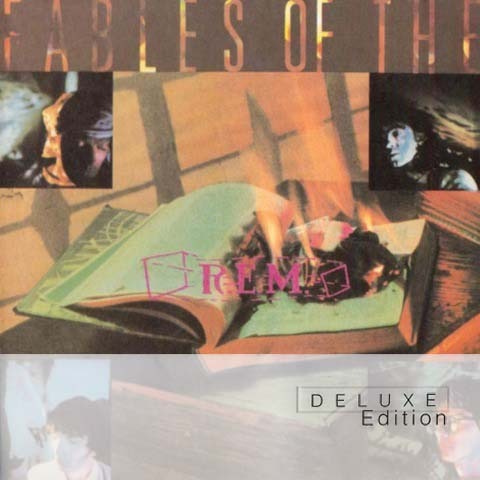
A Fabled Reconstruction

Album Reissue Review

R.E.M.
Fables of the Reconstruction
25th Anniversary Digital Remaster
@@@@@

I don't relish buying the same thing twice, especially at a time when money isn't exactly rolling in. Although I now own a Blu-Ray player and have appreciated the far superior quality Blu-Ray discs offer over standard DVDs, the improvement will likely never be enough to compel me to replace the hundreds of DVDs I already own, especially as another even-more-advanced technology is likely always just around the corner. And having bought numerous new release DVDs over the years, it always has rankled me when an "enhanced version" with additional features (such as director commentary, deleted scenes, etc.) comes out just a matter of months after I have been pushed to buy the original version.

But in moderation, I have found it worthwhile and justifiable to invest in "newly remastered," often deluxe (i.e. extra songs, spiffy packaging) reissued versions of some of my favorite albums, usually released in commemoration of a milestone anniversary of the original release. I have done so for Springsteen's "Born To Run," "Who's Next," U2's "The Joshua Tree," the Stones' "Exile on Main Street," R.E.M.'s "Reckoning" and a handful of Beatles' albums.

In all cases, I had owned the original CD for more than 20 years, dating back to the just about the introduction of CDs, when, despite promotional claims, they did not really sound significantly better than LPs and could very much become scratched (although at the time, my music collection had already transitioned from records to cassettes, which were inferior to CDs). And whether because of the original recording, mixing and/or mastering of the music or the methodology for transferring records to CDs, the sonic quality of many early CDs was especially poor (I have a nice, but not high-end stereo system, do not consider myself an "audiophile" and now do most of my listening via mp3s).

For all the albums cited above, hearing the newly remastered versions--even if only in mp3 form--has been a treat, as the music I have long loved now sounds even better. But still, more than 90% of the joy in listening to the upgraded versions is in the brilliance of the original music. Modern engineers can make all kinds of sonic improvements, but they can't write Baba O'Riley, Backstreets or A Day in the Life.

Having recently downloaded the newly remastered, 25th anniversary edition of R.E.M.'s third album, Fables of the Reconstruction, I can hyperbolically say that I have never heard an album reissue that has so greatly enhanced the pleasure of hearing its source material.

Not that 'Fables' wasn't good to begin with; I have always found there to be much magnificence in the moody collection of tracks that the then still-nascent Athens, GA band struggled to record in London (from Wikipedia: The band members found the sessions unexpectedly difficult, and were miserable due to the cold winter weather and poor food; the situation brought the band to the verge of break-up.) But when the the gloominess of the music sounded even more so given the muddled production, among R.E.M.'s amazing first five albums (Murmur, Reckoning, Fables, Life's Rich Pageant and Document), their third album has long ranked a clear fifth, in terms of the frequency of my listening, my opinion and that of reviewers (such as AllMusic.com). 

While the songs themselves are still quite dark, the remastering that eliminated hiss, added clarity & volume and brought Michael Stipe's murky vocals a bit more to the fore, has made listening to them a whole lot brighter. To the point that I now find Fables to be very much the equal of any of their first five albums, all of which rank among my favorite albums by anyone (several of their subsequent albums are also quite worthwhile).

Unlike the reissues of Murmur and Reckoning (I only own the latter), the second disc of the Fables anniversary package does not include an R.E.M. concert from the period, but rather demo versions of the songs that made the album, plus two that were on subsequent releases and one--Throw Those Trolls Away--heretofore unreleased. These don't excite me much and thus I only chose to download the remastered 11-song album and not splurge ($26.98) on the full physical package.

As such, I imagine the CD version might sound even better than the downloads, but as I was apt to just import it to iTunes and then put it on my iPhone, even in digital form I'm extremely enamored with how well Fables has been reconstructed. Its abundant merits should now be a whole lot clearer to just about anyone.

In addition to hearing snippets of all the songs through the Amazon product page, there is also a customer video that includes several full songs. 

Thursday, July 08, 2010

Spending A Day in Chicago's Past

I love history, not so much in terms of wars or rulers, but in terms of people, how they lived and what they created. I am particularly fascinated by much of Chicago's rich history, and in the past have learned about and/or explored the works of Frank Lloyd Wright and Louis Sullivan, old movie theaters, the Essanay Studios, classic hot dog stands, the Columbian Exposition of 1893, Graceland Cemetery and much else. (I also value the Chicago History Museum, but as I wrote here, feel they greatly need to enhance the modernity of their exhibits).

A couple weeks ago, I noted with interest--via this Tribune article--that it was the 30th anniversary of the Blues Brothers movie. I rewatched the film and also spent some time exploring this website, which is a handy guide to the movie's shooting locations in and around Chicago.

In doing so, I became curious to know more about Chicago's old Maxwell Street Market, which I'd long heard about but had never gone to (although the original marketplace still existed for the first 25 years of my life). Combining what I already knew with what I learned on Wikipedia and by watching an excellent documentary called Cheat You Fair: The Story of Maxwell Street (not even available on Netflix; try your local library), Maxwell Street is one of the Chicago's oldest residential districts. Its famed market existed from the late 1800s until 1994, when expansion of the University of Illinois at Chicago (UIC) displaced the market--according to the documentary, in part because of some shady deals and dubious reasons (i.e. self-interests of those involved).

Though the market still takes place Sundays along Desplaines St., north of Roosevelt Rd., it is but a fraction of what it used to be. Back in the day, it was supposedly a socially vital, inter-racial gathering place where people of myriad statures and backgrounds sold their wares. The market was also the birthplace of Chicago Blues and the "Maxwell Street Polish."

So, motivated as I often am by my taste buds--though in trying to diet I ate nothing else that day--as well as a sense of curiosity, last Thursday, I drove down to visit Jim's Original, said to be where the Maxwell Street Polish (sausage sandwich) was created in 1943. Now located about a block from its original location at Maxwell & Halsted and next to another surviving old Maxwell Street Polish sausage purveyor, Express Grill, Jim's Original remains a blast from the past.

Although both Jim's and Express are surrounded by newfangled UIC buildings and new commercial developments--some with old facades of Maxwell Street buildings affixed to their fronts--the two 24-hour stands, devoid of seating areas, comprise a delightedly utilitarian island in a bourgeois-sea.

And--I say this as a long-time devotee of Polish Sausages throughout Chicago, including my beloved Poochie's in Skokie--I think the Polish at Jim's was the best I ever had. Plus, with a hefty portion of fries that accompany all sandwiches, the Polish was only $3.25! (Monday, July 12, Jim's is having a Founder's day celebration, with Polishes only 75 cents from 2-6pm, but as someone there said, the line will be down the block).

After also grabbing a regular hot dog at Express--it seemed appropriate as I was taking pictures--I drove around the corner and parked momentarily near Maxwell & Halsted just to say I was at the location of the original marketplace (although I've been to the newly developed area before).

Sadly, there really are no remnants of the past in the old location, other than the old building facades and perhaps some sculptures I didn't notice (but later read about).

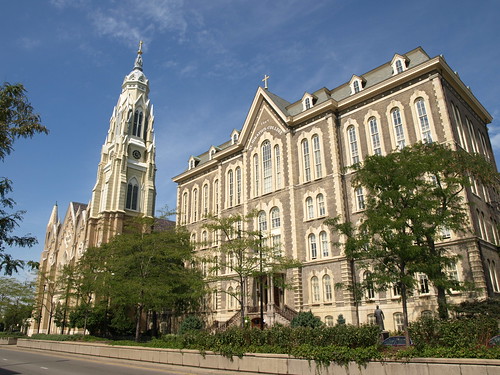
Continuing my magical history tour, I drove up to Taylor Street, had a Blue Raspberry Italian Lemonade at Mario's (which as the sign says, has been there since 1954), took a photo of my long-loved original location of Al's #1 Italian Beef and drove past the stately St. Ignatius High School and the church with a beautiful tower next to it. 

I then headed southeast, where I was able to drive into the grounds--and even enter the main building--of the South Shore Cultural Center, which used to be the ornate South Shore Country Club, has a still-in-use 9-hole public golf course and is where Barack and Michelle Obama were married in 1992.

But for me, the main draw for the South Shore Cultural Center--which in getting to at 71st & LSD had me the only white face for blocks on end--was that it was used as the Palace Hotel for the final concert in The Blues Brothers (just the exterior, the interior shots were done at the Hollywood Palladium).

But the interior of what is now the Cultural Center is ornate and spectacular in its own right and is home to the Parrot's Cage restaurant, operated by the Washburne Culinary Institute.

I was also able to walk out back and practically right up to the lake.

Finally on my day of exploring some of Chicago's storied--and cinematic--past, I drove to Jackson Park, scene of the Columbian Exposition, aka, The Chicago World's Fair of 1893.

It has always fascinated me that what looked like a huge old Roman city existed in Chicago over 100 years ago and then disappeared (except for the Museum of Science and Industry building, which was the Palace of Fine Arts at the Fair). As I understand it, most of the structures of "The White City" were meant to be temporary, so even if a fire hadn't burned them down in 1894, they likely wouldn't have survived until today.

But in addition to enjoying the MSI and seeing photos and even virtual interpretations of the Columbian Exposition, I also love the beautifully gilded--albeit 1/3 scale--1918 replica of Daniel French's Statue of the Republic (also known as Columbia) that sits in Jackson Park on the former site of the fair's Administration Building (the current statue is atop this post; the original stands across the Grand Basin from the Administration Building in the 1893 World's Fair photo at left).
I wanted to explore a bit more of Jackson Park, including the Wooded Island and the bridge that was used for the Nazi rally scene in the Blues Brothers, but it was getting late and there seemed to be some potentially shady dealings going on in the park's parking lot, so it didn't feel too prudent to be wandering around snapping photos.

But all in all it was a great day (re)discovering part of Chicago's wonderful history and I look forward to similar future excursions.

And of course, having another Polish at Jim's.