Showing posts with label Plays. Show all posts

Monday, September 03, 2012

As An Insightful Variation on the Theme of Genius, '33 Variations' Strikes the Right Notes -- Chicago Theater Review

Theater Review

33 Variations
by Moisés Kauffman
TimeLine Theatre Co.
at Stage 773, Chicago
Thru October 21
@@@@1/2

As this blog conceivably portrays, I am endlessly fascinated by creative genius.

Whether in the realm of art, music, theater, film, architecture, literature, comedy, photography, television and even less obvious realms such as athletics, cooking and technology, exploring and deriving pleasure/enrichment from the creatively-gifted is in large part what gives my life nourishment and meaning.

Although I have seen or read numerous documentaries, biopics, articles and biographies about creators of brilliance, I have rarely found the dissection of genius anywhere near as captivating as the mere delivery of it. My favorite parts of the documentaries I've seen on Bob Dylan, as just one example, are simply when he's shown singing in concert.

Part of the problem, I perceive, with works that try to provide insights on artistic practitioners, is that the inspiration process is relatively impossible to delineate and yet, especially in its abstraction, is truly what separates the great from the common. There is no way to show how, or even why, Lennon & McCartney wrote songs that were better than most; they just did. And for me, just listening to a Beatles song has invariably been more gratifying than perusing any book, article or movie that tries to "explain" the Beatles.

While some biographical movies, documentaries, etc., have certainly been better than others, and many rather worthwhile, by and large I have found the theatrical stage to be the venue through which creative genius has been best explored.

Red, a play about painter Mark Rothko by John Logan, Fela!, a musical about Fela Kuti featuring music by the Nigerian percussionist, Frank's Home, a play about Frank Lloyd Wright by Richard Nelson and Amadeus by Peter Shaffer (though the movie was good, too) are just a few bio-based stage works that I have found satisfying, in part because they--particularly the dramas--have not attempted to paint a comprehensive portrait of their subject, but rather woven a more universal story around it.

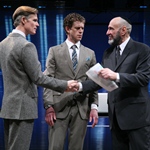
Photo Credit: Lara Goetsch
Similarly, 33 Variations, a terrific play by Moisés Kaufman ostensibly about 33 variational compositions Beethoven wrote between 1819-1823 based on a mediocre waltz by a middling composer named Anton Diabelli, works largely because it is just as much about a fictional musicologist and her daughter as it is about the great maestro.

In fact, Katherine Brandt--not Ludwig--is clearly the lead role, one played by Jane Fonda on Broadway in 2009 and quite superbly by Janet Ulrich Brooks at Stage 773, which the TimeLine Theatre Company is using to expand its audience for this show. (TimeLine's own venue is at 615 W. Wellington; Stage 773 is at 1225 W. Belmont, the old Theatre Building).

Katherine is a noted musicologist, fascinated by the riddle of why Beethoven--beset by deafness and in otherwise declining health yet still capable of composing major works such as the Missa Solemnis mass--would even honor the request from Diabelli (more so a music publisher than composer) to create a variation of his waltz, let alone devote four years to producing 33.

Although I enjoy Beethoven's music and found the on-stage renditions of the variations performed by George Depauw to be sublime, I am far from a classical music expert and 33 Variations was the first I've ever heard of the titular compositions. I have to imagine the play's attempts at explaining Beethoven's inspiration and how the variations varied would have much greater resonance for a true aficionado.

Still, even in sharing the focus on Beethoven (well-played by TimeLine stalwart Terry Hamilton) with Katherine, her own debilitating illness, her relationship with daughter Clara (Jessie Fisher) and an evolving romance between Clara and Katherine's nurse, Mike (Ian Paul Custer), 33 Variations did an impressive job in helping me appreciate Beethoven's brilliance, along with his not-so-coincidental tempestuousness.

Photo Credit: Lara Goetsch
Although Diabelli's waltz is seemingly much more historically slight than Velasquez' painting Las Meninas, I was reminded of all the variations--58 in all--of that masterpiece Pablo Picasso painted in 1957. The idea that a genius would be stimulated in such a fashion doesn't seem that odd, and Kaufman's wonderful script provides plausible explanations for Beethoven's undertaking and accomplishment.

In doing so, it captivatingly tells a far more immediate tale about the bond, discomfiture, pride and, at times, overwrought concern among parents and children. The acting is outstanding throughout, and along with the above, I should also cite Michael Kingston as Diabelli, Matthew Krause as Beethoven's servant and biographer Anton Schindler and Juliet Hart as the keeper of Beethoven's archives in Bonn, where Katherine goes to research the maestro's manuscripts.

Leaving you to explore any further details of this play, which I found not only to be yet another excellent production by TimeLine, but quite reasonably priced on HotTix, I enjoyed the message that if one looks, appreciable "genius" can found just as much in our everyday lives as it can in the legacies of transcendent artists.

As such, 33 Variations stands as one of the best plays of recent vintage I've seen over the last year or so, ranking with Tony winners Red and Clybourne Park, and--per the Chicago productions I've seen--far superior to Yasmina Reza's God of Carnage, which beat it out for the 2009 Best Play Tony. In other words, although it is a drama, not a musical, this is an extremely well-composed, wonderfully-orchestrated work of theater. (Although I can't say I picked up on it, it is noteworthy that Kaufman wrote the play in 33 scenes).

Saturday, June 16, 2012

Redtwist Provides Commendable Treatment of 'The Cripple of Inishmaan' -- Theater Review

Theater Review

The Cripple of Inishmaan
a play by Martin McDonagh
directed by Kimberly Senior
Redtwist Theatre, Chicago
Thru July 1
@@@@1/2

Excepting perhaps David Mamet--though more so for his work through 1992--Martin McDonagh is my favorite contemporary playwright.

I have not yet seen his most recent play, A Behanding in Spokane, which received disappointing reviews when it opened on Broadway in 2010, but after taking in a strong rendition of The Cripple of Inishmaan at Chicago's Redtwist Theatre, I have now seen five of McDonagh's stage works--as well as a film, In Bruges, that he wrote and directed--and have very much liked them all.

I'll let Wikipedia supply you with McDonagh's bio--he's an Irishman who grew up in London--and the full chronology of the plays he has had published and produced; of these, other than Behanding, I have only yet to see A Skull in Connemara.

First produced in late 1996, The Cripple of Inishmaan is one of McDonagh's earliest works, written when he was in his mid-20s (or perhaps even earlier). It is the first play of his "Aran Islands Trilogy," although the third in the series was never published or produced.

Set in 1934, the play is set in the small Aran Islands community of Inishmaan off Ireland's west coast. It revolves loosely around the filming of a real (yet fictionalized) documentary called Man of Aran, which is a pretty big deal to the local residents including the play's titular character, a young man named Billy--well-played by Josh Salt--who is partially deformed.

Although The Cripple of Inishmaan is neither as laugh-out-loud funny or overtly violent--two McDonagh trademarks--as the subsequent The Lieutenant of Inishmore, it does contain a substantial amount of dark humor, ribald language and interpersonal viciousness.

Photo Credit: Kimberly Loughlin
But along with being a highly entertaining character study of a collection of Irish villagers--over the course of 2 hours, McDonagh's script richly embodies 9 characters--The Cripple of Inishmaan succeeds due the substantial heart at its core.

As usual, Redtwist makes optimal use of its adaptable storefront space, with the audience members practically within Inishmaan themselves. And as with her masterful production of McDonagh's The Pillowman in the same space, director Kimberly Senior--who also has helmed several other excellent plays I've seen--draws highly believable performances, including understandable brogues, from the top-notch cast.

Salt's Billy is equal parts victimized, vulnerable and resilient, while as his pretty, brash crush Helen, Baize Buzan helps the audience sense the rationale behind and the longing beneath her salty exterior. Brian Parry is also terrific as Johnnypateenmike, who peddles news about the town's residents to its other residents.

Offering plenty of face value entertainment, including some surprising twists, complemented by appreciable depth and insight, The Cripple of Inishmaan is a first-rate play by a terrific writer, and Redtwist's stellar production provides a perfectly formidable introduction.

Based on the other local productions I've seen of McDonagh's oeuvre, I think I like Inishmaan a bit less than Lieutenant of Inishmore or The Pillowman, and a bit more than The Beauty Queen of Leenane and The Lonesome West. But I'm entirely glad I got this chance to see it, and even without HotTix availability, Redtwist's admission prices are quite reasonable.

This type of "storefront theater" is truly one of Chicago's most distinguishing cultural attractions--I'm not sure even New York or London offer similar quality by so many resident troupes--with this play and production serving as a prime example. I can imagine that even among people driving or walking east along Bryn Mawr, the Redtwist Theatre can easily be missed, but having been extended until July 1, The Cripple of Inishmaan deserves not to be. 

Thursday, December 22, 2011

The Best of 2011: The Best Plays I Saw

New York and London are generally regarded as the world's two greatest theater cities. I visited both in 2011 but went to no plays. Only musicals, as is my wont.

But I'm convinced that several of the plays I saw on Chicago stages were every bit as good as what I could have seen on Broadway or in the West End. In fact, some of the productions on my Best of 2011 list have played in or will transfer to one of the meccas, or are the world's first regional stagings.

And my top choice for Best Play of 2011 had its world premiere in my hometown of Skokie. But it starred two Tony winners who would be in demand anywhere.

Two quick notes to keep in mind before I give you my list. Though sometimes the distinction isn't all that clear, even to me, I am ranking the productions I saw, not necessarily the play (i.e. the script) itself. Hence, a classic by Shakespeare is in the middle of the pack, and though many of those listed are new works, not all are. Also, beyond the 15 shows I'll cite below, I only saw 3 additional plays (or non-musical stage works). So omissions may very well be about what I didn't see rather than what I didn't like.

The Best Plays I Saw in 2011 (all in the Chicago area)

1. The Outgoing Tide - Northlight Theatre
(my review)
written by Bruce Graham; directed by BJ Jones

2. Clybourne Park - Steppenwolf Theatre (my review)
written by Bruce Norris; directed by Amy Morton

3. Chinglish - Goodman Theatre (my review)
written by David Henry Hwang; directed by Leigh Silverman

4. Red - Goodman Theatre (my review)
written by John Logan; directed by Robert Falls

5. East of Berlin - Signal Ensemble Theatre (my review)
written by Hannah Moscovitch; directed by Ronan Marra 

6. The Merchant of Venice - Broadway in Chicago; Bank of America Theatre (my review)
written by William Shakespeare; directed by Darko Tresnjak

7. The Beauty Queen of Leenane - Shattered Globe Theatre (my review)
written by Martin McDonagh; directed by Steve Scott 

8. The Trinity River Plays - Goodman Theatre (my review)
written by Regina Taylor; directed by Ethan McSweeny

9. Ann - Broadway in Chicago; Bank of America Theatre (my review)
written by Holland Taylor; directed by Benjamin Endsley Klein

10.  The Hot L Baltimore - Steppenwolf Theatre (my review)
written by Lanford Wilson; directed by Tina Landau

Special Mention
(I couldn't count these one-person shows as "plays," but both were very good)

Colin Quinn - Long Story Short (my review)
written by Colin Quinn; directed by Jerry Seinfeld

Carrie Fisher - Wishful Drinking (my review)
written by Carrie Fisher

Honorable Mention

Stage Kiss - Goodman Theatre (my review)
written by Sarah Ruhl; directed by Jessica Thebus

God of Carnage - Goodman Theatre (my review)
written by Yasmina Reza; directed by Rick Snyder

Night and Her Stars - The Gift Theatre (my review)
written by Richard Greenberg; directed by Michael Patrick Thornton

Tuesday, July 26, 2011

'Chinglish' Translates to a Terrifically Insightful Dramedy -- Chicago Theater Review

Theater Review

Chinglish
a world premiere play by
David Henry Hwang
Goodman Theatre, Chicago
Through July 31, 2011
@@@@1/2

In recently awarding @@@@@ to the touring production of West Side Story now playing at the Cadillac Palace Theatre, I strongly advocated that it is a show any Chicago-area fan of musical theater make a point of trying to see.

Although I am breaking my string of maximum-rating reviews and bestowing “only” @@@@1/2 to Chinglish, I just as strongly advise any lover of great dramatic or comedic theater to go see Goodman Theatre’s world premiere production.

For even in a being a trifle shy of perfect—or that much over my head—it is clearly one of the best plays that will debut in Chicago this year, and a Broadway-bound new work by one of the world’s most acclaimed playwrights, David Henry Hwang.

In addition to being completely topical in its subject matter--which pertains to American businesses expanding into China, where in addition to the challenges posed by politics, corruption and tradition is the tricky matter of often amusingly imprecise translations between English and Mandarin (and other dialects)--Chinglish features the most innovatively modern staging I have ever seen, certainly when it comes to non-musicals.

Making great use of turntables to seamlessly change scenery between numerous settings, David Korins’ set design is absolutely phenomenal. It should get @@@@@ all by itself. And it wouldn’t be at all shocking if Chinglish winds up winning numerous Tony Awards next June.

Although it has been announced that this production—directed by Leigh Silverman—will transfer to Broadway, the most recent article I found on the matter indicates that its unknown whether the entire cast will go to New York.

There's no reason why it shouldn't. 

James Waterston plays Daniel Cavanaugh, a Clevelander who has assumed leadership of his family's sign-making business. He has traveled to China and hired a consultant named Peter (Stephen Pucci) in hopes of convincing a Minister of the Guanxi province (played by Larry Zhang) to award him a signage contract for a new cultural center.

While much humor is derived by the often mistranslated communication among these three characters, it is Jennifer Lim as Vice-Minister Xu Yan who provides the primary interaction with Waterston and raises Chinglish well beyond just a comedy. Presuming Lim heads to Broadway, it's a pretty safe bet that she earn at least a Tony nomination.

Although the play only runs at the Goodman until Sunday, July 31, there are enough twists to preclude me from further describing the narrative. While I thought the entire show was wonderful--in addition to amazing scenic design, the use of music between scenes was also strikingly good, I was left a bit fuzzy by the supposed motivations of a few characters. But this is a play I certainly wouldn't mind exploring again, even if it's a few years from now in a production likely not to be  quite this good. So if you can catch it before it leaves town, by all means do so. Even--or especially--with a good portion of the dialogue in Mandarin and translated through supertitles, Chinglish is a play that speaks volumes.

Thursday, June 09, 2011

Astute Script, Unforgettable Performances Power Great New Play About Alzheimer's -- Theater Review: The Outgoing Tide

Theater Review

The Outgoing Tide
a world premiere play by Bruce Graham
Northlight Theatre, Skokie, IL
Thru June 26, 2011
@@@@@

The Tony Awards will be presented this Sunday night. In order to be eligible for awards honoring the best of the 2010-11 season, theatrical productions must have opened on Broadway by April 28, 2011

Although I haven't seen any of the shows nominated for Best New Play--nor any productions on Broadway in the past year--I'm confident that had The Outgoing Tide opened about three weeks earlier than it did, with the exact same cast, in a Times Square theater rather than at The North Shore Center for the Performing Arts in Skokie, it would have earned a Tony nomination. As undoubtedly would its star, John Mahoney, and likely his two co-stars, Rondi Reed and Thomas Cox. (Mahoney and Reed are already Tony winners).

Produced by the routinely superb Northlight Theatre, the world premiere drama by Bruce Graham stands as the best play I've seen this year, and that includes the Goodman Theatre production of God Of Carnage, which earned the Best New Play Tony in 2009.

I feel lucky that Northlight performs 5 minutes from my home, attracts world-class talent--and Chicago stalwarts--like Mahoney and Reed and offers "Day of Show" discount tickets for $20 when available (call 847-673-6300). For this play, about a man afflicted with Alzheimer's Disease facing both his future and his past, is well-worth the effort for anyone to get to; on a trip to New York or London, you'd be unlikely to see a new dramatic work that's any better.

There are some twists and surprises from the beginning of the narrative, so I'll share very little of the play's plot, but Mahoney delivers a masterful performance as Gunner, a retired businessman not willing to passively accept the ravages of senility. His relationship with his wife, Peg (Reed), is not a simple one; she is doting but often harsh, inherently sympathetic to his plight but at times exasperated to the point of cruelty.

To see these two veterans--plus the also very fine Cox--interact for 2 hours would be worth the ticket price in itself, but Graham's script is shrewd, poignant, thought-provoking and even quite humorous. Director BJ Jones does a great job of never letting it get too cloying, or even predictable, and even the stage set would suffice just fine in a small Broadway house.  

Regular followers of Seth Saith may be ready to submit an entry to Ripley's Believe It or Not, for this is my third straight @@@@@ review. That's never happened before. But The Outgoing Tide is that good; if justice is to be served, it may yet earn a Tony nom--amidst a successful Broadway run.

Tuesday, May 17, 2011

A Hat Trick of Quick Theater Reviews

Merrily We Roll Along
a musical by Stephen Sondheim
The Music Theatre Company
at the Karger Center, Highland Park, IL
Run Ended (saw on May 13)
@@@@

It distresses me to no end that among Americans under 50, Kim Kardashian undoubtedly has a higher Q Rating than Stephen Sondheim. I still don't know what she's ever done; he's simply the greatest composer and lyricist musical theater has ever known. This 1981 show was his notorious flop, but the score is still sumptuously sublime, with typical Sondheim sophistication in the music and lyrics. And the backward sequencing of the plot is an interesting narrative device. The cast was a bit young, but quite talented and the show rolled along quite merrily, indeed.

Photo Credit: Joel Moorman, Steppenwolf.org
The Hot L Baltimore
a play by Lanford Wilson
Steppenwolf Theatre, Chicago
Thru May 29, 2011
@@@1/2

I liked the premise of this 1974 play by the recently-deceased Wilson: a bunch of social misfits demonstrating camaraderie, dignity and perseverance in the dying days of a once-grand Baltimore flophouse. The set design at Steppenwolf was fantastic and the '70s music that accompanied the show was a lot of fun. The acting by the large ensemble cast was excellent and the beautiful Kate Arrington shedding all her clothes at one point was quite, uh, eye-opening. But while it added up to a worthwhile show, the highly splintered focus (or lack thereof) was a bit hard to follow, rendering the Hot L Baltimore not wholeheartedly worth checking into.

Stage Kiss
a world premiere play by Sarah Ruhl
Goodman Theatre, Chicago
@@@1/2

This show was quite funny and therefore enjoyably entertaining. But in addition to dragging on way too long, it didn't seem to provide any shrewd insights or say much more than "actors often turn on-stage passion into off-stage romance, but it often winds up being a superficial, unsustainable relationship."

Tuesday, March 22, 2011

'God of Carnage' a Fine Farce, but Leaves Me Agnostic About Any Deeper Meaning or Merit -- Theater Review

Theater Review

God of Carnage
a play by Yasmina Reza, directed by Rick Snyder
Goodman Theatre, Chicago
Thru April 17, 2011
@@@1/2

God of Carnage is a farce. I don't mean that as an insult, but as a genre description of a play whose absurdity--in the tradition of Albee and Moliere--is presumably part of the point.

The comedy, another global smash written by Yasmina Reza--who enjoyed similar success with Art--is also one of the most decorated new plays of the last few years, having won the Tony in 2009 and the Olivier (for London theater) before that.

I found it enjoyable, and even laugh-out-loud funny at times, but if it winds up being the best play--of any vintage--I see in 2011, I'm not getting out enough. Actually, it already isn't.

Certainly the fact that I was solidly entertained for the whole show--albeit a 75-minute one-act quickie--says much about Reza's (and translator Christopher Hampton's) gift for dialogue and, well, appealing absurdity.

But if, even just two days after seeing it, God of Carnage is supposed to have any lasting resonance--as a truly great play should--it really doesn't. 

The show features a four-person cast comprised of two married, well-to-do couples who get together at one of their posh Brooklyn homes to discuss a schoolyard fight between their 11-year-old sons. The conversation takes various twists and turns, changes up "debate partners" and becomes about more than the relatively minor impetus, but none of the characters are particularly appealing, interesting or empathetic.

When God of Carnage opened on Broadway, the couples of Michael & Veronica and Alan & Annette were played by James Gandolfini & Marcia Gay Harden and Jeff Daniels & Hope Davis. Given that I would pay to overhear those four having a conversation over dinner, I imagine the casting not only lent largely to the play's success, but to its acclaim.

In Chicago, where Goodman Theatre is staging the initial production after a Broadway tour was scrapped, four very good actors star in the play. David Pasquesi is typically excellent as Alan, a smarmy lawyer with annoying cell phone habits. Beth Lacke, as Alan's wife Annette, Mary Beth Fisher as Veronica and Keith Kupferer in the Gandolfini role of Michael all do solid work under the direction of Rick Snyder.

But none of them are what the world at large would call "stars." And without star power to amplify one's enjoyment of self-righteous squabbling amongst shallow, self-absorbed people, what's left is a farce without any forceful purpose.

With some great moments, God of Carnage--as presented at the Goodman--is suitably entertaining, in a manner not unlike a good episode of Modern Family. But in simply spoofing a stereotype--which presumably matches many in the target audience--Reza's latest smash just doesn't compare to other highly-lauded plays of the past decade, including Proof, Doubt, Frost/Nixon, The Pillowman and August: Osage County.

If you're a Goodman subscriber like me, you'll probably be glad just to get a glimpse of something so recent as part of the season. I imagine this show would likely make a decent choice for date night, particularly at a discount. But with stellar choices almost always on the boards in Chicago, this much-heralded 'God' really doesn't merit too much reverence.

Saturday, March 19, 2011

'The Merchant of Venice' Pays Off With Modern Staging But Remains A Tough Sell -- Theater Review

Theater Review

The Merchant of Venice
by Shakespeare
Bank of America Theatre, Chicago
Thru March 27, 2011
@@@@

As with opera, ballet and much quality television, Shakespeare is an art form for which--for me--impassive appreciation far outweighs emotional affinity. Especially on a somewhat exhausted weeknight, Sir William's dense, poetic language, multi-faceted plots and myriad supporting characters can prove challenging for me to comprehend.

So when The Merchant of Venice appeared in town this week as part of my Broadway In Chicago series, which is comprised primarily of musicals, it was nice to note that at least an Oscar winner was starring in it.

I haven't seen F. Murray Abraham in much, or perhaps anything except a guest stint on The Good Wife, since he earned the Best Actor award for playing Salieri in Amadeus. It seems he's largely worked on stage and in Europe since then, and I was surprised to read just now on Wikipedia that he grew up in El Paso and was a gang member as a teenager.

He starred as Shylock, which is the lead but not title role in Merchant of Venice, and even from the balcony of the Bank of America Theatre, his acting prowess was readily apparent.

While I have seen several Shakespeare plays in a variety of stagings, and can appreciate the beauty of traditional garb, I also was initially pleased--and ultimately quite satisfied--with this rendition of Merchant being done in modern dress. Although it may sound ghastly to Elizabethan purists, the stage was adorned with Apple laptops & flat screen TVs, the character of Launcelot (right) was quite streetwise and the action was accompanied by a significant use of jazz.

With the inclusion of a very attractive woman--Kate MacCluggage--playing the primary female role of Portia, an heiress who welcomes numerous suitors, if I'm going to sit through Shakespeare for nearly three hours on a weeknight, this was about as user-friendly a version as I'm likely to get.

And for the most part I enjoyed it, except for the fact--or, well, my opinion--that The Merchant of Venice is a very ugly play with few likable or redeeming characters. I really don't know, and Wikipedia suggests it's an eternal debate, whether Shakespeare was commenting on anti-Semitism, simply reflecting it or perhaps even participating in it.

Certainly, Shylock, a moneylending Jew, is rather despicable for demanding a pound of flesh from Antonio, the titular merchant who is late in repaying him 3,000 ducats. Although the way Shylock is treated, before, while and after insisting on collecting on his debt with a sharp blade--even though the play is over 400 years old, I feel it wrong to reveal what happens--is also deplorable, and in the end unnecessarily degrading, I was just as puzzled by the great Sir William's need to tack on twenty frivolous minutes after what should have been a highly dramatic ending.

To me--and I'm obviously no Shakespearean scholar--the silly androgeny-based conclusion of the drama is as insulting as anything that precedes it, and actually undermines what had been quite compelling, although  troubling. If Shakespeare was indeed intending this play as a study of prejudice, the end only amplifies my belief that ignorance is no excuse for it.

But who am I to question Shakespeare? Even with some flaws, The Merchant of Venice is still a great play. Abraham is excellent and recites the famous "Hath not a Jew eyes" speech with panache, power and--given recent anti-Semitism spewed by John Galliano and (arguably) Charlie Sheen--particular resonance.

With all the caveats above, this is one of the most enjoyable productions I've seen of a Shakespearean work, so catching it during its brief Chicago run is certainly worth your while.

But that doesn't mean I hath not a few criticisms.

Monday, March 07, 2011

'Sex With Strangers' Well Performed, But Not All That Fulfilling -- Theater Review

Photo Credit: Michael Brosilow, Steppenwolf.org
Theater Review

Sex With Strangers
A new play by Laura Eason
Steppenwolf Theatre, Chicago
Thru May 15, 2011
@@@

Very impressively staged in Steppenwolf's upstairs theater, Laura Eason's Sex With Strangers is a play whose parts are better than its sum.

The two-character drama stars Stephen Louis Grush and Sally Murphy, both first-rate performers who are typically excellent here.

Grush plays Ethan, a 24-year-old blogger who writes openly about his sexual exploits and has turned his blog into a book that shares its title with the play. Murphy's Olivia, pushing 40, is a novelist who hasn't published anything in years but is working on her second book as the show opens.

There are many possibilities here, and perhaps that's the problem. For while Sex With Strangers is about several potentially compelling topics--romance between people of different ages & perspectives, the art & emotion of writing, the immediacy and openness of blogging vs. the deliberate nature of authoring long-form fiction, the way publishing and technology has changed, the voyeuristic nature of the Internet, the propriety of compromise, and more--the result was too much of a hodge-podge for me to care very much about any of it.

Often feeling like a scenario better suited for a mediocre romantic comedy movie, Eason's new work--which was first presented at Steppenwolf's 2009 First Look Festival--has a narrative that seems too compressed and contrived to hold real emotional heft or provide societal insight, and despite the talents of the actors, neither of the characters are fully realized nor particularly empathetic.

This is subject matter with potential and there are a few laughs and enough to think about to make the post-show discussion worthwhile. If, like I did, you can grab a $20 day-of-show ticket, 'Sex With Strangers' may be worth experiencing, despite its flaws. It's quite possible that you may find something there that just didn't connect with me.

But in the end, it just doesn't add up to any all that fascinating, or despite its name, even titillating (one guy in the post-show discussion complained that the stage went dark for all the sex scenes). Despite an attractive couple of partners, this 'Sex' just ain't all that great.

Sunday, February 20, 2011

McDonagh's 'Beauty Queen of Leenane' a Bit Beastly, but Still Worth Beholding -- Theater Review

Theater Review

The Beauty Queen of Leenane
a play by Martin McDonagh
Shattered Globe Theatre
presented at the Athanaeum Theater
Thru February 27, 2011
@@@@

Martin McDonagh is a master at dark humor. I have now seen four plays by him--The Pillowman, The Lieutenant of Inishmore, The Lonesome West and now, The Beauty Queen of Leenane--plus In Bruges, a movie he wrote and directed, and have enjoyed everything.

The Beauty Queen of Leenane was the first of his plays to be staged, initially in Galway in 1996, and its subsequent Broadway run earned a Tony nomination. Today, in a local Chicago production by the recently reconstituted Shattered Globe Theatre, I saw it for the first time.

Although the acting and production values were stellar, I can't say I loved 'Beauty Queen' as much as The Pillowman or Lieutenant of Inishmore, my first two experiences with the Irish playwright's work. Back in November, when I saw a production of The Lonesome West for the first time, I said much the same thing.

Linda Reiter and Eileen Nicolai, above, were both quite good.
There was nothing really wrong with Beauty Queen, but with the strong Irish brogues sometimes hard to follow and the story of a spinster battling with her derisive mother lacking some of the over-the-top humor I've enjoyed in McDonagh's other plays, it took a quality production--directed by Steve Scott, an Associate Producer of Goodman Theatre--and a strong final half-hour to convince me that it deserves @@@@ out of 5.

If you're a McDonagh fan like I am, The Beauty Queen of Leenane is well worth your while, especially in support of the Shattered Globe, whose 19th season was in serious jeopardy last fall. But if you're looking to get acclimated to McDonagh or just catch a good play next weekend--which is the last of the run--there may be other works to behold ahead of this Beauty.

Monday, January 31, 2011

Powerful Emotions Flow Throughout "The Trinity River Plays" -- Theater Review

Theater Review

The Trinity River Plays
A new play by Regina Taylor
in three acts titled Jar Fly, Rain and Ghoststory
Goodman Theatre, Chicago
Thru February 20, 2011
@@@@

As I tried to convey above--and as the Chicago Tribune's Chris Jones did much more stridently in opening his review--"The Trinity River Plays" is deceptively titled.

Certainly, as evidenced by the work, playwright Regina Taylor is a highly skilled writer and perhaps her reasoning for the nomenclature was simply lost on me. But what I saw last night at the Goodman Theater was essentially one play in three individually-named acts, with the characters and story arc continuing throughout.

In revolving around an African-American family in Dallas, initially in 1978 and then 17 years later, Taylor's three-hour tale--written after losing her mother to ovarian cancer--focuses on relationships both contemptuous and compassionate, mournful and remorseful, bitter and bemusing. As such, it reminded me a bit of August: Osage County, though not quite as sprawling in cast size nor levels of the on-stage house that served as the sole set piece. 

I can't really describe too much of the plot without revealing key crises, and though the show was powerfully written and significantly moving, I felt it was a more interesting in its dialogue-driven narrative than in providing any particularly novel insights. In fact, the symbolism that Taylor tried to incorporate mostly came off as too overt or cloyingly contrived.

While Act 2 was clearly the best, I was never bored with Trinity River, which is saying a lot for a 3-act drama on a Sunday night, especially as I've been less than enthralled with much of what I've seen at the Goodman in recent seasons. This was one of the theater's best in recent memory, certainly of those staged in the larger Albert auditorium.

Karen Aldridge, who played Iris, a fictionalized alter ego for Taylor, was excellent, initially as a gawky 17-year-old girl and then as a thirty-something professional struggling to deal with grim circumstances, past and present. Christiana Clark is also quite strong as Jasmine, Iris' slightly older and much wilder cousin, while Penny Johnson Jerald and Jacqueline Williams shine as their respective mothers.

Under Ethan McSweeny's direction, the new play, which world premiered in Dallas last October, may not have remarkable depth beneath the surface, but I was substantially captivated by a family's frayed yet tightly-bound kinship, as this 'River' ran through it.

Monday, December 13, 2010

The Best Plays I Saw in 2010

Dramatically speaking, 2010 was a good year. Although I generally prefer musicals to plays and have often found myself disappointed and/or confused by many dramatic works I've seen over the years, throughout the past 12 months I saw more plays--31--than musicals and the majority of them were excellent.

Recollecting what I saw as best I can, below is my ranking of the plays--all presented in Chicago across a variety of levels and venues--and productions I thought were most superlative, with some credence given to resonance months down the road (hence, the ratings in my reviews may not precisely correspond to the order here).

 Please be aware that unlike the "Best of" list published yesterday by the Tribune's fine theater critic, Chris Jones, my list does not combine plays with musicals--I'll rank those separately--or other theatrical presentations (such as the modern circus, Traces, which won't be making any list of mine). Also, Chris obviously has seen many more productions than I, so omissions below may be a matter of what I didn't see rather than what I didn't like. Finally, as most of the works below were not brand new, my judgments and rankings are as much about the productions as the plays themselves.

The Best Plays I Saw in 2010 (all in the Chicago area)

1. The Pillowman - Redtwist Theatre (my review)
written by Martin McDonagh; directed by Kimberly Senior

2. Trust - Lookingglass Theatre (my review)
A new work written by David Schwimmer & Andy Bellin; directed by David Schwimmer & Heidi Stillman

3. Frost/Nixon - Timeline Theatre (my review)
written by Peter Morgan; directed by Louis Contey

4. Speed-the-Plow - American Theater Company (my review)
written by David Mamet; directed by Rick Snyder

5. American Buffalo - Steppenwolf Theatre (my review)
written by David Mamet; directed by Amy Morton

6. August: Osage County - Touring production at Cadillac Palace Theatre (my review)
written by Tracy Letts; directed by Anna Shapiro

7. Harper Regan - Steep Theatre (my review)
written by Simon Stephens; directed by Robin Witt

8. The Long Red Road - Goodman Theatre (my review)
a new work written by Brett C. Leonard; directed by Philip Seymour Hoffman

9. Cat on a Hot Tin Roof - Raven Theatre (my review; show still running)
written by Tennessee Williams; directed by Michael Menendian

10. Detroit - Steppenwolf Theatre (my review)
a new work written by Lisa D'Amour; directed by Austin Pendleton

Honorable Mention

Alfred Hitchcock's The 39 Steps - Touring production at Bank of America Theatre (my review)
written by Patrick Barlow; directed by Maria Aitken

After the Fall - Eclipse Theatre Co. (my review)
written by Arthur Miller; directed by Steve Scott

Awake and Sing - Northlight Theatre (my review)
written by Clifford Odets; directed by Amy Morton

Killer Joe - Profiles Theatre (my review)
written by Tracy Letts; directed by Rick Snyder

The Lonesome West - Gift Theatre (my review)
written by Martin McDonagh; directed by Sheldon Patinkin

Savage in Limbo - Village Players of Oak Park (my review)
written by John Patrick Shanley; directed by Jacque Lueken

Suicide, Incorporated - Gift Theatre (my review)
written by Andrew Hinderaker; directed by Jonathan Berry

Sweet Bird of Youth - The Artistic Home (my review, show still running)
written by Tennessee Williams; directed by Dale Calandra

War With the Newts: Mr. Povondra's Dream - Next Theatre (my review)
written by Jason Loewith & Justin D.M. Palmer; directed by Jason Loewith

One more I'd like to mention is Return to Haifa at Next Theatre. I enjoyed this work and would cite it among my Honorable Mentions, but its production led to charges of plagiarism and other improprieties that cost Next's Artistic Director his job (story here). Thus, it doesn't seem right to call it "Honorable" but the play that was presented was very good and any creators, crew and cast that didn't do anything wrong are deserving of kudos.

Monday, November 22, 2010

Worthwhile, Well-Done 'Sweet Bird of Youth' Almost a Heavenly Chance Encounter: Theater Review

Theater Review

Sweet Bird of Youth
a play by Tennessee Williams
The Artistic Home, Chicago
Thru December 19, 2010
@@@@

Like The Lonesome West, a play by Martin McDonagh I saw the night before and reviewed below, Tennessee Williams' Sweet Bird of Youth is not the very best work by an outstanding playwright--or so I perceive after my initial encounter--but it is pretty damn good.

Especially in the hands of The Artistic Home, a Chicago production troupe whose work I was seeing for the first time and another in an apparently endless array of local venues where you can witness truly first-rate performances. The depth of theatrical talent in the Chicago area never ceases to amaze me; in 2010 alone, I have seen productions from 25 local companies--some in settings smaller than a soup can--and nearly all have been stellar, at worst.

While I didn't absolutely love Sweet Bird of Youth and neither Williams' narrative nor this rendition seemed note perfect, they both have plenty of readily apparent merits. I should probably see the 1962 movie starring Paul Newman and Geraldine Page--who also starred in the original Broadway production--to gain a better understanding of the source material. For while Josh Odor and Kathy Scambiatterra are both good here as gigolo Chance Wayne and fading movie star Alexandra Del Lago, the scenes with the two of them together were, for me, the least interesting in the play. Yet they seemed to be the most important.

With Chance accompanying Alexandra to his fictional hometown of St. Cloud, Florida (not to be confused with the non-coastal real St. Cloud, Florida) in hopes of rekindling his romance with Heavenly Finley (played here by Elizabeth Argus), without giving too much away, he runs afoul of her father and brother. And whatever psychological-study reason Williams had for diverting his script from any direct interaction between Chance and Heavenly or Chance and Boss Finley, I left the theater thinking that might have been more fulfilling than what I witnessed.

Obviously, The Artistic Home can't be held accountable for the decisions made by one of the greatest playwrights ever, and while most of their interpretation--from first-rate performances to a convincing set in a small space--was top-notch, something didn't quite click as well as I thought it should have.

As such, at this point I'd put Sweet Bird of Youth on par with Night of the Iguana, quite good but a step below Williams' masterworks, The Glass Menagerie, A Streetcar Named Desire and Cat on a Hot Tin Roof (which I've yet to see on stage but is currently running at the Raven Theater). But especially for less than $20 on HotTix, even if it's not quite a Heavenly-Chance encounter, The Artistic Home's production is well-worth Tennesseeing.

The Lonesome West Not McDonagh's Best, But Still Quite Leenane Tasty: Theater Review

Theater Review

The Lonesome West
a play by Martin McDonagh
The Gift Theatre, Chicago
Thru December 19, 2010
@@@@

On the basis of having now seen and very much enjoyed three plays by Martin McDonagh--of the seven he has had produced and published  along with an excellent movie, In Bruges--the 40-year-old Irish playwright ranks as my favorite working today. Or at least the one whose full oeuvre I most hope to eventually see, even if his latest play--A Behanding in Spokane--opened on Broadway this past March to very disappointing reviews.

Over the last few years, I have seen The Pillowman, twice, including an outstanding rendition in January at Chicago's Redtwist Theatre, and the similarly superlative The Lieutenant of Inishmore, the second play of his second trilogy (The Aran Islands Trilogy, whose third play, The Banshees of Inisheer, has never been produced or published).

So I was very much anticipating seeing The Lonesome West, the Tony nominated last play of The Leenane Trilogy, on Saturday at Chicago's tiny Gift Theatre, where I had recently seen their highly acclaimed original work, Suicide, Incorporated. Although I have yet to see The Beauty Queen of Leenane or A Skull in Connemara, I was assured that they weren't prerequisite for understanding or enjoying Lonesome West.

I did enjoy it and, except for wishing for a bit of clarity regarding a plot point at the very end, I think I understood it, yet it didn't provide nearly the visceral thrill of Lieutanant of Inishmore or exude quite the brilliance of Pillowman. John Gawlik and John Kelly Connolly were both excellent as the feuding Connor brothers but it wasn't until the half-hour final scene that Lonesome West really started to rock. In fact, I thought the play may have been at it's end--like 'Inishmore' this one required quite a bit of stage mopping after multiple scenes--before the rollicking last scene came about.

Also like 'Inishmore' and I'd imagine many of his works that I've yet to see, I'm guessing McDonagh meant The Lonesome West as allegory about senseless, ongoing violence in Ireland and how "peace" may always be tenuous at best, especially when past destruction can never be fully forgotten. As such, like much of Arthur Miller's best work, The Lonesome West has a resonance that extends considerably beyond the action on stage.

So even if it isn't the very best example of McDonagh's unique talent--and according to Tribune critic Chris Jones something was lost in the Gift's tight space staging--especially with discount tickets typically available through HotTix, The Lonesome West still more than merits your heading in its direction.

Sunday, October 10, 2010

'Detroit' Well-Worth Visiting Even If It Feels a Bit Too Safe -- Theater Review: Detroit at Steppenwolf Theatre

Theater Review

Detroit
a new play by Lisa D'Amour
Steppenwolf Theatre, Chicago
Thru November 7, 2010
@@@@

Although full of somber undertones, Lisa D'Amour's world premiere play, "Detroit," is the most overtly enjoyable and thought-provoking new work I've seen at Steppenwolf in some time, probably since August: Osage County premiered there in 2007.

As such, it's well worth your time and presuming you can get a discounted ticket through myriad options--Steppenwolf's Twenty for $20 program each morning at 11am (which I took advantage of, even at 12:30), their half-priced rush tickets, HotTix and Goldstar--your money.

It may be the going rate, but $53-$73 for a normal ticket (depending on the day) is not only antithetical to Detroit's theme of recessionary consequences, but is likely to blame for why on Friday night--with $60 the standard price--Steppenwolf had more empty seats than I'd ever seen. And this for a well-reviewed show starring Laurie Metcalf, a longtime ensemble member who's enjoyed considerable TV fame.

Suffice it to say that Detroit seemed significantly better for $20 than it would've felt for full price, and some folks in the after-show discussion expressed chagrin over what they had paid for the show they saw. Who knows if it's feasible, but this would be an ideal play for which to hold free or cut-rate "Newcomer Nights," especially if expressly marketed to a more culturally-diverse audience than was in the house on Friday night.

Photo Credit on all: Michael Brosilow
As it was, I was quite entertained by D'Amour's well-paced and accessible script, and especially fine performances by a full cast of Steppenwolf ensemble players, including Metcalf, Ian Barford, Kate Arrington, Kevin Anderson and Robert Breuler.

In playing a perplexed middle-class suburbanite, Metcalf's characterization as Mary couldn't help remind of her most famous role as Jackie on 'Roseanne,' and she was superb. Barford was typically great as her unemployed husband, Ben, the always-engaging Anderson was fun as ex-drug addict Kenny, who moves in next door with his also previously strung-out wife, Sharon, played with beautiful believability by Arrington, who has never been better. Breuler has a smaller role, but likewise plays it well.

With a very watchable and quite pertinent storyline--revolving around the relationship between the neighboring couples--, wonderful performances and impressive characterizations, "Detroit" well-deserves the @@@@ I am awarding it. And yet, I can't help but think that it could've been considerably better.

Mind you, many of my issues likely have to do more with the play I expected/wanted it to be, rather than flaws in what was presented. Between my own ongoing state of unemployment, the lack of Clash, Public Enemy or Nirvana-like beacons to shake (or at least loudly comment upon) our societal malaise and Chris Jones' Tribune review calling "Detroit" a "major new play about the soul-destroying layoffs [and] the collapse in real estate values," I went in hoping for a Howard Beale moment stretched over 95 minutes.

And given the connotations of Detroit, a city I actually like but that has been blighted for years by economic and racial strife, and which has seen recent strides devastated by the problems of the U.S. auto industry (and overall economy), I guess I was anticipating something a bit more specific and direct.

Not only is the play set in a "first ring" suburb rather than within Detroit itself, but D'Amour (via the Steppenwolf program) states that it doesn't even necessarily take place in the Detroit vicinity, as the neighborhood portrayed could exist on the edges of many other U.S. cities.

As such, if the play were called "Morton Grove" (a near first-ring suburb of Chicago) or "There Goes The Neighborhood," and if Jones' hadn't prepared me for more outright anger--to be fair, his review does detail some of the same shortcomings in tone that I found--I might have been entirely satisfied with its engaging portrayal of middle-class disconnect and, per the stated theme of the new Steppenwolf season, its take on Our Public/Private Self.

But assuming that D'Amour intended "Detroit" to be more strident a commentary on our tough economic times, I thought the overall tone felt a bit too facile and not infused with enough vitriol, daring or true sense of danger and consequence. I don't want to reveal anything that happens, and therefore it's hard to get specific about perceived shortcomings, but I just had a sense that there wasn't quite enough bleakness, desperation or overt tension in the situation being shown.

But this is very much a recommendation, so perhaps if you see the play, get in touch and we can debate whether 'Detroit' truly connected on all cylinders, or perhaps could stand to be a bit more revved up.

----

Two small things (these aren't really spoilers, but probably more apt after you've seen the play):

1. I think a moratorium should be placed on the utilization of Journey's "Don't Stop Believin.'" I enjoy the song and endorse its message, but it's been overused to the point of being trite. Given the play's supposed setting, why not incorporate some Seger or Motown? (Yes, I know DSB mentions South Detroit)

2. This is probably due to having recently re-watched the movie "Fight Club," but 'Detroit' is almost more fun if you consider Kenny & Sharon (Kevin Anderson/Kate Arrington) as merely Tyler Durden-esque characters in their relationship to Ben & Mary (Ian Barford/Laurie Metcalf).

Sunday, October 03, 2010

A Graceful Approach to A Grim Subject -- Theater Review: Suicide, Incorporated at The Gift Theatre

Theater Review

Suicide, Incorporated
a world premiere play by Andrew Hinderaker
The Gift Theatre, Chicago
@@@@

I have high regard for the difficulty of writing any play, let alone a very good one, let alone a drama tackling the difficult topic of suicide.

For Andrew Hinderaker--a Resident Playwright at Chicago Dramatists--to do so, in memory of a lost friend, and in turn have the world premiere production of Suicide, Incorporated at Chicago's Gift Theatre earn rave reviews, merit a Jeff Award nomination and extend its initial 6-week run multiple times, is obviously quite admirable.

I felt fortunate to get a ticket to see the show Sunday afternoon, a week before it has to close, as the Gift's tiny Jefferson Park venue continues to sell every seat. The 80-minute drama centers around a fictional business enterprise that specializes in helping those planning to off themselves write better suicide notes.

Although I respect Hinderaker taking imaginative dramatic liberties in having the company's hiring of a new writer--who used to compose Hallmark cards--serve as the jumping off point for a compelling story that intertwines several characters contemplating and/or affected by suicide, I was a bit bothered by the implausibility of the enterprise. Not so much because it couldn't theoretically exist, but because it had three employees and seemingly just one customer. And how much would one really pay to have their farewell statement spruced up a bit?

Which isn't to say Suicide, Incorporated isn't quite worthwhile. I very much enjoyed it and would recommend that avid theatergoers try to see it, this week or in a future staging. Hinderaker is certainly a skilled writer, at a relatively young age, and this is a substantive new work. I wouldn't be giving it @@@@ (out of 5) if I wasn't largely impressed, enlightened and entertained.

But I was a bit less enthralled than the Tribune's Chris Jones--who gave it 4 stars out of 4, although his review also garnered several comments of disagreement--and without meaning to be glib given the subject matter, Suicide, Incorporated just doesn't feel life-changing. Few plays truly do, and this one is better than many I've seen, but coming within the same 8-day span as viewing David Mamet's Speed-the-Plow and Peter Morgan's Frost/Nixon, it was all the more obvious that Hinderaker's fine piece is a good bit shy of the highest praise heaped on it, at least in comparison to more consummate works.

Not that it wasn't presented extremely well. Though some of the performers are now replacements for original cast members, almost all were quite good, particularly Michael Patrick Thornton, the Gift's artistic director (at right in the photo) who embodied the despondent character of Norm with a combination of poignancy and humor.

Yet at least one of the main characters didn't feel quite right in the personification, which perhaps added to my conclusion that while Suicide, Incorporated is an excellent work, and really quite astonishing for a storefront drama by a new writer, it is not "note perfect." Like the letter that Norm has drafted, the script and staging still have room for improvement, and are even apt to be taken in a slightly better direction.


(Hinderaker's newest play, Kingsville, opens soon at Chicago's Stage Left Theater and has been called "one of the most anticipated shows of the fall.")

Friday, October 01, 2010

An Unimpeachably Dramatic Take On A Revelatory Conversation -- Theater Review: Frost/Nixon at TimeLine Theatre

Theater Review

Frost/Nixon
a play by Peter Morgan
TimeLine Theatre, Chicago
Thru October 10
@@@@1/2

With no disrespect nor disparagement to the theaters Steppenwolf,  Goodman, Northlight, Next or Profiles--and others where I have also seen numerous stellar works--and excepting musical-only producing venues such as Marriott Lincolnshire, Drury Lane Oakbrook and Light Opera Works, there is no Chicago area theater that I attend with a greater expectation of satisfaction than TimeLine.

Granted, I don't see nearly as many productions there as at some of the others, but of the six shows I've seen at TimeLine, all have been very good to truly exceptional, giving them a higher "batting average" in my book than anywhere else.

And it seems I'm not the only one who thinks so, as although TimeLine continues to perform within a Lincoln Park church complex rather than in a posh downtown theater with its own marquee, I had to pay full price--still only $28--a month ahead of time just to get a ticket to Wednesday night's performance of their latest outstanding production, Frost/Nixon. Except for day-of-show and turnback ticket possibilities, the rest of the run through October 10 is already sold out.

Deservedly so. Although my familiarity with the 2008 movie version of the 2006 play--both penned by Peter Morgan--depleted some of the inherent suspense in the dramatics surrounding and within the televised 1977 interview of Richard Nixon by David Frost, everything about the Chicago Premiere at TimeLine was first-rate. And the friend I attended with, who had not seen the movie or acutely recalled the actual events, confirmed that the narrative was as riveting to him as the movie had been for me, which led me to call it my favorite film of 2008.

Because of my basic familiarity with the material and key plot points, the fine production didn't quite bristle with edge-of-your-seat tension, but I can't hold that against any of those involved. As you might not be able to get tickets this time around, the Ron Howard-directed movie could serve as a worthwhile introduction to this fascinating material, but the TimeLine cast delivers it with typical crackerjack panache.

Terry Hamilton--who I perhaps not so coincidentally remember leading rousing odes to corruption in TimeLine's magnificent version of "Fiorello"--gives a finely nuanced performance as the disgraced yet defiant former president giving his first interview after resigning in 1974. But the true standout is Andrew Carter, who captures David Frost--a British television personality but not heretofore respected journalist--with a tone and temperament that rivals Michael Sheen's remarkable movie portrayal. And Carter had to adopt an English accent, which he seemed to do perfectly.

In his role as Jim Reston, an advisor to Frost who serves as the play's narrator, Matthew Brumlow is also notably superb, as is David Parkes as Nixon chief-of-staff and staunch defender, Jack Brennan.

I won't pretend I'm astute enough to have naturally considered the connection between the Nixon we see here and reality-defying ex-Illinois governor Rod Blagojevich, but the parallels pointed out in a similarly laudatory review by Chicago Tribune critic Chris Jones only serve to add a level of acuity to one of the best plays of recent times.

While it may seem that my recommendation may be moot given the scarcity of tickets, you needn't be resigned to being shut out. As the TimeLine website states, it may be possible to obtain tickets turned back by subscribers or get on a day-of-show waitlist. I suggest you try, as you'll not only be seeing a exemplary historical drama, but also a work emblematic of what very well may be the best theater group in Chicago.

---

Here's an absolutely fascinating clip of the real Nixon in his interview with Frost:

Monday, September 27, 2010

Green-Lighting the Degredation of America, At Our Behest -- Theatre Review: Speed-the-Plow at American Theater Company

Theater Review

Speed-the-Plow
a play by David Mamet
American Theater Co, Chicago
Thru October 24, 2010
@@@@1/2

In the theater just before the start of "Speed-the-Plow"--David Mamet's 1988 play about Hollywood decision-making--a classic Rolling Stones song was playing. At first I thought it was Sympathy For The Devil, but it was actually Gimme Shelter.

I don't know if the pre-show music was specified in the stage directions, was acutely chosen by this production's director, Rick Snyder, or was just what the folks at American Theater Co. felt apt.

But while Gimme Shelter certainly set the tone, on my way home after the show on Sunday afternoon I couldn't help think of one of the most incisive lyrics in rock history, from 'Sympathy': "I shouted out 'Who killed the Kennedys?,' when after all, it was you and me."

At least on the surface, Speed-the-Plow is about a studio executive named Bobby Gould wrestling over whether to "green-light" (i.e. approve to get made) a lousy movie with a big star involved or a likely much better but less bankable film. And while the typically acerbic Mamet, who had directed his first movie--the wonderful House of Games--the year before Speed-the-Plow premiered on Broadway, is seemingly lampooning the "Hollywood suits" for both embracing and epitomizing stupidity, he's also shrewd enough to make clear what the smarter business decision would be. As well as to imbue Karen, the secretary who pushes to Gould green-light the good film, with ulterior motives of her own, even if they're not quite as overt as those of film producer Charlie Fox in championing the morally-bankrupt blockbuster.

In his program notes, ATC Artistic Director PJ Paparelli writes, "In the shadow of the 1987 Wall Street Crash, Speed-the-Plow illuminates the universal struggle over doing what is right or what is profitable." But the brilliance of the play, or at least what I took from my first encounter with it, is that the parable isn't that simple.

Hollywood gets blasted by those of us who appreciate higher-quality films for putting out an overload of recycled drek, but the American public shelled out $161 million this summer on the latest poorly reviewed Adam Sandler film, Grown Ups, while the critically-lauded The Kids Are All Right--which was fairly successful for a movie of its type--has grossed $20 million. So in an industry called show "business" for a reason, how much can Hollywood be demonized for feeding us the crap we love to eat.

(On a similar note, not to get too far off-topic, a health group recently put out this video blaming McDonald's for causing heart attacks. I don't know about you, but Ronald McDonald hasn't ever broken into my home and stuffed a Big Mac down my throat. Let's not absolve ourselves of the detrimental choices we consciously make. I mean it's not like I was brainwashed in my youth to crave two all beef patties special sauce lettuce cheese pickles onions on a sesame seed bun.)

This was a Mamet play I needed to see, in more ways than one. For although I've long considered him my second favorite playwright--behind Arthur Miller but ahead of Shakespeare, Tennessee Williams and Eugene O'Neill--that's really on the strength of just Glengarry Glen Ross and American Buffalo. I liked Oleanna (which I didn't see at ATC in its dual run with Speed-the-Plow and likely won't based on a much lesser review from the Tribune's Chris Jones), but didn't care much for "A Life in the Theater" or two of his more recent works, "Romance" and "November." In fact, my love of two of his written & directed movies, House of Games and The Spanish Prisoner (and to a lesser extent, Heist and State & Main) probably imprecisely aids my regard for Mamet's stage canon.

With excellent performances from Darrell W. Cox (who adroitly adapts and refines the "manic aggressive" act I've seen him do in several roles at Profiles Theatre), Lance Baker and Nicole Lowrence, this rendition of Speed-the-Plow felt like a first-rate take on Grade A-minus Mamet. Not as evocative, multi-faceted or delightfully profane as 'Glengarry' or as subtle in its as allegory as American Buffalo, Speed-the-Plow is fun to watch and has considerable depth beyond its surface. And with as much resonance today as in 1988, it's certainly worth--in a half-baked attempt at Mametian language--your f-ing time and attention.  

(Discount tickets for many performances should be available thru HotTix as I was able to get one for just $17.50.)

Friday, September 17, 2010

'The Invasion of Skokie' Doesn't Quite Hit Home

Theater Review


The Invasion of Skokie
a play by Steven Peterson
Chicago Dramatists
Through October 10, 2010
@@@

When I invaded, from Skokie, the Chicago Dramatists' theater for a world premiere drama penned by one of their network playwrights, I had high expectations to take in substantive new work of considerable personal significance.

Not only is Chicago Dramatists a great resource for developing talented new writers--most notably of recent vintage, Keith Huff, whose 'A Steady Rain' ran on Broadway with Hugh Jackman and Daniel Craig--but in addition to being a current resident of Skokie, I grew up there.

As a child under the age of 10, I likely didn't grasp the full significance when a group of "Illinois Nazis" requested permission to march & demonstrate in Skokie in 1977-78, and upon being denied, enlisted the ACLU to represent them all the way up to the U.S. Supreme Court. But I was aware--and later became far more so--that Skokie at the time was a village where a vast majority of the population (roughly 40,000 of 70,000 residents) was Jewish, with about one-sixth of the Jews being Holocaust survivors.

I more acutely remember when the Nazis came to demonstrate in Evanston's Lovelace Park, about a 5-minute walk from my family's Skokie home, in October 1980 (I didn't attend, but still recall it being discussed at Hebrew school) and when the events of 1977-78--which ended with the Nazis ultimately gaining permission to march, sans swastikas, but canceling two days prior to the planned demonstration and opting to instead appear in Chicago--were depicted in the 1981 TV movie Skokie, starring Danny Kaye and Eli Wallach. (This is a fairly good chronology from the Skokie Historical Society website of what actually happened; this is a Time article on the legal battle from June 26, 1978)

This unseemly but unifying bit of local history inspired several of the survivors in town to open a Holocaust museum, which ultimately morphed into much larger one that bowed last year with visits from Elie Wiesel and Bill Clinton. Preceding the new museum's grand opening, the Chicago Tribune Magazine featured a long and quite informative background piece written by Howard Reich, the Trib's jazz critic who grew up in Skokie as the son of Holocaust survivors.

So when a friend recommended we see The Invasion of Skokie, which got a positive review from the Tribune's Chris Jones, I was really looking forward to it.

Photo Credit: Jeff Pines
Before I even entered the theater, on the window I read another press clipping from the Chicago Sun-Times in which the playwright Steven Peterson says, "It's not a history play. It's a play about one family, and the march serves as an intensifier for their story." So I knew it wasn't going to be too similar to the movie 'Skokie,' which I recently re-watched, and perhaps not quite what I was expecting, but I went in with an open mind.

'The Invasion of Skokie' started out successfully enough. The best set I've ever seen at Chicago Dramatists realistically depicted a local home and backyard, and with strong performances from everyone in the five-person cast, I thought the first act was pretty strong, if not quite perfectly nuanced.

But by the end of Act 2, I left rather disappointed that Peterson's attempt to weave a melodramatic family plot involving a proposed inter-faith marriage--rendered far more poignantly years ago in 'Fiddler On The Roof'--with a recounting of the outrage (and for some, call to arms) that accompanied the Nazis almost coming to Skokie had struck a discordant note on both strands. Though not quite as bad, The Invasion of Skokie reminded me of Rebecca Gilman's disastrous 'A True History of the Johnstown Flood,' where a truer history would've been far more compelling than a convoluted weaving of factual & fictional narratives.

A good deal of Peterson's intertwined arcs just rang untrue, and while I hopefully won't give much away--unlike a tidbit in the press about the play, which ruined the tension of a key moment--I came away feeling that the main character, Morry Kaplan, in objecting to his daughter's engagement to a "Shabbes goy" long beloved by the family and then heading off to meet the Nazis with rifle in hand (stupidly dressed like Elmer Fudd for some reason), demonstrated self-righteous indignance nearly as ugly as the bigotry of the unseen Nazis. (Although the distinction may not have mattered to anyone indelibly scarred by the sight of swastikas, the idiots in Nazi uniforms were technically the National Socialist Party of America, led by Frank Collin, who was ousted from leadership when it was revealed his father was a Jew who claimed to have been a prisoner at the Dachau concentration camp.)

Photo Credit: Jeff Pines
Morry is clearly identified as having lived his whole life in Chicago and thus not himself a camp survivor nor a European Jew who escaped persecution. Certainly, all Jews--really all humans--should detest and decry what Hitler and his minions did, and anyone who espouses such venomous anti-Semitism, but the rage-cum-rifle toting machismo Peterson instills in Morry is not only criminal and anti-constitutional, it feels like piggybacked vigilantism next to the innate fear, revulsion and rebellion of those with numbers tattooed on their arms, many of whom--as depicted by Danny Kaye in 'Skokie'--saw their loved ones murdered before their eyes.

At the end of the night, I never really bought Morry as an inherently anguished Jew--his faith never seems all that central to him--fearing for his family's safety or fighting to uphold their Jewish identity as much as simply a belligerent asshole who lashes out to prop up his skewed, ever-diminishing sense of purpose. While most fictional works are open to interpretation, I'm guessing this wasn't quite the intent of playwright Peterson or director Richard Perez.

I realize that this is extremely tricky subject matter for any writer to tackle, for it's almost antithetical to suggest to anyone--even ourselves--when and where logic should supersede emotion, especially in regards to issues of race, religion and self-preservation. From a legal, First Amendment standpoint, to say the Nazis should have been prohibited from demonstrating in Skokie due to people hating what they espoused is congruent to suggesting Dr. Martin Luther King Jr. should have been disallowed from staging civil rights demonstrations to which bigots violently objected. Or, though the parallel is far from exact, that peaceful Muslims should be precluded from building a mosque in downtown Manhattan because of how loudly certain factions may be shouting it down.

So I applaud Peterson for attempting to pull off, at worst, a challenging, thought-provoking play with a bit of originality. The acting by Mick Weber, Cindy Gold, Tracey Kaplan, Michael Joseph Mitchell and Bradford R. Lund is all first-rate, as is the scenery. And given my high regard for the Chicago Dramatists, combined with the substantive nature of 'The Invasion of Skokie,' I wouldn't suggest that anyone inclined to see it should stay away. But as a play that tries--albeit in a roundabout way--to get to the heart of my hometown's most historical moment, it just didn't hit me where I live.