Showing posts with label Theater Reviews. Show all posts

Wednesday, March 11, 2020

Where Are They Now?: Ex-TV Stars Make for a Fun If Fleeting Trip to 'Middletown' -- Chicago Theater Review

Theater Review

Middletown: The Ride of Your Life!
a play by Dan Clancy
starring Sandy Duncan, Donny Most, Adrian Zmed & Kate Buddeke
Presented by GFour Productions
at Apollo Theatre, Chicago
Thru March 22
@@@1/2

likable \ˈlī-kə-bəl \
having qualities that bring about a favorable regard: PLEASANT, AGREEABLE

Certainly there are worse things to be called, and while I wouldn't dub Middletown: The Ride of Your Life brilliant or stupendous or deep or sensational or especially incisive, I found the four character play--performed without scenery or props and with the actors reading from scripts, often while seated--to indeed be likable.

The draw in Chicago for presumably most attendees is the cast, consisting of three fairly well-known names from television and a local stage actress of some note.

Sandy Duncan, a frequent presence on our sole household TV when I was a kid in the '70s, but also boasting dozens of theater credits and three Tony nominations, looks great and is quite amiable as Peg, long married to Tom, played by Adrian Zmed, a Chicago-bred one-time heartthrob best-known for co-starring on TV's TJ Hooker in the '80s.

As Middletown chronicles, Peg and Tom are close, weekly-dinner friends with Don (Donny Most, forever known as Ralph Malph on Happy Days) and the sassy Dottie (Kate Buddeke, a longtime Chicago theater performer--I saw her in Airline Highway and Superior Donuts at Steppenwolf--who also has Broadway, film and TV credits).

And across 90 minutes and at least 30-some years, we learn about their lives.

How the spouses met, how Peg and Dottie met, when the husbands got introduced, about their jobs, their families, their ups and their downs--some particularly wrenching--and to a degree, how the world changed around them.

Not too much happens that one mightn't expect, but writer Clancy does a nice job making the characters and scenarios seem both unique and universal.

Though I have no aversion to nostalgia and have seen numerous TV celebs onstage over the years--Linda Evans, Joan Collins, Jason Alexander, Kelsey Grammer, John Mahoney, David Hyde Pierce, Bebe Neuwirth, George Wendt, Teri Hatcher, Christina Applegate, Marilu Henner, Alan Thicke, Michael McKean, Carol Kane, Melissa Gilbert, Richard Thomas, Richard Kind, Holland Taylor, etc., etc.--I can assure you that I have never wistfully wished to see Duncan, Most and Zmed act together. (I did once see Duncan years ago in The King and I.)

But each was fun and--yes--likable, and Buddeke more than held her own.

Her character, Dottie, a grade school teacher with a sharp tongue who enjoys a cocktail or three, is probably the best written of the quartet.

And Dottie's life with Most's Don just feels a bit "cooler" than the Duncan/Zmed pairing, not that they don't too come off well.

I see and enjoy all kinds of theater, much like I take in a good cross-section of movies, TV and books. Everything has it's place and art needn't be groundbreaking or profound to be worthwhile.

So while, despite its subtitle, Middletown wasn't quite the "ride of my life," and not the type of play I would want to regularly ingest, it was undeniably fun to see some older yet still familiar faces in the comfortable confines of Chicago's Apollo Theatre.

And--perhaps all the more so amid global pandemics and crashing stock markets--it was perfectly nice just to see something likable. 

Tuesday, March 10, 2020

Not to Be Missed: Sharp Satire, Powerful Messages Entirely Present in 'Day of Absence' -- Chicago Theater Review

Theater Review

Day of Absence
a classic play by Douglas Turner Ward
directed by Anthony Irons
Congo Square Theatre Co.
at Victory Gardens Biograph, Chicago
Thru March 22
@@@@1/2

A friend of mine has frequently surmised about the potential efficacy of "avoidance strikes" to protest various injustices.

What if--abetted by the ability of social media to spread the word to millions or even billions of people--everyone of a like mind agreed not to purchase gas on a given Monday or use a credit card for any purchases on a given Friday.

Might corporations and politicians take notice? Isn't it possible to imagine change could occur in response?

Day of Absence--a bitingly satirical play written by Douglas Turner Ward, first performed in New York in 1965 and now being staged in a re-imagined production by Chicago's erstwhile Congo Square Theater--powerfully posits how an organized disappearance by people of color might counter and combat racial prejudice.

Photo credit on all: Jazmyne Fountain
Within the upstairs Richard Christiansen Theater at the Victory Gardens Biograph Theater, the show--with tweaks to make it feel contemporary, such as the inclusion of mobile phones--is set in an unnamed southern town.

With each of the black and Hispanic actors strikingly adorned in whiteface, Day of Absence begins with a pair of mall workers (played by Ronald L. Conner and Kelvin Rolston Jr.) slowly coming to realize that no dark-skinned people have shown up to work, or to shop.

At their home, an affluent couple (Jordan Arredondo, Meagan Dilworth) sleeping off a bender is rather wildly bewildered to discover that their housekeeper/nanny is nowhere to be found.

And while I'll won't spell out each ensuing circumstance--as sharply humorous-yet-telling vignettes are pretty much the entirety of the 70-minute piece--the town's mayor (Ann Joseph), a news reporter (Dilworth, who like everyone deftly rotates through roles) and business people (Bryant Hayes, Sonya Madrigal) are among the "white folk" who come to realize the essential everyday contributions of those suddenly gone.

And though it sometimes feels more like an elongated sketch comedy piece than traditional narrative theater, Day of Absence--directed by Congo Square ensemble member Anthony Irons--is genuinely inventive, engaging and compelling.


While making shrewd social comment, it's also a lot of fun.

Congo Square is currently celebrating its 20th season of presenting theater with largely African-American themes.

Though I have seen a variety of diverse plays and musicals at the Black Ensemble Theater, Fleetwood-Jourdain Theatre and presented by Goodman, Steppenwolf, Victory Gardens, Court, Northlight, TimeLine, Writers, Shattered Globe, Porchlight, Raven and many other troupes around Chicagoland, I believe this was my first Congo Square Theatre foray, and I'm certainly better for it.

My interest was candidly prompted by a recent article in the Chicago Reader by Coya Paz Brownrigg that somewhat challenged critics--particularly those from the daily newspapers--to expand their horizons and see/review more works by & representing those of non-white backgrounds.

The Reader piece is certainly worthy of consideration, though IMO also somewhat flawed in some of its contentions. I won't delve deep into that here, but in noting Paz Brownrigg's assertion that the Tribune "rarely covers performance happening on the south and west sides of Chicago," I specifically tried to find shows I might see in such areas.

And wound up in the heart of Lincoln Park.

In no way is this meant as criticism of Congo Square for staging Day of Absence at the Biograph. It's an easily accessible location near the Fullerton Red Line stop and the Christensen theater space well-fits the production.

I just honestly would like to learn of some of the stellar work Paz Brownrigg was referencing--without any specificity--that regularly takes place in areas I don't much get to. 

But whatever your cultural background, consider yourself well-advised to make yourself present at Day of Absence.

For sometimes it takes a bit of disappearance for our individual and collective importance to rightfully be recognized. 

Thursday, March 05, 2020

Stories We Could Tell: A Rather Solid Take on 'The Pillowman' at The Gift -- Chicago Theater Review

Theater Review

The Pillowman
a play by Martin McDonagh
directed by Laura Alcalá Baker
The Gift Theatre, Chicago
Thru March 29
@@@@

I first saw Martin McDonagh’s chilling drama, The Pillowman, in 2006 at Steppenwolf, and enjoyed it immensely.

It helped that Michael Shannon and Tracy Letts were both in it, and I still recall Jim True-Frost being fantastic.

At the end of 2009 I would rank it as one of my favorite plays of the decade.

And then, early in 2010, I also loved a version I saw early in 2010 at Chicago’s Redtwist Theatre, and would cite it as the top play seen in that year.

So I was very much looking forward to seeing it once again, now staged by one of Chicago's best storefront theaters, The Gift, in Jefferson Park.

I still very much liked it, and--particularly for fans of McDonagh and/or those who have never seen The Pillowman--would definitely recommend it.

The acting, led by Martel Manning as Katurian--a writer being interrogated by cops because grisly
scenarios from some of his stories have been enacted in real-life--is excellent, and good chunks of the play remain absolutely riveting.

But for whatever inexact reasons, I can't say I loved this rendition as much as past productions, as best I recall and per ratings I keep in a Shows Seen database.

Now, although I believe I maintained consciousness and pretty good focus across nearly 2 hours and 45 minutes (including intermission), a Monday night performance on a workday may well bring challenges beyond the material itself.

Especially in a first act that seemed to go on and on.

Yet while I feel it apt to note not quite being blown away--due to long thinking of The Pillowman as one of my favorite plays--this is still very much a positive review of a fine production of a work of tremendous imagination.

And the truth is, that as much as I regard the Irish-British McDonagh as among the very best contemporary playwrights, and now also a fine screenwriter and movie director, various works of his--plays The Lieutenant of Inishmore, The Cripple of Inishmaan, The Beauty Queen of Leenane, The Lonesome West and films In Bruges, Three Billboards Outside Ebbing, Missouri and Seven Psychopaths--have left me hotter or colder, sometimes across different stagings or viewings of the some piece.

But at the very least, The Pillowman warrants your awareness, and director Laura Alcalá Baker does some nice things with this iteration.

To begin, whereas past casts have typically been all male, here Cyd Blakewell is terrific as she handles the role of Topolski, the "good cop" interrogating Katurian in a dingy, seemingly Eastern Bloc jail cell, along with "bad cop" Ariel (Gregory Fenner, who is also quite good).

That Manning and Fenner are both African-American further illustrates how talented performers of differing backgrounds than those seen before in the same roles can considerably adjust the context and tonality of a play in intriguing ways.

Rounding out the cast at the Gift is Jay Worthington as Michal, the mentally addled brother of Katurian, who has also been brought in for questioning.

I think it best for me to avoid further details, but should mention that the purported crimes are quite dark--as are, interconnectedly, Katurian's stories and matters of family history & psychology.

But there is also much more going to The Pillowman than merely a crime mystery.

Which is why McDonagh's script spends so much time in the telling--and even acting out--of several of Katurian's stories.

And while stellar drama often offers a good deal of relevance no matter when it's seen, the idea of a creative storyteller facing off against an authoritarian state, well, hello.

So if you see The Pillowman and absolutely love it, I can readily understand why.

And if your regard for the play is a bit more middling, it's also entirely possible for you to like it far more on a subsequent encounter.

Or a previous one. 

Monday, February 24, 2020

Last Dance: 'Summer' a Shimmering If Shallow Salute to the Queen of Disco -- Chicago Theater Review

Theater Review

Sunmer: The Donna Summer Musical
National Tour
Nederlander Theatre, Chicago 
Run Ended; tour continues
@@@1/2

When I was around 10, before--and even after--impudent voices would suggest that "Disco Sucks" or intimate that certain songs should only appeal to certain kinds of people, Donna Summer ruled the airwaves with several catchy singles.

And though I don't think I've ever owned any of her music, I can't deny that tunes like such as "Last Dance," "MacArthur Park," "Hot Stuff" and "On the Radio" have have long conjured a sentimental smile...and even some rather oafish booty shaking.

The singer certainly had enough hits and--though I never knew much about it--sufficient drama in her life to make for a jukebox musical. And in the spring of 2018, Summer: The Donna Summer Musical bowed on Broadway.

It would only last until the end of that year, and is now on a tour that began last fall, runs through September and just finished two weeks in Chicago.

For the nearly 20 years I've been a Broadway in Chicago subscriber, I've always gotten tickets for the first Tuesday of a show's run. But for whatever odd reason, I was given the closing Sunday night for Summer.

Perhaps BIC thought I'd want to be present for the "Last Dance" in town.

Thus, this review won't do much good for theatergoers in Chicago, wondering if they should adorn their disco garb.

Theoretically, some could catch Summer this summer in Detroit or Minneapolis, but--especially relative to time, effort and cost--I think watching the real Donna on YouTube would be more satisfying than a road trip.

Which isn't to suggest those local to upcoming tour stops should stay away from Summer.

With some strong touring talent, the show makes for sufficiently satisfying--at times even superb--entertainment.

If you love Donna Summer, you may well relish how the 100-minute piece pays tribute.

But you'll only get some bullet-point biography--rather than real insights into her ups and downs--and true musical theater lovers will recognize why this is a rather routine jukebox musical, and far from tremendous theater.

If you've seen the far superior Jersey Boys or Beautiful: The Carole King Musical, or perhaps the more similar Cher Show or On Your Feet! about Gloria Estefan--all "jukebox" musicals that are about famed musicians, rather than using their songs to tell other stories (a la Mamma Mia)--Summer's narrative approach will seem rather similar.

Eventual superstar shows considerable talent at a young age, gets discovered, makes great music, becomes famous, quarrels with record executives, hits a few speed bumps and--sometimes, as in Donna Summer's case--dies. (She passed in 2012 at the age of 63.)

Embodying the star onstage, sometimes simultaneously, are mature Diva Donna (Dan'yelle Williamson), twentysomething Disco Donna (Alex Hairston) and teenage Ducking Donna (Cameron Anika Hill, understudying for Olivia Elease Hardy at Sunday night's performance).

With Hairston and Williamson doing the bulk of the lead singing, all three women are demonstrably good.

After Hairston begins "MacArthur Park" by herself, impressively, Summer's first #1 hit becomes a showcase group number, while the middle Disco Donna also dazzles on a moving "Dim All the Lights" and the Diva, Williamson, sparkles on "Friends Unknown."

Though all the hits you might expect--including the songs I cited at top, plus "I Feel Love," "Love to Love," "Bad Girls," "No More Tears (Enough is Enough)" and "She Works Hard for the Money"--are represented, it's to the show's credit that I enjoyed some Donna Summer songs that were unfamiliar before a bit of Spotifamiliarization in recent days.

Along with "Dim All the Lights" and "Friends Unknown," these included "Heaven Knows" and "I Love You." (As a huge Bruce Springsteen fan, I was hoping I might hear "Protection," which he wrote for Donna.)

But while Colman Domingo, Robert Cary and Des McAnuff, who are co-credited as Summer's book (i.e. script) writers well-chose the songs to include, the superficiality of the narrative made me think they simply made a list of biographical factoids and just plugged them in one-by-one, in roughly chronological order.

While this probably sounds like what any biographical jukebox musical should do and has done, the problem is that even extremely weighty matters are often handled in mere seconds and then discarded.

Arguing with her parents, check. Dropping out of high school, check. Being molested as a church singer, check. Landing a role in a tour of Hair, check. Meeting Giorgio Moroder (interestingly played by a woman, Kyli Rae; several other roles are also gender fluid), check. Getting married, check. Having a baby, check. Becoming a superstar, check. Taking pills, check. Finding a new love, check. Being beaten by her ex-husband, check.  Suing her record company, check. Suffering a loss and singing at a funeral, check. Contemplating suicide, check. Stepping away from the spotlight, check. Dedicating herself to motherhood, check. Finding Jesus, check. Getting a terminal illness, check.

I've seen so many jukebox musicals that I think I can imagine the creative debates among those making them:

Do we make it biographical or tell another story with the songs?

If the former, do we cover the entire life or focus on a specific compelling period?

If the former, do we make it primarily chronological or bounce all around?

Do we keep the storytelling rather staid so as not to interfere with the famous songs, or do we really ratchet up the pathos in parts to provide dramatic heft?

And, honestly, I don't condemn Summer: The Donna Summer Musical's creators for routinely making the first, more routine choice. The songs shine and that's obviously what has put fannies in the seats, and occasionally up & dancing.

Heaven knows, everyone onstage works hard for the money, and there are many moments to love to love.

Simply as a fun night out, it's a disco ball.

But as a holistic work of theater, Summer just isn't hot stuff. 

Sunday, February 23, 2020

Not Your Plain Ol' Sisters: Existential Tonality Makes It Hard for Me to Reach 'Plano' -- Chicago Theater Review

Theater Review

Plano
a new play by Will Arbery
directed by Audrey Francis
First Floor Theater
at Steppenwolf 1700 Theatre, Chicago
Thru March 28
@@

Sometimes it happens.

I see a show I don't much care for and am compelled to say so, having been invited--literally--to share my opinion.

Over the years, I think you will find that the vast majority of shows I see and review--be they plays, musicals, concerts, operas, ballets, comedians, magicians, etc.--are ones I truly enjoyed.

On my @@@@@ Seth Saith rating, I'm guessing all the theatrical performances I've reviewed would average at least @@@@.

This actually might seem excessively positive, but even in now being invited to most theater I attend, the majority is put on by venerated troupes, usually of works that have been acclaimed elsewhere.

I do occasionally like "taking a flier" on a piece I've never heard of, perhaps by an upstart theater company. Surprises can be sensational.

And though I'm far from a huge influencer, as a "critic" the only fair thing to theaters, the press agents that directly invite me and readers is to give my candid assessment of any show I see.

Yet I have too much regard for the whims of taste, my own proclivities and the estimable talent & efforts of anyone who delivers any type of public performance to presume that I am "right."

Or that what I say should unilaterally determine what shows others may see or avoid.

I do what I do with integrity, a fair amount of wherewithal--I've written over 500 theater reviews for this blog--and presumably some ego, but I relish someone saying: "I saw that show you didn't like and think you were dead wrong; it was fantastic."

I love theater and want everyone to love whatever they see.

I just didn't love Plano, a recent play by Will Arbery, now being staged in Chicago by First Floor Theater as part of Steppenwolf's Lookout Series.

The one-act dramedy ran Off-Broadway in New York last year, and I've noted some strong reviews, others more lukewarm.

Here it is being directed by Audrey Francis, a Steppenwolf Ensemble Member who's done some fine acting work at several local theaters.

And I have only good things to say about the performers, including Elizabeth Birnkrant, Ashley Neal and Amanda Fink who play sisters named Anne, Genevieve and Isabel. (Supposedly there is some allusion to Chekhov's Three Sisters, but I've never seen or read it.)

Let me here candidly admit that I often don't well-embrace plays that are abstract, surreal, avant
garde, etc., and while I can hail some originality in Arbery's writing style--which repeatedly references something happening "later," and then instantly jumps to "it's now later" rather humorously--the tonality certainly didn't abet my affinity.

Certainly, I tried to go with it, and beyond the oddities appreciate the scenarios regarding the sisters and their respective men, who frequently seem to be "going to Plano" metaphorically in terms of not doing right by the women.

Without divulging too much of even the parts I understood, elder sister Anne is married to Juan (Chris Acevedo), who also goes by John, and may or may not be gay.

Middle sister Genevieve's husband Steve (Andrew Cutler) is so untoward she appears to imagine him as two different people.

Isabel gets mixed up with a Faceless Ghost (Andrew Lund), while I won't reveal how a character listed in the program as Mary (Janice O'Neal) factors in.

There is some existential angst at play, and seemingly righteous condemnation of our patriarchal society, but neither the narrative nor overarching themes much resonated with me.

At least not acutely.

I won't belabor the problems I had with Plano, as many are hard to specify.

Maybe because of the structure and tone, or maybe for reasons well beyond it, I just didn't find myself much caring.

Out of respect, deference and vagaries of predilection, I won't say that Plano is bad, or even not worth your while.

I will merely say that I didn't really like it.

Sometimes it happens.

Monday, February 17, 2020

Of Race and Raw Footage: 'Sheepdog' Provides a Searing, Nuanced Glimpse Into Police Shootings -- Chicago Theater Review

Theater Review

Sheepdog
a new play by Kevin Artigue
directed by Wardell Julius Clark
Shattered Globe Theatre
at Theater Wit, Chicago
Thru March 15
@@@@@

In the first 45 days of this new decade, I've seen and reviewed 12 works of theater.

All have been worthwhile, many superb, a few sensational.

I've also attended some concerts, and of course I can't get to everything. (Besides blogging, I'm presently working full-time.)

But four current shows I hadn't seen--Sheepdog, Top Girls, Sophisticated Ladies and An American in Paris--have drawn raves from the Chicago Tribune's esteemed theater critic, Chris Jones.

His 4-star (out of 4) review, other high praise and the topical subject matter particularly intrigued me to see Sheepdog, and so I did on Sunday afternoon, where the sold out crowd at Theater Wit also included at least one Tony-winning actress and a noted local Artistic Director.

And though sometimes it doesn't quite work out this way, I found Sheepdog to be as terrific as Jones opined.

Deftly written in non-linear fashion by Kevin Artigue and wonderfully directed by Wardell Julius Clark, the 90-minute one-act drama features just two characters, though recorded voices flesh out a few scenes.

Amina (Leslie Ann Sheppard) and Ryan (Drew Schad)--with both actors doing remarkable work--are Cleveland cops, roughly in the present day.

Neither is a rookie, but also not old; perhaps late-20s/early-30s.

As scripted by Artigue, she is black, he is white.

Initially they are partners, and as one supports the other through recovery from a significant line-of-duty injury, they become lovers and eventually move in together.

The romance appears genuine, with Ryan and Amina seeming to overcome hesitancy born from parents who treated them harshly and/or spoke belligerently about those of other races.

She is proud of her heritage and having risen out of "the ugly" of Cleveland's East Side; he is from a small Ohio town but works with inner city youths and befriends a veteran African-American cop who becomes something of a mentor.

There are places they don't quite intersect--Amina extols James Baldwin beyond his familiarity; Ryan can't fathom that she's never heard of Pearl Jam--but the relationship feels strong.

Until--and even awhile after--one of them shoots and kills a suspect of the opposite race in an incident where it is unclear if excessive force was used.

I'm purposefully keeping the details even more vague than Chris Jones did, in part because I can imagine a thrilling play switching up who does what to whom.

But Artigue's riveting work is clearly drawn from tragic episodes that ended the lives of Michael Brown, Freddie Gray, Laquan McDonald, Philando Castilo. Walter Scott and several others.

Each of these real-life incidents is in some way unique, and not only may public perceptions vary, they might have changed as more became known and additional footage was released.

So besides chronicling a young cop whose actions go viral in a way all-too-familiar, Artigue smartly addresses relationships with other cops--including one's work & life partner--as well as institutional responses (from the police department, unions, city management and the justice system) and an increasingly malleable explanation as to what exactly happened.

As often seems true to me, the cover-up may be more deplorable than the deadly act itself.

Abetted this particular Sunday--I'm not sure if it's a regular occurrence--by a post-show discussion featuring a longtime but now retired Chicago police officer who provided some excellent insights, Sheepdog is one of the best new plays I've seen in awhile.

It's topical, about a highly charged subject, but it's also balanced, enlightening and absolutely riveting.

And the Shattered Globe production at Theater Wit has now been extended until March 15.

So if you haven't heeded Chris Jones' recommendation--and that of several other critics--you can now follow mine.

For Sheepdog--the title is explained within the show--demands your attention, theatrically and beyond.

Friday, February 14, 2020

It's a Family Affair: In 'Stick Fly,' A Summer Gathering on Martha's Vineyard Gets Rather Heated -- Chicago Theater Review

Theater Review

Stick Fly
a play by Lydia R. Diamond
directed by Ron OJ Parson
Writers Theatre, Glencoe, IL
Thru March 15
@@@@1/2

Think about your family.

Not just your spouse and kids, if you have such, but your parents, siblings, aunts, uncles, cousins, grandparents, nieces, nephews, etc.

Undoubtedly, there are some pretty good stories you could tell. Arguments and disagreements you could share.

Good times, bad times, moments of profuse laughter and unstoppable tears.

This is why families—whether a writer’s own, entirely fictionalized or somewhere in between—are often chronicled in plays.

They are inherently ripe with both drama and comedy, with aspects that are unique and universal at the same time.

But while many excellent plays have been written about families, one can readily imagine the inherent challenges.

Photo credit on all: Michael Brosilow
Tell tales that feel too much like daily life and attendees might think, "My own family is more entertaining; why'd I pay good money for this?"

But if the writer weaves in a whole bunch of intersecting drama--as Lydia R. Diamond does in her fine 2008 play, Stick Fly--it can begin to stretch credulity and feel somewhat contrived.

Although family masterpieces like Eugene O'Neill Long Day's Journey Into Night and Tracy Letts' August: Osage County have had longer running times, and likewise a lot going on, there were points in watching Writers Theatre's strong take on Stick Fly that I felt it seemed overstuffed with numerous threads.

And yes, 20-30 minutes too long.

But I was kept entirely engaged, often riveted, with much to think about when the onstage action came to an end.

Pardon any plot details I don't get exactly right, as not only does Diamond give us much to follow--though director Ron OJ Parson keeps it quite digestible--but there isn't a synopsis I can readily find online.

But as a description without giving too much away, here goes.

The LeVay family owns a vacation home on Martha's Vineyard in Massachusetts.

The patriarch, Joe (David Alan Anderson) is an African-American neurosurgeon who I believe has long been married to a white woman from an extremely wealthy family, but she has not joined the family on this summer weekend.

Their sons are Flip (DiMonte Henning), a plastic surgeon and long something of a proud playboy, and Kent (Eric Gerard), a more sensitive, socially-conscious type who is--to Joe's chagrin--pursuing a fledgling career as an author.

Although Stick Fly dates back to 2008, it also helps that Diamond set it in 2005, before the days of Facebook and photo texting would make it less likely that Joe wouldn't yet know of the women in his sons' lives, or them of each other.

Kent has brought his fiance Taylor (Jennifer Lattimore), a daughter of divorce who grew up in relative hardship with her mom while her father was a famed social anthropologist.

Taylor is highly intelligent, studying biology pertaining to flies--hence the play's title--and while a bit geeky, rather assertive about perceived slights. Lattimore does a terrific job finding the right balance, including natural nervousness in Taylor's meeting her fiance's family.

Kent's girlfriend is an affluent, "pretty white girl" named Kimber (Kayla Raelle Holder), who though a tad pretentious is imbued with a strong sense of self and the gumption not to wilt under some withering glares and sharp rejoinders.

Joining these five at the house is Cheryl (Ayanna Bria Bakari, excellent here as she recently was in Writers' The Niceties), the daughter of the LeVay's longtime Vineyard housekeeper who is ill and having her daughter fill in.

There are several conversations--often quite charged--between characters in every possible pairing, as well as in larger groups and all together.

As I referenced, it will seem like there is a lot happening, maybe even too much, but to the credit of Diamond, Parsons and the entire cast, all of the characterizations and interactions are substantive and relatable.

There were points when I thought @@@@ (on my @@@@1/2) might be apt, which still signifies an excellent, engaging play.

But with some terrific escalating tension, Stick Fly plays out in a way that makes the myriad narrative strains and long runtime readily forgivable.

It isn't the best play I've ever seen, but it is a family drama that enlightened and moved me, including in various racial contexts.

And while I don't pretend to be an expert arbiter, just a theater lover with a blog, as a family play I liked Stick Fly--which ran on Broadway for just a few months starting in late 2011 and didn't garner a Tony nomination for Best Play--more than The Humans, which won that award in 2016.

Obviously it's all relative, but like families themselves family plays can be a tricky thing.

And despite all the ways it intertwines, Stick Fly comes together quite endearingly. 

Tuesday, February 11, 2020

A Perfectly Gay Soirée: In Immersive Windy City Playhouse Production, ‘The Boys in the Band’ Excels Through Specificity AND Universality -- Chicago Theater Review

Theater Review

The Boys in the Band
a classic play by Mart Crowley
directed by Carl Menninger
Windy City Playhouse, Chicago
Thru April 19
@@@@@

In 1968, when The Boys in the Band—which incidentally isn’t a musical and has nothing to do with a band—premiered Off-Broadway, most of the United States (including New York) was covered by sodomy laws that essentially made homosexuality illegal.

The next year, the Stonewall Riots in NYC would serve as a catalyst for the gay rights movement and, ultimately, bring increased acceptance and tolerance, though society clearly still has a long way to go.

So Mart Crowley’s one-act play—whose title comes from a line in the 1954 film, A Star is Born, that has James Mason saying to Judy Garland, “You're singing for yourself and the boys in the band”—was quite groundbreaking and courageous in chronicling a birthday party attended by several gay men.

And even after a Tony-winning 50th anniversary 2018 Broadway revival starring openly gay film & TV stars like Zachary Quinto, Jim Parsons and Matt Bomer seemingly made a point about progress, the play—which I saw for the first time Sunday in a splendid production at Windy City Playhouse—still feels more daring and unique than it probably should.

Photo credit on all: Michael Brosilow
I appreciate how important, representative and prideful The Boys in the Band must be—historically, presently, always—for those in the LGBTQ community.

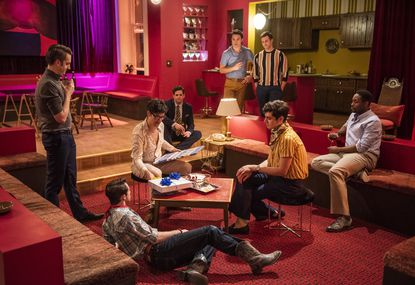
And the terrific cast at WCP under the direction of Carl Menninger seemingly does Crowley’s trailblazing work great justice, with the immersive staging—the audience sits around the apartment where the party takes place after riding an elevator to reach it—having added considerably to my emotional embrace.

But where The Boys in the Band transcends being eye-opening and ballsy for its time—and even our time—and stands as dramatically superlative is in chronicling the experience of youngish gay men in late-‘60s Manhattan while simultaneously reflecting universal human emotions, experiences and truths...anytime, anywhere.

This was my first visit to Windy City Playhouse’s flagship venue on Irving Park Road after having seen and loved Every Brilliant Thing last October, presented in a space on Motor Row along South Michigan Ave.

That show, which I named my favorite play of 2019 and nearly my favorite solo theatrical piece of the decade, was also quite successfully staged in imaginatively immersive fashion.

Over the years, I’ve been to a few shows where the audience sits among the actors, rather than in seats facing a stage, but never as holistically or effectively as at these two WCP productions.

Every Brilliant Thing featured a single actress who regularly interacted with the audience, occasionally in acting out small scenes.

The Boys in the Band has us sitting amidst the nine actors as they move about the spacious apartment—and "stage hands" kindly bring around some food & drink—but doesn’t really have the actors engaging with the audience (at least at the performance I attended).

I thought it might be fun if we were asked to get up and dance, or kibitzed with in some ad hoc way, though narratively it wouldn’t really make sense for a party attended rather privately by gay men to also include, say, Japanese grandmothers or anyone else comprising the play’s ideally diverse audiences.

So although the immersive conceit is wonderful, it only stretches so far.

But, as far as one’s imagination wants to wrap, we are in the Upper East Side apartment of Michael (played by Jackson Evans, who shows terrific versatility after also excelling in musicals like Avenue Q, Ride the Cyclone and Matilda).

He’s hosting a birthday party for Harold (Sam Bell-Gurwitz), but first to arrive is Donald, who I believe is Michael’s ex-boyfriend. He’s played by Jordan Dell Harris, who I’ve also seen do nice work in some local musicals.

Guests also include Emory (William Marquez), Hank (Ryan Reilly), Larry (James Lee), Bernard (Denzel Tsopnang), Alan (Christian Edwin Cook) and Cowboy (Kyle Patrick), though a couple of them weren’t directly invited.

It’s to the credit of Crowley’s script, whatever alterations may have been made to modernize it a bit, all of the actors and director Menninger that each of the characters is quite distinctive and well-defined.

You should get to know these men on your own, but one is quite flamboyant, another a newly divorced father, several loquacious and/or acerbic, a few self-loathing, one far from monogamous even within a relationship and one seemingly closeted.

All—understandably given that, when the play was written, they would egregiously be considered criminals—have some struggles of self.

As at parties everywhere, the friends eat, drink, chat, banter, bicker, tease, curse, cajole, share, laugh, play music, commiserate and have cake.

But driving forward a particularly poignant part of the narrative is a “game” in which each person is
to telephone someone they have truly loved, and—if connected—tell them.

Some of what then occurs is wrenching, even heartbreaking. And the scenarios revealed are at times devastating because of homophobia encountered, or residual apprehension, embarrassment, humiliation, etc.

Yet this is also where The Boys in the Band connects us all, because who couldn’t think of someone they would call?

Or might be afraid to?

So yes, this is an important, admirable, enlightening work of theater because it is about gay men, be they businessmen, teachers, photographers, interior decorators, artists, prostitutes, African-Americans, Catholics, New Yorkers or whatever else distinguishes them.

But it is a great play because the underlying themes—our commonalities that far outweigh our differences—pertain to everyone.

In one way or another, we are all the boys in the band.

Giving Nothing Away: 'How a Boy Falls' Has Plenty of Twists but Lacks Gravity -- Chicago Theater Review

Theater Review

How a Boy Falls
a World Premiere play by Steven Dietz
directed by Halena Kays
Northlight Theatre, Skokie, IL
Thru February 29
@@@1/2

I love thrillers.

And mysteries.

Hitchcock films.

Page-turning novels by the likes of Harlan Coben—my favorite contemporary author, at least in terms of reading for entertainment.

Whodunit TV series that typically solve cases within a given episode.

The Mousetrap by Agatha Christie, the longest-running play in the world (in London), currently being well-done by Chicago’s Court Theatre.

Photo credit on all: Michael Brosilow
So I did enjoy How a Boy Falls, a twisty play by Stephen Dietz now in a world premiere production
by Northlight Theatre.

Directed by Halena Kays and clocking in at 75 minutes, it moves fast, offers surprises and--in involving a domestic mystery--feels akin to some of Coben’s books.

But though I’ve read Coben’s entire oeuvre, devouring each novel in under a week, and would recommend his work to anyone seeking a fun read—while also extolling his usual inclusion of astute societal commentary and a fair amount of humor—I wouldn’t call what he does great literature.

In part because there isn’t much staying power to what I’ve read. Nothing much to ponder, take away, come back to, discuss, etc.

And this pretty much describes How a Boy Falls, whose plotline I won’t much describe.

Paul (Tim Decker) and Miranda (Michelle Duffy) are husband and wife, living in a posh coastline home. Chelle (Cassidy Slaughter-Mason) is their newly hired nanny. Sam (Sean Parris) and Mitch (Travis A. Knight) are a couple of dudes who notice Chelle in a coffee shop.

The play’s title gives a hint of what happens, but there are a number of sharp turns.

For what it is—which are almost always somewhat damning words—How a Boy Falls is well-written, well-crafted, well-staged and well-acted.

But there’s nothing really monumental about it, and many of the scenarios that unspool feel more theatrically contrived than realistically genuine.

I see tons of theater—presently about 10 pieces in a month's span—and it was nice that this was something a bit different.

Despite the foreboding title, light even.

Yet ultimately, rather forgettable.

A suspense thriller, but not a killer thriller.

It won’t take up too much of your time, and if the price is right, Northlight is always comfortable with easy parking.

A World Premiere is nothing to sneeze at, live theater is a joy unto itself, Dietz's script is at times rather and the performances and production values are strong.

But whether you should see How a Boy Falls, or just how much you'll like it, is a mystery I'm not able to readily solve.
Nor even much guess at. 

Friday, February 07, 2020

Crawling with Possibilities: Steppenwolf's Staging of 'Bug' is Infested with a Pesky Sense of Uncertainty -- Chicago Theater Review

Theater Review

Bug
by Tracy Letts
directed by David Cromer
Steppenwolf Theatre, Chicago
Thru March 15
@@@@1/2

I have a hard time truly appreciating plays or movies I don't really "get."

There is much to be said about the creativity and originality of works that are surreal, abstract, quite science fictional and/open to wide interpretation, but I generally don't acclimate well to being confounded.

And because Bug--a 1996 play by Tracy Letts, currently getting its first staging at Steppenwolf, where he is now an ensemble member—reaches a point of chaotic confusion not easily deciphered, I can’t quite give it @@@@@ or call it one of my favorites.

But as presently directed by the esteemed David Cromer, it is largely terrific, with the ambiguity seemingly part of Letts’ point.

Tracy Letts is now best known for writing August: Osage County, which—following a 2007 premiere at Steppenwolf that I saw—won him a Tony Award and Pulitzer Prize. He is also an actor, recently seen in Little Women, Ford v. Ferrari and Lady Bird.

Photo credit on all: Michael Brosilow
The Oklahoma native—his mom was the novelist, Billie Letts—has become one of Chicago’s most
successful actors (on stage and screen) and playwrights. He’s also written movies and is now married to a film/TV/stage actress of some note, Carrie Coon, who stars in this production of Bug.

But before I had any idea who Letts was, I happened to see the first production of the first play he wrote—Killer Joe—in August 1993 at the Next Theatre Lab in Evanston.

This was the first play I ever saw in the Chicagoland area, and while presumably persuaded by a stellar Chicago Tribune review, I undoubtedly went in part because it was near my Skokie home.

The show starred a then unknown Michael Shannon—I can’t say I acutely remember him—and though I didn’t realize it until just a few days ago, an actress named Holly Ann Wantuch, who was Letts’ longtime girlfriend until she tragically passed early in 1998.

I do recall there was onstage nudity, and that I quite enjoyed Killer Joe.

In the program notes for this production of Bug—which also contains full frontal male and female nudity—Letts shares that the Gate Theatre in London had asked him to write another play with “basically the same people” as Killer Joe, and that he wrote Bug’s character of Peter with Michael Shannon in mind.

Shannon did star in the 1996 London premiere of Bug, then again in the 2001 Chicago premiere at A Red Orchid Theatre, Off-Broadway in 2004 and in director William Friedkin’s film version in 2006, which helped turn him—quite justifiably—into a movie star.  (He continues to occasionally do local theater and I’ve seen him several times.) 

But in this production of Bug, which I had not seen before as a play or film, Namir Smallwood—who was also excellent in True West last year at Steppenwolf under the direction of Randall Arney, who has a small role here as Dr. Sweet—plays Peter, a Gulf War vet who is now something of a drifter. 

Although I was often able to imagine Shannon speaking the same lines, to his great credit Smallwood makes the role his own and finely enacts the escalating tension—and uncertainty—it demands.

Coon—who has starred in TV series The Leftovers, Fargo and The Sinner, a number of movies and past Steppenwolf plays (like Letts' superb Mary Page Marlowe)—here plays Agnes, a cocktail waitress who onstage never leaves the confines of the motel room in which she resides.

Fearing a visit from her violent ex-husband Jerry (Steve Key), who has just been released from prison, “Aggie” commiserates—and snorts coke—with her friend R.C. (Jennifer Engstrom), through whom she had met Peter, who comes to her room and prefers to smoke crack.

Drug use is rather prevalent in Bug, yet never seems to consume the characters.

Unless it does.

In different yet largely empathetic ways, we learn that both Agnes and Peter have had rather imperfect pasts, and though both remain troubled, there is a genuine sweetness in the affection they develop for each other.

But near the end of an expository first act, which does include a visit from Jerry, Peter finds a bug.

Or does he?

Much of Act 2 has to do with an obsession with bugs.

But are they real or imaginary? Or both? Representative somehow of surveillance “bugs”? A metaphor for romantic insecurities? A result of Peter’s wartime experiences? Part of some human experiments of the Jason Bourne variety? Psychological delusions run rampant?

I won’t say, but honestly even after seeing the play, I don’t really know.

And while Letts notes that he did more research in writing Bug than he has for any other play, even if he had a certain rationale in mind, I’m thinking he would be fine with the audience's ambiguity, even desirous of it.

For the myriad possible interpretations, now in a different world than when the play was written and set, is much of what makes Bug so intriguing.

So I won’t hold my confusion against it as strongly as I have for some plays that really left me perplexed throughout.

But though Bug is undoubtedly a deft piece of writing, with terrific acting here under the direction of Skokie-native turned Tony winner David Cromer, I think it might leave too much for each viewer to decide.

Such as, was there ever really a bug?