Wednesday, July 22, 2015

My 100 Favorite Rock Songs of All-Time (at least as of today) -- Spotify Playlist Included

After posting My 100 All-time Favorite Artists of Popular Music on Sunday, I was asked if I could cite my 100 favorite songs in a rock or pop music vein.

So I quickly put this list together, and think it's pretty accurate even if almost every song could easily be swapped out for another one I love, even by the same artist.

Reflecting the flavor of my favorite artists list, you'll note a preponderance of guitar-driven hard rock tunes, mostly of a classic or alternative rock bent.

This is clearly what I enjoy most in a rock vein, but not only would an exhaustive list of songs I enjoy include a much wider swath in terms of pure pop, soul, blues and more, but would also represent my love of Broadway, several great jazz tunes, classical compositions and more.

For your listening pleasure, I compiled a Spotify Playlist to match the list below, albeit without a combined six songs by The Beatles and Bob Seger, whose songs aren't streaming. So I added 6 other songs to make a 100-tune Seth Saith favorites playlist and cite them at the end here.

1. Backstreets - Bruce Springsteen
2. Smells Like Teen Spirit - Nirvana
3. Rock and Roll - Led Zeppelin
4. Baba O' Riley - The Who
5. You Shook Me All Night Long - AC/DC
6. Going Underground - The Jam
7. The Spirit of Radio - Rush
8. Where the Streets Have No Name - U2
9. Badlands - Bruce Springsteen
10. London Calling - The Clash

11. I Wanna Hold Your Hand - The Beatles
12. Under Pressure - Queen & David Bowie
13. Gimme Shelter - The Rolling Stones
14. A Day in the Life - The Beatles
15. Thunder Road - Bruce Springsteen
16. So. Central Rain - R.E.M.
17. Blitzkrieg Bop - The Ramones
18. Pride (in the Name of Love) - U2
19. Rebel Rebel - David Bowie
20. Bullet with Butterfly Wings - Smashing Pumpkins

21. Voodoo Child (Slight Return) - Jimi Hendrix Experience
22. Like a Rolling Stone - Bob Dylan
23. Born to Run - Bruce Springsteen
24. The Whole of the Moon - The Waterboys
25. Surrender - Cheap Trick
26. 29x the Pain - The Wildhearts
27. The Waiting - Tom Petty and the Heartbreakers
28. Beds Are Burning - Midnight Oil
29. Hurt - Johnny Cash
30. After the Gold Rush - Neil Young


31. Local Boy in the Photograph - Stereophonics
32. Excitable Boy - Warren Zevon
33. Rosalita (Come Out Tonight) - Bruce Springsteen
34. Won't Get Fooled Again - The Who
35. Go Your Own Way - Fleetwood Mac
36. Welcome to the Jungle - Guns 'n Roses
37. Fortunate Son - Creedence Clearwater Revival
38. Solsbury Hill - Peter Gabriel
39. A Hard Day's Night - The Beatles
40. Waterloo Sunset - The Kinks

41. (What's So Funny 'Bout) Peace, Love and Understanding - Elvis Costello
42. Instant Karma - John Lennon
43. Once in A Lifetime - Talking Heads
44. Begin the Begin - R.E.M.
45. Jeremy - Pearl Jam
46. Street Fighting Man - The Rolling Stones
47. Everyday People - Sly and the Family Stone
48. I Wanna Be Your Boyfriend - The Ramones
49. Lithium - Nirvana
50. Police on My Back - The Clash

51. Over the Hills and Far Away - Led Zeppelin
52. The Ties That Bind - Bruce Springsteen
53. Rain - The Beatles
54. Sunday Bloody Sunday - U2
55. Lola - The Kinks
56. Purple Haze - Jimi Hendrix Experience
57. Creep - Radiohead
58. And the Cradle Will Rock - Van Halen
59. I'll Stick Around - Foo Fighters
60. Sympathy for the Devil - The Rolling Stones

61. Life on Mars - David Bowie
62. Bohemian Rhapsody - Queen
63. Alive - Pearl Jam
64. Green Mind - Dinosaur Jr.
65. Layla - Derek and the Dominoes
66. Feel Like A Number - Bob Seger
67. Darkness on the Edge of Town - Bruce Springsteen
68. Wish You Were Here - Pink Floyd
69. Dream On - Aerosmith
70. So Lonely - The Police

71. She's Not There - The Zombies
72. To Be Someone - The Jam
73. Beyond Belief - Elvis Costello
74. Blow Up the Outside World - Soundgarden
75. When the Angels Cry - Jason and the Scorchers
76. Werewolves of London - Warren Zevon
77. Friday I'm In Love - The Cure
78. Whole World With You - Willie Nile
79. If I Can't Change Your Mind - Sugar
80. Ticket to Ride - The Beatles

81. Apply Some Pressure - Maximo Park
82. A Thousand Trees - Stereophonics
83. Refugee - Tom Petty and the Heartbreakers
84. Ain't Talkin' 'Bout Love - Van Halen
85. Monkey Wrench - Foo Fighters
86. American Idiot - Green Day
87. I'll Be You - The Replacements
88. Been a Son - Nirvana
89. Just What I Needed - The Cars
90. The Price You Pay - Bruce Springsteen

91. Pretty Persuasion - R.E.M.
92. Hey, Hey, My, My - Neil Young
93. Sweet Child O' Mine - Guns 'n Roses
94. Sir Duke - Stevie Wonder
95. Your Song - Elton John
96. Hells Bells - AC/DC
97. Redemption Song - Bob Marley
98. Rain on the Scarecrow - John Mellencamp
99. Ball and Chain - Social Distortion
100. Blasphemous Rumors - Depeche Mode

6 extra songs for the Spotify playlist since The Beatles (5) and Bob Seger (1) aren't there.

Get Over You - The Undertones
Maggie May - Rod Stewart
Don't Look Back - Boston
Suspicious Minds - Elvis Presley
Train in Vain - The Clash
God Only Knows - The Beach Boys 

Plus two more songs I really like and wanted to include:

Buck Rogers - Feeder
Common People - Pulp

Sunday, July 19, 2015

My 100 All-Time Favorite Artists of Popular Music - 2015 Edition

A meaningless exercise, perhaps even for me.

For not only could the order of my favorite rock artists--as well as a few from blues, country and R&B genres, with eligibility including rap, pop, folk and funk, though not Broadway, classical or jazz--vary on a different day, let alone month or year, but at any point in time I might rather hear, or even see in concert, an artist nearer (or even beyond) the end of the list than ones closer to the top.

But having compiled such lists around this time in 2005 and 2010, even if largely just for my own point of reference I thought I'd put together a new ranking of my favorite artists.

To be clear, this list is based on my tastes, preferences and listening habits--undoubtedly influenced in part by acts I've seen live, perhaps repeatedly--and is not intended as a critical assessment of importance, impact, influence, originality or other barometers of artistic merit.

For example, I would stipulate the Beatles are the greatest and most important, popular music artist in history, but in terms of fervent, active fandom, I like, listen to and see Bruce Springsteen more. (Of course, The Beatles broke up before I was 2, so I couldn't see them live, though I have seen Paul McCartney and Ringo Starr several times.)

Unlike the 2005 & 2010 editions, I've decided to include bands and any solo acts or other bands that derived from them as a single entry. This gets a bit awkward in the case of, say, Peter Gabriel + Genesis but not Genesis led by or looping in Phil Collins, or in not including Led Zeppelin as a subset of The Yardbirds.

Like everything, it's imperfect, but who cares?

Again, this is a list of my 100 favorites, with another 25 cited, and is in no way exhaustive of every artist I like and/or admire, nor meant to disrespect anyone I didn't include.

While hoping some may enjoy reading though my selections, I firmly believe that the only such list that should really matter to you is your own.

So if you would have undeniably esteemed acts like The Stooges (+ Iggy Pop), Leonard Cohen, Otis Redding, The White Stripes, the Supremes, James Brown, Janis Joplin, Frank Zappa, Lynyrd Skynyrd, The Grateful Dead, Madonna, the Beastie Boys, Public Enemy, the Eagles, the Smiths, etc., etc., etc., in your top 100--or even top 10--by all means, make your own list and share it with me. (Of minor note, in 2012 I made a 100 Best Alternative Bands of the Last 25 Years list that was intended in a more universal critical vein, though was obviously based on my opinion and tastes as well.)

But with a few substantive changes since 2005 and 2010--the top 10 is shuffled, Arcade Fire came from nowhere to #34, System of a Down is newly ranked at #61, lesser-known personal favorites like the Stereophonics and the Wildhearts sank quite a bit, Liz Phair and the Flaming Lips dropped precipitously, Blur was absent in 2005, #58 in 2010 and #36 now, the Ramones remained at #15 from 5 years ago but were #44 in 2005, Jimi Hendrix climbed into the top 20, Elvis Presley rose from the dead--here are:

My 100 All-Time Favorite Artists of Popular Music
(All photos by Seth Arkin; please do not re-post without attribution)

1. Bruce Springsteen
2. The Beatles (+ solo, Wings)
3. Led Zeppelin (+ Robert Plant)
4. Nirvana
5. The Rolling Stones
6. The Who (+ Pete Townshend)
7. U2
8. R.E.M.
9. The Kinks (+ Ray Davies)
10. The Jam (+ Paul Weller)

11. Pearl Jam
12. The Smashing Pumpkins (+ Zwan, Billy Corgan)
13. David Bowie
14. The Clash
15. The Ramones
16. The Replacements (+ Paul Westerberg)
17. AC/DC
18. Tom Petty & the Heartbreakers
19. Cheap Trick
20. Jimi Hendrix

21. Rush
22. Midnight Oil
23. Radiohead
24. Bob Dylan
25. Foo Fighters
26. Dinosaur Jr.
27. Van Halen
28. Queen
29. Green Day
30. Bob Seger

31. Elvis Costello
32. Pink Floyd
33. Talking Heads (+ David Byrne)
34. Arcade Fire
35. Neil Young (+ CSNY, Buffalo Springfield)
36. Blur
37. Aerosmith
38. The Police (+ Sting)
39. Johnny Cash
40. Creedence Clearwater Revival (+ John Fogerty)

41. Stereophonics
42. Guns 'n' Roses
43. Hüsker Dü/Bob Mould/Sugar
44. Soundgarden
45. Willie Nile
46. The Wildhearts
47. The Killers
48. Wilco
49. Steely Dan
50. Simon & Garfunkel/Paul Simon

51. Elton John
52. Eric Clapton/Cream/Derek & the Dominoes/Yardbirds
53. Peter Gabriel/(early) Genesis
54. Billy Joel
55. Warren Zevon
56. The Zombies
57. The Cure
58. Stevie Wonder
59. Maxïmo Park
60. Garbage

61. System of a Down
62. Metallica
63. The Waterboys
64. Fleetwood Mac
65. Alejandro Escovedo
66. Van Morrison (+ Them)
67. Sex Pistols
68. The Doors
69. The Cars
70. Velvet Underground/Lou Reed

71. John Mellencamp
72. Depeche Mode
73. Nine Inch Nails
74. Elvis Presley
75. Red Hot Chili Peppers
76. The Beach Boys
77. The Byrds (+ Roger McGuinn)
78. Smoking Popes
79. Bob Marley
80. BoDeans

81. The Pretenders
82. Stevie Ray Vaughan
83. Buddy Guy
84. Prince
85. Santana
86. Blondie
87. Black Sabbath/Ozzy Osbourne
88. Chuck Berry
89. Buddy Holly
90. Coldplay

91. Supertramp
92. Manic Street Preachers
93. Steve Winwood (all incarnations)
94. Ash
95. Jane's Addiction
96. Oasis
97. Jason and the Scorchers
98. The Flaming Lips
99. Liz Phair
100. Sly and the Family Stone

The Next 25

Rage Against the Machine (+ Tom Morello)
Dire Straits
The Stooges (+ Iggy Pop)
Love
ZZ Top
Bad Religion
The Bangles
The Monkees
New Order/Joy Division
The Miracles/Smokey Robinson
The White Stripes
Def Leppard
The Pixies
The Eagles
Jackson Browne
Material Issue
Boston
Social Distortion
Alice Cooper
Buzzcocks
Leonard Cohen
Electric Light Orchestra
Rod Stewart/The Faces/Jeff Beck Group
The Smiths

Thursday, July 16, 2015

Motown Review: Post-Conclusion Reflections on 'Diego Rivera and Frida Kahlo in Detroit' -- Art Exhibition Review

Art Exhibit Review

Diego Rivera and Frida Kahlo in Detroit
Detroit Institute of Arts
March 15-July 12, 2015
Exhibit seen July 9; now ended
@@@@

Last week, I took a brief road trip from Chicago to Detroit, motivated primarily by the opportunity to see The Rolling Stones at Comerica Park, home of the Tigers.

The Stones were great--see my review here--but I also enjoyed the rest of my 24 or so hours in Detroit and its environs.

Having been there multiple times before, this didn't surprise me, as despite being much maligned, I have always found the city well-worth visiting--as I wrote in this Detroit travel guide--in large part due to a fine collection of museums.

The Henry Ford (in suburban Dearborn), Motown Museum and Detroit Institute of Arts are among my favorites anywhere, and in addition to the DIA, on this trip I valued my first visit to the Holocaust Memorial Center in Farmington Hills. I one day also wish to check out the Detroit Historical Museum and the Charles H. Wright Museum of African-American History, as well as the University of Michigan Museum of Art in nearby Ann Arbor. 

And though the vast construction posed some logistical challenges, it was nice to see advancements being made in the downtown area of a city that declared bankruptcy in 2013, with a new 3.3-mile streetcar along Woodward Ave. aimed to open next year and bringing new housing developments with it.

Diego Rivera, Detroit Industry Murals, 1932-33
Having visited the Detroit Institute of Arts on a number of previous occasions, I was familiar with its outstanding collection spanning numerous genres--including two of the best Van Goghs I've seen anywhere--as well as its excellent explanatory displays that aid patrons in understanding selected artworks and artists.

I had also repeatedly seen the museum's centerpiece, Rivera Court, on whose four walls the great Mexican muralist Diego Rivera painted a tribute--but being a Marxist and humanitarian, also a rebuke of certain practices--to the booming industry that was taking place in Detroit, albeit slowing as the Great Depression took hold.

Rivera, by then a world-famous muralist who had also been part of Parisian art circles with Picasso, Braque, Modigliani and others, arrived in Detroit in April 1932 at the behest of Edsel Ford, president of the Ford Motor Co. and son of its founder, Henry Ford.

Accompanied by his then little-known wife, Frida Kahlo, Rivera created the Detroit Industry Murals, meticulously depicting life on an automotive assembly line, but also highlighting pharmaceutical, chemical and other manufacturing prevalent in Detroit.

Just a month prior to Rivera's arrival, a hunger march of unemployed Ford workers, culminating at Ford's River Rouge plant in Dearborn, resulted in 5 marchers being killed and dozens more injured, in what became known as the Ford Massacre.

So within his factory scenes saluting line workers, Rivera also mocked tyrannical, insensitive executives and made some sly indictments of American industrialism and greed.

For great insights on the murals, their overt & covert messages and the importance of the black & white filmstrip-like "predella" panels, I highly recommend this terrific blog article by my friend Mark Vallen, himself a gifted artist simpatico with Rivera's social realism and renderings of societal injustices merged with a sense of dignity and hope.

Personal illuminations from Mark also helped me better appreciate the numerous Diego Rivera murals--and those of contemporaries like David Alfaro Siqueiros and José Clemente Orozco--I saw in Mexico City on my trip there in January.

Frida Kahlo, Frida and Diego Rivera, 1931
In Mexico City, I also visited the Frida Kahlo Museum at La Casa Azul, the bright blue home where she grew up and then lived with Rivera for many years after their 1929 wedding.

There, and also at the Museum of Modern Art in Mexico City, I saw several canvases painted by both artists, and just a few weeks ago was delighted to note one of Kahlo's riveting self-portraits included in a wonderful--and ongoing--modern art exhibition in Milwaukee, of works from Buffalo's Albright-Knox Art Gallery.

Thus, while I don't know that I would have made a special trip just for it--unlike Vallen, who was inspired to fly to Detroit from his L.A. home back in May--I was quite pleased that a trek to see the Stones enabled complementary satisfaction to be found in the Diego Rivera and Frida Kahlo in Detroit exhibit just days before it closed.

I'm glad I bought a time-slotted ticket days in advance, and though the Woodward Ave. construction mess and some confusion finding the DIA parking lot caused me to be half-hour tardy for my 9:30am entry, I was allowed in without issue.

Understandably, as many of the works are on loan--the exhibition covered not only the couple's brief time in Detroit, but their life and work before and after--photography in the exhibit was not allowed. But in utilizing the free Audio Guide and taking copious notes so I could write this piece, I spent about 2 hours in the exhibition, followed by a long look at the murals themselves and a traipse through several other galleries.

Diego Rivera, Pharmaceuticals, Vaccination and Automotive Assembly
sketches for the Detroit Industry Murals, with actual mural versions also shown
I'm glad I got to see the Diego/Frida show, especially for the way it abetted my appreciation of Rivera's murals in Detroit and Mexico City.

Though I'd assumed that Rivera's art must have involved considerable planning and prep work, his murals are so bursting with human and other subjects--and especially given what I saw at Mexico City's Secretaria de Educacion Publica, so vast and voluminous--I figured much of the astonishing art must have resulted from Diego's ample gut instinct.

But the large mural sketches included in the Detroit exhibition reveal just how meticulously planned every inch of the murals were, to the point that assistants had traced Rivera's sketches onto the walls as guides for his painting.

Still, you can see that the final results weren't always exact to the sketches (at least not the largest one included in the exhibition).

At face value, or simply as a cost/value proposition, the Diego and Frida exhibit was well-worth my time and $14--which included general museum admission--and presumably that of anyone who took it in over its 4 months.

To my awareness, there are no Frida Kahlo works on public display in the otherwise art-rich city of Chicago, and seemingly only two relatively minor, not-particularly-emblematic paintings by Diego Rivera at the Art Institute.

Diego Rivera, Flower Festival, 1925 and The Flowered Canoe, 1931
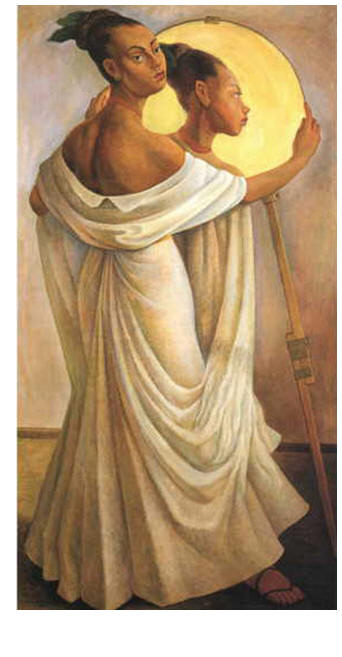
So although the Detroit exhibit had relatively few true masterpieces for such a high profile exhibition--and excepting the mural sketches, most of those were from before and after the artists' residency in the Motor City--works like Rivera's Flower Festival, The Flowered Canoe and his 1949 Portrait of Ruth Rivera (his daughter from a previous marriage) were pleasures to see, along with about five genuine Kahlo gems and some revelatory early works.

While the show provided some illuminating insights about both Diego and Frida, it was a bit lacking in the way of biographical depth, about either artist's life, work, beliefs, etc.--particularly preceding Detroit--and didn't really paint much of a picture about how either spent their time in the city outside of Rivera's work at the DIA.

Frida Kahlo, The Accident, 1926 and Henry Ford Hospital, 1932
Familiar to those who have seen the movie Frida, two tragic incidents in Kahlo's life were reflected in key pieces.

The 1925 bus accident that resulted in devastating injuries and lifelong pain was chronicled in a pencil drawing the next year, and the miscarriage that occurred when she and Diego were in Detroit not only prompted the harrowing Henry Ford Hospital painting that shows her on a bloodstained on a bed surrounded by images of a fetus, pelvic bone, medical model and more, but provoked her famed oeuvre of self-portraits chronicling her psyche and often pain.

Quoted in a video stating...

"Diego does pretty well, but it is I who am the big artist."

...Kahlo indeed seems to retain a much higher U.S. profile than her husband and, among many, greater artistic reverence.

Thus it is unarguably noteworthy that the sad circumstances in Detroit essentially begat her distinct style and hallowed career.

Yet without meaning this to be too critical, simply observational about the tenor of the audio guide and gallery text, insights into Frida Kahlo's time in Detroit could largely be summed up as:
Arrived with her more famous husband while pregnant, worried about the viability of her pregnancy due to her past injuries, wound up miscarrying and subsequently made herself the compelling, near-constant subject of her art in ways that were uniquely personal and often agonizing.
Frida Kahlo, Suicide of Dorothy Hale, 1940
Anything substantially more about Frida, her paintings, persona and perspectives was largely beyond the scope of the exhibition, although the inclusion of her 1940 Suicide of Dorothy Hale--a rare non-self portrait--illustrated the empathy Kahlo had for other women, in this case a New York socialite who like herself, was subjected to much press scrutiny in part due to her striking appearance.

Although Rivera would paint many more spectacular murals and canvases after Detroit--he would die in 1957 at age 70, three years after Kahlo passed at 47--he himself noted the Detroit Industry Murals as the apex of his career.

Especially because it made for one of the more poignant pieces of both art and information in exhibit, it is worth noting that after Kahlo's miscarriage, Rivera added an image of an infant in the bulb of a plant to the east wall of the mural, with a large sketch of such included in the exhibition.

Diego's next commission was famously in New York, where Nelson Rockefeller enlisted him to paint Man at the Crossroads in Rockefeller Center, only to soon have it destroyed due to Rivera having included a portrait of Lenin that he refused to remove.

Rivera would recreate the mural--retitled Man, Controller of the Universe--at the Palacio de Bellas Artes in Mexico City, where I had the pleasure of seeing it in January.

Diego Rivera, Baby in Bulb excerpt from Detroit Industry Murals, 1932-33
While he would remain quite prolific and productive, including creating the mammoth Pan American Unity mural in San Francisco in 1940--one of 3 in that city--and his last mural within Mexico's City National Palace (which I sadly didn't get to see due to a temporary security closure) in 1951, Diego Rivera and Frida Kahlo in Detroit intimates that he pulled back on the overt politicism in his work following the Rockefeller episode. 

Per this fine timeline provided by the Detroit News--nothing so detailed was included in the exhibit--Rivera finished the Detroit Industry Murals in March 1933.

They stand as an astonishing artistic achievement, and--amplified by the people of Detroit instantly championing Rivera's work in the face of some conservative backlash--also as one of the most heroic examples of art as social activism. (I couldn't help ask if it may have inspired another such example, Charlie Chaplin's Modern Times, but a docent didn't know; I'll look into this a bit more.)

Frida Kahlo, Self-Portrait with Cropped Hair, 1940
I wish there was a bit more focus on this aspect of Rivera--and Kahlo--in the exhibit, especially in a 21st century world where Detroit, and the proletariat worldwide, have suffered through hard times while billionaires become ever richer.

While I feel wealthier to have witnessed Diego Rivera and Frida Kahlo in Detroit, the truth is nothing contained within was as amazing as the murals themselves.

So even though I have written this lengthy review after the exhibition has ended, I still suggest Detroit demands a visit from any art lover, in part to witness the brilliant legacy Diego Rivera left behind for eternity, and to pay homage to what Frida Kahlo took forth from her traumatic time in Motown.

---
I did not purchase one, but the catalogue for Diego Rivera and Frida Kahlo in Detroit is available online through the DIA shop.


Diego Rivera, Self-Portrait, 1930 and Nude With Beads (Frida Kahlo), 1930. Frida Kahlo, Self Portrait with Monkey, 1945.

Monday, July 13, 2015

It's Stiletto Quite a Kick: Back Where It Was First Fashioned, 'Kinky Boots' Retains Its Fine Footing -- Chicago Theater Review

Theater Review

Kinky Boots
Cadillac Palace, Chicago
Thru July 26
@@@@1/2

On October 2, 2012, I saw the first ever public performance of Kinky Boots, at Chicago's Bank of America Theatre prior to the show heading to Broadway.

In my review the next day--perhaps the first anyone wrote about the show, which wouldn't officially open for another few weeks--I pronounced that it was "already one of the best new musicals of the last few years" and predicted that Kinky Boots and star Billy Porter would win Tony Awards the next year.

That happened, with co-star Stark Sands also nominated (in the same category as Porter) and composer/lyricist Cyndi Lauper becoming the first woman to individually win the award for Best Score.

Approaching 3 years later, Kinky Boots continues to do strong business on Broadway, and the show's first National Tour is in Chicago for a 3-week run, of which I again saw the first performance.

Any modifications or adjustments that have been made since I last saw the show weren't readily apparent or appreciable, and I still found the stage adaptation of a British film comedy--with which I was unfamiliar before the musical came along, but have now seen albeit not recently enough to recall many details--to be a first-class piece of musical theater entertainment.

The story of Charlie (nicely played here by Steven Booth), who inherits a shoe factory in Northern England after the death of his father, and in the face of its impending closure enlists the aid of Lola--the nom de plume of a gay black drag queen named Simon--in designing boots for womanly-attired men, has only gained resonance given recent developments supporting LGBTQ rights and equality.

Without my meaning to intimate that abundant bigotry and hate doesn't still exist, the seemingly universal affection of the audience--which bestowed a standing ovation--actually almost made the fish-out-of-water storyline that has Lola (a terrific Kyle Taylor Parker) facing overt derision feel somewhat dated.

And the show's narrative feels weakest in fashioning a boilerplate intolerant asshole out of an oafish factory worker named Don (Joe Coots) and in having Charlie maliciously flip out on Lola in a moment of Act II dramatic tension that feels forced and unnatural.

But the book, by Broadway legend Harvey Fierstein, is predominantly both funny and poignant, while Lauper's score is truly terrific even as it avoids obvious hallmarks of her pop hits.

Songs like the early "The Most Beautiful Thing in the World," Lola-led numbers "The Sex is in the Heel" and "What a Woman Wants," a tune sung by a smitten-with-Charlie factory worker named Lauren (the delightful Lindsay Nicole Chambers) called "The History of Wrong Guys," Charlie's "Soul of a Man" and the closing "Raise You Up/Just Be" are all stellar show tunes that get fine renditions on the national tour.

Under the direction of Jerry Mitchell, who also helmed Chicago's latest pre-Broadway musical tryout, On Your Feet, the staging of Kinky Boots remains positively brilliant, for which the choreography by Mitchell and David Rockwell's scenic design--most demonstrably involving a conveyor belt employed as a dance platform--undoubtedly deserve plenty of credit.

So if you love musicals and have never seen Kinky Boots--or like me, loved it here back in 2012--there is no reason not to get down to the Cadillac Palace by July 26.

There is no noticeable downsizing post-Broadway and the three excellent leads all boast Broadway credits, even if Parker is a smidgen less astonishing than the Tony-winning Billy Porter.

As upon my initial encounter, I did not find Kinky Boots to be a perfect show, and though a top-tier musical, it is not quite on the level of 21st century masterpieces like The Producers, Hairspray, Wicked, Avenue Q, Billy Elliot, Spring Awakening or perhaps the latest rage, Hamilton, which I have yet to see.

If you buy a ticket expecting to have your mind-blown, it's possible you won't quite, but for any musical theater lover looking for a show with winning songs, creative staging and a touching tale, these 'Boots' are certainly made for walking out of the theater with a smile on your face--and in your brightly bedazzled, high-heeled heart.

Saturday, July 11, 2015

'A Sondheim Celebration' Provides Perfect Night Music (with and without lyrics) at Millennium Park -- Chicago Theater / Classical Review

Theater / Classical Review

A Sondheim Celebration
Grant Park Orchestra
Paul Gemignani - Guest Conductor
Elizabeth Stanley and Alexander Gemingnani - Vocalists
Tedd Firth - Piano
Jay Pritzker Pavilion, Millenium Park, Chicago
July 10 (also July 11)
@@@@@

I've written often and extensively on this blog about my exhaustive esteem for the work, life and wonderfully insightful erudition of Stephen Sondheim.

In addition to having seen (and in many cases reviewed, if since 2010) most of his masterpieces, multiple times--including West Side Story*, Gypsy*, A Funny Thing Happened on the Way to the Forum, Company, Follies, A Little Night Music, Pacific Overtures, Sweeney Todd, Merrily We Roll Along, Sunday in the Park with George, Into the Woods and Passion--I've attended several live conversations with the composer/lyricist and a number of Sondheim revues or tribute concerts. (*Sondheim only wrote lyrics for West Side Story and Gypsy; he wrote the music as well for all other shows.)

Earlier this year, I found Porchlight Theatre's production of Sondheim on Sondheim--which interspersed songs with video commentary from its subject--to be especially outstanding.

But I never tire of hearing Sondheim's music well-performed in any venue, and nicely coinciding with getting a bit of dinner at the Taste of Chicago, the Grant Park Orchestra's A Sondheim Celebration at Pritzker Pavilion made for idyllic setting on a beautiful night.

And the music was rather sublime as well.

As a Sondheim salute and something of a retrospective, Friday's performance--repeating Saturday--wasn't quite as far-reaching nor exhilarating as The Birthday Concert from 2010, available on DVD and Blu-Ray. (I did not see that NYC concert in person.)

Yet sharing the same conductor, Paul Gemignani, who has worked with Sondheim for well over 40 years, it was pretty darn terrific.

Though the evening wasn't quite as starry as the Sondheim: 80 tribute I saw at Ravinia back in 2010--which featured Broadway legends Patti LuPone, Audra McDonald, George Hearn and Michael Cerveris--I still recall ruing that concert lasting barely an hour, or about half of this one.

At Millennium Park, with its gorgeous Frank Gehry-designed bandshell, admission was charged for the front of the pavilion, but hundreds of seats were free--I was pleasantly surprised to be able to avail myself of one--in addition to the lawn.

And it wasn't as though Broadway-level talent wasn't on display.

Paul Gemignani not only well-led the excellent Grant Park Orchestra but was joined in the Windy City by his son Alexander, a Broadway vet with numerous credits, who was complemented by the similarly accomplished Elizabeth Stanley (I happened to have seen her a few years back in a touring version of Xanadu).

Also accompanied by Tedd Firth on piano, the younger Gemignani and Stanley sounded about as good as one could want, together and separately, on such Sondheim gems as "Old Friends," "Too Many Mornings," "Being Alive" and an encore of "Broadway Baby."

"Sooner of Later," which Sondheim penned for the Dick Tracy movie, was resplendently delivered by Stanley, accompanied only by Firth and a bassist or two.

She was also wonderful on "The Miller's Son" and "Send in the Clowns," both from A Little Night Music, while Alex Gemignani mastered one of my very favorite Sondheim compositions, "Finishing the Hat" from Sunday in the Park with George.

But what elevated this concert from a simple--though in itself quite satisfying--showcase of wonderful songs, demonstrating Sondheim's delectable, sophisticated lyrics, splendidly sung by great vocalists in front of a superb orchestra, was the way it was programmed to intrinsically leverage the symphonic talent on stage.

In addition to the nine songs magnificently handled by the vocalists, Paul Gemignani--who served as the Music Director for numerous Sondheim shows on Broadway--conducted the Grant Park Orchestra on instrumental suites from Into the Woods, A Little Night Music, Sunday in the Park with George and Sweeney Todd, as well as the opening "The Advantages of Floating in the Middle of the Sea," a tune from Pacific Overtures that has no lyrics.

Not only did the suites sound exquisite, with lesser known passages blending with the familiar strains of "No One Is Alone," "Children Will Listen," "Send in the Clowns," "Sunday" and "The Ballad of Sweeney Todd," they amplified the brilliance of Sondheim as a musical composer, which is sometimes overshadowed by regard for his universally sage and incisive lyrics.

Along with a whole lot of other joy brought to my ears, I particularly loved how pianist Firth lifted the beautiful "Johanna"--from Sweeney Todd--rather liltingly.

Unlike at a 2006 Sondheim tribute concert in the same place, as well as at multiple times at Ravinia, the now 85-year-old maestro did not himself make an appearance.

Nonetheless, more than a little--rather spectacular--night music made for a wonderful Friday in the Park with Stephen, or at least his terrifically talented collaborators and interpreters.

If there's still time to get to tonight's 8:00pm performance, I strongly suggest you do.


Friday, July 10, 2015

It's Not Just My Imagination: The Rolling Stones Rock Motown, Resoundingly -- Detroit Concert Review

Concert Review & Photos

The Rolling Stones
w/ opening act Walk the Moon
Comerica Park, Detroit
July 8, 2015
@@@@@

Having seen, greatly enjoyed and lavishly reviewed The Rolling Stones when they played in Milwaukee just 2 weeks ago, I don't think I need to spend countless paragraphs singing the praises of their Detroit concert.

Not that I couldn't. Or won't, to some extent.

Whereas it was great to see the Stones at Milwaukee's Marcus Amphitheatre with a relatively intimate 22,544 other fans, I was glad to again experience a Stones show at full stadium size (having done so repeatedly in past years).

As the home of the Detroit Tigers, Comerica Park welcomed around 40,000 people and was able to fit a much larger stage, video screens and catwalk in center field than squeezed into the Milwaukee pavilion.

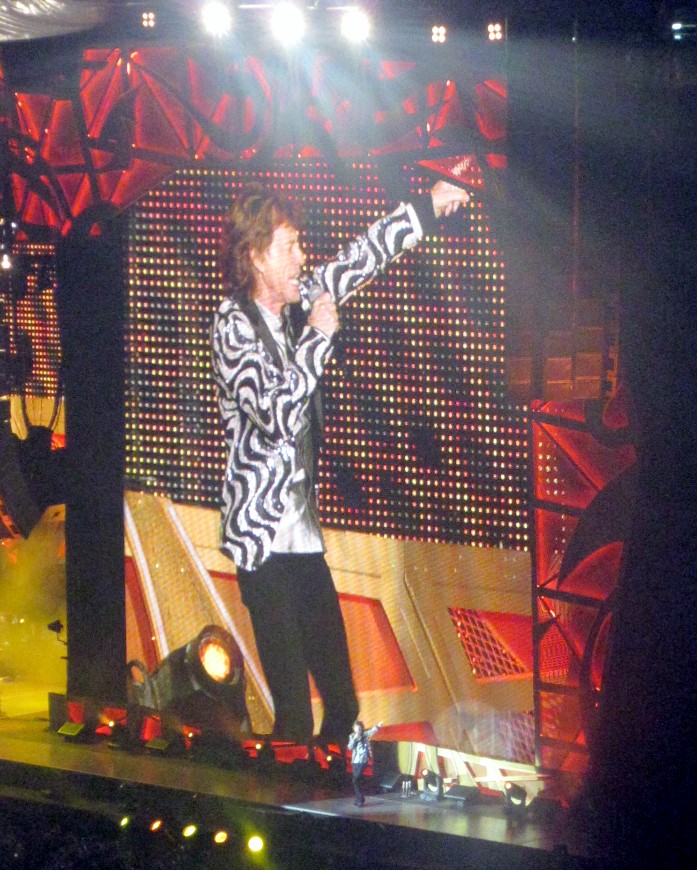
With the four main Stones ranging in age from 68 to 74, they continue to remarkably defy time, with the band sounding great and Mick Jagger running and dancing like a whirlwind while sounding strong vocally. A couple times on the video boards, Keith Richards looked a bit befuddled, and I sensed him missing a couple of iconic chords, but in taking his standard turn at the microphone--for "Before They Make Me Run" and "Happy"--he seemed rather spry and in good spirits.

If you look at the Rolling Stones' full Detroit setlist on Setlist.fm, you would note that it is much the same as they played in Milwaukee and at other stops on their brief, outdoor Zip Code tour of the United States.

But I felt lucky that out of the first 8 songs at Comerica, 4 were different than what I heard at Summerfest in Milwaukee.

"All Down the Line" in the third slot sounded terrific, and on a night where Mick overindulged in local references that never sound natural--"Michiganders," multiple mentions of the Tigers--the Stones nicely played their Some Girls Temptations cover, "Just My Imagination (Running Away with Me)" in homage to Motown.

Jagger also paid spoken tribute to other great musicians of Detroit, including Bob Segar, Eminem and Kid Rock.

Although I voted for "Street Fighting Man" in the internet poll, I'm happy "Rocks Off" won after losing to "Doo Doo Doo Doo Doo (Heartbreaker)" in Milwaukee. And the Exile on Main Street opener sounded terrific.

From Sticky Fingers, the zipper clad 1971 classic album whose reissue inspires the "Zip" Code moniker, I would have preferred "Wild Horses" to "Moonlight Mile," which I had heard in Milwaukee, but was glad to have it paired with "Bitch" rather than another "Can't You Hear Me Knocking."

This is getting rather long for what I meant to be just a brief re-review. So I'll simply say that, yes, the Rolling Stones were again phenomenal--for any age--and classics like "Gimme Shelter," "Sympathy for the Devil," "You Can't Ever Get What You Want" (accompanied by the Oakland University chorus) and "(I Can't Get No) Satisfaction" were an absolute delight to hear--no matter how many times I have--in a packed stadium on a perfect night.

I am glad the show inspired a brief road trip that enabled me to see a couple great museums (look for subsequent posts), but on this night it was decidedly Detroit Stone City. (An oblique reference to the KISS song, "Detroit Rock City.)

And rather than more words, I'll leave you with a bunch of photos of the Rolling Stones in Detroit:


Tuesday, July 07, 2015

'Vanya and Sonia and Masha and Spike' Doesn't Equal the Sum of Its Parts -- Chicago Theater Review

Theater Review

Vanya and Sonia and Masha and Spike
a recent play by Christopher Durang
Goodman Theatre, Chicago
Thru July 26
@@@1/2

One of the biggest holes in my rather vast theatergoing database is that I've never seen--nor read--any of the four masterpieces by Anton Chekhov.

Although The Seagull, Uncle Vanya, Three Sisters and The Cherry Orchard are all titles I've often heard, they aren't plays I've knowingly had (and/or took advantage of) opportunity to "Chekhov" my list.

Until Sunday night at the Goodman Theatre, I also had never seen anything written by Christopher Durang, one of the more prolific and noted contemporary playwrights. As with Chekhov, this has never been a matter of abject avoidance, rather just mere lack of acute occasion.

It's certainly possible that were I more familiar with Chekhov and Durang, I may have better appreciated the latter's Vanya and Sonia and Masha and Spike, whose first three titular characters are adult siblings named after characters in Chekhov plays by their professor parents.

Throughout the 2012 play--winner of the Best Play Tony Award in 2013 for merits I failed to appreciate on this initial viewing--numerous references are made to the Russian writer's works, including some I probably missed if the titles weren't involved.

Being unfamiliar with Chekhov, it's also quite plausible that I failed to appreciate any thematic/stylistic similarities or narrative allusions that Durang may have been making.

But at face value, I found Vanya and Sonia and Masha and Spike to be decent, but not particularly compelling or special, with only late second act proceedings--of a nearly 2 hour and 45 minute play--raising my rating to @@@1/2.

Which isn't to say it isn't any good, as the somewhat absurdist--though not nearly as much so as Beckett and Albee--play has a number of good parts, including not just four but six well-crafted characters.

And the acting in the Goodman production, directed by Steve Scott, is universally strong, with Ross Lehman excellent as Vanya, a single gay man in his late 50s living with his 52-year-old sister, Sonia (played with nice nuance by Janet Ulrich Brooks) in their late parents' home in Bucks County, PA.

Though she doesn't get to use her great singing voice here, E. Faye Butler steals every scene she's in as Cassandra, a Greek mythology monikered cleaning lady-cum-psychic.

And in her second straight show at Goodman following The Little Foxes, Mary Beth Fisher makes for a convincing slowly-fading movie star in Masha, who is supporting her brother and sister in their fringes-of-society existence after years of caring for their folks.

After an initial dialogue between Vanya and Sonia, primarily about morning coffee, the play unfolds as Masha returns to the homestead with her boy-toy, Spike, who spends much of his stage time showcasing his sculpted physique. Incidentally, Jordan Brown, who imbues the non-Chekhovian-named Spike with deeply-ingrained shallowness, played something of a surrogate son to Fisher's character in White Guy on the Bus at Northlight Theatre earlier this year.

The final character is a pretty young neighbor girl, Nina (attractively embodied by Rebecca Buller), who serves mainly to exacerbate Masha's insecurities when it comes to Spike.

There is plenty of humor, including some laugh out loud lines (and I rarely LOL), one of the best static sets I've ever seen--by Scenic Designer Charlie Corcoran--and narrative explorations I could relate to involving unattached and unemployed but quite intelligent people of a certain age pondering their sense of place and purpose while seeking refuge among family.

And for those of us who often rue the erosion of shared experiences and memories in the ever-fragmented and increasingly superfluous digital age, Lehman as Vanya terrifically delivers a raging--if a tad overlong--rallying cry to the twentysomething Spike, whose crime of texting during a performance was actually echoed by the woman sitting in front of me. (See part of Lehman's monologue here if you wish.)

Then there's the rather preposterous--and oft used in promotional materials--stage imagery that has the cast frocked for awhile as characters from Snow White and the Seven Dwarfs.

Throw in some rather touching and poignant moments near the end, plus a bit of voodoo, and it would seem that Vanya and Sonia and Masha and Spike has quite a good bit going for it.

Certainly the Tony voters thought so.

But by intermission, my mom and I, as well as a pair of Sunday night subscriber friends we bumped into, were congruently scratching out heads about the merits and meaning of what we had witnessed.

And while the second act took things up a bit, all told it was a rather middling conclusion to a somewhat "ehhh" season at the Goodman, rather than the recent Tony-winning highlight we hoped it would be.

Throw in a theater balcony that was absurdly arctic throughout Act I and Vanya and Sonia and Masha and Spike ended up being satisfying in part--and name--only.