Monday, August 23, 2010

Terrible acoustics deplete Aerosmith show of much sweet emotion; performance itself a bit impassive

Concert Review

Aerosmith
with Buckcherry
First Midwest Bank Amphitheatre
Tinley Park, IL
Sunday, August 22, 2010
@@@1/2


Last night I went to a concert by a legendary hard rock band and heard music at a considerably lower volume than I did on my drive home.

Thus, while I would like here to encapsulate Aerosmith's performance, the truth is my enjoyment of it was audibly diminished by the atrocious sound system employed by the First Midwest Bank Amphitheatre to reach us peasants on the lawn. The concert itself--coming amidst some recent band turmoil--wasn't perfect, but I know I would've liked it a whole lot better had I been in the pavilion or a good bit closer than halfway up the hill that constitutes the "lawn section."

Funny thing is, I feel as if I almost have no right to complain as due to a promotion by promoter Live Nation prompted by slow ticket sales, I was able to get in for only $10 including parking. As such, the outing with two good friends was still technically "worth it," but Live Nation--which also owns the venue--should be thoroughly ashamed of such completely crappy acoustics.

Chicago Tribune photo by Simon Brubaker
I've always hated the utilitarian Tinley Park "shed"--by far the worst concert venue in the Chicagoland area--but I don't recall ever experiencing a concert so utterly impaired by such a lousy sound system. Just because I didn't pony up for pavilion seats or get to the show early enough to sit closer on the lawn--where every 10 feet forward seemingly improved the volume by about 10%, per a trek to the restroom and late-show descent--doesn't mean I deserved to hear Steven Tyler, Joe Perry and all 5 original Aerosmithians at levels that allowed me to comfortably converse above the music without raising my voice. (I know my hearing is likely a bit depleted after years of concertgoing, but my comrades concurred that the sound was horrendous.)

After all, it's not like I was seeing a concert in a parking garage or even at a stadium not solely designed for musical performances. The only reason this oft-renamed venue exists is to host summertime concerts, so it's stupefying that its acoustics suck so bad.

Now as for Aerosmith, who may have been somewhat complicit in the sound problems by not properly soundchecking to the back of the lawn,  they were--not too surprisingly--something of a mixed bag.

I have been a fan for almost exactly 32 years, tied to the late-summer 1978 release of the not-so-great movie version of Sgt. Pepper's Lonely Hearts Club Band, in which my favorite musical moment was when Aerosmith sang "Come Together."  Not long thereafter, I got their 1978 double live album titled Live Bootleg and have loved it to this day

By the end of the '70s, Aerosmith splintered, with guitarists Joe Perry and Brad Whitford leaving the band. Although the original unit reformed on solid trio of mid-to-late '80s albums, I didn't care much for their outside-songwriter-assisted '90s schmaltz like Crazy, Cryin' and Amazing, three separate yet roughly the same songs whose only redeeming quality were videos that introduced Liv Tyler and Alicia Silverstone to the world.

So going into last night's show, I already knew the setlist would be just as full of material from 1990 forward as the raunchily rocking relics that are what I really love about Aerosmith (along with their first hit, Dream On). But especially for just $10, I was fine with that. Although along with Same Old Song & Dance, Last Child, Sweet Emotion and Walk This Way, I would've loved to also hear Toys In The Attic and Back In The Saddle.

Again, the dreadful acoustics made everything less exciting, but even at 62, Tyler's voice sounded sharp and the classics were fun to hear (the Tribune has a pretty positive review). Yet even if I were in the pavilion, I don't think I would be quite raving about the performance, and not because the setlist wasn't the one I would've put together.

Chicago Sun-Times photo
Maybe it's because after 40 years on the road, the boys have gotten weary, of each other if not in general; maybe it's because after falling off a stage and abruptly ending last year's Aerosmith tour, Tyler threatened to go solo and Perry--who my friend Paolo brilliantly pegged as sporting a Cruella de Vil look--started auditioning new singers, forcing Tyler to have him served with a cease-and-desist order; maybe it's because Tyler's recently revealed new role as an American Idol judge could interfere with the band's future plans; or maybe it's because just last Tuesday, Perry bumped Tyler off a stage in Toronto. But for whatever reason, Aerosmith didn't seem all that "into" last night's show, and clearly not into each other.

The five bandmates all looked to be doing their thing in their own space, and even when Tyler--still a fun-to-watch rock 'n' roll original--tried to engage Perry in some interplay, Cruella, er, I mean Joe, didn't appear to want any part of it. Also dulling things down a bit, besides the latter day ballads, were drum and guitar solos, the latter with Perry cheesily accompanied by his Guitar Hero avatar.

Band members don't have to love each other to make great music; sometimes tension even helps and these guys have probably intermittently loathed each other since 1970, when Aerosmith formed in Boston and bonded over Three Stooges episodes. When my friends and I were able to move about 30 feet down the hill to hear Dream On and Walk This Way as encores to the generous 2-hour-plus main set, we could hear the music significantly better and it sounded damn good.

All in all, I'm glad I went, especially as I'd only seen Aerosmith once before (and that wasn't until 2004 and required a drive up to Green Bay and getting hassled throughout the show by drunk Wisconsinites). For $10, I clearly got my money's worth and next time--will there be one for this band?--I would gladly pay $20 if it means Live Nation will upgrade the venue's 99-cent soundsystem.

Sunday, August 22, 2010

Light Opera Works' Exquisite 'Carousel' Makes Initial Excusion A Very Merry Go-'Round

Theater Review

Carousel
a musical by Rogers and Hammerstein
Light Opera Works
Cahn Auditorium, Evanston
Thru August 29
@@@@@

Rogers and Hammerstein's Carousel is probably the most famous and acclaimed musical--Time magazine named it the best of the 20th century--that I've never seen on stage at any level nor in its film version.

I've never purposely avoided it; I just don't remember ever being presented with an opportunity to see it in the last 10 years when I've avidly been going to musicals. But I guess my lack of familiarity is why I didn't really take notice of Light Opera Works' current production of it--despite loving almost everything I've seen there--and even after the Chicago Tribune's Chris Jones give it a four-star (out of 4) review, I still didn't instantly put it down on my calendar.

But the combination of seeing full-page ads citing additional rave reviews, a lack of other plans for Saturday night and half-price tickets available through Hot Tix (and Goldstar) made me get wise and decide to see the show.

I'm really glad I did. Despite only playing a total of 8 performances--a pittance next to other area musical theater companies of comparable quality, Marriott Theatre Lincolnshire and Drury Lane Oakbrook--the production was truly outstanding, with performances no worse than what I would expect to see in a touring Broadway production, or for that matter on Broadway or in London's West End. Sure, the carousel itself was a one-horse ride, but the scenery was more than sufficient, LOW's trademark full orchestra (with 30 musicians) sounded fantastic and the singing sounded note-perfect.

Photo from ChicagoTribune.com
The Tribune's Jones said he's only seen one better rendition of the 1945 musical and in an article separate from his review, he raves about the tonality that directly Stacey Flaster brings to a somewhat dark and tricky storyline--especially for a Rogers and Hammerstein musical.

I don't have anything to compare it to, but I doubt that any other incarnation could give me a better introductory appreciation of Carousel. This is really a sublime production and although the musical itself had only 1-2 numbers I knew well going in--"June is Bustin' Out All Over" and the graduation staple "You'll Never Walk Alone"--even by intermission, I clearly understood why the show is held in such esteem.

Unlike several pre-1950s musicals that seem to have book & continuity flaws that can make them feel particularly dated--as I mentioned about Annie Get Your Gun upon seeing it last weekend at Ravinia--not only is Carousel wonderfully tuneful throughout, but perhaps due to Flaster's take on it, the narrative holds up well in every sense, even when it gets a bit otherworldly. (I'll have to watch the movie soon for comparison's sake.)

Light Opera Works mainstay Natalie Ford was typically terrific as Julie Jordan and Cooper David Gordon, making his first Chicago area appearance, was outstanding as her flawed and ill-fated husband, Billy Bigelow. Particularly on "Soliloquy," a long and lyrically-intricate song that per its title is delivered unaccompanied, Bigelow showed that he really has a big-time voice. (Though a bit young, he should be great as Javert in Les Miz, which his credits indicate he'll soon be tackling as part of a national company.) And everyone in the major side roles--Elizabeth Lanza as Carrie, Winifred Faix Brown as Nettie, George Keating as Enoch Snow and Jeremy Trager as Jigger--gave sterling performances well-deserving of mention.
With a dark storyline, including domestic violence, nefarious scheming, death and adolescent angst, Carousel can't really be described as a merry musical. But with the 30-piece orchestra--including a harp!--punctuating a glorious Rogers & Hammerstein score, vibrant costuming (by Nikki Delhomme) and wonderful performances from a young, attractive cast, Flaster and crew deliver an exceptionally ebullient ride.

This is one go-'round you really shouldn't miss, but you only have two more chances, next Saturday & Sunday. But I'm already looking forward to LOW's Christmas production of another of the few musical classics I've yet to see on-stage, Hello Dolly. It'll be nice to back, because on the short list of the very best musical theater companies in Chicagoland, or anywhere for that matter, Light Opera Works--celebrating its 30th season--has once again shown that it clearly belongs.

Thursday, August 19, 2010

Latest "Mindset List" Seems Terribly Out of Touch

(Click image at left or here to see the full list compiled by Beloit College)

Yesterday, when I saw a news tidbit relaying that Beloit College has just released the newest edition of its annual Mindset List--this one covering tendencies and trends for the incoming Class of 2014--I was actually, relatively speaking, quite excited.

Although I haven't seen the college mindset list every year since Beloit's Ron Nief started it in 1998, at times that I have, I remember it having some shrewd insight about generational differences and societal changes over the years. Professionally as an advertising & marketing copywriter, I need to stay abreast about the interests, motivations, activities, aversions and lingo of people considerably younger than me, and maintain awareness that what might seem like a commonplace reference to me is ancient history, or completely unknown, to them.

Personally, although I don't have kids of my own and am not often around teenagers, I like to be aware of modern trends and demographic-fueled changes in music, movies and TV. I've also long been intrigued by the societal impact--both good and bad--of advanced technology and have been saddened by stories of schoolyard killings and teen suicides--combined with less overtly tragic effects of peer pressure, bullying and ostracism--to the point of wishing I had the means and background to conduct relevant high school presentations and counseling.

If nothing else, I figured the new Mindset List should provide good fodder for a blog post and perhaps some pithy Facebook updates. So even when the few list items cited in the news story I read didn't seem all that eye-opening, I still looked forward to going to the Beloit website and reading the entire list.

But when I found the time to do so, boy was I disappointed. The 2010 edition is just, as a teen might say, totally lame. It was a chore just to read through the entire list of 75, as many of the items seemed mundane and not particularly intriguing (and those were some of the better ones).

Perhaps open the full list in a separate tab and let's take a look at some of the fascinating, mindset-defining factoids are provided by the folks in Beloit:

11. John McEnroe has never played professional tennis. As Mac once famously exhorted, "You can't be serious!" First off, although he technically retired in 1992--the birth year for most of the incoming class of 2014--John stopped being an elite player around 1985. Secondly, is this something that is really shaping a teenager's mindset today? There are thousands of star athletes from before their lifespan; ironically McEnroe is one that remains semi-relevant today as he is a prominent tennis announcer. Plus his legendary stature is based as much on his temper as his victories; Borg, Connors and Lendl were all more accomplished contemporaries. Similarly, #29. Reggie Jackson has always been enshrined in Cooperstown. references a great athlete very relevant to a generation born at least 20 years earlier, but likely much not at all to kids today. I understand that one's mindset is somewhat shaped by what you're oblivious to (as per my last point far below), but these are rather tenuous and chronologically-deficient reference points in trying to fairly portray a sphere of knowledge for incoming freshmen.

31. The first home computer they probably touched was an Apple II or Mac II; they are now in a museum. I know of nobody who had an Apple-branded computer at home in 1992, or until at least 1998, when the iMac came out. In 1992, Bill Gates was already the richest man in the world due to the dominance of Windows. And even if factually correct, this wasn't enough of a watershed moment in evolution of computer technology to have affected anyone's mindset.

34. “Assisted Living” has always been replacing nursing homes, while Hospice has always offered an alternative to the hospital. Perhaps I haven't been around enough of today's teenagers to know that this is often a topic of schoolyard conversation.

40. There have always been HIV-positive athletes in the Olympics. I imagine this references Magic Johnson playing on the '92 Dream Team; I'm not personally aware of any more recent HIV-positive Olympic athletes, but not only is the inferred comparison to the way things were only relevant to one or two previous Olympic years, but in 1988, HIV-positive Greg Louganis won two gold medals. Hence, this one seems flawed in multiple ways.

54. The historic bridge at Mostar in Bosnia has always been a copy. Gee, I can't tell you how my mindset was affected during those formative years when the "what bridge, where?" was still the original. (Information on the bridge)

46. Nirvana is on the classic oldies station. I get it, Nirvana isn't current anymore, but I defy the listmakers to cite one oldies station that is playing "Smells Like Teen Spirit" or "Lithium" or "All Apologies" alongside "Tracks of My Tears" and "Hot Time Summer in the City." Even funnier, on last year's list they said "Britney Spears has always been heard on classic rock stations." Sure, because she's always been a staple on The Loop in Chicago.

While I realize that the word "Mindset" is used universally rather than in trying to surmise the likely thoughts of any one individual, it still seems unlikely that this listing actually illustrates much in the way of worldview or  perspective of new college freshman. I do like the first item on the list, for it does provide some real insight to how things have changed:

1. Few in the class know how to write in cursive.

But even that follows the statement that For these students, Benny Hill, Sam Kinison, Sam Walton, Bert Parks and Tony Perkins have always been dead. Bert Parks, really? I looked up celebrity deaths of 1992 and there really weren't many big ones, but don't Isaac Asimov and especially Robert Reed (Mr. Brady) have higher Q ratings?

Throughout the list, with a few worthwhile ones, all too many observations cite things that no one ever much cared about--let alone teens--and doesn't help me better know the Millennial generation. A few more lesser examples:

42. Potato has always ended in an “e” in New Jersey per vice presidential edict. A Dan Quayle reference completely lost on anyone born in 1992.

49. While they were babbling in strollers, there was already a female Poet Laureate of the United States. I offer my deepest admiration to anyone who can name her without looking it up. (Oops, I just did and found that Louise Bogan was the first female Poet Laureate, in 1945!!!!!)

50. Toothpaste tubes have always stood up on their caps. Hmm, truly a tectonic cultural shift. 

58. Beethoven has always been a good name for a dog. And Shakes a good one for a clown.

66. Galileo is forgiven and welcome back into the Roman Catholic Church. Sorry, but it's Copernicus who rocks my world.    

75. Honda has always been a major competitor on Memorial Day at Indianapolis. I can honestly say I've never know about participating Indy car manufacturers and still don't care. There are myriad better ways to convey globalism.

Instead of "College Mindset," I think the terrible 2010 list should simply be titled "Some things that happened in 1992."

I realize that in attempting to keep each year's list novel, the people who compile it likely feel a certain compunction to tie most of items directly to 1992. To include nuggets referencing the preponderance of texting and ubiquity of Facebook would not only be obvious and trite, but could apply to last year's list, next year's list, etc.

Rather than simply an amalgamation of things that didn't exist before one's birth year, I tend to think "mindset"--whether individual or collective--is primarily culled from things that occur after we develop an awareness of the world around us. Though I have no kids, I'm apt to believe that most 18-year-olds don't acutely remember or have much affinity for the way things were before Y2K, plus or minus a year or two in regards to certain things.

Yet even when the list becomes inconsistent and moves beyond 1992 milestones, it seems faulty in the timeline or relevance of certain inclusions. Like #6. Buffy has always been meeting her obligations to hunt down Lothos and the other blood-suckers at Hemery High. Buffy the Vampire Slayer came out as a movie in 1992, but is largely irrelevant to almost everyone, except for sparking the popular TV series. Which ran from 1997 to 2003, making it both too late to be factual and too early to be a cultural touchstone for kids of the assumed age (yes, I know it could be watched in reruns, on DVD, etc., but am doubtful a preponderance of 18-year-olds have done so).

Similarly, I'm stupefied by 13. Parents and teachers feared that Beavis and Butt-head might be the voice of a lost generation. B&B stopped running on MTV in 1997 and the movie came out in '96. Were pre-schoolers really watching, as part of a lost generation no less? Besides--and I'm elated that Beavis & Butt-head have been resurrected with new episodes planned for MTV--intelligent parents and teachers should have observed that B&B were brilliantly representing teenagers disenchanted by being spoon-fed a bunch of overcommercialized crap.

I'm also personally insulted by 10. Entering college this fall in a country where a quarter of young people under 18 have at least one immigrant parent, they aren't afraid of immigration...unless it involves "real" aliens from another planet. I entered college in 1986 and was never afraid of immigration and didn't know any classmates who were either. Besides, isn't it only "illegal" immigration that's controversial? I would think going back a few generations, an even higher percentage of children had immigrant parents.

Finally, in terms of berating the Beloit College Mindset List for the Class of 2014, I'm truly stumped by this one:

56. They may have assumed that parents’ complaints about Black Monday had to do with punk rockers from L.A., not Wall Street.

Using Wikipedia, Google, YouTube and AllMusic.com, I barely found one reference to an obscure band named Black Monday with only one EP to their credit, and no notable songs. I guarantee that no parents were complaining about them.

Speaking of complaining, I really shouldn't bitch unless I can do any better. Actually that's not true. Beloit College is a private institution charging $33,000 a year for undergraduate tuition that can dedicate a full year of research to the annual Mindset list, which gets it far more publicity than anything else (as illustrated by 850 news articles accessible through Google). I'm just one unemployed guy who was up until 3 in the morning. So even if my list isn't all that sensational in its own right, at least it points out what a better list should constitute.

Rather than 75 items, here are 20 things that in all likelihood unify the new members of the Class of 2014:

1. They don't realize that before it became a search engine, the most famous Yahoo was Serious.

2. They have likely never used a physical phone book or map.

3. They have never worried about the cost of making a long-distance phone call.

4. Most have probably never seen a baseball box score in a newspaper.

5. Seinfeld has only been consciously seen in reruns or on DVD.

6. They will never speak to an actual travel agent.

7. They probably cannot name all the members of their favorite band, let alone the Beatles, Led Zeppelin or U2

8. OJ Simpson is famous primarily for having been an alleged criminal.

9. Auctions have never ended with "Going once, Going twice...Sold!" only an online countdown.

10. They can't conceive of not knowing who's calling before picking up the phone.

11. Guitar Hero is a video game not Jimi, Eric or Eddie.

12. An encyclopedia has never sat upon a shelf in multiple volumes.

13. Quentin Tarantino is, to them, the most legendary living movie director.

14. Entertainment advice comes from friends and strangers, not professional critics.

15. Saturday morning cartoons--if ever even watched--have never included Bugs Bunny or Road Runner.

16. Many have never had to spend money for music they can listen to by choice at any time. 

17. Most have never opened a car door with a key, and many have never seen their parents do it.

18. They can't recall a world without online shopping.

19. If they know why Monica Lewinsky is famous, they probably haven't discussed it with their parents.

20. Reality shows have almost always been a regular part of their television viewing.

OK, one last thing. My guess is that most new college freshmen would be hard pressed to recognize 5 of the following 30 names. If so, I wouldn't be aghast nor hold it against them. But I am certain that I knew who all these people were prior to entering college, despite all of them becoming famous well before my lifetime, without having the luxury of the internet and to my recollection, not having learned about any of them in school classes.

Joe Louis              Bela Lugosi           Amelia Earhart
Janis Joplin           Scott Joplin           Dizzy Dean
John Wayne         Mae West              WC Fields
Jackie Gleason      George Martin        Leonard Bernstein
Orson Welles        Richard Rogers      Ginger Rogers
Lauren Bacall        Benny Goodman    Wilma Rudolph
Cary Grant           Margaret Mitchell    Vivien Leigh
Edward Hopper     Ian Fleming            Johann Sebastian Bach
Louis Armstrong   Stan Laurel            Jonas Salk
Sam Snead           Jack Benny            Frank Capra

Wednesday, August 18, 2010

Following Up on Arcade Fire's Album Sales

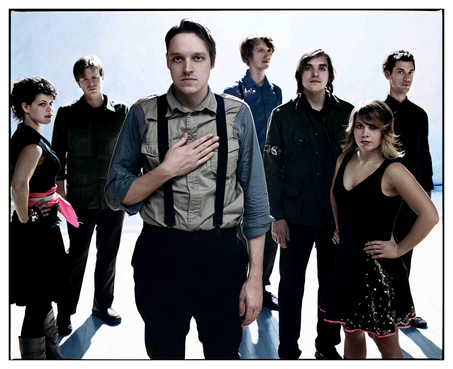
On Sunday, I posted a long piece praising Arcade Fire's new album, The Suburbs, while pontificating on whether they really seem destined--at least in the short term--for rock 'n' roll megastardom in the realm of U2, Radiohead, Coldplay and other groups to whom they've been compared.

I pointed out that hitting #1 on the Billboard charts in the first week out for their third album was an impressive feat for an indie band, but that the 156,000 copies sold was not all that earth-shattering for a record that was accompanied by lots of hype, press, rave reviews, a YouTube streaming event, a Lollapalooza headlining gig and deep discounts ($3.99 for an Amazon download, now upped to $7.99). And the first-week sales figures were well shy of those for comparable albums in the career progression of proven rock superstars like Radiohead and Coldplay.

In case, like me, you were curious how the album would do in its second week, Billboard reports that it fell to #2 on the charts while experiencing a precipitous drop in volume, selling 52,000 copies, or 1/3 of its first week tally. And in doing so, it saw a real music superstar [please] stand up, as Eminem's Recovery album recovered the #1 spot by selling 133,000 albums.

I haven't heard Recovery and have never been a big Eminem fan, but at a time when album sales are in steep decline and seemingly 8-10 years beyond his peak buzz, his success is really quite impressive. Yes, he's been a big star for quite awhile, but in just 8 weeks Recovery has sold 2.1 million copies, opening with 741,000 in the first week, never selling less than 100,000 in any week and topping the charts for 6 of the weeks.

I am also a bit surprised that in announcing a new string of U.S. dates (though unfortunately not one back through Chicago, as I'm still waiting to seem them live), Arcade Fire avoided basketball arenas in markets like St. Paul and especially Los Angeles. After selling out two dates at Madison Square Garden, I would have to imagine they could fill the Staples Center, or at least the L.A. Forum, but either they really aren't all that huge yet or they're trying to play down their popularity and stay more true to their roots. Or perhaps most likely, a little bit of both.

Either way, The Suburbs will really have to extend its sales sprawl around Christmas, and well beyond, to ever hope to reach the neighborhood of total sales achieved by the best-selling albums of previous alt-rock superstars.

Tuesday, August 17, 2010

Bobby Thomson Dies, 59 Years After Achieving Immortality


Until he passed away yesterday at the age of 86, Bobby Thomson was alive for more than 2.7 billion seconds. The reason I know his name, which will likely never be forgotten among baseball lovers, is because of something he did in approximately 3 of them.

On October 3, 1951, the Brooklyn Dodgers were playing their crosstown rivals, the New York Giants, in the third game of a 3-game playoff. There were no divisions in each league back then; the team with the best record at the end of 154 games won the pennant and went to the World Series. Unless there was a tie. Which despite being 13-1/2 games behind in mid-August, the Giants earned and forced a best-of-3 playoff to decide the National League Pennant. The two teams split the first two games, and the Dodgers had a 4-1 lead heading into the bottom of the 9th at the Polo Grounds, home of the Giants.

The Giants scored a run and then had runners at second and third with one out, trailing 4-2. Ralph Branca came into pitch for the Dodgers and Bobby Thomson came to the plate. With an 0-1 count, Thomson hit a high fastball into the left field stands. Although only one of three broadcasters calling the play, Russ Hodges most famously shouted (as heard on the video above):

“There’s a long drive ... it’s gonna be ... I believe — the Giants win the pennant! The Giants win the pennant! The Giants win the pennant! The Giants win the pennant!

“Bobby Thomson hits into the lower deck of the left-field stands! The Giants win the pennant, and they’re going crazy, they’re going crazy! ...

“I don’t believe it, I don’t believe it, I do not believe it!”

As Richard Goldstein of the New York Times wrote in Thomson's obituary: 

Partly because of the fierce rivalry between the Giants and the Dodgers; partly because it was broadcast from coast to coast on television; and partly because it was memorably described in a play-by-play call by the Giants radio announcer Russ Hodges, Thomson’s three-run homer endures as perhaps the most dramatic moment in baseball history. It was a stirring conclusion to the Giants’ late-summer comeback, known as the Miracle of Coogan’s Bluff, and remains an enduring symbol of victory snatched from defeat (and vice versa).

Beyond the legendary moment in baseball history, what I have found fascinating about Thomson is that he and Branca became close friends, if not during their careers than for many years long after, when they would often do joint speaking appearances and autograph signings. This despite the fact that Branca always suspected Thomson of benefiting from stolen signs and knowing a fastball was coming, a suspicion seemingly validated in recent years.

As Goldstein reports, at one joint appearance on the 40th anniversary of his dramatic home run, Thomson remarked that “Ralph didn’t run away and hide.” To which, Branca responded, “I lost a game, but I made a friend.”

Some years back, I saw Thomson and Branca at an autograph show or two, where I got the above photo and ball at right signed by both of them. I remember how at ease they seemed about their joint history, despite the glory for one and ignominy for the other. And Thomson especially seemed like a really nice and gracious guy.

Similarly, as the New York Times' Dave Anderson writes, Thompson--who had a stellar career in which he amassed 264 home runs and 1,026 RBI over 15 seasons--never gloated about his most famous moment because he didn't ever want to embarrass Branca. When the San Francisco Giants planned to commemorate the 50th anniversary of "The Shot Heard 'Round the World," Thompson declined to attend the festivities.

“They were going to have Ralph and me ride around in a cart,” he said at the time. “Ralph doesn’t need that.”

So while he'll forever be best known for three storied seconds, it seems Bobby Thomson deserves to be similarly remembered for always clearing the fences when it came to consideration and class.

Monday, August 16, 2010

Ravinia's 'Annie' Gets Gun, Hits Mark and Doesn't Skip Out Before Sunset

Theater Review

Annie Get Your Gun
Starring Patti LuPone, Patrick Cassidy & George Hearn
Ravinia Festival, Highland Park, IL
@@@@

I'd been intending to see Ravinia's semi-staged production of Annie Get Your Gun ever since it was announced, probably sometime in late 2009. I am an avid fan of musical theater and the show's announced star, Patti LuPone, is about as good a practitioner of the art form as any performer active today.

But then, a few semi-funny things happened on the way to mid-August. First, back in March, I saw LuPone in a concert-type performance with Mandy Patinkin. Although her singing was sublime as always, I didn't find the show to be as good as it should have been. Then, at some point in the summer, it was announced that Brian Stokes Mitchell, a Tony-winning Broadway star slated to appear with LuPone in Annie Get Your Gun, would not be doing so; Patrick Cassidy, the lesser-known son of Shirley Jones and/or Jack Cassidy (Shaun is his brother; David his half-brother) was announced as his replacement. Finally, just two weeks ago, I went to see LuPone and other Broadway luminaries perform at Ravinia in a celebration of Stephen Sondheim's 80th birthday. Although what they sang sounded fantastic, the night turned into a fiasco due to the performance lasting only 65 minutes on a night that doubled as a gala dinner for Ravinia benefactors and volunteers. (When an outdoor evening performance ends before it's dark out, you know you're being shortchanged.) 

Although seemingly no fault of LuPone's, the brevity of the concert made me question whether I'd be giving Ravinia any more of my time and money, at least this season for a theatrical-type performance. Although I found Ravinia's public response to less than stellar, they did offer 2-for-1 pavilion tickets to Annie Get Your Gun to all patrons of the Sondheim event. As they eventually extended the offer to everyone (at least those on Ravinia's email list), allowed half-price purchases for odd-number tickets and included lawn seats, I and other family members decided to go on Saturday night.

I sat in the pavilion for just $25 and appreciated the clear sightlines and good acoustics for a discounted price. Although the staging, backed by the Chicago Symphony Orchestra, didn't really include much in the way of scenery, the musical was being acted out to a certain extent, so actually seeing it was my preference. 

While LuPone is technically a bit too old to be playing Annie Oakley, it didn't matter and she sounded great while seemingly having lots of fun. I thought Cassidy sounded quite good, too, as Annie's love interest, Frank Butler. Venerable stage stars, George Hearn and Joseph Anthony Foronda, supplemented a fine supporting cast, and at a full 2-1/2 hours, everything about the evening was perfect.

Except the show itself. Although Annie Get Your Gun, composed by the legendary Irving Berlin, was a big success in its original 1946 run, a movie version and multiple revivals, like a number of other pre-1950 "classic musicals," I find it to be relatively flawed.

Yes, it contains wonderful songs like There's No Business Like Show Business, Doin' What Comes Natur'lly and Anything You Can Do, but there are several lesser ones, the book has narrative problems and Old West thinking about Indians and feminism wasn't all that updated by 1946.

I much preferred seeing LuPone in Ravinia's past staging of Sondheim works, like Gypsy and Sunday in the Park With George, but it was still a pleasure hearing her belt out the best of Berlin's classic showtunes. In sum, the evening featured an excellent rendition of a famous & fun musical, though in truth, one that's a bit shy of phenomenal. 

But if nothing else, as it was dark when I left after offering LuPone, et al, hearty applause, at least I got my money's worth.

Sunday, August 15, 2010

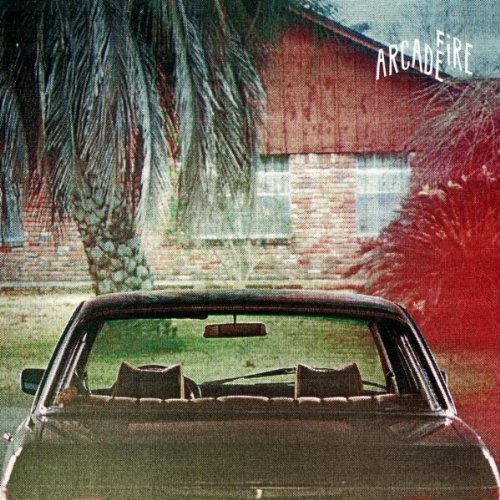
Arcade Fire Burns (Relatively) Bright

Album Review and Artist Analysis

Arcade Fire
The Suburbs
@@@@1/2

In many respects, Arcade Fire seem to be poised on the precipice of--or may have already made the jump into--rock 'n' roll mega-stardom.

A level of popularity achieved by relatively few rock  acts, especially at a time when musical tastes are more fragmented than ever and mainstream success is often transient at best, it is defined by multi-platinum album sales and sold out arena shows, high-profile slots headlining major festivals and ultimately, for the biggest of the big, concert tours that fill football stadiums. More intangibly, it is about becoming seemingly ubiquitous in the modern zeitgeist, as likely to be playing on the iPhones of thirtysomethings on their way to work as displayed on t-shirts in high school hallways. And while mass success and critical favor are often mutually exclusive, or at least not achieved in unison, many of the acts who have reached the strata that Arcade Fire may now be entering--U2, Radiohead, Coldplay--have similarly enjoyed both respect and riches.

The Montreal-based band's excellent third album, The Suburbs, was preceded by a considerable amount of hype and dozens of rave reviews. The album currently has a composite Metacritic score of 86 that I feel is about right; I've been wavering between @@@@ and the @@@@1/2 that I awarded. It is an extremely accomplished album, and one that I've enjoyed listening to several times over the past two weeks, but perhaps akin to my infrequent revisiting of their first two albums, it may not be a work compelling enough to long remain in my regular rotation. It's quite good, but I don't think it's near the level of The Joshua Tree, Nevermind or Born to Run, although it can't fairly judged in those terms this soon.

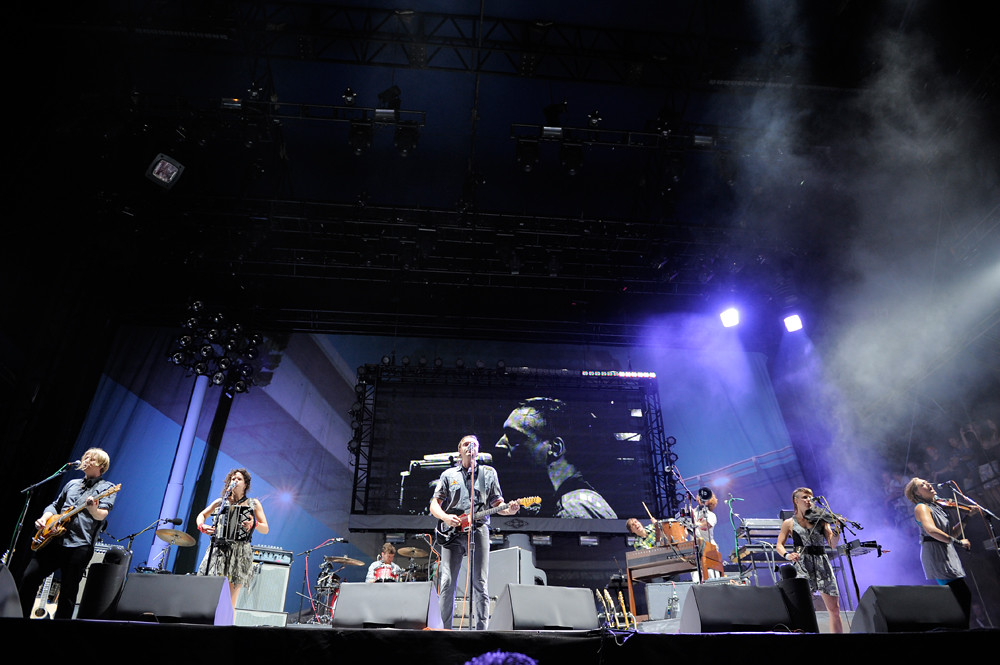
I'll get back to some subjective commentary in a bit, but as evidence of Arcade Fire's escalation in popularity, within the same week that the new album was released, the band played two sold-out shows at New York City's famed Madison Square Garden--the second of which was streamed live on YouTube-- and according to friends, attracted a crowd on the closing Sunday night of Lollapalooza that was as big if not bigger than a reunited Soundgarden.

In its first week of release, The Suburbs went straight to number one on the Billboard charts, selling 156,000 copies in the United States. It was also #1 in Canada--not surprising for a Montreal-based band, although lead singer Win Butler and his guitarist brother Will's upbringing in the suburbs of Houston prompted the album's theme--and the United Kingdom, where the band just announced a December arena tour.

But while going to #1 is impressive for anyone, particularly a band that still officially qualifies as "indie"--it's signed to Merge Records--and it doesn't appear anyone will have to "pass the hat" for Arcade Fire anytime soon, a closer look at the sales figures shows that the band may not be quite so mega just yet, and that perhaps as a corollary, "mainstream popularity" may largely be a pinnacle of the past for modern artists of a rock ilk (still my personal preference).

Keeping in mind that album sales are not the only barometer of popularity, and that until now Arcade Fire has been bigger in terms of press and buzz than in units shipped or downloaded--their first two albums have sold only 1 million copies combined--the reality is that 156,000 in first week sales is 7,000 copies short of the preceding week's #1 debut by Avenged Sevenfold, an album that didn't received the type of adoring press that preceded The Suburbs. It it also only about 20% of 2010's top first week sales leader, Eminem's Recovery, which sold 741,000 (it has eclipsed 2 million in 8 weeks and per some reports, is likely to overtake Arcade Fire this week by a 3-to-1 margin).

Against the "break really, really big" album of other bands seemingly at similar points in their careers, The Suburbs also comes up somewhat surprisingly short in initial week sales. Coldplay's X&Y, likewise their third album, sold 737,000 week one copies in the U.S. The Killers' second album, Sam's Town, sold 315,000 and though their next one, Day & Age only debuted at #6, it sold 193,000 copies in week one. Radiohead's Kid A, which followed OK Computer but was relatively experimental, sold 210,000 units in the U.S. in its first week, and back in 1995, The Smashing Pumpkins double CD set, Mellon Collie and the Infinite Sadness, opened with 246,000 albums sold.

Certainly, times are different than they were even a few years ago. In a recent Time magazine article, Pitchfork.com editor Scott Plagenhoef is quoted as saying, "There isn't really such a thing as mainstream rock anymore." The same article reveals that in 2009, only 11 artists released new albums that received a platinum certification (representing 1 million albums sold) from the Recording Industry Association of America; as recently as 2006, there were 56. It also states that whereas 50,000 albums were released in the U.S. in 2005, that number had risen to nearly 100,000 in 2009.

But though it would seemingly be easy to say that the segmentation of today's music purchasers--coupled with the increased prominence of people buying only single songs from iTunes and a good number undoubtedly still downloading music for free--readily explains the relatively low sales burst for The Suburbs, the album also benefited a great deal from modern technology, including an Amazon promotion offering digital downloads for $3.99. Nielsen SoundScan reveals that 62 percent, or 97,000 copies, of Suburbs sales came from digital purchases.

Also, though few purveyors of the lyrical, guitar-driven rock that I most relish have established, built and maintained mainstream American relevance in the '00s--to varying degrees of success and personal preference, I think only Coldplay, The Killers, The White Stripes, Kings of Leon and Muse really qualify; album & concert sales show Nickelback to be rather huge, but I've never heard a single person, whether friend or critic, who claims to like them--acts like Lady Gaga, Taylor Swift and the Black Eyed Peas have clearly broken through to mega-stardom. And beyond Eminem's huge sales, artists as disparate as rapper Drake and country band Lady Antebellum have sold over 450,000 albums in their first week out over the past few months. Album sales may be way down, but some acts still sell them in bunches. 

I'm not saying any of this should be held against Arcade Fire. Although I don't yet consider them a historically great band--I didn't include them in a recent ranking of My 100 All-Time Favorite Artists of Popular Music--and probably don't like any of their three albums quite as much as many others do, I consider them not only one of the best of today's bands, but probably the one on the biggest upswing. Unlike years back, not many artists build from one album to the next the way Arcade Fire has; most get some pub for a critical lauded album in a given year, but don't manage to maintain popular interest (or particularly my own) one or two more records down the road.

In terms of looking forward to seeing them live--I never have, other than the recent YouTube stream--, anticipating future albums and following their ascent to super-stardom, no matter how high or low its apex, The Arcade Fire excite me more than The National, MGMT, Phoenix, LCD Soundsystem, The Hold Steady, Death Cab for Cutie or other relatively recent quasi-rock acts that have garnered some acclaim and popularity (and these are among those that I somewhat like). I don't think they're as good as The Killers, in terms of the best bands of current vintage, and I even prefer some smaller acts that I've heard out of England (this year, the Len Price 3; Maximo Park over the last five).

So I suggest you give The Suburbs a listen; if you don't want to buy it you can hear it in full on MySpace Music. It probably won't be the best album you've ever heard; at an hour in length it can drag in spots, and even after listening while reading through the lyrics, any great profundity about growing up in the suburbs is largely lost on me (although "We Used To Wait" makes an observational statement that I endorse). But especially if you give it some time, you may agree that it's one of few new things in a rock 'n' roll vein worth tapping into.

And that's saying something, for if one looks at the chart at left, of the top concert tours of the first half of 2010, not only is it largely devoid of any new rock acts (except Muse), one really has to wonder who will be filling arenas 10 years from now. Maybe it will be Arcade Fire, but even that seems like an uncertain bet.

(The video below is Ready To Start, my pick as the best song on The Suburbs, taken from the recent concert streamed from New York, where it opened the show.)

Thursday, August 12, 2010

'A Parallelogram' Presents Interesting Angles, But Is Too Obtuse to Be Acutely Rewarding

Theater Review

A Parallelogram
a play by Bruce Norris
Starring Tom Irwin, Kate Arrington & Marylouise Burke
Steppenwolf Theatre, Chicago
@@@

Aside from plays that I see as part of subscriptions to Goodman Theatre and Broadway in Chicago, there are about five factors that influence my desire to attend a dramatic performance. In no particular order, these include critical praise from the media (mostly the Tribune's Chris Jones, but also the Sun-Times, Reader and other local press), rave reviews from friends & family, particular actors that I want to see, the desire to become more familiar with a given playwright and finally, the ability to obtain cheap tickets.

'A Parallelogram,' now playing in the downstairs theater at Steppenwolf, had a solid four and nearly five of these motivators in its favor. Jones lauded the world premiere show and an astute theatergoing friend recommended it. It stars Kate Arrington, probably the most attractive actress working in Chicago today, and Tom Irwin, a longtime Steppenwolf ensemble member who I enjoyed long ago as the father on TV's "My So-Called Life." Although I haven't seen much by writer Bruce Norris, who I've only heard of because he's regularly commissioned by Steppenwolf and is the brother of former MTV News reporter John Norris, I liked his 2005 play, The Pain and the Itch. And as I usually do, I was able to obtain a $20 day-of ticket by calling the box office at 11am.

Unfortunately, my enthusiasm for 'A Parallelogram' was greater going in than it was upon leaving. Although the play, which depending on one's interpretation revolves around time travel, psychic abilities or projections of one's future due to traumatic illness, is inventive, includes engaging, at-times humorous dialogue, and moves along at a good clip, in the end I was unsure what it meant, literally or figuratively. And despite a post-show talk that indicated that the play is intentionally ambiguous, it didn't leave me with a good confusion--as in "let me ponder all the intriguing questions"--as much as a sense of unresolved ambivalence.

Despite dressing down for the role, Arrington was lovely as main character, Bee, and interacted engagingly with the likable Irwin and even more so, Marylouise Burke, who played Bee at an advanced age. The stage set changed in unique ways that complemented the time-shifting storyline. But ultimately I never really cared about the characters, and whatever Norris may be trying to say about living for today, not worrying about the future, etc., didn't really strike me as all that meaningful given the narrative at hand.

Perhaps 'A Parallelogram' was profound in ways that I just didn't appreciate, but it felt like merely a run-of-the-mill play, not a special one. And while a second viewing and further consideration might help it better take shape, I don't anticipate re-discovering it anytime in the near future.

Still Not All That Keane

Concert Review

Keane
with Ingrid Michaelson
and Fran Healy
Riverside Theatre, Milwaukee
August 10, 2010
@@@1/2

Although I've enjoyed the British band Keane, to a certain extent, since seeing them on Live 8 in 2005, I took a pass on attending their concert when they played in Chicago a few weeks ago.

Even after my friend Paolo and sister Allison raved about the Chicago show, I didn't feel any great remorse about missing it. I had seen Keane in 2007 and felt the crowd was a bit too adoring, as to me the trio had a few really good songs and filled their set with a bunch of songs that struck me as just lesser duplications of the better ones. And though they have a new EP out, I hadn't gotten it and didn't love the one song I heard.

But I received a number of emails promoting their Tuesday night show in Milwaukee's comfortable Riverside Theatre, so after going to Milwaukee to see an Evel Knievel exhibit at the Harley-Davidson museum, I was able to get a great seat for Keane an hour before showtime.

In a nutshell, they weren't bad and I wasn't sad I went, especially supported by a couple solid opening acts, but very similar to my feeling when I saw them in 2007, I can't say that I found them phenomenal. Of 90 minutes on stage, only about 30 were really first-rate, with the rest mostly filler from a band that doesn't seem to be pushing themselves as hard as they could.

First up on the triple bill was Fran Healy, singer & songwriter of the Scottish band Travis. He interacted quite affably with the crowd in delivering an enjoyable 45-minute solo acoustic set. Per his song intros, he played a few Travis cuts, but I was disappointed he omitted the one I know (Why Does It Always Rain on Me). In addition to citing recorded collaborations with Neko Case and Paul McCartney, he did give a somewhat apt overview of the last 15 years of British rock. "Oasis + Radiohead spawned Travis, Travis + Radiohead = Coldplay, Coldplay + Travis = Keane, etc." 

Next up was Ingrid Michaelson, a singer I didn't really know except one song Allison had played for me. But she winsomely led an equally coed six-piece band through a pleasant set, with engaging humor in her stage patter. Mid-set, she did a solo rendition of Creep that I thought could have been greatly enhanced had she gotten Healy to duet with her.

After about 20 minutes of Keane anticipation (sorry, couldn't resist), the headliners took the stage around 9:10. They opened strong, with three good songs including Bend And Break and Everybody's Changing from their 2004 debut, Hopes and Fears. But from there on out, the only songs I acutely remember two days later are their hit singles, "Is It Any Wonder?" and "Somewhere Only We Know" (setlist).

Lead singer Tom Chaplin has a really good voice and the band has written a handful of decent pop songs, but they just come off as far too clean. The addition of a touring bassist and Chaplin's occasional guitar-playing has punched up their live sound (previously consisting of keyboards & drums) but there's never any sense of daring, danger or much consequence in their music. I know Chaplin has been through rehab in the past, but he still comes across as someone without much soul (which is a shame given his voice). Wearing a polo shirt and shiny white sneakers on stage doesn't make one a bad guy, but Chaplin and the rest of Keane might do well to force themselves to write songs on the streets of New Orleans, Memphis or somewhere that might give them some edge.

Paolo, whose musical tastes I respect and even share to a large degree, called Keane's Chicago show "the best concert" he's seen this year, two weeks after giving Hole that honor and two before awarding the crown to Green Day. Maybe they lost their mojo between Chicago and Milwaukee, but I tend to doubt that's why Keane wouldn't come anywhere close to the top of my list, and I haven't seen half the shows that Paolo has. But I guess that's what makes music great; everybody hears it a different way. And one person's "eh, so-so" is bound to be another's "quite Keane." 

(Here's video I shot of Keane's best song, Somewhere Only We Know, at least until my memory ran out.)

Daring To Get To The Root of Evel

Museum Exhibit Review

True Evel: The Amazing Story of Evel Knievel
Harley-Davidson Museum
Milwaukee, WI
Thru September 6, 2010
@@@@

I'm about two months away from turning 42, which for the mathematically challenged means I was born in 1968 and spent most of my formative years in the 1970s. I was a bit too young to know Muhammad Ali and Led Zeppelin until close to the end of their heydays, but along with Walter Payton and the Fonz, one of the foremost cultural icons of my early childhood was Evel Knievel.

I consciously remember coverage of his ill-fated attempt to jump Utah's Snake River Canyon in 1974 in a personal rocket, his scrapped attempt (due to wiping out in practice and injuring both himself and a cameraman) to jump a shark tank at Chicago's International Amphitheatre in 1976, various appearances on ABC's "Wide World of Sports" and stories of his numerous broken bones, including having broken every bone in his body at one point or another. And when my Dad delighted the family and made me the envy of my friends in about fourth or fifth grade by buying a home pinball machine, the model was an Evel Knievel Bally machine that remains part of the family until this day.

So although I've never been a motorcycle rider nor much of a Harley-Davidson enthusiast (despite long perceiving it as one of the world's most powerful brands), when I noticed that there would be an Evel Knievel exhibit at the Harley-Davidson Museum, I took note and Tuesday afternoon, I drove up for a visit.

I started by exploring the HD museum proper, which was worthwhile in its own right and gave me a nice overview of the legendary motorcycle company's origins in Milwaukee, its growth, the cultural impact of its "hogs," periodic struggles and impressive success over its 107-year history. The earliest existing "Harley" is pictured above, while a pair of bikes replicating those used in "Easy Rider" are at right.

The Harley-Davidson museum is a complex unto itself, separate from the company headquarters, local factory or bike dealership, although I understand that factory tours are given as part of the museum entry on certain days (not Tuesday, when I was there). So after lunch at the Racer Cafe, rather than the more elaborate Motor restaurant nor options at the nearby, but seemingly not HD-owned Iron Horse Hotel, I headed to the Archives Building, where the True Evel exhibit is being held through September 6th.

Although the Evel Knievel exhibit wasn't huge,  it was well curated and presented with highlights including the Sky Cycle (a cycle in name only) used in the Snake River Canyon jump and a couple of his more traditional motorcycles.

While the exhibit celebrates Harley's relationship with Knievel, it was impressively honest in presenting how Evel could often be difficult to deal with--he would commonly send his HD Marketing contact "suggestions"--and how the relationship was frequently tenuous at best. Keep in mind that, as I learned in the main museum, during the time of Harley-Davidson's sponsorship of Evel, it was actually owned by AMF. This period is now looked upon as a low point in the storied history of Harley-Davidson, and although companies are always quite bottom line-conscious, HD was was especially so during the time that it was connected with Knievel.

Knievel, who passed away in 2007, was a mass of contradictions; at times he was admired & adored, but especially after an unsuccessful stunt, was often ridiculed and lampooned. His unique "career," complete with all sorts of Evel Knievel toys, made him quite wealthy, but lavish spending left him on the verge of bankruptcy. He was a master showman and in some ways a role model to kids like me for the courage he showed in getting back on the bike even after terrible mishaps, but the fact that he would attempt such crazy stunts caused a lot of kids to imitate him in ways that might not have been in their best interests.

There have certainly been other daredevils throughout history, including Knievel's son Robbie, but to my familiarity, there has never really been anyone quite him. And as the strong exhibit shows, along with an abundance of silliness, there was quite a lot of good in Evel.


(Here's one quick Evel Knievel jump clip. Many more can be found through YouTube and a page dedicated to his connection with Wide World of Sports.)

Wednesday, August 11, 2010

Friday Night Lights Completes Another Winning Season

TV Show Spotlight

Friday Night Lights
NBC/DirecTV

I've come to accept that it's probably a character defect that I have never been captivated by Mad Men or almost any of the other television shows that friends and critics seem to rave about (although I do enjoy Burn Notice).

On the other hand, I'm somewhat proud of myself for never succumbing to shows like Jersey Shore, the Real Housewives of anywhere or any reality TV fare for that matter, including American Idol or Survivor. So I guess while I don't appreciate the most supposedly brilliant of television shows, I also don't get into the most tawdry.

But the show that I have found phenomenal ever since it debuted in 2006, and which I consider the best show on TV, is Friday Night Lights.

While FNL has long garnered critical support--the Tribune's Maureen Ryan has been an especially avid supporter--the show has never been much of a success in terms of viewership. In its third and fourth seasons, and up-and-coming fifth and final one, the drama has been relegated not only to 13-episode seasons but has aired exclusively on DirecTV in the fall, with NBC presenting it beginning in January in 2009 and May this year. Not being a DirecTV subscriber, it has been frustrating to have to wait so long to see new episodes, but the show is so well done that a delayed-season is better than none at all.

Although I imagine some people stay away from Friday Night Lights due to its football theme, you need not be anymore of a football fanatic to enjoy the show's deeply compelling human stories than one likely needs to be an advertising expert in order to enjoy Mad Men.

Take for instance one of this season's most moving episodes in which Matt Saracen (played by Evanston's Zach Gilford) had to deal with the death of his father in Iraq and grieve for a man he barely knew. As you can see from the clip below, this doesn't have anything to do with football, just life.


In Season 4, which concluded on NBC last Friday, Saracen and Tim Riggins (played by Taylor Kitsch) were holdovers from the show's first three seasons after graduating from the fictional Dillon Panthers last season. But other than that, the show has done a nice job this season of not stringing along stories of high school students into their college years (as many a teen drama has struggled to do effectively). Instead, several new characters and storylines were introduced as former Dillon coach Eric Taylor (Kyle Chandler) had to deal with starting up the football program at East Dillon High, a school that had fallen on very rough times.

In dealing with these issues like gang violence and teenage pregnancy, Friday Night Lights never feels false or comes off as preachy; rather it depicts people dealing with difficulties in a very real manner (even if they sometimes get resolved a bit too cleanly). And even the football scenarios are so well done that I truly couldn't guess which way the season finale would end, and was quite moved by the way it did.

It might seem strange for me to be hyping a show after it has left the air for awhile, but with video available On-Demand and at NBC.com, full seasons streaming on Netflix, syndication showings starting soon on ABC Family and the 4th Season DVD being released next Tuesday, there are plenty of ways for you to get into Friday Night Lights if you haven't already. And truth be told, I was planning on writing a post around the NBC premiere back in May, but as I imagine is the case with many fine shows that I haven't "gotten into," a single episode wasn't likely to win your devotion.

With only 63 episodes of Friday Night Lights yet aired, the show won't take you long to catch up on. So kickoff with the still much-praised pilot episode and discover why this has been the best show on TV. Even if you hate football.

Monday, August 09, 2010

What Happens When An Everyman Marries the World's Most Famous Woman?

Theater Review

After the Fall
A play by Arthur Miller
Eclipse Theatre Company
Greenhouse Theater, Chicago
Thru August 22, 2010
@@@@

Of all the major playwrights with whom I'm somewhat familiar--including O'Neill, Williams, Beckett, Odets, Simon, Foote and Mamet--Arthur Miller is clearly my favorite. Perhaps it's because his works are so simultaneously accessible and allegorical, but plays like Death of a Salesman, All My Sons, The Crucible, Incident at Vichy and The Price are pretty much the benchmarks by which I gauge all dramas.

Myriad critical assessments of Miller certainly provide depth beyond anything I can add, but if you're familiar with the paintings of Edward Hopper, which depict people in states of melancholy and disquiet, I like to think of Miller as the writer who can best provide the backstory to Hopper's troubled souls. And what has made characters like Willy Loman  (in 'Salesman'), Joe Keller (All My Sons), Victor Franz (The Price) so compelling is the way that Miller imbues them with universality. I'm sure it's been said numerous times, but Miller was a master at writing about the "everyman."

Though I never had seen nor read his 1964 play, After the Fall, before catching a fine staging of it by the Eclipse Theatre Co. on Saturday, I knew in passing that it was an autobiographical work about Miller's ultimately failed marriage to Marilyn Monroe. Yet during the first act, when it's obvious that the central character, Quentin, represents Miller and that many of the dramatics taking place inside his head--the play is mostly an exposition of Quentin's thoughts--are loosely based on events in Miller's life even before the Marilynesque Maggie character becomes prominent, Quentin's crises are universal enough that I could readily see him as an everyman. It's not hard to imagine that the folks populating Nighthawks have had similar troubles with their friends, co-workers, parents and spouses.

The funny thing is that even though the 90-minute first act has enough of Miller's shrewd dialogue and engaging themes to move quickly, the play becomes more riveting (though not necessarily better) in Act 2, when the drug-addled Maggie (i.e. Marilyn) provides Quentin/Arthur with more than he can handle before winding up dead from suicide as Monroe famously did (conspiracy theories aside) in 1962. I'm sure audiences in 1964 were even more consumed by the autobiographical aspects than any grand statements Miller may have been trying to make, and while I was sufficiently entertained, I too lost track of any overarching message.

In essence, After the Fall becomes much more dramatic when it starts being less about everyman and more narrowly about Miller (and Marilyn), but because of this it is less ultimately rewarding than his more universally-themed dramas. But second-tier Miller, even 3 hours of it, is still better than many other plays and Eclipse is to be applauded for taking on this challenging work. About the best a theater company can hope to achieve is to leave viewers convinced that they wouldn't have appreciated the source material any more if presented anywhere else (on a similar first-viewing), and Eclipse's version of After the Fall accomplishes this, with excellent performances throughout. Nathaniel Swift as Quentin (who is onstage and central throughout the entire 3 hours) and Nora Fiffer, who encapsulates Monroe's seductively naive fragility as Maggie, are especially stellar.

Back in 2004, I saw Miller's final play, Finishing the Picture, in its world premiere production at Goodman Theater. Like After the Fall, this was also interpreted as a largely autobiographical play, and will even less so be remembered as one of his masterpieces. Seems Miller was a genius when writing of the collective human condition, but more of an everyman when writing about his own.

Friday, August 06, 2010

My 100 All-Time Favorite Artists of Popular Music - 2010 Edition

In honor of Lollapalooza weekend in Chicago--although I'm not attending this year's fest, due to being too old & fat to enjoy standing in a field all day, let alone three, and a scarcity of acts that interest me--I thought it would be a good time to update my list of 100 favorite popular music (mostly rock) artists, which I first compiled and published five years ago.

Although without too many wholesale changes, there are a number of acts that either newly made or fell off the top 100, and others that bounced around within it. Beyond asking myself at each berth, "Do I like "x" better than the artist below," there was no scientific methodology, but I did try to consider each artist's recorded output, their merits as a live act (where applicable), how often I tend to listen to them and the depth & duration of my affinity.

As such, the rankings are based on my personal fondness more than my critical regard for one's originality, impact, influence or other barometers of artistic merit. In other words, although I know Bob Dylan (#30) is "greater" than Rush (#19), I don't "like" him better. On stature alone, Elvis Presley, Chuck Berry, Stevie Wonder and Bob Marley clearly belong, and I enjoy all four and others of their ilk, but none have been mainstays in the "soundtrack of my life" to the extent of the 100 who made the cut.

Keep in mind that I've seen more than 200 different artists as concert headliners and have nearly 1,400 artists in my iTunes library, so I like far more than the 100 listed here. And as this is meant as an "all-time" list, although  I've been listening heavily of late to stellar new releases from The Len Price 3, The Arcade Fire and LCD Soundsystem, among others, I couldn't allow myself to be too myopic in my selections.

Finally, one thing that I had some trouble being consistent about was in how to consider solo acts who were previously in bands. I like the individual post-Beatles output of John, Paul & George enough to give them their own slots, as well as that of Paul Weller outside The Jam, but though I've enjoyed Ray Davies' solo recordings & concert appearances, I didn't cite him beyond The Kinks. I included Bob Mould/Husker Du/Sugar as a single entry, and likewise Eric Clapton/Cream/Derek & the Dominoes, but listed Ozzy Osbourne, not Black Sabbath (despite liking his output in both forms). Neither Steve Winwood nor Traffic (or Blind Faith) made the cut, but perhaps should have if considered in sum, yet I combined Velvet Underground & Lou Reed. And my penchant for Neil Young includes his work in CSNY, Buffalo Springfield and more so with Crazy Horse than without, but he's only included individually.

Oh, well, life is full of inconsistencies and so is my list. But here it is, as of August 6, 2010:

1. Bruce Springsteen
2. The Beatles
3. R.E.M.
4. Nirvana
5. Led Zeppelin
6. The Rolling Stones
7. U2
8. The Kinks
9. The Who
10. The Jam
11. Pearl Jam
12. The Clash
13. The Smashing Pumpkins
14. AC/DC
15. The Ramones
16. David Bowie
17. Radiohead
18. Cheap Trick
19. Rush
20. Tom Petty & the Heartbreakers
21. Midnight Oil
22. Stereophonics
23. Foo Fighters
24. Dinosaur Jr.
25. Green Day
26. Jimi Hendrix
27. The Replacements
28. Van Halen
29. Bob Seger
30. Bob Dylan
31. Pink Floyd
32. Elvis Costello
33. Queen
34. Talking Heads
35. The Police
36. Aerosmith
37. Neil Young
38. John Lennon
39. Creedence Clearwater Revival
40. Johnny Cash
41. Guns 'n' Roses
42. Alejandro Escovedo
43. Husker Du/Bob Mould/Sugar
44. The Wildhearts
45. The Killers
46. Paul McCartney
47. Steely Dan
48. Simon & Garfunkel
49. Elton John
50. Eric Clapton/Cream/Derek & the Dominoes
51. The Cure
52. Billy Joel
53. The Zombies
54. Metallica
55. The Flaming Lips
56. Peter Gabriel
57. Warren Zevon
58. Blur
59. Sex Pistols
60. Garbage
61. Soundgarden
62. Paul Weller
63. Van Morrison
64. The Waterboys
65. The Doors
66. Maximo Park
67. The Pretenders
68. Velvet Underground/Lou Reed
69. The Cars
70. BoDeans
71. Wilco
72. Nine Inch Nails
73. Depeche Mode
74. Liz Phair
75. John Mellencamp
76. Stevie Ray Vaughan
77. Prince
78. Dire Straits
79. Fleetwood Mac
80. The Byrds
81. The Beach Boys
82. George Harrison
83. The Move
84. Ash
85. The Pixies
86. Buddy Guy
87. The Smoking Popes
88. Def Leppard
89. Ozzy Osbourne
90. Blondie
91. The White Stripes
92. Buddy Holly
93. Coldplay
94. The Smiths
95. Beck
96. Eagles
97. Jackson Browne
98. Social Distortion
99. Boston
100. Material Issue

Top 3 Almosts: Supertramp, Love & Graham Parker

Dropouts from the 2005 list: Elvis Presley, Jason & the Scorchers, ZZ Top, Red Hot Chili Peppers, Santana, Bad Religion, The Wallflowers, The Darkness, Counting Crows, Jane's Addiction, Love and Graham Parker

Monday, August 02, 2010

A Little Too Little Sondheim Music

Theatrical Concert Review

Sondheim: 80
Celebrating the 80th Birthday of Stephen Sondheim
Starring Patti LuPone, George Hearn, Audra McDonald and Michael Cerveris
Ravinia Festival
Saturday, July 31, 2010
@@@1/2
(@@@@@ for the quality of what was performed; @@ for the extreme brevity)

After seeing and enjoying Shrek: The Musical on Thursday and Bon Jovi with Kid Rock on Friday, on Saturday night I went to a performance that promised a selection of songs a bit more sophisticated. Unfortunately, while the quality of what I heard was sublime, my enjoyment was quite constrained by an astonishing lack of quantity. Let's just say that as an opening act, Kid Rock played just as long as four Broadway legends and the Chicago Symphony Orchestra did at Ravinia in paying tribute to the 80th birthday of Stephen Sondheim.

Throughout the last decade, I have come to greatly appreciate the genius of Sondheim, who I consider the best living Broadway composer and lyricist, and probably the best ever. I have seen all of his major musicals at least once, attended three of Ravinia's five concert stagings of his works and even paid just to hear him speak at the Harris Theatre this past March.

So I had Saturday night's performance marked on my calendar for quite awhile. The four stars--Patti LuPone, George Hearn, Audra McDonald and Michael Cerveris--are all outstanding singers and actors, who I have seen & heard performing Sondheim and other shows at Ravinia and elsewhere. Although Ravinia's lawn ticket prices have risen quite a bit over the last few years, my sister and I considered the $25 well worth it (we even inquired about pavilion tickets, but weren't going to pony up $125, especially as we could see a good deal of the show from our spot on the lawn and by standing alongside the pavilion).

On the Ravinia website, it mentioned that Saturday's show was a "Gala Benefit Evening of the Women's Board" and those so inclined could have clicked around to buy benefactor tickets starting at $750 for inclusion in the Gala Dinner, but nowhere did it mention that the concert would be abbreviated. At the show, there were signs in the pavilion saying that there would be no intermission, but I still assumed there would be at least 90 minutes of music.

But not counting a rendition of the National Anthem that opened the evening--something I'd never heard at Ravinia--a total of 17 selections were performed, clocking in at 65 minutes. Appropriately, the Chicago Tribune's theater critic, Chris Jones, took Ravinia to task for the embarrassingly short show, followed-up by coverage of Ravinia's response, which I found to be piss-poor from a PR standpoint. The two pieces on Jones' blog have almost 300 combined comments from readers, including me, most of whom likewise slam Ravinia for not anyone their money's worth (whether one paid $25, $125, $750 or a whole lot more). 

The great shame of this is that what was performed sounded magnificent. From Cerveris doing "Finishing the Hat," (a great song from Sunday in the Park with George) to LuPone shining on Send in the Clowns and Everything's Coming Up Roses, and with wonderful work from McDonald and Hearn as well, I doubt many in the audience were disappointed with the quality of what they heard.

But never mind a second act--in which the selections derived from Ravinia's past Sondheim shows could have been augmented by many of his other phenomenal tunes, such as pieces from West Side Story, A Funny Thing Happened on the Way to the Forum and Into the Woods--there wasn't even an encore.

When I saw the evening's program book titled "A Little Sondheim Music" I had no idea I should take it so literally. Ravinia should be embarrassed for leaving so much good will on the table, even if it's a $50,000 table at their gala dinner. Send in the clowns, indeed.

(In case anyone's wondering, Sondheim himself was not there, even though he has attended past performances and even done pre-show talks.)