There is little in life that excites and delights me more than learning of things I should "check out"--particularly within an artistic realm--and which I wind up loving, or at least being happy to know about.
So although 2015 has been somewhat slow so far in a variety of ways, including not yet attending any live events of any kind or seeing any movies in a theater, it has been really rewarding thanks to friends--old and new, verbally and virtually--introducing me to works, artists, etc. that I've really enjoyed.
However archaic or digitally-reinvented it may seem, the concept of "word of mouth" is alive and well among those I know, and I'm much the better for it.
So in hopes of paying it forward and perhaps enlightening others, here are some cool things I've been turned onto over the past few days, as well as a few that I found on my own.
 Good Ol' Freda
 (
Netflix link) - I had never heard of this 2013 documentary nor its subject--Freda Kelly, secretary to the Beatles throughout their career--until a friend and former co-worker mentioned it tangentially in a text. Even then I didn't know what the title was referring to until I looked it up.
Fortunately the film is currently streaming on Netflix, and is well worth the time of any serious Beatles fan--and anyone who admires people who do their jobs, at any level, with great diligence and little fanfare or self-promotion.
Sign Painters (
Amazon link) - This is another excellent documentary suggested by a former co-worker, albeit one that I didn't actually know when we worked together. In complimenting my entertainment and culture-infused Facebook

posts, a fellow former colleague likewise cited this other guy's for being highly enlightening. I'm glad he accepted my Friend request for this has proven to be the case, with
Sign Painters being one prime example of what he has turned me onto in just a few weeks.
As the appropriately concise title conveys, the 2014 film explores--and celebrates--the declining art of hand-painted signs and its remaining practitioners. The erosion of artistry due to technology is a theme I have long echoed, but filmmakers Faythe Levine and Sam Macon have done a great job of finding a wonderfully motley crew of sign painters across the USA who come off prouder of their increasingly rarefied expertise then angry or bitter about the changing times. The well-made and designed film dovetails well with my recent fascination with
"Ghost Signs" that adorn many brick buildings in Chicago.
It isn't yet on Netflix, but
Sign Painters can be rented or purchased for online streaming through Amazon.
The same former co-worker also had posted the video below--featured on Adweek.com--and I similarly found it fascinating, even without being anymore a logo designer than I am a sign painter.
Logo Design Tutorial Clip -
Lynda.com, a online library of video tutorials and courses, had a logo design contest, and Aaron Draplin, a freelance designer in Portland, OR put together this video showing how he went about designing a logo for a concrete company. It's really pretty fascinating--and well worth 16 minutes of your time--even for non-designers.
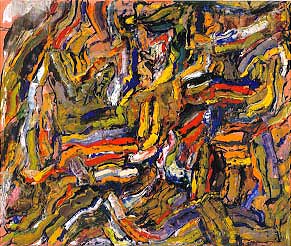
 John Altoon, 1950s-60s painter
 - Although I only lived in Los Angeles from 1990-92, I have maintained several friendships including with a good handful of the many
talented artists I came to know. One is Mark Vallen, who maintains an
outstanding blog called
Art-for-a-Change, featuring his art and others' worthy of awareness. Another is Ray Cuevas, a rather accomplished painter whose
work you can see here.
Both Mark and Ray shared their outstanding artistic insights in recent days, with Mark providing excellent suggestions on artists for me to appreciate on an upcoming trip, which I may showcase afterwards. Despite long living well north of Los Angeles-proper and rarely venturing to the city, Ray shared that he was glad he had done so last year to see an exhibition at the Los Angeles County Museum of Art (LACMA) on John Altoon, a Southern California painter from the 1950s until his death in 1969 at age 43.
Now over, this was the first major retrospective on Altoon, who seems to roughly fit in with the Abstract Expressionists, but not precisely. Unfortunately,
the exhibition website does not seem to include a gallery, but I've liked some of what I've found via a Google Image search, including:
1,
2,
3,
4,
5.
James Ensor (+ Lucy McKenzie, Bridget Riley and Toshusai Sharaku), Art Institute of Chicago - I never need much reason to visit the Art Institute, but hadn't been there since September. The other day, my friend Paolo obliquely referenced hearing good things about an exhibition on a contemporary artist somewhat reminiscent of M.C. Escher.
He couldn't cite the artist's name, but from the
Art Institute website, I guessed he was referring to Lucy McKenzie,
about whom it says "her primary mode is trompe l’oeil (literally, “deceive the eye”)."
The exhibit in the Modern Wing closes on Sunday, and with an open Tuesday I decided to go check it out.
The exhibition on the Scottish-born, Belgium-based artist McKenzie is worth perusing, but not extensive or distinctive enough to justify a special visit and/or full-price Art Institute admission in itself.
And while the now just 37-years-old McKenzie employs some visual whimsy--the nearby painting called
Manhattan depicts that and other New York boroughs through the arrangement of leaves--I wasn't really reminded of Escher's much more inventive optical illusions (
as seen on WikiArt.org).
So I still don't know if that is who Paolo meant. Stopping in the gift shop on my way out of the museum, I noted a book on another, older, female British artist named Bridget Riley.
On paper, her paintings still didn't seem quite Escheresque, but perhaps more so than McKenzie's, so I wandered back through the Art Institute and over to the Modern Wing, where there was a single-gallery, 4-work exhibit on Riley.
One sculptural painting that you walked through was rather innovative, and a piece called
Ascending and Descending Hero holds a certain appeal.
This exhibit will be up to March 8, and while worth a glance, also doesn't mandate a special trip.
But I am glad that--however ambiguously, still--Paolo's recommendation prompted me to visit the Art Institute, for I genuinely enjoyed their largest current exhibit, which runs through January 25.
Titled
Temptation: The Demons of James Ensor, the exhibition centers on a monumental drawing called
The Temptation of St. Anthony, which the Belgian artist (1860-1949) created across 51 separate sheets of paper.

This artwork was interesting, accompanied by an interactive guide to the various components of the
drawing, but I much preferred many of Ensor's paintings that the Art Institute curated to show his work before and after the monumental drawing of the 1880s.
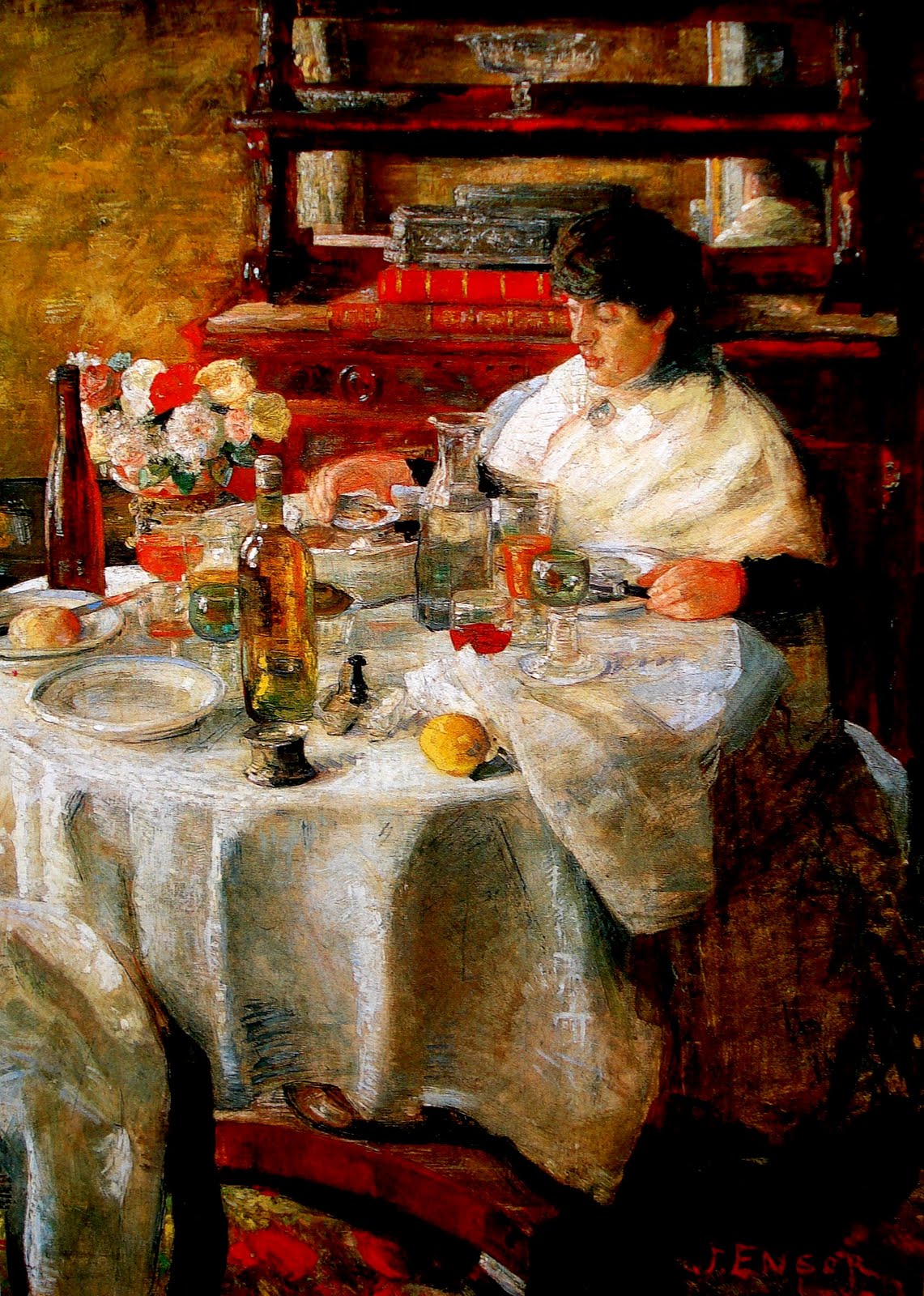
I enjoyed the somewhat odd piece (shown here) called
The Intrigue, and others such as
The Oyster Eater and
The Lady with Fan.
Overall, I would give the Ensor exhibit @@@@ (out of 5) and do suggest it may be worth getting to specifically before it closes. Especially as it can provide an excuse to explore the Art Institute's great permanent collection and other special exhibits.
Along with Impressionism masterworks, on this trip I especially enjoyed seeing the work of Toshusai Sharaku in the Japanese Prints gallery.
Bill Burr, comedian - I recently struck up a new Facebook Friendship with a woman who is the niece of a close friend of mine. In messaging back and forth, I pointed her to a recent blog post highlighting
some of my favorite writings of 2014 (as well as one piece by her uncle).

In reading the
remembrance of Robin Williams I penned upon his death, in which I rued the relative lack of new, younger comics I knew and liked, she commented about Bill Burr, a comedian I did not know.
Turns out he has
three stand-up specials on Netflix, all of which she recommended. I watched the newest one called
Bill Burr: I'm Sorry You Feel That Way, and found it rather enjoyable. Like all first-rate comedians, Burr offers a nice mix of jokes and insights, and largely held my attention and interest across 80 minutes. He tackles a variety of current events, offers a rather shrewd take on religion and relates a rather shocking--and yet terrifically funny--story about an old guy who threw himself out of a helicopter.
Even if you don't have Netflix, you can see the
entire special on YouTube.
Bob Dylan: The Other Side of the Mirror, Live at the Newport Folk Festival 1963-1965 - I have long appreciated the musical and cultural magnitude of "Dylan going electric," referring to his playing with a full band at the 1965 Newport Folk Festival to the outrage of folk traditionalists.
But I only came to know of this DVD (and Blu-ray) showing Bob Dylan's full performance at Newport in 1965--as well as 1963 and 1964--because a trailer for it accompanied the DVD of
I'm Not There, a 2007 film in which 6 different actors (including most famously, Cate Blanchett) embody Dylan at various points in his life.
I probably should have seen
I'm Not There long ago, but I never had until it was recently mentioned and extolled at a
Chicago Film Discussion Meetup Group lunch. I always get great movie recommendations from friends like Dave, Brad and Al, but truth be told I didn't really love
I'm Not There. It didn't teach me much new about Dylan, and my favorite parts were simply his songs (this was also true about the Scorsese documentary on Dylan,
No Direction Home).
But especially as there's little of Dylan's '65 Newport appearance on YouTube, I was tickled to learn there was a DVD of it, and I bought it instantly. (It came out in 2007.)
Rather than containing any explanatory narration,
The Other Side of the Mirror is simply a film by director Murray Lerner capturing Dylan's performances at the Newport Folk Festival over the course of 3 years. It's interesting to note that even within the same fest, Dylan played on multiple stages, including ones shared with Joan Baez, who he was dating around that time. There is also a clip of Johnny Cash playing a Dylan song after speaking about him.

The music is obviously outstanding, from each festival, and it's pretty fascinating to see how Dylan's persona, stature and confidence grew over just three years. And the electric performance is scintillating; with no fanfare, Bob took the stage with a recently cobbled together band including Mike Bloomfield and Al Kooper, and played wondrous versions of "Maggie's Farm" and "Like A Rolling Stone," each followed by loud "Boos!"
He was convinced to then play a couple acoustic songs, ending with a notably acerbic, "It's All Over Now, Baby Blue," after which he was heavily applauded.
Though only 83 minutes long,
The Other Side of the Mirror makes for an altogether illuminating yet unadorned glimpse into a storied moment in music history.
Glenn's Diner - Although it has been in the same spot on Montrose, just west of Ravenswood, for 10 years, I came know of this Chicago restaurant only last year, when I visited Margie's Candies (the
other location) just across the street.
Even then it looked pretty nondescript, but in walking past, I was intrigued by all the fresh fish preparations written on chalkboards lining both sides of the interior.
So when my friend Dave and I were looking for somewhere new to eat on Saturday, ideally near an L stop as he'd be coming from downtown, I suggest we try Glenn's.
We both found it excellent, with first-rate food in a comfortable, low-key atmosphere adorned not only by chalkboards, but a display of cereal boxes.
I got Pretzel-crusted Walleye Pike and Dave got Lake Superior Whitefish. Both came with roasted potatoes and garlicky broccoli, which actually made me want to eat my broccoli (and even take home Dave's). We also shared a creme brulee for dessert and concurred that we would gladly revisit Glenn's Diner.
Ironically, just the next day, Dave forwarded me an
article from the Chicago Reader revealing that the
original proprietor, Glenn Fahlstrom, had been booted from his titular diner two years ago after a legal battle with a partner, and now runs the similar Fahlstrom's Fish Market (which the Reader writer seems not so wild about).
That concludes my recap of new things discovered in just the last few days, but in the same spirit I offer a few more quick recommendations.
A Band Called Death, documentary (
Amazon)
/ Death - For the Whole World to See, album (
Amazon) - Although oddly similar to that of another long-forgotten Detroit musician--Rodriguez, as told in
Searching for Sugar Man--the story of a band that really was called Death is remarkable in its own right. In 1974, three African-American brothers were playing and recording punk music, before most anyone had heard the Ramones or other punk pioneers. The documentary is terrific and the album, compiled in 2009 from old recordings, is really phenomenal. Unfortunately the movie doesn't appear to be on Netflix anymore, but you can find it through Amazon.
 Ida
Ida (
Netflix link) - I recently named this 81-minute, black & white Polish film
the best new movie I saw in 2014, and I wasn't alone in my acclaim. Several critics bestowed similar praise, and two friends who heeded my suggestion separately conveyed that it felt like watching a series of Vermeer paintings, give the beautiful compositions employed by director Pawel Pawlikowski in telling a rather poignant and insightful tale.
Ida is currently streaming on Netflix and is my top recommendation for anyone looking for a "good movie to watch."
 Bruce Springsteen & the E Street Band - The Agora, Cleveland 1978
 (
purchase here) - The Boss is my favorite musical artist of all-time, and by far my favorite live performer, so that I'd love the acoustically-pristine new release of a classic show from before I started going to them is kind of obvious. But
Rolling Stone just called this "official bootleg" of a long-storied concert from the
Darkness on the Edge of Town tour Springsteen's greatest live album, and I think they're right. For just $10 for the MP3 download, it's a gimme for fellow fans, and a pretty good place for neophytes to start beyond the studio albums that are
on Spotify.