I'm presently stopped in Toledo, waiting for the Greyhound I took out of Cleveland--after seeing my beloved Cubs play in two World Series games against the Indians--to resume its approx. 8-hour trek to Chicago.
Thinking about the Chicago Film Discussion Group's next Lunch Meetup this Sunday--normally I'd include a hyperlink but can't on the Blogger app--on the topic of The Films of 1999, I decided to make a list of those I've seen (as best I can recall; I used the Wikipedia page on "1999 in Film" as my point of reference).
Anyway, this certainly won't make for the most scintillating blog post, and I can't add any graphics from the road, but some planning to attend Sunday's Meetup may enjoy perusing my list.
I realize "less heralded" is rather vague and imprecise, and that some films quite foreign--pun intended--to causal movie fans may be very familiar to world cinema buffs (and vice-versa).
Many of the films below are far from secrets, including Oscar winners and nominees.
My intent is to highlight some foreign films I've greatly enjoyed beyond what I perceive as fairly well-known masterpieces like La Dolce Vita, The Seven Samurai, Bicycle Thieves, Rules of the Game, Cinema Paradiso, City of God, A Separation, etc.
Of various vintages, I've purposely chosen just one movie per country of origin. These are all foreign language films and thus the list does not include quality movies from England, Ireland, Australia, etc.
This is not intended as a ranking, nor a comprehensive list of worthwhile films.
1. Blancanieves(Spain, 2012) 2. The Umbrellas of Cherbourg(France, 1964) 3. The Son(Belgium, 2002) 4. Ballad of a Soldier(Russia, 1959) 5. Wadjda(Saudi Arabia, 2012) 6. The Burmese Harp(Japan, 1956) 7. Ida(Poland, 2013) 8. Yesterday(South Africa, 2004) 9. Wild Tales(Argentina, 2014) 10. Mother(South Korea, 2009) 11. Sin Nombre(Mexico, 2009)
And a few more Phoenix(Germany, 2014) The Matchmaker(Israel, 2010) Central Station(Brazil, 1998) Smiles of a Summer Night(Sweden, 1955) Monsieur Lazhar(Canada, 2011) The Song of Sparrows(Iran, 2008) Peepli Live(India, 2010) Malèna (Italy, 2000)
As always, I would love to hear some of your picks.
In a couple weeks, I'll begin my blitz of Best of 2015 posts, including my favorite movies of the year. So before I do, I thought I'd share my favorite films of this decade up to 2015, as best as memory--and a database--serves.
I'm including as eligible 2014 films that didn't open in Chicago until 2015, which may also be represented on my Best Movies of 2015 list.
(F = Foreign; D = Documentary) 1. Ida (F) 2. A Separation (F) 3. Selma 4. The Social Network 5. Blancanieves (F) 6. Take Shelter 7. Poetry (F) 8. 12 Years a Slave 9. Hugo 10. Fruitvale Station 11. Zero Dark Thirty Plus a few more
Boyhood Short Term 12 The Artist Rabbit Hole The Secret in Their Eyes (F) The Past (F) Argo Mother (F) The Interrupters (D) Inside Job (D)
1. Martin Scorsese 2. Alfred Hitchcock 3. Orson Welles 4. Charlie Chaplin 5. Billy Wilder 6. Sidney Lumet 7. Quentin Tarantino 8. Akira Kurosawa 9. Frank Capra 10. Jim Sheridan 11. Steven Spielberg Plus a few more Francis Ford Coppola David Fincher Christopher Nolan Stanley Kubrick Federico Fellini
A few months back, my friend Ken texted me with a suggestion for a blog post about character actors, naming a few that I knew well--Jack Warden, Strother Martin--and others with which I wasn't so familiar (Slim Pickens, Ben Johnson, Martin Balsam).
My reply: "That's a great idea; why don't you write it?"
Such a piece would seemingly be in Ken's wheelhouse, as he has a pretty thorough knowledge of classic and more recent cinema, and has written a few guest posts on Seth Saith.
But he demurred and got caught up--rather consistently, it seems--with other, ahem, more pressing matters.
So I started thinking I would try to write this tribute of sorts to character actors. Yet while I consider myself something of a film buff, I lack the historical breadth and/or depth of Ken and several other friends, including Dave, Bob and Brad.
So on Facebook I asked my Friends to "Name a great character actor or actress of any era."
I said that I would start with John Turturro.
While many of my Facebook queries bring perhaps a single comment--often from Dave--this one garnered over 50, likely the most "social interaction" I've ever gotten.
Again, some of the names shared were ones I knew well, but many weren't, proving that I am not nearly the best-equipped person to write this homage, especially as one of my friends, Susan Doll, is a film professor, historian and blogger for TCM.
Steve Buscemi
Susan provided some great insight, and a clarifying definition of "character actor" as:
"A secondary or supporting player. It is not the same as a versatile actor who lacks a definitive star image, or one who decides to take on a supporting role or cameo "for fun." "In today's industry, this is the difference between star and character player: A star is calculated to pull in so much money at the box office, which producers use to attract investors to a project. That is a burden for the star but he gets better treatment on the set (points on the box office; a trailer; food preferences, assistants). A character actor does not have a dollar value; he supports the stars and the narrative. He is paid one sum; he is not touted to the press to promote the film. There are complexities and gray areas to all of this, but a character actor in general is not a major player in a film."
As her favorite character actor of all time, Susan cited Harry Dean Stanton, with Ethel Barrymore as her favorite character actress. She also mentioned Jack Elam and Allison Janney, the latter as a relatively rare example of a prominent contemporary character actress, as Alice Ghostley, Ellen Corby and Anne Ramsey were in the 1970s-1990s.
She also noted that "there are also African American character actors, though their story has a tragic aspect to it because they could only be character actors in the Golden Age. An interesting one from the Golden Age was Canada Lee, who did not play the stereotype forced on many black actors (he was in Lifeboat). Another one who defied stereotypes was Roscoe Lee Browne, from the 1970s through the 2000s. Morgan Freeman would be an interesting example of a black character actor who became a star, though he has not carried too many films by himself."
Judy Greer
As expected, my friend Dave, a devoted fan of film from all ages, offered several favorite character actors/actresses including vintage names like Peter Lorre, Warren Oates, Elisha Cook, Jr., Thomas Mitchell, Howard da Silva, Thelma Ritter and Hume Cronyn.
More recent and current actors Dave mentioned include Harvey Keitel, Dan Duryea, Christopher Walken, Philip Seymour Hoffman, Michael Shannon, Lili Taylor and Judy Greer, also a favorite of mine from several films, including Adaptation and The Descendants.
I'll also credit Dave with Catherine Keener, as I cited her as one of his favorites.
My friend Todd was the first to respond to my Facebook question, with Joseph Cotten, though Susan pointed out that, while great, Cotten largely played starring roles until he got older. But, perhaps like Todd, I remember him most fondly for supporting Orson Welles in Citizen Kane and other films.
Brad, who hosts the Chicago Film Discussion Meetup lunches I often attend, mentioned a classic--Walter Brennan, who won three Oscars for Best Supporting Actor and was great in To Have and To Have Not, Rio Bravo, Red River, Pride of the Yankees and many more--and one of the best at present: Paul Giamatti.
Robert Shaw
A bit more obscurely, my friend Bob--long a volunteer at Facets in Chicago--mentioned Victor Buono and Veda Ann Borg. Gotta admit, I looked them up and still don't think I know who they are.
Others mentioned include Stephen Tobolowsky (by Alex), Margaret Hamilton (by Mike), James Cromwell, David Morse, Ralph Waite, Scott Glenn, Sam Elliott, Chris Cooper, John Goodman, Cloris Leachman, Dianne Wiest, Michael Jeter, Hal Holbrook (all cited by Judy) and Bonnie Hunt, Ethel Banks (from Barefoot in the Park), Robert Shaw, Darren McGavin, Tony Randall and Burgess Meredith (contributed by Christine).
Amidst the many terrific Facebook Comments, I added Samuel L. Jackson, Stanley Tucci, Robert Duvall, Ned Beatty and Alan Arkin--no relation--knowing that a few of these have had some nice starring roles throughout their distinguished careers. In that vein, Michael Caine also comes to mind.
I mentioned Wilfrid Brambell simply for his wonderful stint as "Paul's Grandfather" in A Hard Day's Night, and should have done likewise for Stanley Holloway as Eliza Doolittle's "Get Me to the Church on Time"-singing dad in My Fair Lady.
Brian Cox
Other favorites of mine not yet mentioned include Brian Cox (I loved him in The Boxer but he's probably better-known for the Bourne and X-Men movies), Joe Pantoliano, William H. Macy, J.K. Simmons, Gary Cole, J.T. Walsh, Rosie Perez and Marisa Tomei (though the latter was also a star for awhile).
In perusing "Best Character Actor" lists like this one, I'm surprised Claude Rains, Christopher Lloyd, Joe Pesci, John Hawkes and Forrest Whittaker failed to get any shout-outs from me or my film-loving friends. But I'm sure that in reading this, Ken will not only realize he could have written it much better--perhaps with better citations of great roles by the aforementioned, whereas I'll defer to IMDB, Wikipedia and AllMovie.com--but will cite several additional wonderful Character Actors and Actresses in the Comments (to this blog post). I hope you will as well.
According to AllMovie.com--which I'm not purporting to be the gospel when it comes to movie ratings, but a pretty fair barometer--15 films directed by Billy Wilder merit 4 or more stars on a 5-star scale (11 of these movies are given 4-1/2 or 5 stars).
Of these 15 films, I have now seen 13, all newly or most recently within the past few years, several within the past few weeks or months.
The only two of these lauded works that I have not yet seen are 1948's A Foreign Affair--only recently released on DVD and not yet within my library system--and 1970's The Private Life of Sherlock Holmes. (1961's One, Two, Three has also been personally recommended.)
I will give a rundown of the Billy Wilder-directed movies I have seen, and while this will be far from a scholarly treatise, I will try to enunciate why I believe that in terms of entertainment, quality, breadth and socially commentative substance, Wilder's filmography ranks among cinema's all-time best.
And this won't even encompass a number of movies Wilder wrote but didn't direct.
While I respect some movie buff friends who aren't nearly as high on Wilder's oeuvre, or perhaps specific films, in my purview Billy Wilder certainly qualifies as one of the greatest movie directors of all-time.
I won't necessarily champion him above other filmmaking immortals such as Alfred Hitchcock, Orson Welles, John Ford, Ingmar Bergman, Akira Kurosawa, Federico Fellini, Stanley Kubrick, Martin Scorsese, Francis Ford Coppola, Sidney Lumet, Steven Spielberg, Quentin Tarantino and others, but I do suggest that for anyone who wishes to explore old, arguably classic movies, there is likely no better crash course than to delve into the best of Billy Wilder's directorial output, as I have.
This isn't merely because of the quality of his films, though I'd agree with AllMovie.com that many are absolutely terrific.
It's because of the breadth of the genres he traversed, and the often daring approach he took to subject matter and societal commentary, something I find sorely lacking in most of today's mainstream Hollywood movies.
I've yet to dig into the Wilder biography I recently got (On Sunset Boulevard: The Life and Times of Billy Wilder), but I can't help but presume that much of his cinematic verve derived from the circumstances that brought him to Hollywood.
According to Wikipedia, Wilder grew up in Austria and later moved to Berlin, where he eventually began working as a screenwriter. Wilder, who was Jewish, left Germany for Paris in the early 1930's and came to Hollywood in 1933. His mother and stepfather would die in concentration camps, while a grandmother perished within a Jewish ghetto.
Although I have not seen it, it appears that his greatest screenwriting-only success came with 1939's Ninotchka, a comedy starring Greta Garbo directed by Ernst Lubitsch.
On all of the other movies I will cite as having seen and enjoyed, Billy Wilder served as director and co-screenwriter, and in some cases, a producer as well.
1942's The Major and the Minor was technically Wilder's second directorial effort--after Mauvaise Graine, which he didn't write and shot in France in 1934--but his first major Hollywood movie behind the camera after a series of screenwriting efforts. He was championed as director by the film's star Ginger Rogers, who shared the same agent and recently had won an Academy Award for Kitty Foyle.
Co-written with Charles Brackett--who would also collaborate with Wilder on The Lost Weekend, A Foreign Affair and Sunset Boulevard--and also starring Ray Milland, The Major and the Minor is a frothy comedy-romance on which Wilder cut his directing teeth.
The storyline is a tad unsettling as Rogers plays a New York beauty who decides to return to her Iowa hometown, and in order to afford the train fare, poses as a girl under the age of 12. She meets Milland on the train, hides in his sleeping car (with his consent), accompanies him to the military academy at which he teaches, meets his fiance and is courted by a bunch of young cadets, with seemingly no one suspecting anything despite Rogers being over 30 in real life.
AllMovie.com rates the film 4 stars, but while it has its moments, I consider it 'minor' among Wilder's major works. It isn't terrible, but there's likely no need to make a point of seeing it.
The same cannot be said for 1944's Double Indemnity, one of the best examples of film noir ever made. I won't describe much of the plot, since each twist is part of the fun, but Fred MacMurray and Barbara Stanwyck get entangled in a unique insurance scheme, which raises the suspicions of the great Edward G. Robinson.
Again, while surely some may disagree, what makes Wilder career so remarkable is that in addition to making one of the preeminent film noir classics, you can also argue that he made one of the best comedies (Some Like It Hot) and courtroom dramas (Witness for the Prosecution), as well as one of the best films about alcoholism (The Lost Weekend), Hollywood (Sunset Boulevard), journalism/media hype (Ace in the Hole), prisoners of war (Stalag 17) and two of the best about adultery (The Seven Year Itch and The Apartment).
The range and versatility to make vastly different films while retaining quality is not only what makes his canon a great starting point in exploring old movies, but what makes Billy Wilder somewhat analogous to The Beatles, Pablo Picasso, Frank Lloyd Wright and Stephen Sondheim as an artist whose talent transcended style/genre and whose brilliance is, in part, defined by the ability to transmogrify so impressively.
It also seems to me that Wilder's films were a bit ahead of their time in terms of their tone and themes. I should also note that, especially compared to many old black & white films, every Wilder movie I watched was acutely and smoothly entertaining. Many may have a hardened edge to them, but they are all easily digestible.
1945's The Lost Weekend deservedly won four Oscars (Best Picture, director, adapted screenplay and actor) as Ray Milland is outstanding as an unrepentant alcoholic, despite the valiant efforts of his wife (Jane Wyman) and brother (Phillip Terry).
Its look at the tenuous hold of reformation is particularly gripping, and still entirely relevant.
1950's Sunset Boulevard was nominated for 11 Oscars but won just 3--in writing, music and art direction. Yet the story of washed-up Hollywood starlet Norma Desmond (Gloria Swanson) and her live-in scribe/obsession Joe Gillis (William Holden) is likely regarded as Wilder's greatest critical success. In both of the American Film Institute's (AFI) lists of the 100 best American movies, Sunset Boulevard--which can be considered a film noir classic as well as one of the best movies ever made about movies--ranked among the top 16.
I had scant awareness of 1951's Ace in the Hole until I saw it a few months ago, but was amazed at how prescient--and still acute--it is in depicting how a media frenzy can fuel, well a media (and perhaps secondarily, public) frenzy.
Kirk Douglas is terrific as a disgraced New York reporter who winds up having to beg for a job at an Albuquerque newspaper. His coverage of a man trapped in a collapsed cave brings tourists out in hordes, and with it plenty of questions about journalistic ethics and humanistic morality.
Perhaps due to its cynicism, Ace in the Hole was a critical and commercial flop upon its release, but I give it @@@@@, which is even a half-star more than its AllMovie rating.
1953's Stalag 17 is just as good. A precursor to Hogan's Heroes and conceivably M*A*S*H, the film deals with American airmen holed up in a Nazi prisoner-of-war camp (a.k.a. stalag). William Holden won the Best Actor Oscar for his role, but a strong ensemble cast makes the film--part comedy, part war movie, part suspense thriller--truly outstanding.
Coming after Sunset, Ace and Stalag, the romantic comedies (or some combination thereof) Sabrina (1954), The Seven Year Itch (1955), Love in the Afternoon (1957) and Some Like It Hot (1959) are all lighter fare, but each has its charms including Audrey Hepburn (in Sabrina and Love in the Afternoon) and Marilyn Monroe in the other two.
With its love triangle between Hepburn, Humphrey Bogart and William Holden, Sabrinamakes great use of all three of its stars, and while Audrey's pairing with Gary Cooper in Love in the Afternoon isn't nearly as delectable, she's fun to watch, as is Maurice Chevalier as her father, a private detective investigating inveterate playboy Cooper, with whom the virginal Hepburn becomes quite smitten.
Including perhaps the most famous 'posterized' frame of film in movie history, The Seven Year Itch features Monroe at her most fetching, as she coyly titillates the clueless Tom Ewell while his wife is away.
Though not nearly as strident in its exploration of adultery as 1960's The Apartment would be, Seven Year Itch nonetheless tackles a topic that likely was largely taboo in 1955 America.
I also have to imagine that the conceit behind Some Like It Hot--with Jack Lemmon and Tony Curtis dressing in drag to travel to Florida with a group of female musicians, including Monroe--was considerably more shocking in 1959 than it feels today, but I can't concur with AFI's ranking of it as the funniest film of all-time.
Still, it seems to stand as Billy Wilder's most famous film, and shouldn't be missed in any exploration of his (or Marilyn's) best work, or even a rather modest survey of classic comedies.
Amidst the Audrey/Marilyn pictures came a wonderful courtroom thriller: 1957's Witness for the Prosecution, starring Tyrone Power and Marlene Dietrich with a wonderful supporting turn by Charles Laughton. AFI ranks Witness as the 6th best courtroom drama ever made in the U.S., and while I best leave the plot entirely out of evidence, my verdict is that you shouldn't miss this one.
Nor, for that matter, The Apartment, in which Jack Lemmon stars as a bachelor who rises in his company due to letting executives use his convenient flat for extramarital trysts, while an attractive young Shirley MacLaine demonstrates a bit more temerity than one might expect from a woman in her position in 1960. The societal commentary is rather biting in The Apartment, which won Best Picture and earned Wilder his second Best Director Oscar (out of 8 nominations).
I've yet to see One, Two, Three (1961), Irma la Douce (1963) or Kiss Me, Stupid (1964), all rated 3-1/2 stars by AllMovie.com, but liked 1966's 4-star The Fortune Cookie more than I might have expected.
Two years before The Odd Couple, Fortune Cookie was the first film pairing of Jack Lemmon and Walter Matthau, who would go on to star in nine more movies together. Lemmon is a football cameraman who gets run over by a member of the Cleveland Browns, played by Ron Rich. Though not seriously injured, Lemmon is convinced by his brother-in-law (a deliciously unscrupulous Matthau) to act as though he is, in order to cash in on a lawsuit. While I lack any real knowledge of the American legal system of the mid-60s, Fortune Cookie plays like a treatise on tort reform, likely well before it became a buzzword.
As I mentioned many paragraphs ago, I have not yet seen the last of AllMovie.com's 4+ star rated Wilder directorial efforts, 1970's The Private Life of Sherlock Holmes, nor 1948's A Foreign Affair.
So there is still something for me to explore, as well as much to re-explore in years to come. I am grateful for easy access to most of Billy Wilder's films through the excellent Skokie Public Library, but it shouldn't be hard for anyone to find many of his classics.
When you do, you might be surprised to find that a director who, 11 years after his death at age 95, may best be remembered for his comedies, delved deep--and with unstinting sagacity--into issues like alcoholism, adultery, faded glory, media hype, wartime captivity and more.
If you ever want to scour old movies that may tell you more about the present day than most current films, you could do a lot worse than to work your way through the remarkable oeuvre of Billy Wilder.
While you likely won't be equally wild about each of his films, you may end up considerably wilder about motion pictures in general, and the way they once--and should still--pointedly reflected the world of those who watched them.
Quite a number of movies in recent years--including some of the most successful and/or acclaimed-- have been created by brothers working in tandem, as writer & director and/or co-directors.
Joel and Ethan Coen are responsible for No Country for Old Men, O Brother Where Art Thou, Fargo, A Serious Man, The Big Lebowski and a number of other notable films.
Many likely know that Christopher Nolan directed The Dark Knight, The Prestige, Memento and the forthcoming The Dark Knight Rises, but were you aware that that his brother Jonathan co-wrote them?
The Wachowski Brothers, Andy and Larry, made the Matrix trilogy, V for Vendetta and other films, though seem to no longer technically be brothers as Larry has become Lana. Their upcoming film, Cloud Atlas, is based on a novel my friend Dave really loves.
Check IMDB and you may be surprised by how many familiar movies have been made by the brothers Hughes, Farelly, Weitz, Zucker and Duplass. The Maysles have long been master documentarians and though Ridley and Tony Scott have only directed individually, they have produced films and TV shows in tandem. I was also referenced to the Polish brothers and Taviani brothers, and should mention the Ephron sisters, who have collaborated on You've Got Mail, Michael, Bewitched and more.
Over the last few years--thanks largely to recommendations from Dave, an even more fervid film buff--I've come to know the wonderful work of the Dardenne brothers, Jean-Pierre and Luc.
The Dardennes are Belgian and make their films in French. According to IMDB, they have been making documentaries, shorts and narrative movies, together, dating back to 1978. But common consensus seems to cite 1996's La Promesse as their first feature film to garner international attention and acclaim.
Their latest movie is The Kid With A Bike, which is still playing at select theaters in the U.S.
I saw it recently and very much enjoyed it, as I have all six of their films since La Promesse. Though I only caught wind of the Dardennes' long stellar work in recent years, I've had no trouble seeing all their movies thanks to the excellent World Cinema collection of the Skokie Public Library. Hopefully your local library is comparable, but I've noticed that The Son--my favorite Dardenne Bros. film to date--is on Netflix instant streaming, with Lorna's Silence available as a DVD selection.
There are certainly similarities that run through the Dardennes' string of six superlative pictures--most revolve around troubled kids and/or low-grade criminals on society's outskirts; some of the same actors have roles in several films--but each stands entirely on its own, so don't feel you need to see them in order of release.
With the possible exception of Ramin Bahrani, no one in recent times
has made such richly insightful films about basic humanity; thus the Dardennes' films should be readily understandable--on the surface and considerably deeper--to any viewers who aren't afraid of subtitles (or are fluent in French).
These are not overly obtuse or abstract "foreign" films. In fact, the look of the movies--and often their storylines--can appear deceptively simple, akin to something a gifted film student might make with a handheld camera. But there is usually no soundtrack music and even a sparsity of sound other than dialogue, which itself is frequently taciturn in favor of unspoken expressiveness. Adding to the naturalism of their films, the Dardennes--who co-produce, write and direct each picture--frequently use only available light.
So if the movies you enjoy must be loud and flashy, with tons of special effects and big explosions, the films of Jean-Pierre and Luc Dardenne will likely be off-putting, perhaps even boring. You actually have to pay attention for 90 minutes or so without much in the way of diversionary commotion. And don't expect typical Hollywood endings or formulaic feel-good narrative choices transparently determined by test screenings.
But if you can appreciate intimate stories of personal discovery that suggest universal truths about the human condition--not so unlike those found within great novels and plays--you're likely to walk out of the theater (or eject the DVD, close the browser, etc.) with more to think about than many films leave you with.
Yet while these aren't stuffy films by any means, because they're so different from what Hollywood or even independent American directors typically feed us, they might initially be a bit challenging to ingest. But that's OK; some of the best things in life--and art--can take a little time and effort to appreciate, especially if much of their merit comes from unconventionality.
While I would rate all six of these Dardenne movies at least @@@@ on the Seth Saith @@@@@ scale, The Son is the only one that I'd give a perfect score. Yet almost all of them have earned international plaudits and awards that go well beyond my estimable regard. Although I have watched or re-watched each of these movies within the past two weeks, it's not improbable that I would see even greater eloquence upon further exploration and perhaps better acclimation.
But if, like me, you value learning about (often lesser-known) artists who are doing great things in their field of endeavor, you'll be richer for having Jean-Pierre and Luc Dardenne on your radar. And other screens.
In production order, below are the six très bien films the Dardenne brothers have made since 1996--which have made them among the finest movie directors in the world. Especially as I prefer to let almost all plot points come as a surprise, I won't say much about the stories themselves, which often serve to address larger themes. The awards I cite aren't meant to be comprehensive, so consider this just a basic overview.
La Promesse (1996, English: The Promise, but seemingly never officially titled as such) - A teenage boy trapped in his father's criminal world involving the transporting of immigrants is faced with significant decisions of loyalty and integrity after a troubling incident. Among other accolades, La Promesse was named the Best Foreign Language Film by the National Society of Film Critics in the U.S. My rating: @@@@
Rosetta (1999) - The title character is a 17-year-old girl living in a trailer park with her alcoholic mother. She battles internal and external turbulence as she tries to find and keep a job she hopes can lift her above her circumstances. Rosetta won the Palme d'Or (the highest prize) at the Cannes Film Festival, where first-time actress Émilie Dequenne was named Best Actress. My rating: @@@@
The Son (2002, French: Le Fils) - A man named Olivier (played by Olivier Gourmet, who's in several of these films and won Best Actor at Cannes for his role in this one) teaches woodworking at a training center. His newest student is a teenage boy recently released from prison for having killed Olivier's son. Roger Ebert ranked The Son #7 on his list of Best Films of the Decade. My rating: @@@@@
The Child (2005, French: L'Enfant) - A young street thief and his girlfriend have a baby; he sees the child as a moneymaking opportunity and makes some decisions that aren't mutually agreed upon. The Child was the second Dardenne brothers film to win the Palme d'Or at Cannes. My rating: @@@@1/2
Lorna's Silence (2008, French: Le silence de Lorna) - Lorna is a young Albanian living in Belgium. Having arranged a fake marriage for Lorna so that she may obtain her citizenship, a local thug named Fabio is intent on bringing the marriage--to a hardcore drug addict--to a quick end so that he can marry Lorna off to another client. But things get complicated when Lorna comes to care for her husband more than she is supposed to. Lorna's Silence won Best Screenplay at Cannes. My rating: @@@@1/2
The Kid with a Bike (2011, now in U.S. theaters, French: Le gamin au vélo) - A young boy resists living in a foster care facility after being abandoned by his father, but encounters a woman who may be willing to care for him if he can avoid getting in his own way. The Kid with a Bike won the Grand Prix (the second most prestigious award) at Cannes. My rating: @@@@1/2
A documentary, as the term suggests, serves to document--a notable life, a historic event, a natural phenomenon, a rare artistry, etc.
Most documentaries worth their salt also serve to educate--as much as is realistic in 90 minutes or so--about a given subject matter. Docs exist about almost every topic you can imagine and many you can't.
Many documentaries, some more subtly, some more overtly, aim to advocate--about ending war, changing policies, reversing legal decisions, curbing corruption and much else.
Some documentaries, perhaps surprisingly so, manage to robustly entertain--with a level of drama, suspense, humor and imagination beyond many a narrative film.
But at their very best, along with some or all of the above, documentaries reveal--not just information about their surface level subjects, but often more compellingly, insights about the human condition, the world at large and, well, ourselves.
And thus, I have found my recent documentary binge--in the first three months of 2012, I have watched 61 documentary movies--to be quite revelatory.
This isn't quite as many as I had watched throughout the rest of my life, but it's pretty close. And certainly if I add the 35 other docs I've seen since 2010, the 96 are roughly 75% of all the documentaries that I've ever seen.
I realize this may sound exorbitant, almost even an addiction. Yet not only do I view documentaries as being as importantly eye-opening, but I see this as justifiable given that I haven't spent a single minute this year (and very few ever) watching the modern-day derivative of the documentary: reality television.
In fact, as part of my extensive exploration of documentaries--inspired in large part by their being the topic of the Chicago Film Discussion Lunch Meetup I attended yesterday--I wondered what type of documentary-type programming exists on cable channels such as Discovery, Science, Military, History, National Geographic, TLC, etc.
In looking at the On-Demand listings, it seems that rather than these channels offering much in the way of one-off topical documentaries, they have what sound like reality series: Swamp Loggers, World Tough Truckers, Alaska Troopers, American Weed, Built for the Kill, Miami Ink, etc.
Not having seen any of these shows, I realize some (and others of their ilk) might be quite good, but my point is that I couldn't readily find any TV shows--other than in the Movies sections of HBO and Showtime--that seem to be documentary-style spotlights on, say, sea turtles or the Spanish American War or Christopher Wren or the Civil Rights Movement. (If someone knows where I should be looking, please let me know.)
Behind The Music used to pretty well simulate music documentaries, albeit under an hour, but in looking at VH1, they now seem to offer shows like Baseball Wives and Mob Wives.
So while the definition of "documentary" can be pretty broad--according to my film historian friend Susan Doll, the father of the documentary is a guy named John Grierson, who (around 1926) defined it as: "The creative treatment of actuality"--for my purposes here I will focus on documentary movies, not television shows.
And while there have been highly credible, even superb multi-part documentaries--from Shoah, which I have not seen to The Beatles Anthology, which I have, to Ken Burns' Baseball, Jazz and The Civil War, which I've only seen in part--my selections below are all documentaries that can easily be watched in a single sitting.
My list of 101 Documentaries You Might Enjoy is comprised solely of documentaries that I've seen and personally recommend.
It excludes some rather decent ones, but I felt 101 was enough (although I do wind up mentioning a few more). Besides omissions that I've yet to see or just didn't love, I've left off a few films I haven't seen in a long time--such as Madonna: Truth or Dare--and skipped some, like Stop Making Sense, that I see more as concert films (although technically they are documentaries).
The documentaries are not listed in order of preference and some of my categories may be imperfect. A few favorites, at least of late, are shown in yellow, but I consider all here to be quite worthwhile.
Many of these films should be available at your local library--I borrowed several from the Skokie Public Library and also the Glenview Public Library--as well as through Netflix. Though I didn't use it or even explore it much yet, you might be able to see some of these (and/or others of worth) for free online at DocumentaryJungle.com. You can also find a good number of free docs on YouTube.
Various Topics (often pertaining to careers and pastimes
1. The Aristocrats- a bunch of comedians tell the same raunchy joke
2. Catfish - two New Yorkers make out-of-state friends via Facebook; questions of truth
3. Cheat You Fair: The Story of Maxwell Street
4. Every Little Step - the casting of the Broadway revival of A Chorus Line
5. Expo: Magic at the White City - the Chicago's World's Fair of 1893
6. Gates of Heaven - Errol Morris' highly acclaimed look at pet cemeteries and their proprietors
7. The Gleaners and I - Legendary French filmmaker Agnes Varda explores various types of gleaning
8. Grey Gardens - two relatives of Jacqueline Onassis living in squalor
9. Harlan County, U.S.A. - a 1970's Kentucky coal miners strike in the
10. Helvetica- a film about the ubiquitous typeface and design in general
11. The Interrupters - Chicago-based activists work to curb gang violence
12. The King of Kong: A Fistful of Quarters - a man aims to set a new world record on Donkey Kong
13. Last Train Home - a Chinese documentary about workers that leave small towns for big cities
14. My Kid Could Paint That - a child painting prodigy and questions of veracity
15. Only When I Dance - struggles of aspiring dancers in Brazil
16. Page One: Inside the New York Times
17. Salesman- four bible salesmen in the late '60s
18. The Spaghetti West- the Italian westerns by Leone, Corbucci and others
19. Tabloid - a beauty queen stalks and kidnaps her Mormon lover
Activism and Investigation (including War, Politics, Finance, Crime and Nature)
20. An Inconvenient Truth - the consequences of global warning
21. Body of War- a disabled Iraq War vet becomes a protester
22. Bowling for Columbine - Michael Moore's look at gun violence
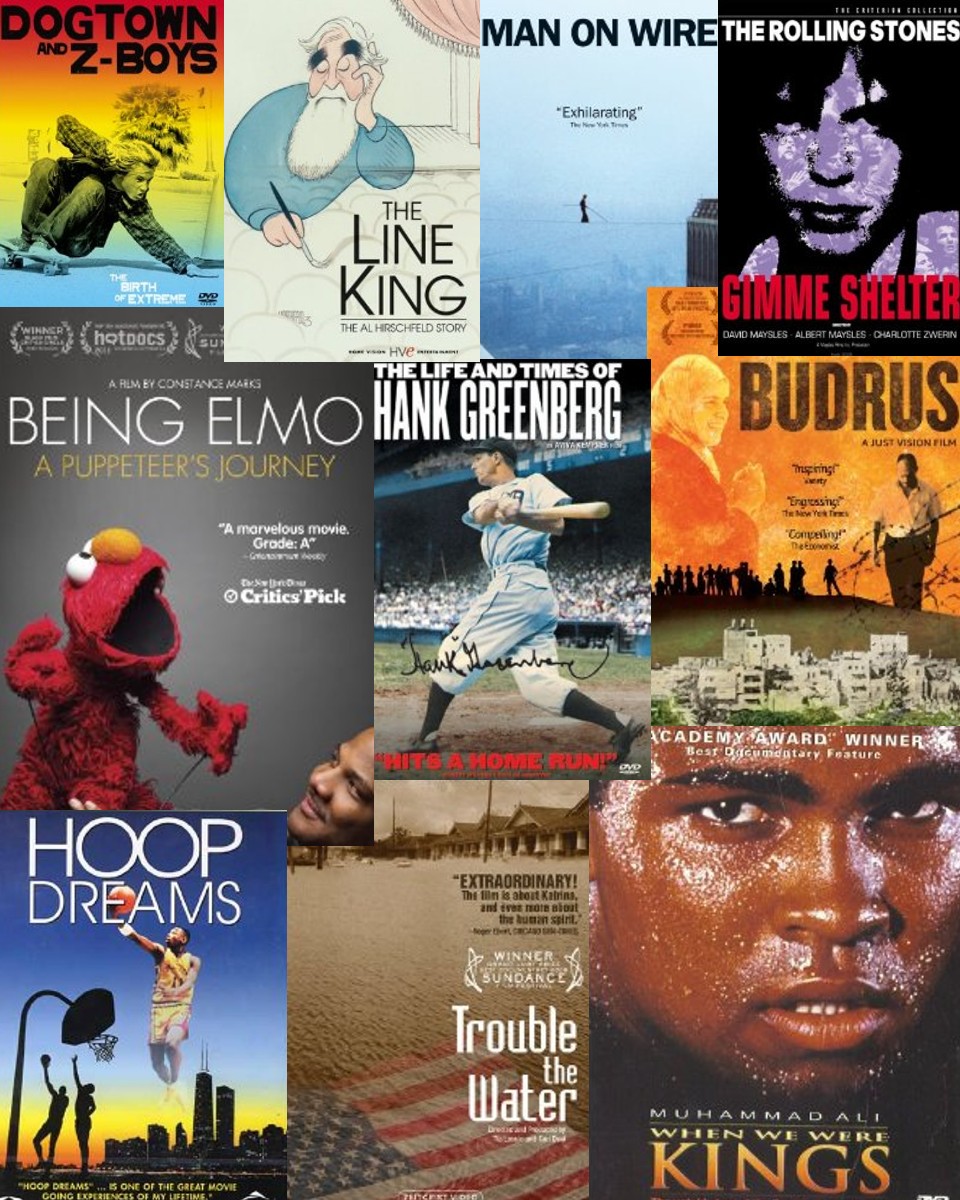
23. Budrus - an Israeli documentary about a Palestinean community slated for displacement
24. Capitalism: A Love Story - Moore's exploration of the financial crisis
25. Capturing the Friedmans - a father & son are imprisoned for crimes on seemingly false premises
26. Casino Jack and the United States of Money - Jack Abramoff and how lobbying affects Congress
27. The Cove - explores and aims to end the practice of slaughtering dolphins in a Japanese city
28. Fahrenheit 9/11 - President Bush and his actions after 9/11, including the Iraq War
29. The Fog of War - Defense Secretary Robert McNamara and the Vietnam War
30. Food, Inc. - how food is manufactured and distributed by relatively few companies
31. GasLand- a Pennsylvania man explores how natural gas mining contaminates our water
32. Hell and Back Again - a soldier returns from war with serious physical and emotional damage
33. Inside Job - the 2008 financial collapse, reasons and repercussions
34. Jesus Camp - a look at evangelicals and their children
35. March of the Penguins - how penguins survive and multiply on the South Pole
36. Paradise Lost 3: Purgatory - three Arkansas teenagers are wrongly jailed; third in a series that helped get them released
37. Religulous - Bill Maher's look at religion and its influence
38. Restrepo - on-the-ground documentary about U.S. troops in Afghanistan, some who didn't survive
39. Roger and Me - Michael Moore's first doc; about General Motors closing plants in Flint, MI
40. Sicko - another Moore doc; about health care in the U.S. and how it compares with elsewhere
41. Super Size Me - Morgan Spurlock eats all his meals at McDonald's for one full month
42. The Thin Blue Line - a man is sent to prison for a crime he likely didn't commit; the film helped get him released
43. The Tillman Story - the valor of Pat Tillman and the cover-up that surrounded his death in Afghanistan
44. Trouble the Water - the events and aftermath of Hurricane Katrina utilizing first-hand footage
45. Waiting for Superman - the U.S. educational system and rise of charter schools
46. Waltz With Bashir - from Israel, an animated documentary chronicling a battle in Lebanon
47. Why We Fight - how the military industrial complex affects U.S. foreign policy
48. The Wild Parrots of Telegraph Hill - a flock of parrots in San Francisco and the man who cares for them
Biographies (besides music and sports)
49. Ahead of Time - Ruth Gruber, a pioneering photojournalist
50. Being Elmo: A Puppeteer's Journey - Kevin Clash, Sesame Street
51. Bill Cunningham New York - longtime New York Times fashion photographer
52. Cameraman: The Life and Times of Jack Cardiff- a movie cameraman and photographer
53. Crazy Love - Burt and Linda Pugach, a married couple despite his criminal misdeeds against her
54. Dogtown and Z-Boys - pioneering skateboarding legends in the California seventies
55. Exit Through the Gift Shop - graffiti artists
56. Gonzo: The Life and Work of Dr. Hunter S. Thompson - the famed gonzo journalist
57. Grizzly Man- Timothy Treadwell, who lived with bears in Alaska
58. I Knew It Was You: Rediscovering John Cazale - the actor whose five films were all Best Picture nominees
59. Jean-Michel Basquiat: The Radiant Child - a popular fine artist from New York in the '80s
60. Joan Rivers: A Piece of Work
61. The Kid Stays in the Picture - film producer and executive Robert Evans
62. Lenny Bruce: Swear to Tell the Truth - the famed ribald comedian
63. The Line King: The Al Hirschfeld Story - legendary theater cartoonist for the NY Times
64. Man on Wire - Philippe Petit and his attempt to cross the Twin Towers via high wire
65. My Architect: A Son's Journey - architect Louis Kahn
66. Sing Your Song - singer Harry Belafonte, but more about his involvement in civil rights activism
67. The Times of Harvey Milk - slain San Francisco commissioner and gay rights advocate
68. Two in the Wave - French film directors Francois Truffaut and Jean-Luc Godard
69. Unknown Chaplin - Charlie Chaplin, with a focus on his filmmaking techniques; The Tramp and the Dictator, on The Great Dictator Chaplin Collection DVD set is also quite good
70. Waste Land - artist Vik Muniz and his use of landfill recyclables from Rio de Janeiro
Music and Musicians
71. Anvil: The Story of Anvil - a lesser known heavy metal band from Canada
72. Blur: No Distance Left to Run - the reunion of one of the biggest bands in Britpop; I also love the concert video that accompanies the DVD
73. Dixie Chicks: Shut Up and Sing - focuses on the backlash of Natalie Maines' anti-Bush comments
74. Don’t Look Back - Bob Dylan's 1965 tour of England; Martin Scorsese's No Direction Home about Dylan is also very good
75. Gimme Shelter- the Rolling Stones 1969 free concert that resulted in a tragedy; Shine A Light and Stones in Exile are also worthwhile
76. A Great Day in Harlem - about the jazz musicians who gathered in 1957 for a photo of the same name by Art Kane
77. Joe Strummer: The Future is Unwritten - the leader of The Clash; I also liked one called Joe Strummer: Let's Rock Again about his later days
78. Maxwell Street Blues - blues musicians who played at Chicago's Maxwell Street Market
79. Metallica: Some Kind of Monster
80. New York Doll - New York Dolls bassist Arthur Kane
81. PJ20 - Pearl Jam
82. Runnin’ Down a Dream: Tom Petty & the Heartbreakers
83. Rush: Beyond the Lighted Stage
84. The Clash: Westway to the World
85. The Filth and the Fury: A Sex Pistols Film
86. The Kids are Alright - The Who, from 1979. There's also a more recent one called Amazing Journey.
87. The Last Waltz - The Band and their star-studded final concert
88. The Promise: The Making of Darkness on the Edge of Town - Bruce Springsteen; Wings for Wheels about Born To Run should also appeal to Boss fanatics
89. The Ramones: End of the Century
90. Thelonious Monk: Straight No Chaser
91. Who Is Harry Nilsson (and Why is Everybody Talkin’ About Him)
92. Young @ Heart- about an elderly choir from Massachusetts that sings pop hits
Sports
93. Bobby Fischer Against the World
94. Hoop Dreams - Illinois high school basketball players in the 90s
95. On the Shoulders of Giants - a pioneering African-American basketball team in Harlem
96. Senna- late Formula One racer Ayrton Senna
97. The Life and Times of Hank Greenberg
98. This Old Cub - Ron Santo
99. Touching the Void- a pair of British mountain climbers and an ill-fated expedition
100. Tyson - Mike Tyson
101. When We Were Kings - Muhammad Ali and his 1974 fight with George Foreman; Muhammad Ali: Through the Eyes of the World is solid as a more complete overview
20 More I Hope To See Soon (all categories)
Bully Hey, Boo: Harper Lee and 'To Kill a Mockingbird' Crumb I Like Killing Flies Brother's Keeper Herb & Dorothy LennoNYC Black Power Mix Tape Kurt and Courtney Please Vote For Me Night and Fog Harvard Beats Yale 29-29 The Cats of Mirikitani Wordplay Genius Within: The Inner Life of Glenn Gould Chuck Close Client 9: The Rise and Fall of Eliot Spitzer Dig! Murderball Land of Silence and Darkness What other documentaries do you recommend?
Excepting a possible high school or college film class screening I've long since forgotten, it was also my first serious exposure to Chaplin as an artist.
For while I've always known of Chaplin--or perhaps more specifically, his immortal Little Tramp character--as an icon from the early days of cinema and always found brief snippets of his slapstick humor amusing, until this year I was largely oblivious to his true expanse as an actor, comedian, writer, director, producer, editor, composer and, beyond knowing he was once considered "the most famous man in the world," as a person.
So since viewing Modern Times, I made Chaplin the subject of one of my "creativity benders" in which I vociferously ingest vast quantities of artistry and information by, or about, a given musician, band, composer, painter, sculptor, filmmaker, writer, actor, architect, photographer, comedian, genre, etc.
Few of these creativity benders have ever been as eye-opening and gratifying as the one that educated me about Sir Charles Spencer Chaplin, born April 16, 1889 in London. And not just due to his numerous exceptional movies.
Along with some basic internet research--Chaplin's Wikipedia bio and filmographies on IMDB, All Movie and Wikipedia--I read some articles (1, 2, 3) about the time he spent in Chicago in the winter of 1914-15 after signing with Essanay Studios, following his initial batch of films with Mack Sennett's Keystone Studios.
I watched the first movie he made with Essanay, aptly titled His New Job, which was the only one Chaplin created in Chicago, for he would soon decide he'd rather film in California than at the 1343-45 Argyle Street buildings that now house St. Augustine College.
On the same day that I would take a tour of the old Chess Records studio, where Chuck Berry, Muddy Waters, Etta James and many others recorded songs seminal to the rise of popular music, I also stopped by the old Essanay Studios to experience a bit of pioneering cinematic ether.
Although the original entrance remains intact (as seen at right), not surprisingly considering Essanay closed its doors in 1918, the studios have long since been re-purposed to serve the needs of various tenants, currently St. Augustine.
But one of Essanay's old sound stages--conceivably but not assuredly one where His New Job was filmed--is now dubbed the Charlie Chaplin Auditorium. Though various college and community events are held there, it wasn't open when I stopped by, but a building worker kindly unlocked it and let me take a peek and a few pictures.
As shown at left, an image from Chaplin's 1921 classic, The Kid, is prominently painted in the auditorium, although that film had nothing directly to do with Essanay (it was filmed in Los Angeles for Chaplin's own First National production company).
And out back of the old studio buildings, Charlie can still be seen hanging around.
I also walked around the corner from Essanay to see these houses Chaplin supposedly had built (according to this article, which is more about another film icon, Gloria Swanson, who Chaplin cast in a bit role in His New Job). But given that--from what I can gather--Chaplin spent little over a month in Chicago during his time with Essanay, I can't see how there was time for the mirrored homes to be constructed, let alone for the star to live in one.
Yet while his direct ties to Chicago were rather brief,
according to this article, His New Job--released on February 1, 1915--is the movie that catapulted Chaplin to true mega-stardom, so his Chicago connection is more than trivial.
I also watched another Essanay silent, called The Tramp, which though not the debut of Chaplin's trademark character, is largely seen as the de facto formation of the "the most universally recognized fictional human figure in history" (according to a featurette on the Modern Times DVD).
Chaplin moved from Essanay, for whom he made 15 films in less than 18 months, to Mutual and I enjoyed his 1917 classic from this studio, called The Immigrant.
Though the above films were two-reelers (about a half-hour long), the rest of Chaplin's films that I recently watched are what we would call "feature length," at least an hour or a good bit longer. These include:
- The Kid (1921) - The Gold Rush (1925) - City Lights (1931) - Modern Times (1936) - The Great Dictator (1940) - Monsieur Verdoux (1947) - Limelight (1952)
The first four films listed above are silent films, which means that Chaplin consciously made the decision to make City Lights and Modern Times against the tide of "talkies," which were otherwise standard by 1930. His reasoning was that The Tramp should never talk on film and given that both movies are pure genius and rather successful in their day, he clearly made the right--albeit gutsy--choice.
Even--or perhaps especially--in silence, The Tramp of The Kid, Gold Rush, City Lights, Modern Times and the earlier short films went far beyond the cheeky imp I used to perceive. He was an everyman (readily understood in every language), a philosopher, a romantic and a forever resilient champion for the underdog.
Although the first three above are astonishingly inventive works of art, with much to say about life and society, I like Modern Times and The Great Dictator best as Chaplin put his globally-beloved persona on the line by bringing his social stridency to the fore. Having spotlighted Modern Times in my previous post, I wanted to touch a bit on what a daring and brilliant work The Great Dictator is.
In addition to writing, directing, producing, editing and composing the score--as he did for almost all his feature films--in his first non-Tramp feature Chaplin played both a Jewish barber (albeit resembling the Little Tramp) and Adenoid Hynkel, the buffoonish dictator of Tomania, who was quite openly and obviously intended to lampoon Hitler.
Keep in mind that as conveyed in the documentary, The Tramp and the Dictator, which accompanies the Chaplin Collection DVD of the film--all of these sets, which I got at the Skokie Public Library, contain excellent bonus material--when Chaplin began writing the story in 1938, the U.S. was still far from entering World War II and most of Europe was in a state of appeasement when it came to Hitler. Upon Chaplin's announcement about making the film, the British said that they would ban it.
Much of Hollywood, including Jewish producers who feared it would infuriate Hitler, tried to dissuade Chaplin from making the film. But through an intermediary, President Roosevelt encouraged Chaplin to go ahead, and he did, financing the entire project himself.
The film itself is wickedly funny--particularly scenes where Hynkel is joined by a character spoofing Mussolini--tremendous poignant and quite powerful. Though some have criticized Chaplin's closing speech, where he largely drops out of character as either the barber or Hynkel, as being out of tone with the rest of the film, I think what he does here is remarkably moving, with the message holding much resonance over 70 years later.
Certainly, even the tremendously well-read and worldly Chaplin--who was born the same week as Hitler and didn't miss the similarity of the Führer's mustache to the Tramp's--didn't grasp the true extent of Hitler's depravity or Nazi atrocities. In retrospect, Chaplin said he wouldn't have made The Great Dictator if he had.
But according to Stanley Kauffmann, a film critic featured in the documentary along with luminaries like Sidney Lumet, Budd Schulberg and Ray Bradbury, upon the film's release "every one of my friends, many of whom were Jewish, like myself, felt that a David had arisen, a comic David, to fight Goliath, and we could only be happy.
"Here this man had come out against Hitler. It was as if the greatest
angel in the calendar of saints and angels had suddenly taken a stand."
According to The Tramp and the Dictator documentary, it is believed that Hitler watched The Great Dictator, at least twice. But while he may have been a fan of Chaplin's movies, and mustache, Hitler included Charlie in a book comprising a Nazi hit list of prominent Jews, even though Chaplin wasn't Jewish. Baptised in the Church of England, Chaplin was primarily agnostic, but always refused to challenge or refute
claims that he was Jewish, saying that to do so would always "play
directly into the hands of anti-Semites."
Per film historian Kevin Brownlow, who co-directed The Tramp and the Dictator, Chaplin made The Great
Dictator in response to seeing himself on the Nazi hit
list. "The Nazis mistakenly thought he was Jewish because Chaplin
never denied it," Brownlow said. "He was sent a copy of this book and it is widely believed
that this led to him to make the film The Great Dictator as an act
of defiance."
No wonder David Robinson wrote in his 1985 biography, Chaplin: His Life and Art:
"Quite apart from any particular merits of the film, The Great Dictator remains an unparalled phenomenon, an epic incident in the history of mankind. The greatest clown and best-loved personality of his age directly challenged the man who had instigated more evil and human misery than any other in modern history."
Now, having read portions of Robinson's biography, watched the 1992 Chaplin biopic (not lousy but not great, though Robert Downey, Jr. is excellent) and seen Unknown Chaplin--a 3-part documentary focusing primarily on Chaplin directorial techniques--plus numerous extras on the various DVDs, it is clear that Chaplin was far from flawless.
As a director, he was at best a maddening perfectionist, at worst a capricious jerk. (Interestingly, his early silents were shot without scripts, resulting in numerous takes of each scene before Chaplin could "mold the clay.") Due partly to his deliberateness, from 1925 on--or the last 52 years of his 88-year life--his filmography consists of a relatively paltry nine works. And considerably more troubling was his lifelong penchant for much younger--e.g. teenage--women; I'm not sure what was considered "underage" at the time, but his first two wives were just 16 when he married them, after having impregnated them. He met his fourth and final wife--Oona O'Neill, daughter of playwright Eugene, who disowned her over the relationship--when she was 17 and married her at 18, when he was 54. Unlike his other short-lived marriages, he and Oona were together for 34 years until his death in 1977.
Chaplin also took heat from the British press for not enlisting in their Army during World War I, while instead making a fortune in America. But according to Wikipedia, he had in fact presented himself for service, but was denied for being too small at 5'5" and underweight. In the U.S., he joined Liberty Bond drives that raised millions of dollars and his 1918 movie Shoulder Arms, per Robinson, "metamorphosed the real-life horrors of war into a cause for laughter" bringing huge appreciation from troops themselves. It was one of his greatest successes.
Chaplin films raised morale more than any other during WWI (per The Tramp and the Dictator), he made the wondrous The Gold Rush and City Lights, which like many of his films can be seen as testaments to human dignity and perseverance, he took on the industrial establishment with Modern Times and he took on Hitler--largely before anyone else did--with The Great Dictator.
And for his efforts, Charlie Chaplin got kicked out of America in 1952.
Click image to see stories in full
I won't make this too much longer going into details largely beyond my familiarity, but somewhere relatively early, Chaplin put himself in the crosshairs of J. Edgar Hoover. In the mid-40's, he was embroiled in a paternity suit with a (clinically) crazy ex-lover, in which tests proved the baby wasn't his, yet he still somehow was ordered to pay to support it. He also was a target of Joseph McCarthy, who accused Chaplin (and much of Hollywood) of Communist activities.
After making Monsieur Verdoux in 1947, where he clearly left the Tramp behind and played a murderer, largely to make a statement about war--"One murder makes a villain, millions a hero. Numbers sanctify."--he then wrote (originally as a 100,000-word novel draft), directed, produced, composed and starred in the touchingly self-reflective Limelight in 1952. Here he played an old clown, once hugely famous but now down and out, but still maintaining heart and dignity. Chaplin even gave his old silent-era rival, Buster Keaton, a small part; this was the only time the two legends were on-screen together. (By the way, to give myself a point of comparison, I also watched Keaton's The General as well as F.W. Murnau's silent classic, Sunrise. Both of these are great, but in no way lessened my regard for what Chaplin was doing around the same time.)
Both Monsieur Verdoux and Limelight, though not quite on par with The Gold Rush, City Lights, Modern Lights and The Great Dictator--which may still reign as cinema's greatest Grand Slam--are quite interesting movies and very worthwhile.
Upon attending the world premiere of Limelight in London in 1952, Chaplin and his family were denied re-entry under a Justice Department code which permitted the barring of aliens on grounds of "morals, health or insanity, or for advocating Communism or associating with Communist or pro-Communist organizations." (Robinson, p572)
At least per what I was able to learn about Chaplin through this rather fulfilling, if expedient, exploration, this seemed like a disgraceful way to treat one the America's greatest entertainers & ambassadors who also served as one of the world's greatest proponents of peace & social justice.
In fact, though at the beginning of 2012 I had vague regard but little true knowledge of Chaplin's life and art, I now believe he deserves to be seen as one of the 20th Century's very greatest artistic forces, along with The Beatles and Picasso.
After being exiled in 1952, Charlie Chaplin wasn't allowed to return to the U.S. until 1972--when not incidentally Hoover was trying to get another genius and force for good, John Lennon, deported--as he came to Hollywood to accept an honorary Oscar. In doing so, he received a 12-minute standing ovation, the longest ever--still--in Academy Award history. (This video captures only part of it.)
As the great French film director Claude Chabrol explains in a brief documentary accompanying Monsieur Verdoux on DVD:
"Chaplin equals survival. The central question in all his films is 'How do you survive?'"
Given my new found enlightenment, when it comes to Chaplin I'd answer "With quite a lot of grace, humor and humanity."
35 years after his death, which came on Christmas Day 1977--I also went to the library and read the obituaries in Chicago Tribune and New York Times on microfilm, quite a revelatory exploration in itself--we can still learn a whole lot from a Little Tramp.