Showing posts with label Harry Belafonte. Show all posts

Tuesday, January 29, 2013

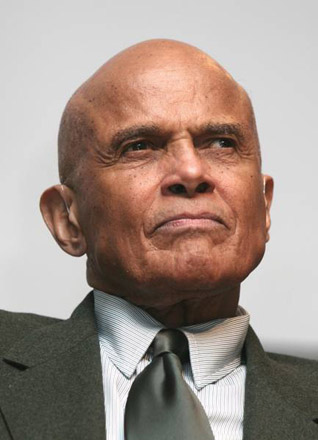
A Noble Man Honors a King -- Harry Belafonte Talks About MLK, January 29 at Northwestern

“We’ve come to a time when we’ve abandoned radical thought. Radical thought is essential [to bring about change].”

It’s amazing how the things I often prattle on about sound so much more sage, and eloquent, when voiced by an international legend—and human rights hero—like Harry Belafonte.

While at 85, the resonant tenor of the man who had the first million-selling album has been reduced to a rasp, as the Keynote Speaker at a Northwestern University program honoring Dr. Martin Luther King Jr., Belafonte still spoke volumes.

Of course, the singer, actor and activist—who I learned much more about last year through the Sing Your Song documentary, and subsequently saluted in this birthday blog post—had plenty of history to draw upon, as he became a close confidant of Dr. King when both men were in their mid-’20s. Belafonte recalled how MLK initially called him and said, “I cannot do it alone.”

And to a Pick-Staiger Hall audience comprised largely of NU students, though also the general public, Belafonte’s speech had an underlying theme of devoting oneself to helping others, particularly the disenfranchised.

Though no longer the spry performer who enjoyed groundbreaking success in music, theater, film and television—at the very least, check out his Wikipedia bio—Belafonte began his talk by displaying the warm-spirited personality that once made millions of worldwide fans wild about Harry.

Following an impressive performance by the Northwestern Small Jazz Ensemble, a remarkably buoyant rendition of “Amazing Grace” by the Alice Millar Chapel Choir and remarks from Charles Whitaker—an NU journalism professor who co-chaired the event—and Evanston mayor Elizabeth Tisdahl, Belafonte was welcomed to the stage by Victor Shao, president of Northwestern’s student government.

Harry noted that it was the first time he’d ever been introduced by a person of Asian descent, but that as someone who had long traveled the world, he had joyously experienced “thousands of Japanese singing Day-O.” Belafonte also shared how his grandkids had teased him when he told them—before flying to Evanston from his New York home—that he’d be making a 20-minute speech: 'Grandpa, you can’t say hello in 20 minutes.'

But as Belafonte got to the heart of his speech, relaying how he and King had worked together on the “Poor People’s Campaign” shortly before MLK’s 1968 assassination, and reflecting on how upon hearing JFK—who he also befriended and advised—urge “Ask not what your country can do for you, but what you can do for your country,” he focused on what it meant specifically for black people, I doubt anyone was glancing at their wristwatch (including me, who always does).

In looking at the notes I took on Belafonte’s speech, which was followed by a brief on-stage interview by a journalism student, I am struck again at how masterfully he wove together themes of affliction, action and hope with equal depth and acuity.

He spoke of financial inequity, crippling levels of incarceration among African-Africans—“we build more cells than classrooms”—the loss of our “moral compass” under George W. Bush, improvements yet not widely realized remedies under President Obama and the terrible scourge of guns, for which he advocated “a radical movement to challenge the second amendment.”

Despite walking with a cane, Belafonte looked good and sounded sharp, but acknowledged his own mortality while expressing that gun control was “what I’m committing to in the last days of my life.”

Yet his endlessly impressive devotion to activism was nicely balanced by Belafonte referencing how his wife—who I believe is his third—and family were the most important part of his life, and that their support and understanding as he traveled the world and sometimes championed controversial causes largely enabled him to do all that he has.

Particularly moving, especially given the occasion, was when Belafonte shared being privy to Dr. King’s moments of doubt. ‘In the quest for integration, we are integrating into a burning house,’ Harry cited Martin telling him, to which Harry replied, ‘Then we’re going to have to become firemen.”

Without any boasting or braggadocio, Belafonte also looped in working on behalf of Native Americans and having been the motivator behind “We Are The World” and related African-relief efforts.

I apologize for reprising another of my common kvetches, but in watching Harry Belafonte speak I couldn’t help but again be chagrined over the relative superficiality and societal insignificance of so many of today’s so-called celebrities and—since they’re increasingly not one and the same—artists.

Much to my contentment and cognitive validation, Belafonte espoused how artists need to do more to stimulate the masses to address injustices, such as Wall Street fraud. And that everyone—especially those within institutions of higher learning—needs to share in a commitment to radical thought, the path to which, Belafonte voiced, “was the first thing the oligarchy sought to stamp out.”

As someone who often thinks and writes about societal transformations,  plagues, inequities and the like, yet sometimes can’t help think that I’m just pissing into the wind, it was personally quite gratifying to hear similar concerns conveyed by someone with such stature, perspective and gravitas.

So while many people who might well benefit from learning about Harry Belafonte and listening to him speak about activism, accountability and the Reverend Martin Luther King, Jr. will likely remain willfully oblivious, I greatly appreciated the salient sentiment as Harry acknowledged the choir standing on stage behind him, made a joke about preaching to it and shared the wise words once intimated by his friend:

‘Harry,’ Martin said, ‘you’ve got to preach to the choir. If you don’t, they’ll stop singing.’

Thursday, March 01, 2012

Happy Birthday-O to the Remarkable Harry Belafonte as the Singer, Actor and Activist Turns 85

It's a bit ironic that the 85th birthday of Harry Belafonte comes the day after Black History Month, for in living a life worth celebrating 366 days a year, his biography could serve as a textbook on civil rights, social justice, human dignity and trailblazing artistic achievement in music, film, theater and television, among much else.

I can't remember a time when I didn't know Belafonte's name, but I long associated his fame primarily with the "Banana Boat Song" (a.k.a. Day-O). I knew he was once a very popular singer, also noted for his great looks, and in 2009 I learned a bit more about his pioneering film work when I saw a screening of Odds Against Tomorrow at Chicago's Music Box Theatre, at which Harry spoke.

I had the privilege of shaking his hand, having him sign my ticket stub and snapping some subpar photos on my phone camera, but at that point I had scant knowledge of all that the man has done and stood for.

Within the past month, absurdly belatedly but perhaps otherwise appropriately, I have had my eyes opened to Harry Belafonte's huge effect on history.

While I don't suggest that a 100-minute documentary, complimented by Wikipedia, YouTube and Spotify, makes me genuinely much more informed about a man who has traveled thousands of miles, literally and figuratively, in his first 31,046 days on Earth, I highly recommend you watch Sing Your Song if you can catch it on HBO On-Demand, DVD (upon release) or at a special screening near you.

As I said to a friend, I found it to be a very good documentary that illuminated me greatly about a truly exceptional man. 

It won't take you very long to explore Belafonte's life to the extent I have, and I assure you you will be better off for it, but for those who want the Cliff Notes version of the Cliff Notes version, here is a list of just a few of the impressive things Harry has done:

  • After high school, Harry joined the Navy and served in the munitions corps during World War II
  • In the late 1940s, he took an acting class in which Marlon Brando, Walter Matthau and Tony Curtis were classmates
  • He also joined the American Negro Theatre, where he met Sidney Poitier
  • The first time he sang in public, Harry was backed by the Charlie Parker band, which included Parker, Max Roach and Miles Davis 
  • In 1953, he was cast in John Murray Anderson’s Almanac, a Broadway revue, for which he won a Tony Award
  • He toured America in a 1950s traveling variety show hosted by Gower & Marge Champion despite being subjected to many racial indignities, particularly in the South
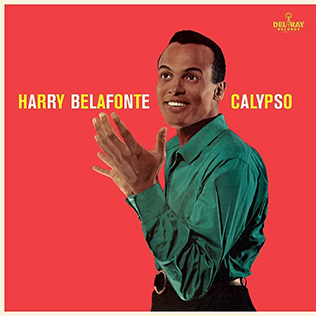
  • His 1956 album, Calypso, spent 31 weeks at #1 and was the first album by any artist to sell 1 million copies in the U.S., as well as in the U.K
  • The "Banana Boat Song" was also an early million seller
  • Harry Belafonte befriended Martin Luther King Jr. in the 1950s and became one of his key confidants; according to Coretta Scott King, "Harry motivated Martin."
  • His 1957 film Island in the Sun controversially explored an interracial romance between Belafonte and Joan Fontaine and his 1959 classic, Odds Against Tomorrow--created under Harry’s HarBel Production company--was the first film noir movie to feature a black protagonist.

  • Harry starred in a campaign commercial for John F. Kennedy in 1960, after having advised JFK to pay attention to the Civil Rights Movement, and sang at his Inaugural Ball. Kennedy later named Belafonte cultural advisor to the Peace Corps.
  • Belafonte was the first African American to win an Emmy, for his first solo TV special Tonight with Belafonte in 1959.
  • Though he hosted other TV specials and often guest hosted the Tonight Show—where guests included RFK and MLK—he walked away from greater TV success when networks insisted against on-screen integration in his variety shows
  • His 1962 album, Midnight Special, features Bob Dylan’s first appearance on record
  • He was an early foe of apartheid in South Africa and recorded an album in the 1960s with South African singer Miriam Makeba
  • Harry aided many African countries in their fight for independence and also—along with Jackie Robinson and others—brought many Kenyan students to America, including Barack Obama, Sr.
  • He helped organize the March on Washington in 1963, encouraging Marlon Brando, Charlton Heston, Paul Newman and other celebrities to (in Harry’s words) “lend a peaceful presence” to soothe JFK's concerns
  • At MLK’s behest, he organized a concert celebrating the march to Montgomery in 1964, featuring Tony Bennett, Nina Simone, Peter Paul & Mary and others
  • Also in 1964, he bankrolled the Student Non-Violent Coordinating Committee in Mississippi and  personally delivered money to Greenwood, despite being chased by the Klan
  • He was prominently involved in anti-war protests during the Vietnam and Iraq Wars
  • He helped organize the “We Are the World” charity single and visited Ethiopia to deliver food
  • He coordinated Nelson Mandela’s first visit to America and served as his host
  • He demonstrated/organized for/publicly supported many other causes, including Native American rights, Haiti relief, curbing gang violence and creating better conditions for children
  • Belafonte received the Kennedy Center Honors in 1989, was awarded the National Medal of Arts in 1994 and won a Grammy Lifetime Achievement Award in 2000.
  • When asked during a protest if he remained optimistic, he answered,
    “I live in a perpetual state of optimism. If you don’t have optimism then you can’t nourish hope.”
     
  • He guest starred on one of the most famous and unique Muppets episodes—said to be Jim Henson's favorite—as seen below: