Niles Historical Museum
8970 Milwaukee Ave., Niles, IL
Visited January 29, 2014 Website
Yesterday, my friend Ken and I took advantage of an open afternoon and traveled back to the early 20th century--and even a bit further--by visiting the Niles Historical Museum.
This was the first time either of us had been to the imposing building a bit south of Golf on Milwaukee--which served as the Cook County Sheriff's Quarters from 1923 to 1984--despite Ken being a Niles resident for 30 years and me living in nearby Skokie, part of Niles Township, on and off and on again for 45 years.
Although there are occasional movie showings and other special programs on weekends, the museum is regularly open just Monday, Wednesday and Friday from 10:30am to 3pm. It is operated by volunteers of the Niles Historical Society, and though admission is free, we were taken on a nice tour of the collection's three floors that made us happy to each donate $5 at the end.
Certainly the museum contained plenty of history directly tied to Niles, including photos of long-gone homes, farms and taverns, relics from prominent local businesses such as Salerno, reminders of the Tam O'Shanter Country Club (which survives in part as a 9-hole public golf course but once hosted major tournaments and celebrities) and Mill Run Playhouse, impressive battlefield paintings by hometown artist Konrad Hack and items that were donated by local residents, including the uniform and shoes a Niles man had worn as a POW in North Korea.
But with our docent, Doris, being a good bit older than Ken, who is a half-generation beyond my 45 years, I best enjoyed how items likely present in many similar local historical museums--lanterns, school desks, old telephones & typewriters, radios & televisions, dollhouses & other toys, ice boxes, early washing machines, etc.--prompted varying levels of recollect and discussion among the three of us. Of course, many items displayed predated us all, such as a covered wagon, Model T Ford and various tools & farming instruments.
But with myself having only known color televisions, electric typewriters and (for the most part) touch-tone phones during my lifetime--and all that the Internet and digital information age has fostered--it was pointed and a bit poignant to be reminded of the types of items people managed to live with, and even without, back in the proverbial day.
Rather than describe everything we saw, I'll post below a gallery of photographs I took--while encouraging you to stop into the Niles Historical Museum if you ever get your chance.
It's well-worth a couple hours of your time, and many decades preceding it.
(The photos are "beneath the fold;" click below to see them if you don't.)
The other day I wrote this post about Harry Belafonte, in which I listed some of the remarkable things the singer, actor and activist has done.
My impetus was his 85th birthday but my interest was largely sparked by a documentary I had seen just days before. Though I've known Belafonte's name almost my whole life, largely as a singer whose heyday was before my time, Sing Your Song--which remains available on HBO On Demand--really opened my eyes to Harry's Herculean humanitarian efforts.
Read my post below or, better yet, watch the movie, but this is a man who was a close confidant of JFK, RFK, MLK and Nelson Mandela, among others, was central to the civil rights movement and many of its major events, and helped to organize numerous African relief efforts, including the "We Are The World" single.
Although I've been watching many documentaries of late, inspired in part by them being the topic of the next Chicago Film Discussion Meetup Lunch, and am intending to soon write a post listing several documentary films that I recommend--I'd also love to hear your suggestions--I wasn't planning on following my Harry Belafonte post with another documentary subject.
But after watching a documentary called Ahead of Time, about Ruth Gruber, it just seemed right to complement the Belafonte piece with one drawing attention to a Jewish-American woman whose fame never rivaled Harry's but whose actions and accomplishments were similarly remarkable and altruistic. (The movie is available on Showtime on Demand, with scheduled airings as well.)
It isn't Ruth's birthday today--she turned 100 last September 30--nor is the documentary, which I've been heretofore oblivious to since its 2010 release, my first exposure to her rather storied life.
No, I first became aware of this woman--who at 20 became the youngest person to earn a Ph.D., embarked on a career as a pioneering female foreign correspondent and photojournalist, befriended Virginia Woolf, explored Alaska as a Special Assistant to the U.S. Secretary of the Interior, helped publicize the plight of Jewish refugees aboard blockaded ships after the Holocaust and wrote numerous books--when she was just 99.
That was last August, when on the last day of a 4-day trip to New York City, at the tail end of a visit to the International Center for Photography--whose primary exhibit was an excellent one about Elliot Erwitt--shortly before having to head to a theater matinee, I saw a small exhibit on Ruth Gruber. What she had done, which went leaps & bounds beyond photography, was fascinating.
It's strange sometimes, how we learn what we do. If it hadn't been for that brief exposure last August, I almost certainly wouldn't have been prompted to watch the documentary when I noticed it among Showtime's offerings--even that's a fluke, as I'm just days from the end of my 3-month free trial--and would have remained clueless about not only Ruth Gruber, but the 1947 voyage and blockade of the refugee ship Exodus, whose passengers wound up on another ship, where they painted a swatstika on the Union Jack, which Gruber exclusively photographed, which contributed to bringing about the formation of the State of Israel.
It's cool that Mrs. Gruber is still with us after a full century of doing phenomenal things and I hope she's doing well. Though I'd imagine her books are quite worthwhile--there was also a 2001 TV Mini-series about her--if you have access to Showtime (or are willing to buy the DVD--it's not listed on Netflix--or attend/arrange a special screening), I assure you Ahead of Time will be well worth sparing 73 minutes of yours.
What "I remember exactly where I was when I heard about ____________" moments resonate strongest with you?
I wasn't alive until nearly five years after JFK was assassinated on November 22, 1963, and with December 7, 2011 being the 70th anniversary of the bombing of Pearl Harbor, that day will soon live in infamy well beyond a preponderance of people who can actively remember it.
With the MLK and RFK assassinations coming slightly before my birth (in October 1968), and the Moon Landing coming only 9 months after, I don't directly remember those events, but I think I slightly recall watching Nixon leave office on August 9, 1974. And I know that, while on family vacations in 1976 and 1977, I saw news reports about the deaths of Chicago Mayor Richard J. Daley and Elvis Presley, respectively. I can't really recall if I heard about John Lennon via Howard Cosell's announcement during Monday Night Football or the next morning from Steve Dahl & Garry Meier (on Chicago radio), but I remember being quite stunned, even though I was much more familiar with Paul McCartney, who'd been far more active during my years of awareness.
I remember coming home from school on March 30, 1981 excited to watch that evening's NCAA Championship and the Academy Awards, and having my dad tell me that President Reagan had been shot. (The game was played, with Indiana beating North Carolina; the Oscars were postponed to the next night.)
I also won't forget Frank Sinatra's death coinciding with the last episode of Seinfeld (on 5/14/98), and know I found out about Michael Jackson initially through a post on Facebook shortly after others about Farrah Fawcett made the rounds (on 6/25/09). Like most, I have vivid sad memories of 9/11/01 and can still recall WSCR's Dan Bernstein first alerting me to an airplane having crashed into the North Tower of the World Trade Center, while I was driving to work after having seen Bob Costas on the Today show discussing Michael Jordan's decision to play for the Washington Wizards. I also remember my boss at the time insisting we treat it as a normal workday, even as all the horrible events unfolded.
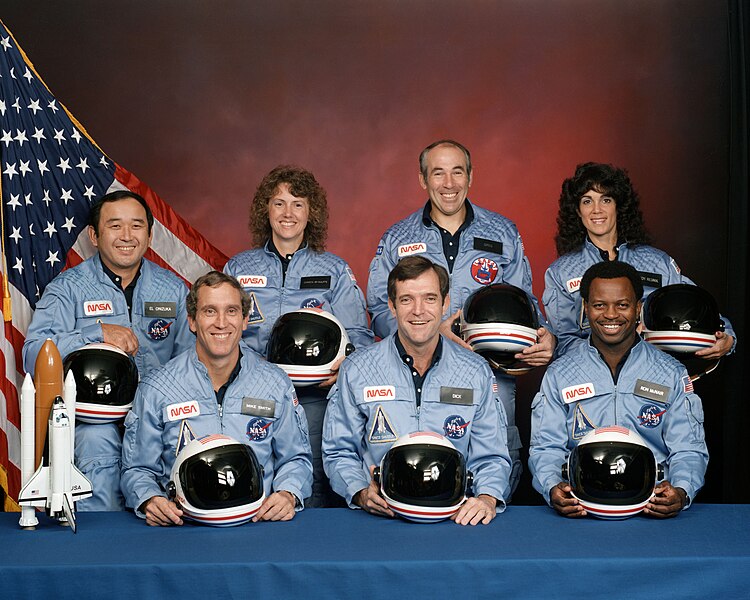
But as much as any non-personal event--and even most of those--I'll never forget the day 25 years ago today, January 28, 1986, when the Space Shuttle Challenger disintegrated shortly after liftoff, killing its seven crew members.
It wasn't just that it was a completely shocking tragedy--one that at age 17 I doubtfully ever even contemplated, at least not in a way so dissimilar from a "Ground Control to Major Tom" scenario--or that what happened was captured by television cameras for all to see. (I didn't witness the catastrophe as it happened, but repeatedly in its wake.)
No, what makes the Challenger tragedy so extraordinarily memorable was the timing of it. Especially for Chicagoans.
You see, just two days before, on Sunday, January 26, 1986, the Chicago Bears completed their greatest season in history by defeating the New England Patriots 46-10 in Super Bowl XX. I'm sure you can imagine the euphoria being shared through the halls of Niles North High School--where I was a senior--and everywhere in the region that Monday, and carrying through Tuesday. Keep in mind that up to that point, other than the basically irrelevant Chicago Sting soccer team, no Chicago sports team (professional or collegiate) had won a championship during my lifetime. And with the Bears going 15-1 during the regular season, being coached by Mike Ditka, led by Walter Payton, Jim McMahon, Richard Dent, Mike Singletary and many other stars, featuring William "The Refrigerator" Perry and boldly predicting their success through "The Super Bowl Shuffle," the '85 Bears were truly a phenomenon.
Even had the current Bears beaten the Packers last Sunday, advanced to Super Bowl XLV and won it, in my opinion it would have paled next to the '85 Bears for anyone old enough to recall the excitement they stirred around town and even across the country (and I still think theirs was the best defense ever).
So, Sunday, January 26, 1986, the Bears win the Super Bowl for Chicago's first major sports championship since the Bears won the NFL Championship in 1963 (about 5 weeks after the Kennedy assassination).
The city goes bonkers and celebrates into Monday, when a ticker tape parade is held along LaSalle Street, with a rally in Daley Plaza.
Jubilation was still abundant at Niles North in Skokie on Tuesday, January 28, 1986, when someone says in the hallway that "the Space Shuttle blew up." My initial reaction was to assume it was some kind of joke; disbelief is often the way we respond to horrific news. But the buzz soon became louder and I think it was in a classroom (so much for precise exactitude) that the grim truth was confirmed.
Talk about a downer.
I remember that it immediately felt wrong to feel so happy about the Bears. Seven people, including teacher Christa McAuliffe, lost their lives in such a stunning way. School wasn't canceled and thus life pretty quickly resumed normalcy, but as this article should attest, I'll never forget going from so high to so low in such succession, at least in terms of events that didn't involve a personal loss or direct consequence. The juxtaposition greatly exacerbated the shock of the tragedy, and the acuity of the memory.
For although I also remember the Space Shuttle Columbia disaster that killed its seven crew members, without looking it up just now, I couldn't have told you that it happened on February 1, 2003.
But January 28, 1986 is a day, and feeling, I will never, ever forget.
As an adult, I've never done a whole lot in terms of Halloween. Sure, I ate candy and brought some to the offices where I've worked, but without any kids of my own, I haven't done any trick or treating, and living in apartment & condo buildings, I haven't often had my bell rung.
This year was one of the more active Halloweens I remember, although in actuality it was on Saturday the 30th that I went to a party--for which I wore a costume for the first time since childhood--and followed it up by attending a Fright Night movie at Facets Multimedia. I saw a silent, 66-minute 1928 version of "The Fall of the House of Usher" with the Cursed Bird Ensemble offering a phenomenal live score.
Earlier in the day on Saturday, my Mom, sister and I took our own walking tour of Graceland Cemetery, not far from Wrigley Field in Chicago.
I had toured the cemetery several years ago, but we had recently inherited a detailed book on what is Chicago's most famed burial ground and for anyone who loves Chicago history, architecture and sculpture, Graceland is one of the city's "must see" sites. In fact, other than perhaps Pere Lachaise in Paris, it is the coolest cemetery I have ever visited for site-seeing purposes, although the list isn't that long.
Click here or on the image below to see my photo gallery of many of the famous graves and great monuments, including those designed by Louis Sullivan, sculpted by Lorado Taft and Daniel Chester French and honoring famed Chicagoans of a bygone age such as Potter Palmer, Marshall Field, William Kimball, George Pullman and William Goodman.
With many of the area's most famed architects interred here--including Sullivan, Daniel Burnham, William LeBaron Jenney, Bruce Goff and the recently deceased Bruce Graham--the diversity of styles showcased in the memorials is not only remarkable, but remarkably apt for a city that continually broke new ground in how metropolises were shaped.
[ Click image to see full gallery; all photos by Seth Arkin ]
---
All in all it was a pretty Happy Halloween for me personally, and hopefully for you, but I was quite saddened to read of the tragic accidental death of Megan Duskey while horsing around at the Palmer House, where she was attending a party on Saturday night. With the senseless death of Declan Sullivan at Notre Dame--someone needs to be fired or worse--and the brutal slaying of Toni Keller at my alma matter, NIU, it has been a particularly tragic week in regards to young Chicago area residents who won't be able fulfill their dreams and aspirations. "What a shame" doesn't nearly cover it, but then, hoping that their family and friends can find some semblance of comfort also seems quite trite given the circumstances.
It hasn't been lost on me that a number of things I've written about here hearken back to my childhood, in one way or another. From concerts I've seen & reviewed by favorite acts since my youth--AC/DC, Rush, Cheap Trick, Aerosmith--to pieces about or involving childhood icons like Evel Knievel, Mark Fidrych and Ernie Banks to a review of a new play--The Invasion of Skokie--about late-'70s events in my hometown, I've done a good bit of looking back. My long piece on saving ticket stubs was also fueled, in part, by a sense of nostalgia.
Even beyond what I've blogged about, there have been trips down memory lane, including visiting my junior high school (Old Orchard) when it had an Open House celebrating its 50th anniversary--at which I spoke with several former teachers--and reconnecting with a number of long-lost friends and classmates on Facebook.
But while I am now less than a month from turning 42, I am not acutely aware of being in the midst of a mid-life crisis (though I guess few really are). Although I hope to soon again be working more regularly and would certainly accept some financial, romantic and physical improvements if they came with no strings attached, I don't consciously feel any particular sense of unrest, unhappiness or longing. I am grateful for what I do have, content with who I am and, all things considered, wouldn't trade places with anyone.
Yesterday, after watching the Bears' surprising victory over the Cowboys, I watched 'Hot Tub Time Machine,' a 2010 movie in which John Cusack and friends are magically transported back to 1986, with some unclear assistance from Chevy Chase. It was OK but not wonderful and even those nostalgic for the '80s would probably be better served just watching The Sure Thing, Say Anything or National Lampoon's Vacation.
But it was a bit of fun being taken back in time, with references in the film to Duran Duran, Miami Vice, Alf, Cassette Walkmans, "Where's the Beef?", leg warmers, Super Mario Bros. and "Safety Dance" (quick, name the band). I also liked the nod to Back to the Future with a bit part by Crispin Glover.
The once & future idiot, circa 1985. And no, I can't play guitar.
So largely with the help of YouTube, I set out to create my own (virtual) time machine.
As you can see at top, I set my DeLorean gauge for 1985. The following year, when I graduated high school and entered college, may have been a bit more notable, even in terms of major news events, but as a silver anniversary ago and more of a midway point of the '80s, 1985 seems more apt. Plus, '85 was the year Marty McFly went back to the future.
Now as I share some of my favorite moments & memories of 1985, I'll first note a number of things that have pretty much remained the same.
In 1985, I lived in Skokie, Illinois. Although I didn't for about 18 of the next 25 years, in 2010 I live in Skokie, Illinois. Two of my closest friends were/are Jordan and Mark. My favorite singer was/is Bruce Springsteen, with The Beatles, Stones, Kinks, Who, U2, Tom Petty and those named above being others spanning 25 years and beyond. Sartorially speaking, I favor(ed) concert t-shirts and blue jeans. I liked eating at local joints like Poochie's and Sarkis', and still do. I wore a Casio digital watch and have never since worn a different brand (it recently dawned on me that Casio is the brand, of any kind or category, to which I've been most loyal).
And though many tastes & passions have come along since--art, theater, photography, travel, etc.--in 1985, as I do now, I liked rock music (though I wasn't yet that tuned into R.E.M., Husker Du, The Replacements, The Cure or some others I should've been), sports, movies, TV and writing (I was the Sports Editor for my high school newspaper).
As such, the videos below collect only things that I knew about and actively liked at the time, not in retrospect. And while it may seem like I'm not really broaching on major news events, even in doing a bit of research, there wasn't a whole lot of unforgettable stuff in that regard. Reagan began his second term, there were number of major plane crashes and natural disasters that killed thousands worldwide and the most famous deaths were probably those of Rock Hudson--the AIDS epidemic was just coming to the fore--and Leon Klinghoffer, an American killed aboard the hijacked cruise ship, Achille Lauro. (Orson Welles, Yul Brenner (both on the same day, October 10), Marc Chagall, Anne Baxter, Roger Maris, Ruth Gordon and Flyers goalie Pelle Lindbergh also died in 1985, as did an actor mentioned below.)
So fasten your seatbelts and get ready as the YouTube Time Machine takes us back to 1985.
My favorite TV show in 1985 was Cheers. Its third season was 1984-85, and sadly, Nicholas Colasanto who wonderfully played Coach, died on February 16 at age 61. The clip below is just a random one I found, but sums up Coach and Cheers pretty well. Colasanto's replacement, Woody Harrelson as Woody was great also, from fall 1985 on, but I always missed Coach.
It's not a show I ever revisited in reruns or on DVD, but the early days of Moonlighting--which debuted on March 3, 1985--were fantastic.
1985 wasn't a fantastic year in movies, but here are a couple quick clips that may spark some memories.
1985 was a very good year in sports, both locally (in Chicago) and nationally.
I saw Michael Jordan play in person for the very first time. This is a clip from the actual game, March 9, 1985 against Utah.
The NCAA Tournament ended with a huge upset I'll never forget when Villanova beat Patrick Ewing-led Georgetown (though it's a bit less famous than NC State beating Houston 2 years earlier).
This was probably the greatest round in boxing history:
On Sept. 11, 1985, Pete Rose got hit number 4,192 to break Ty Cobb's record. I was at the game 3 days earlier at Wrigley when he got hits 4,190 and 4,191, in a game that ended in a 5-5 tie.
The World Series was also noteworthy, as the Kansas City Royals beat state rival St. Louis Cardinals in 7 games, aided by a blown call in Game 6. And Dwight Gooden had what may have been the best pitching season in my lifetime (as I was born after McClain & Gibson's seasons in '68. Although Guidry, Maddux, Pedro and Clemens might provide some argument).
But the biggest sports story in 1985 were the Chicago Bears, who went 15-1 on their way to winning their only Super Bowl in January 1986, with the greatest defense--those who enjoyed the Bears victory over the Cowboys today, check this out--and best collection of personalities the NFL has ever seen. I don't think anyone around at the time will ever forget the Super Bowl Shuffle.
In the realm of music, some of my tastes from 1985 have aged better than others, with Talking Heads, John Mellencamp, Dire Straits (Money for Nothing video), Bryan Adams and The Hooters and, yes, Ratt, being among some of my favorites not already mentioned. I'm not so proud of it, but I loved this song and video:
The biggest musical event of 1985 was Live Aid. I still vividly remember watching much of it and was blown away by this performance by U2.
And I can still hear myself shrieking, "Led Zeppelin's on! Led Zeppelin's on!" when a reunited (3/4 at least) took the stage for the first time since John Bonham died in 1980.
As for concerts I attended, Bruce Springsteen and the E Street Band at Soldier Field on August 9, 1985 was by far the biggest one. I couldn't find any clips from that show, but this is pretty close:
Finally, outside any of the above areas, here's a little reminder of a great idea that didn't work out so well.
Well, thanks for reminiscing with me. Admittedly, this was a post I enjoyed more myself than I imagine many others will, but it could be fun to replicate it in your own way for whatever year may be suitable.
Time to head back to 2010, as tonight I'm going to a concert I'm really looking forward to: Roger Waters re-creating the Wall on the 30th anniversary of Pink Floyd's landmark album. Another glorious memory of childhood, and I don't even need a time machine to see it. Just some binoculars.
----
NOTE: A commenter let me know of a website he created that takes this idea a whole lot further. Check out yttm.tv to see videos that take you back to the year of your choice, all the way to 1860. A really cool site.
I love history, not so much in terms of wars or rulers, but in terms of people, how they lived and what they created. I am particularly fascinated by much of Chicago's rich history, and in the past have learned about and/or explored the works of Frank Lloyd Wright and Louis Sullivan, old movie theaters, the Essanay Studios, classic hot dog stands, the Columbian Exposition of 1893, Graceland Cemetery and much else. (I also value the Chicago History Museum, but as I wrote here, feel they greatly need to enhance the modernity of their exhibits).
A couple weeks ago, I noted with interest--via this Tribune article--that it was the 30th anniversary of the Blues Brothers movie. I rewatched the film and also spent some time exploring this website, which is a handy guide to the movie's shooting locations in and around Chicago.
In doing so, I became curious to know more about Chicago's old Maxwell Street Market, which I'd long heard about but had never gone to (although the original marketplace still existed for the first 25 years of my life). Combining what I already knew with what I learned on Wikipedia and by watching an excellent documentary called Cheat You Fair: The Story of Maxwell Street (not even available on Netflix; try your local library), Maxwell Street is one of the Chicago's oldest residential districts. Its famed market existed from the late 1800s until 1994, when expansion of the University of Illinois at Chicago (UIC) displaced the market--according to the documentary, in part because of some shady deals and dubious reasons (i.e. self-interests of those involved).
Though the market still takes place Sundays along Desplaines St., north of Roosevelt Rd., it is but a fraction of what it used to be. Back in the day, it was supposedly a socially vital, inter-racial gathering place where people of myriad statures and backgrounds sold their wares. The market was also the birthplace of Chicago Blues and the "Maxwell Street Polish."
So, motivated as I often am by my taste buds--though in trying to diet I ate nothing else that day--as well as a sense of curiosity, last Thursday, I drove down to visit Jim's Original, said to be where the Maxwell Street Polish (sausage sandwich) was created in 1943. Now located about a block from its original location at Maxwell & Halsted and next to another surviving old Maxwell Street Polish sausage purveyor, Express Grill, Jim's Original remains a blast from the past.
Although both Jim's and Express are surrounded by newfangled UIC buildings and new commercial developments--some with old facades of Maxwell Street buildings affixed to their fronts--the two 24-hour stands, devoid of seating areas, comprise a delightedly utilitarian island in a bourgeois-sea.
And--I say this as a long-time devotee of Polish Sausages throughout Chicago, including my beloved Poochie's in Skokie--I think the Polish at Jim's was the best I ever had. Plus, with a hefty portion of fries that accompany all sandwiches, the Polish was only $3.25! (Monday, July 12, Jim's is having a Founder's day celebration, with Polishes only 75 cents from 2-6pm, but as someone there said, the line will be down the block).
After also grabbing a regular hot dog at Express--it seemed appropriate as I was taking pictures--I drove around the corner and parked momentarily near Maxwell & Halsted just to say I was at the location of the original marketplace (although I've been to the newly developed area before).
Sadly, there really are no remnants of the past in the old location, other than the old building facades and perhaps some sculptures I didn't notice (but later read about).
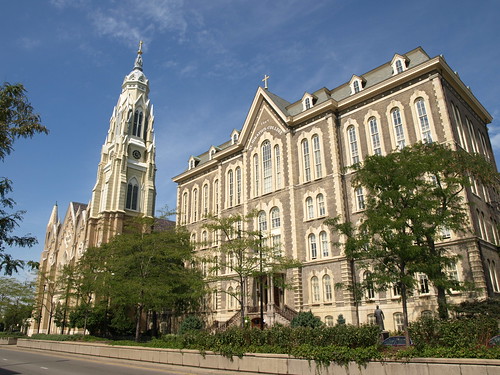
Continuing my magical history tour, I drove up to Taylor Street, had a Blue Raspberry Italian Lemonade at Mario's (which as the sign says, has been there since 1954), took a photo of my long-loved original location of Al's #1 Italian Beef and drove past the stately St. Ignatius High School and the church with a beautiful tower next to it.
I then headed southeast, where I was able to drive into the grounds--and even enter the main building--of the South Shore Cultural Center, which used to be the ornate South Shore Country Club, has a still-in-use 9-hole public golf course and is where Barack and Michelle Obama were married in 1992.
But for me, the main draw for the South Shore Cultural Center--which in getting to at 71st & LSD had me the only white face for blocks on end--was that it was used as the Palace Hotel for the final concert in The Blues Brothers (just the exterior, the interior shots were done at the Hollywood Palladium).
But the interior of what is now the Cultural Center is ornate and spectacular in its own right and is home to the Parrot's Cage restaurant, operated by the Washburne Culinary Institute.
I was also able to walk out back and practically right up to the lake.
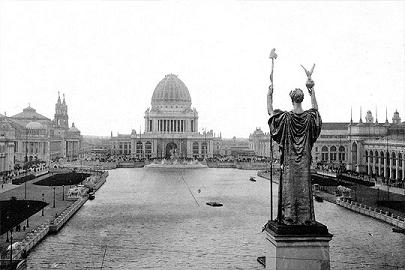
Finally on my day of exploring some of Chicago's storied--and cinematic--past, I drove to Jackson Park, scene of the Columbian Exposition, aka, The Chicago World's Fair of 1893.
It has always fascinated me that what looked like a huge old Roman city existed in Chicago over 100 years ago and then disappeared (except for the Museum of Science and Industry building, which was the Palace of Fine Arts at the Fair). As I understand it, most of the structures of "The White City" were meant to be temporary, so even if a fire hadn't burned them down in 1894, they likely wouldn't have survived until today.
But in addition to enjoying the MSI and seeing photos and even virtual interpretations of the Columbian Exposition, I also love the beautifully gilded--albeit 1/3 scale--1918 replica of Daniel French's Statue of the Republic (also known as Columbia) that sits in Jackson Park on the former site of the fair's Administration Building (the current statue is atop this post; the original stands across the Grand Basin from the Administration Building in the 1893 World's Fair photo at left).
I wanted to explore a bit more of Jackson Park, including the Wooded Island and the bridge that was used for the Nazi rally scene in the Blues Brothers, but it was getting late and there seemed to be some potentially shady dealings going on in the park's parking lot, so it didn't feel too prudent to be wandering around snapping photos.
But all in all it was a great day (re)discovering part of Chicago's wonderful history and I look forward to similar future excursions.
On Monday, after some business to attend to in downtown Chicago, I made a point of stopping at the Chicago History Museum on my way northward.
It had been quite awhile since I visited the building on North & Clark formerly known as the Chicago Historical Society, at which I had enjoyed some special exhibitions in the past. Although I could have gone for free on the first weekend of May as part of Bank of America's Museums on Us program for customers, I had noted that all Mondays are free at the History Museum, so though I couldn't get there until about 3:00pm and closing time is at 4:30pm, I figured I'd see what I could and perhaps visit again.
But while I enjoyed some of what I saw and valued learning a bit more about various famous events in Chicago's past--such as the Haymarket Square Riot and 1968 Democratic National Convention--90 minutes was plenty and I'm sure glad I didn't pay the normal $14 adult admission fee.
For despite recently rebranding itself to expand its appeal, the Chicago History Museum just feels woefully stuck in the past. Sure it provides some decent information about a number interesting topics, and certainly justifies an occasional free visit, but there really isn't a whole lot to look at that feels truly compelling.
For instance, I have long been intrigued by Chicago having hosted two World Fairs, particularly the Columbian Exposition of 1893, at which a glorious "White City" was constructed on Chicago's south side, but destroyed by fire soon thereafter (the Museum of Science and Industry occupies the only remaining building). This topic is covered at the CHM in a few panels of text and photos, and a couple small artifacts like the "I Will" bust above. In this digital age, why not have a virtual White City created, so that visitors can get a real sense of this magnificent moment in Chicago's past? Or at the very least have a physical model built?
Chicago's relatively short but quite deep history in the realms of architecture, music, theater, television and sports are also covered in rather tepid displays, with almost nothing providing an "Oh, wow!" moment.
Sure, there was a Playboy Bunny outfit--the first service uniform to be registered with the U.S. Patent and Trademark office--and a Schwinn bicycle and a couple lesser Frank Lloyd Wright art glass windows and a police helmet from the 1968 DNC riots, but would it be so hard to let visitors try their hand at Bozo Buckets, play old Bally Pinball Machines or even watch a collection of Michael Jordan highlights? Or how about having an interactive Chicago Gangster (and/or Politician) Hall of Shame? And given Chicago's great diversity, how about computerized displays highlight the various neighborhoods and communities, coupled perhaps with a concession stand featuring food of various ethnic origins?
Theoretically, I have no problem with history being primarily something that should be read about, but with half the world now able to access Wikipedia and the entire Web on their cell phones, and therefore capable of instantly learning far more about any subject covered in museum display text without reading any of it, the Chicago History Museum really has to figure out how to "engage" 21st century visitors.
There are currently two new exhibitions going on; one is a roomful of nothingness about the Lincoln Park area while the other, a multimedia presentation called My Chinatown, sounded promising but runs every 18 minutes with no indication of exact start times, so unless you happen to be at the auditorium doors at just the right moment, you can't see it (which I didn't).
The most famous relic in the museum's collection--Abraham Lincoln's death bed--is currently inaccessible. All the more reason not to pay $14.
I did enjoy seeing what an old 'L' car looked like, learning a bit about Fort Dearborn and discovering why Chicago is so named (it comes from an Indian word meaning wild onion).
But my favorite piece of previously unbeknownst trivia was that the birth control pill was patented and first marketed by Searle, in my hometown of Skokie.
Interestingly, this bit of information was paired with a panel about another Chicago scientific breakthrough: the first nuclear chain reaction--created by Enrico Fermi and others at the University of Chicago in 1942-- which made the atomic bomb possible.
Tellingly, with deference to the significant amount of knowledge it can impart to visitors of all ages and the value of free admission Mondays, the Chicago History Museum really needs to be newly conceived. For right now, on an acute enjoyment level, it's a bit of a bomb.