Showing posts with label Impressionism. Show all posts

Monday, July 08, 2013

Fashionable Exhibit Paints Pretty Impressive--If Not Entirely Impressionistic--Picture -- Art Exhibition Review

Édouard Manet, La Parisienne, 1875
Art Exhibition Review

Impressionism, Fashion and Modernity
The Art Institute of Chicago
Thru September 22
@@@@1/2
Exhibit website 
 
As someone who has visited well over 100 art museums around the world, it is with a rather small amount of acknowledged homerism that I say the Art Institute of Chicago has one of the very best collections of Impressionism--and Post-Impressionism, as per Seurat's pointillist masterpiece, A Sunday Afternoon on the Island of La Grande Jatte--anywhere in the world.

Two other museums about which the same can certainly be said are the Metropolitan Museum of Art in New York and the Musee d'Orsay in Paris.

So it would serve to reason that an impressionism exhibition organized by these three prestigious institutions would be pretty impressive. And Impressionism, Fashion and Modernity certainly is, even beyond the art contained within.

While I highly recommend the exhibit to anyone who finds themselves in Chicago before September 22--note the free admission opportunities provided to Bank of America customers on the first weekend of every month--if you only have two hours to spend in the Art Institute, you're apt to find a greater swath of amazing impressionist works in the general collection. (The same is also true in the Met and Musee d'Orsay, where this exhibit previously ran.)

Édouard Manet, Woman Reading, 1879/80
But especially as exhibit entrance is included in the museum's general admission fee, and at least three of the Art Institute's greatest impressionist works--La Grande Jatte, Caillebotte's Paris Street, Rainy Day and Renoir's Woman at the Piano--are currently displayed as part of the special exhibit, it is well worth any part of your time you can allocate.
"The latest fashion...is absolutely necessary for a painting. It's what matters most."
-- Édouard Manet, 1881 (posted on the first wall of the exhibit galleries)
Even for those who don't truly have a passion for fashion--uh, me--Impressionism, Modernity and Fashion showcases an impressive array of artists, paintings and accompanying dresses.

For example, the exhibit--which does not allow photography; the picture below is from this article by Jill Krementz about the Met showing--complements Claude Monet's Madame Louis Joachim Gaudibert, from 1868, with a similar ensemble nearby.

Interestingly, this and other early Monet works that are included actually seem to pre-date his foray into impressionism; they are much more realistic than his art would become.

And while are several shining examples of impressionism as I perceive it--by Monet, Manet, Renoir, Cassatt and Caillebotte, among others--the artist best represented, both by number of works and, arguably, collective quality, is James Tissot, who while depicting Parisienne fashions in the exhibit's 1860's-1880's epoch, cannot be considered an impressionist.

But he painted pretty pictures, several of which are included in the exhibition (a few of which I'll show below).

Yet what makes this exhibit especially appealing, as I referenced above, is the way it's put together beyond the artworks themselves.

Every work of art in the show is accompanied by a placard that not only gives the artist and title, but a concise yet informative description of the work. In many exhibitions, only selected works get this treatment.

Albert Bartholomé, In the Conservatory (Madame Bartholomé), ca. 1881
Beyond the dresses, other complementary materials--such as fashion plates (essentially advertisements) and magazines in which they ran, accompanied by a notation that they served as points of reference for Monet and Cezanne--are excellent.

So are the galleries themselves, which try to match the types of fashions contained within. For example, the room that showcases portraits of people outdoors has faux-grass flooring, park benches and the sound of birds chirping.

And while most of the clothes are merely representative of those depicted in the paintings, a portrait by Albert Bartholomé of his wife--In the Conservatory (Madame Bartholomé), ca. 1881--is paired with the exact dress she wore, which he preserved after her premature death.

Thus, while some--uh, me--might prefer the Art Institute's Van Gogh masterpieces and even Monet's paintings of haystacks, water lilies and the Japanese bridge to some of the pictures in the Impressionism, Fashion and Modernity exhibit, the wonderfully-curated show is a rather remarkable work of art in itself.

So try to get to it, even if you have to hustle and, uh, bustle.

For those who can't, in addition to some highlights I'll include below, you may wish to reference the Art Institute exhibition page, the much more thorough Metropolitan Museum of Art exhibit section and the article about the New York run referenced above.

And particularly because I found several of the artwork images upon it, wikipaintings.org is a great website to know about for anyone who loves art.

---
Edgar Degas, Sulking, 1870
Claude Monet, Camille, 1866
Pierre Auguste-Renoir, The Loge, 1874
Renoir, The Swing, 1876
Henri Fantin-Latour, Portrait of Édouard Manet, 1867
Henri Gervex, Rolla, 1878
Henri Guérard, The Assault of the Shoe, 1888. An etching done after the death of his wife, Eva Gonzalès,
whose paintings of pink slippers are included in the exhibition.
James Tissot, Portrait of Mademoiselle L.L., 1864
Tissot, Evening, 1878
Tissot, Portrait of the Marquise de Miramon, 1866
Accompanying the painting was a piece of the actual peignoir depicted:


Tissot, The Circus Lovers, 1885

Monet, Luncheon on the Grass (left panel), 1865–66
Gustave Caillebotte, Paris Street, Rainy Day, 1877
Caillebotte, Le Pont de l"Europe, 1876
Georges Seurat, A Sunday Afternoon on the Island of La Grande Jatte, 1886

Thursday, January 05, 2012

In Exhibit of Big Name Impressionists, Federico Zandomeneghi Makes a Surprising Impression -- An Art Exposition


Last Saturday, on the last day of 2011, I went on an excursion to the Milwaukee Art Museum. Although I had already visited "Brew Town" a few times during the year, as tends to be typical, and never need an excuse to see--in Santiago Calatrava's Quadracci Pavilion addition--the most beautiful building built in America this century, my impetus was an exhibit called Impressionism: Masterworks on Paper. 

In my own head, it was notable that I had visited the Louvre in Paris on the first day of December. And though over the three days prior, I had seen wondrous works of Impressionism at London's National Gallery and Courtauld Gallery, especially in not having time to once again visit the Musee d'Orsay--Paris' great repository of Impressionism--it seemed rather apropos to see this exhibit on the last day of December. Some kind of abstract symmetry or something.

The exhibit, which opened in October, closes this Sunday, so I won't write a full-fledged review, but highly recommend that those so inclined get to it if possible.

On the Seth Saith @@@@@ rating scale, I would award the exhibit @@@@, as focusing primarily on drawings, I can't say that it was quite as exciting as roomfuls of paintings by the masters of impressionism, but it was extremely worthwhile in providing complementary insight.

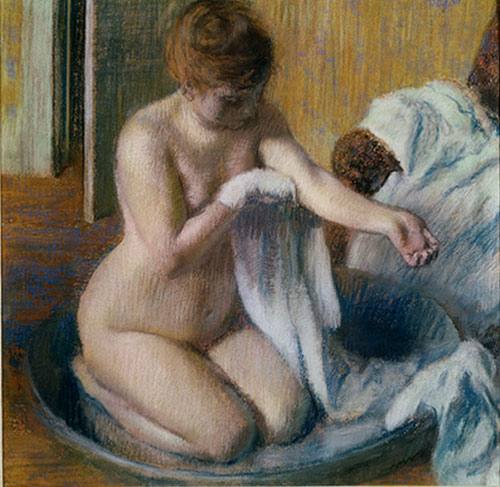
I enjoyed seeing drawings--from black line drawings by Seurat that looked nothing like his paintings to full-fledged pastels by Degas (as at left) that were just as beautiful as his oils--by almost all of Impressionism's main superstars. Besides the aforementioned, these included Monet, Manet, Renoir, Cezanne, Van Gogh, Toulouse-Lautrec, Pissarro, Gauguin, Morisot, Cassatt and Signac.

Those who won't make it to Milwaukee may derive value from viewing the exhibition website or an even more in-depth teacher's resource that I stumbled upon.

I should mention that in addition to about 8 galleries of drawings, there were a few paintings, mainly from the museum's permanent collection, but also including this lovely Renoir, borrowed from Pittsburgh's Carnegie Museum of Art after the MAM won a gentleman's wager when the Packers beat the Steelers in the 2011 Super Bowl. And though it's not in the exhibit, but rather the MAM's main collection, this painting by Caillebotte is an impressionistic masterwork that shouldn't be missed.

Beyond seeing many excellent and informative drawings--plus a few paintings--by Impressionists (and technically, post-Impressionists) with whom I have long been familiar, even if to a lesser degree such as Redon and Boudin, I was struck by the number of exquisite works by artists whose names I didn't recall.

I have never been an art scholar, but long an avid amateur aficionado, fortunate to have visited many great art museums around the world. Though my memory isn't what it used to be, I have come to know of hundreds of artists across many eras and genres, with the Impressionists long being among my favorites.

So for an Impressionism exhibit in Milwaukee to have among Monet, Manet, Renoir, Pissarro, Van Gogh, etc., works by at least four of their contemporaries whose names--Jean-Louis Forain, Armand Guillaumin, Eva Gonzales and Federico Zandomeneghi--didn't ring a bell, was surprising, but also intriguing and even, in a curiosity-sparking sort of way, exhilarating.

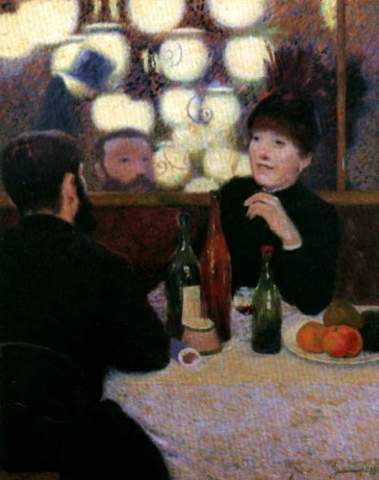
Of the "unknowns," the works of Zandomeneghi--including "At The Fireplace" at right (photo not by me)--were my favorites, and even outshone some of his more famous compadres.

The picture at the top of this piece, titled "Place d'Anvers, Paris" from 1880, is not part of the Milwaukee exhibit. Perhaps that's because it is a painting, not a drawing, but of the relatively sparse array of Zandomeneghi's works that I could find online--this is the best gathering--most seem to be held in private collections, not museums.

Federico Zandomeneghi does have a Wikipedia entry, but it too is very scant, and there are seemingly no English-language books about him I can buy or borrow.

As you might deduce from his name, he was Italian, born in Venice in 1841, but moved to Paris in 1874 and remained there until his death in 1917. He became a close friend of Edgar Degas and his works were included in four of the groundbreaking Impressionist exhibitions (1879, 1880, 1881, 1886). So he seemingly wasn't painting in complete obscurity, unknown in his lifetime.

I have to imagine that in Paris around 1870-1890, there must have been hundreds or thousands of Impressionist-type painters who just weren't worthy of being shown at the Salon (the main exhibition), or if they were, have been forgotten by history, deemed lesser than the legends. After all, not just everyone could have the talent of Renoir and Seurat, et. al.

You've got to figure that beyond the 10-20 Impressionists (and post- and neo-Impressionists) that remain widely revered, the next best 100 or so still had to be blow-your-mind good. Perhaps they didn't become adored by savvy collectors at the time, or by museum curators years later, and maybe their paintings remain hidden in some attic. Who knows?

Perhaps there's a reason I didn't know Federico Zandomeneghi's name (or Jean-Louis Forain or Armand Guillaumin, though he at least is cited in the Wikipedia article on Impressionism).

But I liked what I saw, in the exhibition in Milwaukee and what I've been able to find online since. Probably not all that surprisingly, Zandomeneghi's paintings seem to be a blend of Degas and Renoir. Here are some more examples of an Italian Impressionist, about whom I am now glad to know.