Les Misérables
Drury Lane Oakbrook
Thru June 8
@@@@@
"It's as good as Broadway," was the first thing I heard when the lights came up at Intermission, from the woman sitting next to me, although she was actually speaking to her two companions.
So I turned to her and said, "I saw it last year in London and this is every bit as good."
When I returned to my seat for the start of Act 2, the man sitting on the other side of me asked, "Did you say you saw it in London and this is just as good?"
To which I explained that there was something really cool about seeing Les Misérables in London, where the original production has been running since 1985, and that there--as on Broadway and in downtown Chicago theaters on multiple tours--it can be presented on a considerably grander scale.
But without being able to recall with any exactitude the vocal timbre or acting quality from character to character, I don't think that had I seen the Oakbrook performance in London I would have loved it any less--or vice-versa any more.
And it--my pick for the best musical of all-time, but my second favorite (behind The Producers)--was absolutely fantastic in London, as well the last time I saw it in Chicago, in a revamped, slightly smaller version for the 25th Anniversary U.S. Tour. I have also seen the show on Broadway and several other times in Chicago.
 So it is really saying something to note how thoroughly terrific it is at the Drury Lane Oakbrook.
Not this should sound all that surprising to those--including a large subscriber base--who have patronized (in a good way) the venerable venue now in its 30th year in operation, or those who know that Drury Lane Theatres have been part of the Chicagoland scene since 1949.
Although DRO has a smaller proscenium stage than at large Broadway, West End or Chicago theaters, it has a capacity around 950, which is more than several official Broadway theaters and within 150 seats of many others. All the seats for Les Miz looked filled on Sunday evening, and extrapolated over 80 performances, that's up to 76,000 people who may see this show, many more than a typical 2-week downtown run of a non-blockbuster Broadway tour reels in.
So the stellar work regularly being presented at Drury Lane Oakbrook under the auspices of Kyle DeSantis, who took over after his legendary grandfather Tony passed away in 2007, shouldn't shock those who have paid attention.
Over the past few seasons, I have seen sublime, world-class renditions of Ragtime, Cabaret, Singin' in the Rain, Sweeney Todd, Hairspray, The Sound of Music and Next To Normal, and I no longer live 15 minutes away, as I did when I first went to DRO in 2001.
Yet something about the suburban location, the theater being housed within a multi-use banquet facility and the reasonable ticket prices may prompt some incredulity about Drury Lane staging Broadway-quality productions. (Though prices have increased with the quality of the shows, Les Misérables can be seen for $45 through the DRO box office and considerably less on Goldstar, my option.)
I am sure there are many avid musical theater lovers in Chicago who will go to New York--where Les Miz has been remounted--or London before they even contemplate heading to Oakbrook Terrace.
That's their loss.
 And while I hope those attending the four parties simultaneously taking place at Drury Lane--on arriving, I saw many dressed to the nines--had the time of their lives, I feel a bit bad that they were oblivious to the magnificence taking place just a few yards away.
Though spatial restrictions didn't allow the scenery to quite match that of Les Miz in London, on Broadway or on tour, it the best and most elaborate set I've every seen at DRO. The staging didn't need to be quite as inventive as at Marriott Lincolnshire--where I saw a spectacular in-the-round production in 2008--but it's nonetheless rather brilliant.
Rachel Rockwell is probably Chicago's best musical theater director this side of Gary Griffin and she makes several clever choices I don't recall being previously incorporated into Les Misérables, which only adds to the emotional heft of Victor Hugo's famed storyline and Claude-Michel Schonberg's astonishing musical score. (Alain Boublil is credited as the original musical's co-creator, with Herbert Kretzmer writing the English lyrics.)
Though I always innately admire the work of set and lighting designers, here it was so good as for me to make a point of noting and citing Scott Davis and Greg Hoffman, respectively. Video projections to support the set, created by Sage Marie Carter, were also superb, as was the costuming by Erika Senase and Maggie Hoffman.
The 16-member orchestra, under the musical director of Roberta Duchak and conducted by Ben Johnson sounded strong if--likely due to spatial limitations--not as robust as larger ones in bigger venues.
Yet while all the people behind the scenes and in the pit undoubtedly contribute greatly to just how great this production is, it is the cast and their vocal prowess that most acutely renders apt the comparison to London and Broadway.
 Ivan Rutherford, who plays Jean Valjean here, has played the role on Broadway, as well as on tour and at other regional theaters, more than 2,000 times in total.
He is terrific, and delivers "Bring Him Home" as well as I can recall.
Only devout Les Miz lovers may truly get this, but a large part of how I perceive any production of the show--from Broadway to high schools, where I've also seen it--is in how well the spotlight numbers are delivered.
And every one at Drury Lane is excellent, including Jennie Sophia (Fantine) singing "I Dreamed a Dream," Mark David Kaplan and Sharon Sachs (the Thernadiers) on "Master of the House," Quentin Earl Darrington's (Javert) "Stars," Skyler Adams and Emily Rohm (Marius and Cosette) dueting on "In My Life/A Heart Full of Love" and Christina Nieves (Eponine) emoting "On My Own."
This doesn't even include the best voice of the whole bunch, Travis Taylor as Enjolras, who spearheads the trio of great choral numbers at the end of Act I. Though I've only seen Taylor in supporting roles around Chicago--Sweeney Todd at DRO, Now and Forever, an Andrew Lloyd Webber revue at the Marriott Lincolnshire--each time he has demonstrably stood out enough for me to remember his name and wonder why he isn't a leading man on Broadway.
The child actors rotate performances, but the ones I saw--Charlie Babbo as Gavroche, Ava Morse as Young Cosette--were also splendid.
 I'm running out of unused adjectives, but I think I've made my point.
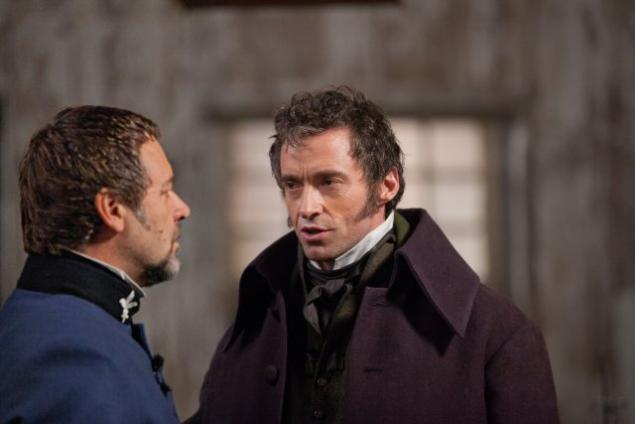
Les Misérables is one of the greatest artistic works of both the 19th and 20th century--the 2012 movie is also wonderful--and while I suspect the musical will play grand opera houses in years to come, it is now being licensed to regional theaters.
It cannot be an easy musical to do justice, but the Drury Lane Oakbrook more than does.
If you love Les Miz, it is well-worth the $36 (incl. fees) I paid to see how well it translates here.
And if you've never seen the show--like the guy next to me, who loved it but wondered if he was seeing it in representative form--this is a truly marvelous introduction.
Either way, you'd be folly to "Miz" it.
For "at the end of the day," culture and community are what will save us from artifice and avarice. Les Misérables not only promotes this notion, but when staged terrifically--as here--best exemplifies it.

And it--my pick for the best musical of all-time, but my second favorite (behind The Producers)--was absolutely fantastic in London, as well the last time I saw it in Chicago, in a revamped, slightly smaller version for the 25th Anniversary U.S. Tour. I have also seen the show on Broadway and several other times in Chicago.
Not this should sound all that surprising to those--including a large subscriber base--who have patronized (in a good way) the venerable venue now in its 30th year in operation, or those who know that Drury Lane Theatres have been part of the Chicagoland scene since 1949.
Although DRO has a smaller proscenium stage than at large Broadway, West End or Chicago theaters, it has a capacity around 950, which is more than several official Broadway theaters and within 150 seats of many others. All the seats for Les Miz looked filled on Sunday evening, and extrapolated over 80 performances, that's up to 76,000 people who may see this show, many more than a typical 2-week downtown run of a non-blockbuster Broadway tour reels in.
So the stellar work regularly being presented at Drury Lane Oakbrook under the auspices of Kyle DeSantis, who took over after his legendary grandfather Tony passed away in 2007, shouldn't shock those who have paid attention.
Over the past few seasons, I have seen sublime, world-class renditions of Ragtime, Cabaret, Singin' in the Rain, Sweeney Todd, Hairspray, The Sound of Music and Next To Normal, and I no longer live 15 minutes away, as I did when I first went to DRO in 2001.
Yet something about the suburban location, the theater being housed within a multi-use banquet facility and the reasonable ticket prices may prompt some incredulity about Drury Lane staging Broadway-quality productions. (Though prices have increased with the quality of the shows, Les Misérables can be seen for $45 through the DRO box office and considerably less on Goldstar, my option.)
I am sure there are many avid musical theater lovers in Chicago who will go to New York--where Les Miz has been remounted--or London before they even contemplate heading to Oakbrook Terrace.
That's their loss.
Though spatial restrictions didn't allow the scenery to quite match that of Les Miz in London, on Broadway or on tour, it the best and most elaborate set I've every seen at DRO. The staging didn't need to be quite as inventive as at Marriott Lincolnshire--where I saw a spectacular in-the-round production in 2008--but it's nonetheless rather brilliant.
Rachel Rockwell is probably Chicago's best musical theater director this side of Gary Griffin and she makes several clever choices I don't recall being previously incorporated into Les Misérables, which only adds to the emotional heft of Victor Hugo's famed storyline and Claude-Michel Schonberg's astonishing musical score. (Alain Boublil is credited as the original musical's co-creator, with Herbert Kretzmer writing the English lyrics.)
Though I always innately admire the work of set and lighting designers, here it was so good as for me to make a point of noting and citing Scott Davis and Greg Hoffman, respectively. Video projections to support the set, created by Sage Marie Carter, were also superb, as was the costuming by Erika Senase and Maggie Hoffman.
The 16-member orchestra, under the musical director of Roberta Duchak and conducted by Ben Johnson sounded strong if--likely due to spatial limitations--not as robust as larger ones in bigger venues.
Yet while all the people behind the scenes and in the pit undoubtedly contribute greatly to just how great this production is, it is the cast and their vocal prowess that most acutely renders apt the comparison to London and Broadway.
Ivan Rutherford, who plays Jean Valjean here, has played the role on Broadway, as well as on tour and at other regional theaters, more than 2,000 times in total. He is terrific, and delivers "Bring Him Home" as well as I can recall.
Only devout Les Miz lovers may truly get this, but a large part of how I perceive any production of the show--from Broadway to high schools, where I've also seen it--is in how well the spotlight numbers are delivered.
And every one at Drury Lane is excellent, including Jennie Sophia (Fantine) singing "I Dreamed a Dream," Mark David Kaplan and Sharon Sachs (the Thernadiers) on "Master of the House," Quentin Earl Darrington's (Javert) "Stars," Skyler Adams and Emily Rohm (Marius and Cosette) dueting on "In My Life/A Heart Full of Love" and Christina Nieves (Eponine) emoting "On My Own."
This doesn't even include the best voice of the whole bunch, Travis Taylor as Enjolras, who spearheads the trio of great choral numbers at the end of Act I. Though I've only seen Taylor in supporting roles around Chicago--Sweeney Todd at DRO, Now and Forever, an Andrew Lloyd Webber revue at the Marriott Lincolnshire--each time he has demonstrably stood out enough for me to remember his name and wonder why he isn't a leading man on Broadway.
The child actors rotate performances, but the ones I saw--Charlie Babbo as Gavroche, Ava Morse as Young Cosette--were also splendid.
Les Misérables is one of the greatest artistic works of both the 19th and 20th century--the 2012 movie is also wonderful--and while I suspect the musical will play grand opera houses in years to come, it is now being licensed to regional theaters.
It cannot be an easy musical to do justice, but the Drury Lane Oakbrook more than does.
If you love Les Miz, it is well-worth the $36 (incl. fees) I paid to see how well it translates here.
And if you've never seen the show--like the guy next to me, who loved it but wondered if he was seeing it in representative form--this is a truly marvelous introduction.
Either way, you'd be folly to "Miz" it.
For "at the end of the day," culture and community are what will save us from artifice and avarice. Les Misérables not only promotes this notion, but when staged terrifically--as here--best exemplifies it.