Showing posts with label Museum Exhibit Review. Show all posts

Sunday, November 26, 2017

An Inspiring Addition: Futuristic Technology Preserves Ever Present Past in Illinois Holocaust Museum's 'Take A Stand Center' -- Museum Exhibit Review

Exhibition Review

Take A Stand Center
Illinois Holocaust Museum
and Education Center, Skokie, IL
Permanent Addition
@@@@1/2

"Your generation should continue to learn and make sure it doesn't happen again in the future.

"Otherwise there will be no future."

Holocaust survivor Sam Harris recently voiced these powerful sentiments at the Illinois Holocaust Museum and Education Center, in response to a question about the lessons that can be learned from his harrowing experiences.

Audience members understandably had many more queries--"How did you survive?," "What happened to your parents?," "Do you have nightmares?--and from his chair onstage the eloquent 82-year-old Harris answered them all...adroitly, candidly and poignantly.

Only thing is, Mr. Harris--the President Emeritus of the museum, whose creation he was instrumental in facilitating--wasn't actually present.

Nor, as some may have surmised, was he appearing via Skype, FaceTime or any other form of live video streaming. 

Rather, within the Abe & Ida Cooper Survivor Stories Experience that is the centerpiece of the museum's new Take A Stand Center, we were seeing, hearing and interacting with Sam Harris in holographic form.

And thanks to leading-edge 3D interactive technology that the Illinois Holocaust Museum is the first in the world to employ, answers that Harris recorded in a Southern California studio--along with 12 other Holocaust survivors--were triggered by questions posed by audience members.

Having sat through two sessions in which Mr. Harris first tells his story via video vignette--after the Nazis overtook his native Poland and sent his parents to perish in the Treblinka concentration camp, he was put into the Deblin camp by his older sister Rosa (as a protective measure) and later transferred to another, Czestochowa--and then asks for questions as he holographically appears onstage, I noted that there will understandably be some inquiries he, and the other participating survivors, just aren't programmed to answer or address.

Museum docents serve as moderators, rephrasing audience member questions--many presumably from inquisitive school kids--to best trigger the appropriate response, with answers from the loquacious Harris often extending far beyond what was specifically posed.

But this actually makes it feel more realistic, and the experience--featuring technology developed by  the USC Shoah Foundation's New Dimensions in Technology program--really is quite impressive and informative.

For now through the end of 2017, the holographic theater is featuring seven Chicago-area survivors long connected to the museum, which the Holocaust Memorial Foundation of Illinois originated in 1981 in a Skokie storefront before the striking Stanley Tigerman-designed building opened at 9603 Woods Drive near Golf Road, in 2009.

Check the Take a Stand Center website for the current and ongoing schedule, which in addition to Sam Harris, includes sessions with Fritzie Fritschall, Aaron Elster, Adina Sella, Izzy Starck, Janine Oberrotman and Matus Stolov.

In speaking with the museum's Communications Manager, Amanda Berrios, my understanding is that in the new year, the holographic Q&A sessions will also feature the six non-Chicagoland survivors who participated in the recording sessions, while repeating the local seven.

Perhaps exacerbated by the reality that I expressly visited the Take A Stand Center--which also has several powerful components complementing the Cooper Survivor Stories holographic theater--and did not walk through the museum's longstanding core, the Karkomi Holocaust Exhibition, yet again, my sense was that it could be fulfilling to see more than one survivor's story in a given visit.

I don't know if on-demand sessions, or multiple survivor stories being scheduled in a given day is in the offing--at present, each session starts on the hour, but even with numerous posed questions only seemed to last about 30 minutes--but as it happened I was able to speak briefly, in person, with Adina Sella, who had come to give family members the chance to view her hologram.

As I had been touring the Goodman Upstander Gallery and missed the start of Dr. Sella's special session, I wasn't able to see any of it, but greatly valued being able to talk to her for a few minutes as we waited for my second session with the virtual Mr. Harris to begin.

"Children do get damaged; childhood has a purpose," shared Adina, in noting that while she felt quite fortunate that she, her parents and brother all survived the Holocaust by hiding from German troops for several years, she recognizes the repercussions of constantly keeping oneself hidden, having to steal food, distrusting nearly everyone, fearing footsteps, etc.

"You can be a chameleon, but never an authentic self, who--like most kids--learns to assess and deal with fear and threats," Dr. Sella, who has long been a psychologist, continued as I sat engrossed.

So even beyond children who died in camps or on trains or lost members of their immediate family, I was getting a grim first-hand account of how devastating the Holocaust also was for kids--like her--who were deprived the "experience of normalcy" vital to one's development.

As she spoke, I couldn't help but think of the Illinois Holocaust Museum's excellent and ongoing--to January 7, 2018--temporary exhibit on the late rock 'n roll promoter Bill Graham, which I had toured and reviewed in August.

Somewhat akin to Adina Stella, Graham--born Wolfgang Grajonca in Berlin--was a fugitive from Nazi hunters for much of his childhood, before eventually coming to America as a refugee. Sadly, Graham's mom and one of his four sisters would perish in the Holocaust.

[This coming Wednesday, November 29, the Holocaust Museum will be hosting an evening concert in which a local band, Mr. Blotto, will perform songs by acts Bill Graham had showcased at New Year Eve shows at New York's Fillmore East in the '60s and '70s. Tickets for this event allow for touring the Bill Graham & the Rock 'n Roll Revolution exhibit, but presumably not the Take A Stand Center or other parts of the museum.]

The harrowing childhood accounts of Adina Stella and Bill Graham also reminded me of a "survivor talk" by the now-passed Walter Reed I had attended at the museum a few years ago and wrote about here. (Survivors involved with the museum have long been on hand to speak with school groups, and each month there is a public "Survivor Talk," which are listed here.)

Although being able to speak with Holocaust survivors, with great realism in the Cooper Survivor Stories theater is the most newsworthy aspect of the Take A Stand Center, I found the Upstander Gallery and Take A Stand Lab nearly as compelling. 

One of the challenges I think any museum devoted to the Holocaust faces--and I've been to many, including the U.S. Holocaust Memorial Museum in Washington, DC, Yad Vashem in Jerusalem and the Holocaust Memorial Center near Detroit--is how to document the nearly unfathomable decimation of 6 million European Jews at the hands of Adolf Hitler and Nazi Germany 70+ years ago in a way that makes this horrific history both resonant and actionable in the modern day.

The vast numbers of Holocaust survivors who eventually relocated to my hometown of Skokie and, with assuredly many others, spurred the development of the Illinois Holocaust Museum and Education Center are to be forever admired and lauded for--despite the deep pain it resurfaces, per Sam Harris--making "Never Forget" quite tangible.

But the "Never Again" corollary is a rather formidable challenge, not just on a micro level with many of the survivors passing on--undoubtedly one of the reasons behind the holographic testimonies--but on a macro one, as hardly a day goes by without hearing of the massacre of civilians, hate crimes and even ethnic cleansings somewhere in the world.

So in noting that the Skokie museum has added a tagline of "Take history to heart. Take a stand for humanity." it was especially pleasing to see not only how the other aspects of the Take A Stand Center well complement the Survivor Stories but also add contemporary inspiration and urgency to the baleful lessons of the IHMEC's permanent exhibition. (The museum has raised its standard admission fee to $15, but it includes all parts of the Take A Stand Center--though guests must set an entry time for the holographic theater--and special exhibits such as the one on Bill Graham.

Though spatial considerations may dictate taking things in a different order on crowded days, the Cooper Survivor Stories holographic theater is the first stop in the Take A Stand Center.

The theater's exit doors lead to a couple of wall displays about the Universal Declaration of Human Rights.

Adopted by the United Nations in 1948 as a response to the Holocaust, this document--expounding a set of Human Rights--serves as a framework for a fine set of on-demand video vignettes at stations next to the Upstander Gallery.

Selectable videos--and nearby wall text--address the topics of Education, Safe Communities, Equal Rights, Economic Opportunity and Health & Education. Each video is under two minutes, but quite compelling in outlining a fundamental right that has failed to reach many in the world, and then chronicling "Upstanders" and their efforts to change things.

Some of the factoids that struck me include:

● Nearly half the world's population do not feel safe from torture 

 ● An estimated 150 million children worldwide are forced into child labor

● Around 700 million people around the world live on less than $1.90 a day

● More than half the world's population has no access to healthcare

● The unemployment rate for African-Americans is about twice that of white Americans at every level of achievement

Further showcased in the subsequent gallery, Upstanders include famous names such as Nelson Mandela, Jane Addams and Malala Yousafzai, but also many impressive individuals of various ages and backgrounds whom I admittedly didn't know, such as Craig Kielburger, Henry Cervantes, Jack Andraka, Ma Jun and Dr. Raj Panjabi.

This is somewhat the point, as both through biographical trilons that can be spun to learn more about each upstander--while seeing oneself in mirrored imagery--and interactive displays that go a bit more in depth about each subject, one can readily learn how soccer star Carli Lloyd is championing equal pay for female players or how Theaster Gates is helping to rebuild Chicago's south side.

While the information to be found in the Take A Stand Center should be educational and inspiring to those of any age, the Illinois Holocaust Museum attracts many school groups, and the user friendly nature of the exhibits should make it particularly accessible, digestible and even actionable for kids.

Toward that end, the Take A Stand Lab has interactive screens in which users can input aspects of their personality and get suggestions for tangible ways to make an impact, complete with helpful resources that can be immediately emailed.

On a nearby wall, museum visitors are invited to Make-A-Pledge committing their efforts to a given cause or vowing to be an upstander, and a nearby display contains panels highlighting "Success Stories" among upstanding individuals and organizations.

These range from the Ice Bucket Challenge benefiting the ALS Association to Civil Rights Activist & Congressman John Lewis to the annual charity drive of Highland Park High School.

The final physical component of the Take A Stand Center is The Act of Art gallery showcasing artworks reflecting the museum's mission.

Here there is some striking artwork that previously was on the museum's upper level and likely often missed by weary visitors.

It's nice to see the fine collection being given more prominence, but it still may wind up being passed by rather quickly.

And while the Take A Stand Center in whole makes a terrific addition to the Illinois Holocaust Museum & Education Center, I think one of the challenges it creates is how patrons should fit it into a holistic museum visit.

For museum members and locals like me who can get to the IHMEC multiple times per year, the Take A Stand Center is well-worth its own visit. The nearly 3 hours I spent is far more than most visitors will need, as I was gathering notes, taking copious photos, engaging in conversations, listening to Mr. Harris twice, etc.

Naomi Tereza Salmon, Asservate
Until the Bill Graham exhibit closes on January 7, it would seem some visitors might well opt to pair that Special Exhibition with the many facets of the Take A Stand Center.

The somewhat tricky part, as I see it, is that first-time visitors to the museum should first spend 1-2 hours in the Karkomi Holocaust Exhibiton, as it not only provides a thorough overview of the Holocaust, it gives context to all of the other exhibits, including the Take A Stand Center.

But if properly ingested, the main exhibition should be emotionally grueling, as the Holocaust is likely the worst thing that's ever happened.

So thinking of one's psyche, as well as just general museum fatigue, I would suggest out-of-town tourists and other first-timers budget at least 4 hours for their visit to the Illinois Holocaust Museum & Education Center. This would include about an hour-long break--perhaps spent getting a bite at Old Orchard or strolling the nearby Harms Woods--allowing for a breather between the Karkomi Holocaust Exhibition, the Survivor Story hologram, the rest of the Take A Stand Center, and then perhaps special exhibits. (The admission fee allows for leaving and re-entering the museum within the same day.)

On my recent visit, primarily devoted to the Take A Stand Center, I also dashed through the excellent Bill Graham exhibit once again and then discovered some fine exhibits on the upper level, which also houses two reflection halls certainly worth some time.

I was particularly moved by BESA: A Code of Honor, which gathers photographs--by Norman Gershman--and stories of "Muslim Albanians who rescued Jews during the Holocaust."

Along with a sizable and lively youth exhibition space designed to illuminate and inspire younger kids, there is also a hallway reproducing pages from a booklet called How It Is But How It Should Be, which a Holocaust prison camp internee named Trudl Besag had written and illustrated for a barracks mate.

So there is a whole lot to be seen and contemplated at the Illinois Holocaust Museum and Education Center, to which the Take A Stand Center makes an excellent addition.

And there's no reason repeat visitors can't properly see everything in due time; the museum is meant as an everlasting resource to battle evil and inspire heroism. Understanding the events and lessons of the Holocaust shouldn't just entail a 2-hour one-time museum visit, and the Take A Stand Center can be pivotal in connecting the bitter past to a better future.

In fact, where the village of Skokie was once well-known for its vast community of Holocaust survivors, it's now noted for its tremendous diversity, celebrated each year through the town's Festival of Cultures and the Coming Together in Skokie programs.

I don't see it as mere coincidence that a group of people who had borne first-hand witness to the very worst of mankind and pledged to fight hatred has led to a suburb that distributes lawn signs proclaiming:

"Skokie Welcomes Everyone."

Such tolerance, respect and neighborly kinship for those of differing races, religions, cultures and colors would seem to be what the Take A Stand Center is all about.

And intended to--eternally and entirely--inspire.

Sunday, August 06, 2017

Presenting Bill Graham: Impressive Exhibit Chronicles Rock Impresario, Holocaust Survivor -- Museum Exhibition Review

Exhibit Review

Bill Graham and the Rock & Roll Revolution
Illinois Holocaust Museum & Education Center
Skokie, IL
Thru November 12
@@@@1/2
Website

Though not for lack of trying, I am not the marketing director for the Illinois Holocaust Museum & Education Center, nor ever employed there in any capacity. (I once interviewed for the role and was told I would continue to, but it didn't happen.)

So questions about the propriety of showcasing rock 'n roll memorabilia within a museum devoted to chronicling the genocide of 6 million Jews and millions of other victims in hopes of preventing such horrors from happening again aren't really mine to answer.

I live 5 minutes from the Skokie museum and have viewed its permanent collection multiple times, and in availing myself of Bank of America's generous Museums on Us program to cover the $12 general admission fee I was able to dedicate a visit strictly to Bill Graham and the Rock & Roll Revolution, a special exhibit costing $5.

As I will detail, the exhibition was superb, as it reflects on the late rock promoter fleeing Nazi Germany--unlike less fortunate members of his Jewish family--while also exhibiting an impressive array of artifacts tied to his career and the rock legends he booked into his San Francisco and New York City venues.

I'm not sure that I could have mentally digested the exhibition--in which the premature deaths of Jimi Hendrix, Janis Joplin, Jim Morrison, Duane Allman, Jerry Garcia and Graham himself unavoidably factor in--right after experiencing the harrowing permanent exhibit.

And as a thorough viewing of the Graham exhibit can take up to 2 hours, seeing it first may well create museum fatigue not allowing for proper intake of the main collection.

So although it's not really my concern, I'd advise those drawn to Skokie by the rock show yet required to pay $17 for a one-day-only visit arrive as the museum opens around 10:00am, view Bill Graham and the Rock & Roll Revolution, head to the nearby Old Orchard Mall (or Portillo's, Culver's, etc.) for some lunch, and then return to give the Holocaust exposition proper attention. (I've been told it's permissible to leave & come back within the same day.)


With an extravagant butterfly costume Bill Graham wore to one of the Grateful Dead New Year's Eve shows he promoted displayed just outside the actual exhibit, the well-curated show--organized and circulated by the Skirball Cultural Center, Los Angeles, in association with the Bill Graham Memorial Foundation--occupies the entirety the museum's downstairs exhibition hall.

The first several panels--though I would have welcomed even a few more--chronicle Graham's early life, beset by considerable trauma and tragedy.

He was born Wolfgang Grajonca in Berlin in January 1931, and his father died that same year. After members of the Hitler Youth Movement came looking to recruit him, his mom first put Bill--not yet his name--in a home for Jewish children, which the Nazis shut down. She then put him on a transport to France, and with other refugee children--including this man I wrote about in 2015--he eventually sailed to America on the Serpo Pinto.

Graham's mom Frieda died on a train headed to Auschwitz, and one of his sisters perished there at just 13. Four other sisters survived the Holocaust, either within concentration camps or by escaping the Nazis.

The early part of the exhibit features a trio of compelling video accounts by Graham's childhood friend, Ralph Moratz, with whom he escaped and later met up with in New York.

There are few video clips of Graham himself, who died in a helicopter crash in 1991 at the age of 60, but several of the placards accompanying photos and memorabilia feature quotes from him.

I was struck by this one, pertaining to his early experiences in the United States after fleeing Nazi Germany:


After noting that the name "Bill Graham" was picked out of a Bronx phone book, the focus of the exhibit rather abruptly--and quite predominantly--shifts to his career as a rock concert promoter, initially in San Francisco in the mid-1960s.

After having gotten into the entertainment world as the manager of a mime troupe, for whom he organized a benefit upon a member's arrest, Graham first promoted concerts at the Fillmore Auditorium, a Frisco venue that already existed by that name--and still does.

Displayed in the exhibition is a basket of apples that greeted patrons at the auditorium's entrance. (One presumes the apples aren't originals;)

By 1968, Graham was more heavily utilizing a different space in the city, which he dubbed the Fillmore West. He also famously ran the Fillmore East in New York, and the larger Winterland in Frisco, all of which have long since closed.

But they hosted some phenomenally gifted and influential artists, and along with several beautiful psychedelic posters promoting Fillmore shows, the exhibition showcases some prime artifacts, including:

- A guitar belonging to Carlos Santana, whom Graham had seen at a jam session and encouraged to form a band
- A cowbell Graham played with Santana at Woodstock
- A microphone and tambourine Janis Joplin played at the Fillmore West
- A guitar belonging to The Who's Pete Townshend
- An amplifier belonging to the Grateful Dead's Jerry Garcia
- A Les Paul guitar Duane Allman played at the Fillmore East in 1971, as recorded for the famed Allman Brothers' live album.
- An outfit worn onstage by Jimi Hendrix
- An outfit worn by Peter Frampton at Winterland, which is depicted on the Frampton Comes Alive album cover
- A wizard costume worn by Graham at another New Year's Eve party/concert by the Grateful Dead
- Boots worn by Keith Richards

See below for photos of most of these objects. (The exhibition allows and encourages photography.)

Although the exhibit only briefly mentions Graham's notoriously fiery temper, it conveys how his personal tempestuousness belied not only the horrors he had lived through, but a rather charitable man who organized many benefit concerts.

Bill Graham coordinated the slate of Live Aid acts who performed in Philadelphia--on hand is a guitar plate signed by Mick Jagger and David Bowie, and a microphone autographed by Ozzy Osbourne, although I don't recall the latter performing at Live Aid--and put together shows for numerous causes, including raising money for San Francisco after-school programs. 

Notably, as a Holocaust survivor, Graham took out an ad in the San Francisco Chronicle in 1985 to address an open letter to President Ronald Reagan, asking him not to visit the Bitburg concentration camp. 

To no avail.

Shortly thereafter, the San Francisco offices of what had become "Bill Graham Presents" were firebombed.

Charred remnants of the Chronicle ad and office equipment are also on display.

Sadly, after attending a concert by Huey Lewis & the News on October 25, 1991, Bill Graham, his girlfriend and the pilot were killed when their helicopter crashed into a high voltage tower.

As the exhibition had begun with a collection of photos showing Graham with family & friends prior to the Holocaust, it ends with a nice wall of pictures depicting him interacting with his kids and other loved ones.

And while the musical instruments played by rock immortals made for the biggest "oohs" and "ahs" and likely the best photos, the exhibit's merits are amplified for the way it depicts how a Holocaust survivor not only came to thrive, but to quite frequently give back.

As noted above, you'll do well to figure out how Bill Graham and the Rock & Roll Revolution best meshes with a more holistic visit to the Illinois Holocaust Museum, but on a variety of levels it is very much worth your time and attention.

---


Saturday, June 07, 2014

Exploring the 'Wonders of the 1893 World's Fair' is Worthwhile, Rest of Field Even Better (including Excellent Contemporary Art by Bunky Echo-Hawk) -- Museum Exhibit Review

Museum Exhibit Review

Opening the Vaults:
Wonders of the 1893 World's Fair
The Field Museum, Chicago
Thru October 7, 2014
@@@1/2
(Museum visit overall: @@@@1/2)

I have long been fascinated by the World's Fair of 1893, which welcomed more than 25 million people to Chicago's South Side at a time when the U.S. population was less than three times that figure.

Dubbed the Columbian Exposition, as it commemorated--albeit a year late--the 400th anniversary of Christopher Columbus' arrival in the New World, the Fair is famed for its colossal White City.

My mind is always boggled when I see photos of the conglomeration of mammoth--though mostly intentionally disposable--classically-designed buildings that once stood in Chicago's Jackson Park.

It's almost as if ancient Rome rose--largely from the imaginations of Daniel Burnham and Frederick Law Olmsted--and fell within a matter of years, with scant traces of remaining evidence. 

But three of Chicago's greatest cultural institutions today trace back to the Columbian Exposition.

No, I am not referencing the Ferris Wheel on Navy Pier, though George Ferris' giant wheel built on the Midway (the first use of that term) was the first of its kind, an engineering marvel, the centerpiece of the fair and perhaps its greatest lasting worldwide contribution.

But the original wheel didn't survive past 1906, yet two of Chicago's best museums--the Field Museum and the Museum of Science and Industry--were and are housed in the only remaining large-scale main-campus structure of the Columbian Exposition: the Palace of Fine Arts.

Following the Fair, the grand building at the north end of Jackson Park housed the Columbian Museum of Chicago, which would subsequently be renamed the Field Museum of Natural History after major benefactor Marshall Field. In 1921, the Field Museum moved to its present location a few miles north and the Museum of Science and Industry would move into the former Palace of Fine Arts during Chicago's next World's Fair, 1933's Century of Progress Exposition. 

Although the origins of the Art Institute of Chicago predate the Columbian Exposition, its main building was built to initially house the World Congress Auxiliary of the Exposition--several miles north of the fairgrounds--and the art museum moved in immediately after.

Over the years I have bought books about the 1893 World's Fair, seen museum exhibits & displays and watched short films and documentaries. (I recommend Expo: Magic of the White City.)

Still, I've been intrigued by the Field Museum's Opening the Vault: Wonders of the 1893 World's Fair exhibit ever since it opened last October, even if I only got to it last week. (Exhibit website)

I enjoyed the exhibit but only recommend it conditionally. 

Focused on artifacts displayed at the fair that are now part of the museum's holdings, the exhibit does little to showcase the grandeur of the White City itself, or the communal melting pot of the Midway, save for a few large photos and slides. 

I've always been more intrigued by the scale and architecture of the Columbian Exposition, and the visitors it attracted, than I've ever wondered much about what was displayed within the huge White City buildings. 

So in showcasing examples of botany, taxidermy, fossils and anthropology that were displayed at the 1893 Fair, the exhibit introduced me to aspects of the Exposition I hadn't ever much considered, while showcasing how the event gave birth to one of the world's great museum collections. 

I valued learning that the 1893 World's Fair was the 19th century's largest user of electricity and that some of the Field Museum's key early employees--such as taxidermist Carl Akeley, who would develop its vast zoology holdings--were individuals who had showcased their talents at the fair.

The anthropology section of the exhibit was forthright in explaining how backwards thinking in that realm was in 1893, when "savages" were put on display for spectators to observe.

Gamelan musical instrument from the Javanese Village of the 1893 World's Fair
I enjoyed reading about how 60 Labrador Inuit people who lived in a village on Fair grounds said essentially, "Forget this," and left due to degrading conditions and treatment.

And the musical instruments that were part of the Fair's Javanese Village--populated by a community from Indonesia--are the most beautiful artifacts in the current exhibit. 

So if your interest in the Columbian Exposition is as mine, and you value learning anything about it, the Field's Opening the Vaults should be worth your time.

That said, rather than pay the museum's standard "Discovery Pass" admission of $25, which includes general admission plus one special exhibit (e.g. Wonders of the 1893 World's Fair), I was able to avail myself of one of a handful of "Discount Days" for Illinois residents. (The next one listed is this Monday, June 9.)

Only having to pay $11 for the special exhibit, and using the CTA rather than pay at least $19 for the on-site parking garage, my expenditure was about 1/3 of what it easily could have been.

I don't know if for $44, I would have found the World's Fair exhibit quite as worthwhile.

And for whatever price you may pay, even if you're a Columbian Exposition aficionado I wouldn't visit the museum simply for this exhibit.

Allot some time for several of the Field's permanent collections; I greatly enjoyed seeing and photographing those on Ancient Egypt, the Ancient Americas, a modern African community and a terrific contemporary Native American artist named Bunky Echo-Hawk.
And it's always fun to see Sue, the Field's prized T-Rex. 

Japanese jar used for tea storage
In fact, I likely enjoyed the permanent exhibits more than the one I paid to see.

It was interesting how the World's Fair contributed to the Field's early collections, but much else is more visually and intellectually compelling, such as the wonderful collection of Native American masks, totem poles and more. 

Bottom line, if you go to the Field for the World's Fair exhibit, see more than just it. And if you go the Field for the rest of the museum, the exhibit may only be worth your time and money if you have a particular interest in the Columbian Exposition. 

Especially the parts I likely wouldn't have seen even if I was there in 1893.

(Along with photos of the 1893's World's Fair exhibit--in spite of a security guard erroneously telling me photography was forbidden; good thing I argued and had him ask someone who knew better--photos from other Field Museum exhibits are below. You may need to click to see them past the page break.)

Thursday, February 20, 2014

Exhibiting Animated Enjoyment: Exploring the Wonderful World of Walt Disney at the Museum of Science & Industry -- Museum Exhibit Review

Museum Exhibit Review

Treasures of the Walt Disney Archives
Museum of Science & Industry, Chicago
Thru May 4, 2014
@@@@1/2

In going to the Museum of Science and Industry for their exhibit on Walt Disney and his creations--as I have in recent years for ones on Charles Schultz & Peanuts and Jim Henson & the Muppets--I wondered if this represented an overt attempt to acclimate kids to science (and industry) to address U.S. shortcomings in math, science and technology disciplines.

But then it dawned on me that the "kids" these exhibits would most acutely appeal to are those around my age or older.

Certainly the name Disney likely still holds resonance with those aged 12 and under, due to the millions of families who travel to Disney World or Disneyland, popular recent movie musicals like Frozen and films made by Pixar under the Disney umbrella.

But if my now teenage niece and nephews are any barometer, I doubt Mickey, Minnie, Donald, Goofy and pals hold much more sense of magic among today's young than Charlie Brown, the Muppets and the Looney Tunes of Warner Bros. (a likely safe bet for a future MSI exhibit if the others have been profitable).

Far more up the alley of kids today--and even this may be very much age-dependent--is Harry Potter, the subject of a 2009 Museum of Science and Industry exhibition that I didn't attend.

So I can't say with any certitude that kids will love Treasures of the Walt Disney Archives--which unlike the Peanuts exhibit that featured a super-sized Charlie Brown, may not have anything that overtly enchants young ones--but their parents and grandparents should find much to enjoy.

Taking advantage of an MSI "free day," which meant I only had to pay $9 for the Disney exhibit and $20 to park my car, I spent nearly 4 hours at the museum including over two exploring the wonderful world of Disney.

Organized by D23, I like how the exhibit was quite informative about Walt Disney--the man, the creative genius, the businessman--while also showcasing his famous creations. (This was also a strength of the Henson and Schultz exhibits in past years.)

The exhibition galleries began with a nice short film about Walt's early years--born in Chicago in 1901, moved to a farm in Missouri at 4 and Kansas City for his teens, served during World War I, etc.

I won't describe every aspect of Disney's life as presented through informative displays, but I was impressed by the resiliency he showed despite various setbacks and huge financial risks.

His first significant undertaking--a series of Alice in Wonderland films combining animation with live action--went undistributed as his company went bankrupt. It was only because another company contacted him to resurrect the project, seemingly out of the blue, that Walt Disney had his first taste of success.

He would then create Oswald the Lucky Rabbit, his first notable cartoon character, only to somehow lose the rights and again face financial ruin. 

But his need for reinvention resulted in Mickey Mouse. 

Walt Disney's commitment to making Snow White and the Seven Dwarfs--the first feature-length
animated movie--and building Disneyland, the world's first theme park, saw him investing everything he owned, including his family's homes.

Understandably, the exhibit stayed away from any controversy or negativity regarding Disney, but as anyone perusing his Wikipedia biography would note allegations of racism and anti-Semitism, perhaps the curators would have seen to address and--if proper as some biographers have argued--refute them.

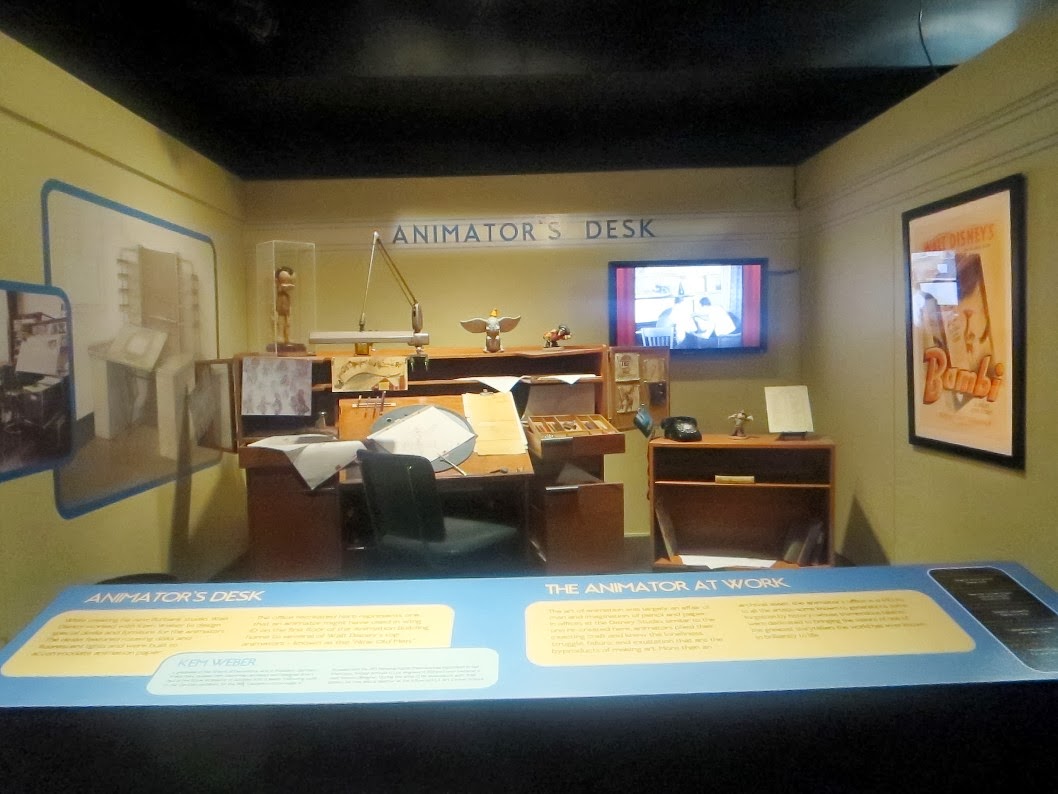
A replica of Walt Disney's office--including his actual desk--was a centerpiece of the exhibit, and the type of workspace used by a Disney animator was also on display.

I valued seeing letters written to Mr. Disney from the likes of President Roosevelt, Mary Pickford and Cecil B. DeMille, an assortment of awards including Oscar statuettes and was particularly fascinated by a display and video explaining the pioneering multi-plane camera which enabled Disney animated films brilliantly simulate two-dimensional depth and movement.

But the star attractions--especially for those of us old enough to remember and/or appreciate them--were many impressive movie, TV and theme park artifacts.

There was Walt's original script for Steamboat Willie--the first Mickey Mouse short--with hand-drawn illustrations by early Disney collaborator Ub Iwerks (he created Mickey), Annette Funicello's Mouseketeer outfit, the Nautilus submarine used in 20,000
Leagues Under the Sea, and the actual long-standing mail dropbox from Disneyland.

There were original costumes worn by Julie Andrews and others in Mary Poppins, a Snow White outfit worn by Rachel Weisz for a 2007 Annie Leibovitz photo shoot and Johnny Depp's costumes from Pirates of the Caribbean and Charlie and the Chocolate Factory, among many others.

At the end of the exhibit, there is a Disney Animation Studio in which museum employees give tutorials on drawing the famous Disney characters.

I drew a much better Donald Duck than I ever would have expected.

Other than the Disney exhibit, I spent some time exploring the MSI's 80 at 80 displays celebrating their 80th anniversary (who knew the anatomical mannequin featured on Nirvana's In Utero album cover came from the museum's collection?) (see below) and within the Crown Space Center.

But while I fully realize just how steep an expenditure it is for a family of four to attend the Disney exhibit--particularly on a non "free day"--I felt the experience was well-worth the time, money and effort I devoted.

In other words, Treasures of the Walt Disney Archives is a "Mickey Mouse exhibit" in the best sense possible.

It may be a small world, after all, but the exhibition serves as an excellent reminder of--or even introduction to--how much more wonderful Walt Disney and his company have helped to make it.


----