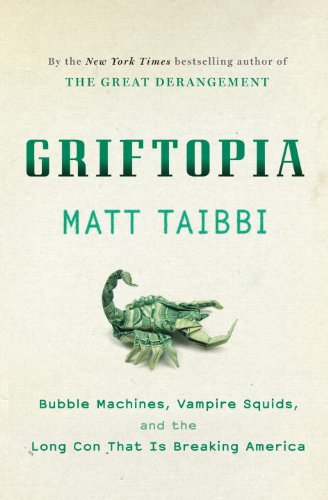
Another great piece of journalism by Rolling Stone's Matt Taibbi, who definitely deserves a Pulitzer Prize.
Fortunately, it seems some important people are reading Taibbi's work.
You should too.
Click the image or here to read the full article at left on RollingStone.com.
Showing posts with label wall street. Show all posts
Tuesday, February 22, 2011
Monday, January 17, 2011
A Truly Devastating Account of How America Got Taken For (Nearly) All Its Worth -- Book Review: Griftopia by Matt Taibbi
Book Review
Griftopia: Bubble Machines, Vampire Squids, and the Long Con That Is Breaking America
by Matt Taibbi
Non-Fiction; published by Spiegel & Grau in November 2010
@@@@@
This Wednesday, I imagine at least 25 million people will watch the season premiere of "American Idol." Nothing wrong with that, even if I won't be among the huddled masses, but I can't help but think that if, at most, one-third of domestic American Idol viewers--or roughly the 8.45 million who watched the season debut of "Jersey Shore"--also chose to read Matt Taibbi's 250-page book, Griftopia
, there would most likely be a revolution in the United States.
That's how powerful and precise Taibbi--who regularly writes incredibly incisive pieces on similar subjects for Rolling Stone--is in explaining, in as close-to-layman's terms such esoteric information can get, the root causes of the financial collapse of 2008 and the complicit culprits who continue to swindle the American public.
His skewer is surprisingly non-partisan and impales both Republicans and Democrats (including Barack Obama and Rahm Emanuel) and not simply the obvious targets such as the Wall Street investment banks--particularly Goldman Sachs--and subprime mortgage brokers (although the depths of their duplicity is descriptively detailed). The caustic but never churlish Taibbi also rips Alan Greenspan a new asshole (or more accurately, calls him one) in a remarkably revelatory chapter that debunks any notion of the former Federal Reserve chief as some sort of economic oracle. With in-depth research, much historical context and numerous substantiating sources, Taibbi shows how continuously and catastrophically wrong Greenspan has been about most economic forecasts and decisions.
As a Chicagoan--actually a suburbanite--it was also interesting to read Taibbi's take on Mayor Daley's decision to sell the city's parking meters, for, as it turns out, a fraction of their true worth and to a consortium comprised largely of Arab wealth funds. You'll also be stupefied by the real reasons behind skyrocketing gas prices.
And though at odds with what I would like to believe, Taibbi's arduous accounting of the manipulative reality behind President Obama's health care bill--mainly that it was concocted by Emanuel as a deal to give insurance companies oodles more cash in exchange for a few election cycles' worth of campaign contributions--really helped me see the ever-dimming light about the American political power structure.
In sum, Griftopia further and more comprehensively clarifies what a variety of other sources--including the books The Big Short
and The Two Trillion Dollar Meltdown
and documentaries Inside Job, Capitalism: A Love Story and Casino Jack and the United States of Money--have already put into my head. Namely that A) Unless you are a member of the top levels of government, the Wall Street investment banks or their co-conspirators, you have been directly screwed by them in ways you can't even imagine, and B) the 2008 financial collapse (and resulting recession) was not caused by everyday citizens buying homes beyond their means and being unable to pay their mortgages when home values dropped.
This is what the powers that be want the American Idol-worshipping public to believe, but as Taibbi does a great job in explaining--as did Michael Lewis in the more mortgage meltdown-specific The Big Short--outright criminality was at play, not merely misfortune or consumer overreach. (I tried explaining what happened a bit more in this piece, but you really owe it to yourself to read Taibbi's and Lewis' user-friendly expositions.)
I have never been much of a conspiracy theorist and I am not an anti-capitalist. But having lost my job amid the fallout from the financial collapse of September 2008--and Taibbi reveals how it may have been avoided, not just by redressing years of deregulation, collusion and avarice, but had Goldman Sachs not pulled an unnecessary, cohorts-in-the-Treasury-aided power play to push AIG over the precipice--I've felt obligated to investigate the root causes a bit further than the mainstream media has presented. (Taibbi, who has only been on the financial beat for a couple years, embarrasses most of the press by revealing so much that the general public has never known, but should have.) And though in my case, Griftopia was a tremendous complement to other coverage I'd read and seen, I recommend it as strongly as possible to anyone as a place to start in deciphering what has brought us to where we still are today.
It won't be easy, throwaway reading, but Taibbi artfully keeps it from becoming too dense, with considerable humor to mitigate the detailed explanations of complex matters (like financial derivatives). And while Taibbi never advocates specific actions that us Main Streeters should take, he includes more than enough fodder for anyone looking for a reason to take to the streets.
I don't want to give away too many of Taibbi's numerous great tidbits, but this was one that especially made me cringe:
In 2008, the year by which the routinely immoral actions of Goldman Sachs, among others, would wipe out roughly 40% of the world’s wealth, the investment bank paid out $10 billion in compensation and bonuses—including $42.9 million to CEO Lloyd Blankfein—and made a $2 billion profit, they paid just $14 million in taxes. Ruin the world, get bailed out by the American taxpayer and give back less than what a superstar athlete makes in a year.
Where's my pitchfork?
---
Next up, from the Skokie Public Library, I will be reading Washington Rules
by Andrew Bacevich, about how Congress is in bed with the military-industrial complex, and Travel as a Political Act
, by my favorite travel writer, Rick Steves.
Griftopia: Bubble Machines, Vampire Squids, and the Long Con That Is Breaking America
by Matt Taibbi
Non-Fiction; published by Spiegel & Grau in November 2010
@@@@@
This Wednesday, I imagine at least 25 million people will watch the season premiere of "American Idol." Nothing wrong with that, even if I won't be among the huddled masses, but I can't help but think that if, at most, one-third of domestic American Idol viewers--or roughly the 8.45 million who watched the season debut of "Jersey Shore"--also chose to read Matt Taibbi's 250-page book, Griftopia
That's how powerful and precise Taibbi--who regularly writes incredibly incisive pieces on similar subjects for Rolling Stone--is in explaining, in as close-to-layman's terms such esoteric information can get, the root causes of the financial collapse of 2008 and the complicit culprits who continue to swindle the American public.
![]() |
| Matt Taibbi |
As a Chicagoan--actually a suburbanite--it was also interesting to read Taibbi's take on Mayor Daley's decision to sell the city's parking meters, for, as it turns out, a fraction of their true worth and to a consortium comprised largely of Arab wealth funds. You'll also be stupefied by the real reasons behind skyrocketing gas prices.
And though at odds with what I would like to believe, Taibbi's arduous accounting of the manipulative reality behind President Obama's health care bill--mainly that it was concocted by Emanuel as a deal to give insurance companies oodles more cash in exchange for a few election cycles' worth of campaign contributions--really helped me see the ever-dimming light about the American political power structure.
In sum, Griftopia further and more comprehensively clarifies what a variety of other sources--including the books The Big Short
This is what the powers that be want the American Idol-worshipping public to believe, but as Taibbi does a great job in explaining--as did Michael Lewis in the more mortgage meltdown-specific The Big Short--outright criminality was at play, not merely misfortune or consumer overreach. (I tried explaining what happened a bit more in this piece, but you really owe it to yourself to read Taibbi's and Lewis' user-friendly expositions.)
I have never been much of a conspiracy theorist and I am not an anti-capitalist. But having lost my job amid the fallout from the financial collapse of September 2008--and Taibbi reveals how it may have been avoided, not just by redressing years of deregulation, collusion and avarice, but had Goldman Sachs not pulled an unnecessary, cohorts-in-the-Treasury-aided power play to push AIG over the precipice--I've felt obligated to investigate the root causes a bit further than the mainstream media has presented. (Taibbi, who has only been on the financial beat for a couple years, embarrasses most of the press by revealing so much that the general public has never known, but should have.) And though in my case, Griftopia was a tremendous complement to other coverage I'd read and seen, I recommend it as strongly as possible to anyone as a place to start in deciphering what has brought us to where we still are today.
It won't be easy, throwaway reading, but Taibbi artfully keeps it from becoming too dense, with considerable humor to mitigate the detailed explanations of complex matters (like financial derivatives). And while Taibbi never advocates specific actions that us Main Streeters should take, he includes more than enough fodder for anyone looking for a reason to take to the streets. I don't want to give away too many of Taibbi's numerous great tidbits, but this was one that especially made me cringe:
In 2008, the year by which the routinely immoral actions of Goldman Sachs, among others, would wipe out roughly 40% of the world’s wealth, the investment bank paid out $10 billion in compensation and bonuses—including $42.9 million to CEO Lloyd Blankfein—and made a $2 billion profit, they paid just $14 million in taxes. Ruin the world, get bailed out by the American taxpayer and give back less than what a superstar athlete makes in a year.
Where's my pitchfork?
---
Next up, from the Skokie Public Library, I will be reading Washington Rules
Wednesday, November 03, 2010
The Seth Saith "Our World's Gone Amiss" Manifesto, Volume 1: Awaking to the Further Disunited State of Democracy Inaction as Wall Street Continues to Laugh All the Way to the Bank
Volume 1 (the first in a sporadic series)
Election Day 2010 didn't exactly go the way I would have liked--or for the most part, the way I voted, although in Illinois the existing ineffectual Democratic Governor Pat Quinn holds a slight lead over Bill Brady, who may have earned my vote if he wasn't so far right on social issues--but hewed pretty closely to what I expected.
I have long had an intrinsic preference for what the Democrats supposedly stand for (at least comparatively) and a strong distaste for the intolerance often espoused by Republicans and their mouthpieces. I also firmly believe that in large part "the mess we're in" is due to choices made between 2001-2008 and that the "Change" President Obama promised was never likely to manifest itself immediately.
But as someone who has been out of work for most of Obama's time in office and remains so as part of an official unemployment rate of 9.6% and a real unemployment rate--including individuals who have quit looking or are working part-time not as a preference--closer to 20%, I understand the rancor that resulted in the Republicans picking up at least 60 House seats to take control of it, as well as the GOP's considerable gains in the Senate and governorships.
While I remain skeptical of the policies Republicans might wish to enact and their priorities--which seem to begin and end with driving Obama out of office in 2012--in troubled times Americans often vote more to replace the incumbents than as affirmation of their challengers, and I'm sorry to say that I can't take much umbrage. It's a shame that a progressive and daring legislator like Wisconsin's Russ Feingold had to go down (to a first-time candidate nonetheless) and some bit of consolation that Tea Party miscalculations kept the GOP from overthrowing Harry Reid and taking control of the Senate. And whatever the reason or eventual result, it was interesting to see the GOP and its voters become more inclusive, with non-white Republicans winning several key races, including new Florida senator Marco Rubio.
But even with a Democratic majority in the House and Senate, albeit with a fair amount of obstruction from the other side, President Obama--a man I greatly admire and who I still believe has sufficient vision and skill for the task at hand--has not in any readily apparent way made the country, or my life, significantly better. The economy remains in tatters, our foreign policy remains suspect and his major accomplishment, the health care bill, was far too watered down to really suit those of us who want universal coverage, seems to be despised by most of the country and is likely to be repealed or overhauled before it has much effect.
Other than clogging the streets of Skokie--and I'd imagine many other places--with seemingly unnecessary road construction for the past 8 months, I also haven't seen much effect from the stimulus package. And the Wall Street reform bill Obama signed into law in July seemingly has no real teeth, based on the opinions of those who know much more about it than I, including Matt Taibbi of Rolling Stone.
In fact, beyond the likely truth that the new political power structure will cause even more legislative gridlock--and thus, few significant new bills will pass in the next 2 years--it is primarily because of Washington's ongoing bi-partisan kow-towing to Wall Street, despite the calamity it caused through intentional malfeasance, that I am pessimistic about the future for ordinary Americans.
According to the wonderfully insightful movie, Inside Job, written, produced and directed by a multi-millionaire named Charles Ferguson (his company created the website design software FrontPage before being sold to Microsoft), the top 1% of Americans have more net worth than the bottom 95% combined. And not only did the Wall Street banks--Goldman Sachs, Morgan Stanley, Merrill Lynch, Bear Stearns, Lehman Brothers, etc.--and their accomplices, from subprime lenders like Countrywide to the insurance giant AIG, intentionally wreak havoc on the American financial system and cause "the mess we're in," their leaders and many employees continue to get exorbitantly wealthy off the same type of unethical maneuvering.
Like I imagine many of you, when Wall Street melted down in September 2008, required a bailout for its survival, put us in our ongoing recession and eventually cost many of us--including me--their jobs, I assumed that the collective "we" were to blame. Too many of us were buying homes and cars we couldn't afford and getting into debt over our heads.
But while anyone who bought a $500,000 home with household income under $40,000 and loads of bad credit to their name shouldn't absolve themselves of stupidity, the truth is that subprime mortgage lenders--such as Countrywide or New Century--purposely preyed on less affluent people and gave them mortgages they knew would be most likely be defaulted on.
As explained by Ferguson in Inside Job, in greater depth by Michael Lewis in his outstanding book, The Big Short
, Rolling Stone's Taibbi in a string of deeply-researched articles such as this one about Goldman Sachs (his piece on how Wall Street made a mockery of the bailout is also essential reading and his new book Griftopia
promises to be as well) and the rightfully acerbic Michael Moore in Capitalism: A Love Story
...
Mortgage lenders purposely made bad loans because they didn't care if they ever got paid back.
Silly as this sounds, it's because the mortgages were sold to the investment banks (like Goldman Sachs, etc.) and packaged as subprime mortgage bonds, which were piled on top of each other into an investment product called a CDO (collateralized debt obligation), most of which were given AAA ratings by Moody's and S&P through a combination of collusion & stupidity, and sold to pension funds and other investors (or held by the banks themselves). As if this wasn't bad, or confusing enough, the investment banks also sold something called a Credit Default Swap (CDS) to anyone who wanted to put up a 2% bet--i.e. $2 million to get back $100 million--that any given CDO would go bad, which could happen if only 8% of the subprime mortgages defaulted.
As many of these adjustable rate mortgages (often requiring no money down and little or no documentation of income) featured a two-year low interest teaser rate that jumped after that term, you can see why there were so many defaults starting around 2007--and the situation got exponentially worse as home prices began to decrease. According to Wikipedia, subprime mortgages, which were more lucrative to lenders, especially when they didn't take the hit on defaults, rose to 18-21% of all originations between 2004-2006 from less than 10% in 2001-2003. By 2007, there were approximately $1.3 trillion in American subprime mortgages.
The investment banks actively facilitated the expansion of subprime lending in order to more economically comprise CDOs (towers of mortgage bonds) that would be fictitiously sold as AAA-rated investments, thanks to complicit ratings firms. And in casino parlance--which seems quite apt--AIG started acting as the house on billions of dollars of Credit Default Swaps, including over $20 billion to Goldman Sachs, which, sold CDOs that it knew were crap to investors, while at the same time betting against them (see this video for more info). Bear Stearns, Lehman Brothers, Morgan Stanley and Merrill Lynch took losses in the hundreds of billions on CDOs they owned (and consequently either went under or got sold off) and AIG went under--but was saved by the taxpayers at 100 cents to the dollar--because it couldn't pay off its "losing bets" to Goldman Sachs.
If the last three paragraphs seem impossible to understand, A) that's the way Wall Street wants it and B) if nothing else, you should at least see that the financial collapse involved a great deal of fraud and shenanigans, not just misfortune or consumer excess.
And if it seems like Credit Default Swaps (CDS, one of the instruments known as "derivatives") are just gambling, so far removed from anything doing any good for society or even investments in companies that might be, well, that's why Ferguson, Taibbi, Moore and others all point to deregulation of the Financial Services industry--which began in 1981 when President Reagan made Donald Regan, the former head of Merrill Lynch, the Secretary of the Treasury--as the root cause of the catastrophic messes caused by the S&L scandals, junk bond era, tech stock boom/crash and subprime mortgage meltdown.
And Washington, even under Obama, is doing nothing to stop Wall Street from (still) running wild...and ruining America (and the rest of the world as well).
As I said above, there was a Wall Street Reform bill signed into law by President Obama in July. Seemingly this fulfills his campaign promise to curb Wall Street. But according to Taibbi and many others (1, 2, 3), after the bill was watered down by members of both parties--which along with key appointees in various administrations, including Larry Summers, Tim Geithner, Robert Rubin and Henry Paulson, all with very direct ties to Wall Street, are both culpable for the country-crippling deregulations--it basically changes nothing in the way Wall Street does business.
In this piece, Ferguson goes even further in blaming Obama for failing to stunt the non-sensical, short-term risks by which Wall Street makes itself rich and for which the rest of us pay the price.
Anyway, for things to really change in America--and don't think this esoteric crap that happens on "Wall Street" doesn't directly impact all of us--something needs to be done. And no matter who's in charge, it doesn't appear that anything soon will be. Especially with 3,000 Wall Street lobbyists at work in Washington and billions of dollars in campaign contributions going to Republican and Democratic candidates.
So I might have preferred one fool, you might have preferred another. But let's not fool ourselves about who's really in power. And no, Rich Whitney, it's not that "Green" party.
Election Day 2010 didn't exactly go the way I would have liked--or for the most part, the way I voted, although in Illinois the existing ineffectual Democratic Governor Pat Quinn holds a slight lead over Bill Brady, who may have earned my vote if he wasn't so far right on social issues--but hewed pretty closely to what I expected.
I have long had an intrinsic preference for what the Democrats supposedly stand for (at least comparatively) and a strong distaste for the intolerance often espoused by Republicans and their mouthpieces. I also firmly believe that in large part "the mess we're in" is due to choices made between 2001-2008 and that the "Change" President Obama promised was never likely to manifest itself immediately.
But as someone who has been out of work for most of Obama's time in office and remains so as part of an official unemployment rate of 9.6% and a real unemployment rate--including individuals who have quit looking or are working part-time not as a preference--closer to 20%, I understand the rancor that resulted in the Republicans picking up at least 60 House seats to take control of it, as well as the GOP's considerable gains in the Senate and governorships.
While I remain skeptical of the policies Republicans might wish to enact and their priorities--which seem to begin and end with driving Obama out of office in 2012--in troubled times Americans often vote more to replace the incumbents than as affirmation of their challengers, and I'm sorry to say that I can't take much umbrage. It's a shame that a progressive and daring legislator like Wisconsin's Russ Feingold had to go down (to a first-time candidate nonetheless) and some bit of consolation that Tea Party miscalculations kept the GOP from overthrowing Harry Reid and taking control of the Senate. And whatever the reason or eventual result, it was interesting to see the GOP and its voters become more inclusive, with non-white Republicans winning several key races, including new Florida senator Marco Rubio.
But even with a Democratic majority in the House and Senate, albeit with a fair amount of obstruction from the other side, President Obama--a man I greatly admire and who I still believe has sufficient vision and skill for the task at hand--has not in any readily apparent way made the country, or my life, significantly better. The economy remains in tatters, our foreign policy remains suspect and his major accomplishment, the health care bill, was far too watered down to really suit those of us who want universal coverage, seems to be despised by most of the country and is likely to be repealed or overhauled before it has much effect.
Other than clogging the streets of Skokie--and I'd imagine many other places--with seemingly unnecessary road construction for the past 8 months, I also haven't seen much effect from the stimulus package. And the Wall Street reform bill Obama signed into law in July seemingly has no real teeth, based on the opinions of those who know much more about it than I, including Matt Taibbi of Rolling Stone.
In fact, beyond the likely truth that the new political power structure will cause even more legislative gridlock--and thus, few significant new bills will pass in the next 2 years--it is primarily because of Washington's ongoing bi-partisan kow-towing to Wall Street, despite the calamity it caused through intentional malfeasance, that I am pessimistic about the future for ordinary Americans.
According to the wonderfully insightful movie, Inside Job, written, produced and directed by a multi-millionaire named Charles Ferguson (his company created the website design software FrontPage before being sold to Microsoft), the top 1% of Americans have more net worth than the bottom 95% combined. And not only did the Wall Street banks--Goldman Sachs, Morgan Stanley, Merrill Lynch, Bear Stearns, Lehman Brothers, etc.--and their accomplices, from subprime lenders like Countrywide to the insurance giant AIG, intentionally wreak havoc on the American financial system and cause "the mess we're in," their leaders and many employees continue to get exorbitantly wealthy off the same type of unethical maneuvering.
Like I imagine many of you, when Wall Street melted down in September 2008, required a bailout for its survival, put us in our ongoing recession and eventually cost many of us--including me--their jobs, I assumed that the collective "we" were to blame. Too many of us were buying homes and cars we couldn't afford and getting into debt over our heads.
But while anyone who bought a $500,000 home with household income under $40,000 and loads of bad credit to their name shouldn't absolve themselves of stupidity, the truth is that subprime mortgage lenders--such as Countrywide or New Century--purposely preyed on less affluent people and gave them mortgages they knew would be most likely be defaulted on.
As explained by Ferguson in Inside Job, in greater depth by Michael Lewis in his outstanding book, The Big Short
Mortgage lenders purposely made bad loans because they didn't care if they ever got paid back.
Silly as this sounds, it's because the mortgages were sold to the investment banks (like Goldman Sachs, etc.) and packaged as subprime mortgage bonds, which were piled on top of each other into an investment product called a CDO (collateralized debt obligation), most of which were given AAA ratings by Moody's and S&P through a combination of collusion & stupidity, and sold to pension funds and other investors (or held by the banks themselves). As if this wasn't bad, or confusing enough, the investment banks also sold something called a Credit Default Swap (CDS) to anyone who wanted to put up a 2% bet--i.e. $2 million to get back $100 million--that any given CDO would go bad, which could happen if only 8% of the subprime mortgages defaulted.
As many of these adjustable rate mortgages (often requiring no money down and little or no documentation of income) featured a two-year low interest teaser rate that jumped after that term, you can see why there were so many defaults starting around 2007--and the situation got exponentially worse as home prices began to decrease. According to Wikipedia, subprime mortgages, which were more lucrative to lenders, especially when they didn't take the hit on defaults, rose to 18-21% of all originations between 2004-2006 from less than 10% in 2001-2003. By 2007, there were approximately $1.3 trillion in American subprime mortgages.
The investment banks actively facilitated the expansion of subprime lending in order to more economically comprise CDOs (towers of mortgage bonds) that would be fictitiously sold as AAA-rated investments, thanks to complicit ratings firms. And in casino parlance--which seems quite apt--AIG started acting as the house on billions of dollars of Credit Default Swaps, including over $20 billion to Goldman Sachs, which, sold CDOs that it knew were crap to investors, while at the same time betting against them (see this video for more info). Bear Stearns, Lehman Brothers, Morgan Stanley and Merrill Lynch took losses in the hundreds of billions on CDOs they owned (and consequently either went under or got sold off) and AIG went under--but was saved by the taxpayers at 100 cents to the dollar--because it couldn't pay off its "losing bets" to Goldman Sachs.
If the last three paragraphs seem impossible to understand, A) that's the way Wall Street wants it and B) if nothing else, you should at least see that the financial collapse involved a great deal of fraud and shenanigans, not just misfortune or consumer excess.
And if it seems like Credit Default Swaps (CDS, one of the instruments known as "derivatives") are just gambling, so far removed from anything doing any good for society or even investments in companies that might be, well, that's why Ferguson, Taibbi, Moore and others all point to deregulation of the Financial Services industry--which began in 1981 when President Reagan made Donald Regan, the former head of Merrill Lynch, the Secretary of the Treasury--as the root cause of the catastrophic messes caused by the S&L scandals, junk bond era, tech stock boom/crash and subprime mortgage meltdown.
And Washington, even under Obama, is doing nothing to stop Wall Street from (still) running wild...and ruining America (and the rest of the world as well).
As I said above, there was a Wall Street Reform bill signed into law by President Obama in July. Seemingly this fulfills his campaign promise to curb Wall Street. But according to Taibbi and many others (1, 2, 3), after the bill was watered down by members of both parties--which along with key appointees in various administrations, including Larry Summers, Tim Geithner, Robert Rubin and Henry Paulson, all with very direct ties to Wall Street, are both culpable for the country-crippling deregulations--it basically changes nothing in the way Wall Street does business.
In this piece, Ferguson goes even further in blaming Obama for failing to stunt the non-sensical, short-term risks by which Wall Street makes itself rich and for which the rest of us pay the price. Anyway, for things to really change in America--and don't think this esoteric crap that happens on "Wall Street" doesn't directly impact all of us--something needs to be done. And no matter who's in charge, it doesn't appear that anything soon will be. Especially with 3,000 Wall Street lobbyists at work in Washington and billions of dollars in campaign contributions going to Republican and Democratic candidates.
So I might have preferred one fool, you might have preferred another. But let's not fool ourselves about who's really in power. And no, Rich Whitney, it's not that "Green" party.
Subscribe to:
Posts (Atom)