Showing posts with label Movie Reviews. Show all posts

Friday, May 24, 2019

Hope That Can Save Me: Springsteen-Inspired 'Blinded By the Light' Largely Blinds Me with Delight -- Movie Review

Movie Review + Screening Recap

Blinded by the Light
inspired by a true story and the
words & music of Bruce Springsteen
directed by Gurinder Chadha
Seen May 22 at the Music Box Theatre, Chicago
as part of the Chicago Critics Film Festival
Wide U.S. release: August 14, 2019
@@@@1/2

It's honestly an infrequent occurrence, and allergies were assuredly messing with my tear ducts, but I can't deny that Blinded by the Light made me cry.

This doesn't inherently bespeak a sensational movie, but what a British-Pakistani teen named Javed (newcomer Viveik Kalra, who was on-hand for the screening) experiences onscreen--loneliness, ostracism, fierce arguments with his dad, a love of writing--was quite closely in concert with my own life, around the same time. (The movie is set in 1987-88)

And, along with a few kindred friends, relatives and teachers, Javed's foremost coping--and hoping--mechanism was quite literally mine as well, the music of Bruce Springsteen.

I don't know that I ever thrashed about in a raging windstorm as the lyrics of "The Promised Land" swept past my head--such as in one of director Gurinder Chadha's most imaginative scenes--but countless are the times when blasting "Badlands," "Backstreets" or "Born to Run" on a Walkman (or Discman, iPod, iPhone, etc.) got me through a lonesome day or restless night.

So yes, I arrived at the glorious Music Box Theatre for a screening of Blinded by the Light as part of the Chicago Critics Film Festival--about 4 months after the film premiered at Sundance and roughly 3 before it opens nationwide--as definitively part of the target audience. (In a rather cool story, Bruce gave permission for his music to be used in the film, but wasn't otherwise involved in its creation.)

While I do believe that the movie has cinematic, storytelling and thematic merits well beyond its extolling of the Boss, my devout fandom undoubtedly had much to with my appreciation...and waterworks.

Chadha herself, in directing 2002's Bend It Like Beckham, already told a compelling tale about an Asian teen in Britain finding her passion and purpose--in that case, playing soccer--at odds with the traditional values and trepidations of her parents.

For me, Blinded by the Light also conjured 2016's Sing Street, which focuses on a 1980s Dublin teen who starts a band and seeks to find his voice, driven by quarreling parents, an older brother who turns him onto Duran Duran, The Cure, etc. and a girl he wishes to woo.

Embodied by the delightful Nell Williams as Eliza, Blinded by the Light also traipses in young love.

Believe me, I'd love to suggest that this film should have widespread appeal as it celebrates the "We'll keep pushin' till it's understood and these badlands start treating us good" messaging of Bruce's music that emboldens Javed, not to mention me, journalist & Springsteen superfan Sarfraz Manzoor--upon whose memoir, Greetings from Bury Park, the movie is based--and millions of Boss fans worldwide.

Thematically, it's fairly easy to imagine Javed's transformation representing that of anyone of any persuasion or psyche finding meaning, strength, joy and sustenance in the music of Madonna or Prince or The Who or The Clash or Public Enemy or Stephen Sondheim or anyone else.

The essence of what Javed experiences after another Asian student, Roops (Aaron Phagura, who's a delight), loans him cassette copies of Born in the U.S.A. and Darkness on the Edge of Town--and, straining credulity for me, doesn't insist on getting them back as weeks past--is universal.

Or at least I hope it is, given what music--and not just that of Bruce--has meant to my existence.

But the soundtrack of Blinded by the Light is comprised predominantly (if not quite exclusively) by 17 or 18 songs by Bruce Springsteen and the E Street Band.

Some are heard in full, even getting video montage treatments, while a few are limited to snippets.

I imagine for Springsteen fanatics much of the appeal of this film will be in experiencing how the songs fit in--and I hope newcomers will be grasped by Bruce's working man demanding dignity, hard charging musical heroism--so I won't divulge much.

As revealed in the Warner Bros. film's official trailer, "Dancing in the Dark" and "The Promised Land" are rather prominently featured, and I wish to give props to how Chadha--who wrote the film with Manzoor and Paul Mayeda Berges--slides in "Jungleland" during scenes of ugly unrest and racism during Maggie Thatcher's Britain.

For my money, quite a good bit of which has gone toward seeing Springsteen 50 times to date--which is a third of the reported Boss concert tally of Manzoor--I wish Blinded by the Light could have given Javed a bit more exposure to Bruce's transcendence as a live performer, for as much as I love the man's music, it's his tireless marathons (always with a warm smile on his face) that made me reverential by the time I was 15.

With due respect to the Rolling Stones, Clash, Who, Ramones, Paul McCartney, Pearl Jam, the immortal James Brown, Prince or anyone else I--and/or you--love, I believe Bruce Springsteen to the best live rock 'n roll performer of all-time, by a wide margin.

Uncertain about a thread in the film that may enable Javed to attend an E Street Band show in London on the Tunnel of Love Express Tour, I asked the engaging Viveik Kalra about it during a Q&A after the show.

Without wishing to spoil much, let's just say that Kalra admitted he hadn't before pondered the gist of my question, but rued the sparsity of his experiencing Bruce in concert as part of the movie.

Beyond that, certain aspects of Blinded by the Light feel a touch contrived--and largely predictable--while some film purists or Springsteen naysayers will conceivably blanch at how exaggerated the movie feels at times.

There is quite a bit of exuberant running, gesticulating, even some rule-breaking, but I largely found the visual hyperbole fitting with the feelings of fledgling love, whether for a boy, girl or musician.

The domineering father, particularly of East Asian heritage (played here by Kulvinder Ghir, paired nicely with Meera Ganatra as Javed's mom) feels like an archetype I've seen sufficiently before--though in Bend It Like Beckham it's the mom who's more dogmatic--but what makes Javed's difficult relationship with his dad work is knowing how it parallels that which Bruce seemingly had with his father, Douglas Springsteen. (See Springsteen on Broadway on Neflix if you haven't yet.)

So, abetted by a certain degree of self-identification, Blinded by the Light is a film almost any diehard Springsteen fan should at least like, and probably love.

Its merits go well-beyond worship of the Boss, and I have to imagine the distribution plan for New Line/Warner Bros.--which paid nearly $15 million for the rights despite a lack of known stars save for Hayley Atwell of Agent Carter/Marvel MCU fame--goes far beyond the Jersey Shore.

But if you loathe Bruce Springsteen--and that would be a shame--Blinded by the Light likely isn't apt to help you see the beauty in "wanting things that can only be found, in the Darkness on the Edge of Town."

Sunday, January 29, 2012

And Iran, Iran So Far Away: 'A Separation' Departs, Connects -- Movie Review

Movie Review

A Separation
written and directed by Asghar Farhadi
playing in Chicago area at Music Box Theatre and Century Evanston
@@@@1/2

In awarding A Separation a 1/2@ under the Seth Saith maximum, it seems I liked the Iranian drama a good bit less than the norm.

Somewhat atypically, it was given a 4-star top rating by both Michael Phillips of the Chicago Tribune and Roger Ebert of the Sun-Times, who also named it his favorite film of 2011.

And of the nearly 33,000 people who have rated the movie on IMDB's 10-point scale, a whopping 63% have given it the top score.

Even among the group of movie buffs I saw it with, it seemed I was a tad less vociferous about Asghar Farhadi's film being truly extraordinary.

Yet my feeling apologetic about bestowing A Separation "only" @@@@1/2 (out of 5) should suggest how strongly I recommend that you make a point of seeing this wonderful film. For even if it doesn't quite meet your expectations--and perhaps mine were over-inflated--at worst, this is a movie almost anyone should find extremely worthwhile and well-made. If nothing else, I promise that--similar in many ways to a great play--A Separation will provide you with plenty to discuss and debate afterward.

On its surface, the movie is a family drama, about a woman who wants to leave Iran with her husband and 12-year-old daughter, but with visa in hand is held back by her husband's wish to continue caring for his father, who has Alzheimer's. Per the title, they separate, but she moves in with her mother nearby until an amenable plan can be reached.

The movie then takes numerous turns that I didn't expect and won't reveal here, but winds up offering--along with much else, including a multi-faceted exploration of truth, deceit and consequences--the palpable suspense of a great legal thriller.

Taking it at face value, I thought I noted some structural/logical flaws and at least one instance of confusing editing. And the motivations of some characters weren't entirely clear, but I believe that was part of Farhadi's point. Far more than most Hollywood movies ever do, A Separation deals with its characters as people really are, including being at times, exasperatingly inconsistent. The acting, led by Peyman Moadi, Leila Hatami, Sareh Bayat, Shaheb Hosseini and Sarina Farhadi (the director's daughter), is remarkably realistic and impactful throughout.

The movie also provides quite a fascinating glimpse into Iran, in ways that exhibit vast cultural differences from the U.S., but also rather striking human commonalities. It's a film I definitely look forward to revisiting at some point, and I wouldn't be shocked if I find reason to add that 1/2@.

But at this point, I find no reason--aversion to subtitles, wariness about a film from Iran, etc.--for anyone who likes intelligent drama to miss discovering this terrific movie. In fact, expecting a near sellout and the possibility of not getting in, I was rather disappointed only about 60 people or so made it to the Music Box for the 9:30pm Saturday showing on A Separation's first weekend in Chicago. With a rare film like this, those who make the effort can only be better for it.

Wednesday, December 29, 2010

The Best Movies of 2010 (English-language Feature Films)

Having separately ranked my choices for 2010's Best Documentaries and Best Foreign Language Films, today I offer my picks for the best English-language feature films of 2010.

Like all my lists, this should be taken simply as a judging of the movies I enjoyed most, without any pretense that "best" references technical merit, depth of meaning or other specific criteria.

To date, my pool for purposes of this list is 36 movies released in 2010 (27 seen in theaters; 9 at home). There are a number more I hope to see soon that I've heard or read good things about, and will cite some of these below my list. But in looking at my 2009 list, there are relatively few changes I would now make  with the additional films seen after my blog post.

I was originally going to post my Top 10 plus honorable mentions, but then decided to rank the Top 25 like I did last year. But in considering all the movies that I gave at least @@@@ out of 5 (or 8 of 10 on IMDB; you can see my Vote History here, though it's not quite comprehensive), I got stuck at just 22 films. So I'll leave 3 slots unaccounted for and hope that some of the movies not yet seen will deserve berths.

The Best English-language Feature Films of 2010

1. The Social Network

2. Inception


3. The Fighter


4. The Town


5. It’s Kind of a Funny Story


6. Fair Game


7. Unstoppable


8. Mao’s Last Dancer


9. The King’s Speech


10. Salt 


11. Easy A


12. 127 Hours

13. Nowhere Boy

14. Four Lions

15. True Grit 

16. Toy Story 3 

17. Greenberg

18. Winter’s Bone


19. The Kids Are All Right


20. Green Zone

21. Made in Dagenham


22. The Book of Eli


Notable Among Those Not Yet Seen
The Ghost Writer
Somewhere
Rabbit Hole
Animal Kingdom
Blue Valentine
Another Year
Please Give
Barney's Version
The Company Men
Biutiful
All Good Things

Others Loved These But I Didn't
Black Swan
Scott Pilgrim vs. The World
Shutter Island

Outstanding Performances
Jesse Eisenberg & Justin Timberlake, The Social Network; Christian Bale & Amy Adams, The Fighter; Naomi Watts, Fair Game; Leonardo DiCaprio, Ken Watanabe & Cillian Murphy, Inception; Natalie Portman, Black Swan; James Franco, 127 Hours; Jennifer Lawrence, Winter's Bone; Emma Stone, Easy A; Colin Firth & Geoffrey Rush, The King's Speech; Kerr Gilchrist, It's Kind of a Funny Story

Although this might seem to do it for "Best Of" movie rankings for 2010, I will soon post a list of the Best Films I Watched in 2010 (of any Vintage, Language, Country of Origin, etc.). I also hope to share the differing opinions of a friend or two on the list above.

Tuesday, October 12, 2010

Exploration and Discovery on Columbus Day (Movies, Thai Food, Billboards and more)

Fourteen hundred and ninety-two, yada, yada, yada. Although I didn't overtly try to explore new worlds on Columbus Day, and yesterday being such only really has relevance as an afterthought, I did enjoy some nice discoveries.

Chicago International Film Festival

With a relatively newfound passion for foreign films (as I wrote about here), I felt inspired to go to Chicago's famed International Film Festival for the first time in its 46-year existence.

Although it might have been cool to attend last Thursday's opening night premiere of "Stone" with Edward Norton in attendance or tonight's special presentation of Darren Aronofsky's latest, "Black Swan," or even some of the higher profile evening showings of international selections, paying $20 or more (including Ticketmaster fees required for advance off-site ticketing) to deal with large crowds in order to see movies I can soon watch for considerably less, wasn't particularly compelling.

Instead, I noted that all festival films showing on weekdays before 5pm cost only $5. Not willing to pay the jump to $10+ on Ticketmaster, I took my chances and headed down on the Red Line, got off at Grand and walked over to the AMC River East theater on Illinois St.

The Matchmaker (2010, Israel, directed by Avi Nesher; my review @@@@1/2)
This was the earliest film of the day, at 2pm, and only rush tickets were available when I got to the theater. Besides the film showings taking up 7 of the megaplex's screens for 2 weeks, there wasn't anything else to the "festival." No seminars, vendors, bookstore, food booths, etc., so fortunately I was able to get into the screening of The Matchmaker, while also buying an in-person advance ticket for the 4:20 screening of Sandcastle.

I had read the festival catalog's brief synopsis of the Israeli film, so I wasn't targeting it merely by chance, but didn't realize until afterward that it is directed by the same guy (Avi Nesher) who made The Secrets, an Israeli film I saw and enjoyed last year. The Matchmaker is an interesting drama with great characters, revolving around a late-1960's matchmaker in Haifa who befriends a teenager name Arik, for whom a coming-of-age story--including romance--develops. I gave it a "5" out of 5 on my festival ballot, where 1/2 increments didn't exist. There are additional festival showings which you can learn about here, and I also learned about the Chicago Festival of Israeli Cinema, coming up later this month.

Sandcastle (2010, Singapore, directed by Boo Junfeng, @@@1/2)
A beautifully shot film with a subject, scenario and tone Hollywood rarely captures, as a tech-savvy 18-year-old boy is sent to stay with his grandparents prior to facing obligatory enlistment into Singapore's army. Some dramatic events happen, prompting the teen to explore more of his parents' past. It got a bit slow at times--especially as my second film of the afternoon--nd wasn't as revelatory as it was tender, but as the first film I've seen from Singapore was quite a worthwhile look at a different culture. I gave it a "4" on my festival ballot.

While enjoying these two disparate, but both nicely character-driven, story-centric foreign films would seemingly spark a knock on Hollywood, I actually saw two American movies over the weekend that I found very worthwhile, It's Kind of A Funny Story (@@@@1/2) and The Town (@@@@).

Great Pad Thai at Dao (230 E. Ohio, Chicago)

I have loved Thai food, particularly Pad Thai and a couple of curry dishes, for a long time and have eaten it at myriad places. I recalled Dao as one of the best from years ago, so as a nearby dining option on the way back to the train after the film fest, I stopped in. I got Pad Thai with Beef and, excepting long ago visits to Dao or forgotten elsewheres, it was the best I've ever had. I like my Pad Thai a bit sweet, so if you don't, Dao's might not satisfy you quite as much, but I loved it.

A Billboard with an Air of Greatness

Just yesterday, I read about how Michael Jordan is allowing his likeness to be included in the new video game, NBA 2K11, and is on the cover of the game's case. And walking west on Grand, at Columbus, ironically, I saw this billboard and couldn't help but smile.

And Then I Saw Moses

Walking up Columbus (which actually is renamed Fairbanks Ct. at that point) to Ohio to get to Dao, I noticed the mural below on the side of a building, which is actually the Pritzker Military Library.

It is a 2D rendering of Michelangelo's sculpture of Moses, which I had seen in Rome's St. Peter in Chains church.

I'm not sure how long it's been there, but I've never noticed it before. It too made me smile.
Finally...

On the subway ride back home, I sat next to a guy reading on a Kindle, which I'd never before seen being done in person. I noticed that he was reading Jonathan Franzen's acclaimed new novel, Freedom, which was interesting because I was reading a paperback version of Franzen's previously praised work, The Corrections.

The Kindle seemed cool, but I felt happier with my good old-fashioned version.

All in all, a pretty good Columbus Day.

Monday, October 04, 2010

Fincher, Facebook, Fight Club and Citizen Kane -- Some thoughts on The Social Network

Movie Commentary

The Social Network
directed by David Fincher
screenplay by Aaron Sorkin
@@@@@

I saw The Social Network on Saturday and thought it was excellent. As such, it was nice to see that the movie had a good opening weekend at the box office, earning $23 to "win the weekend."

Since you can read much more insightful reviews in a zillion other places, and I am one who prefers to know as little as possible about the plot details of a movie before seeing it, I won't really write about the film itself or detailing its merits.

But I wanted to share a few thoughts, since in the Facebook age, it's forbidden to have thoughts without letting the world in on them. Hopefully, these aren't quite that trivial.

1. Director David Fincher - Ever since I loved his "Fight Club" in 1999, Fincher has been among my favorite current directors and one of relatively few modern artists in any genre from whom I actively look forward to what will come next. (For Fincher, the American adaptation of The Girl With The Dragon Tattoo is now "on the clock").

I've liked Fincher's films after Fight Club, including Panic Room, Zodiac and The Curious Case of Benjamin Button, as well as Seven and The Game, which preceded it. But while I still consider Fight Club to be his best work, and although The Social Network doesn't quite fit into the quirky, suspenseful style that defined Fincher early on, with a little more time and another viewing or two, I suspect I might perceive it as his high-water mark to date.

Perhaps this is because The Social Network doesn't feel overtly like "a Fincher movie" yet tells a story about computer programming and lawsuits without even seeming slow, tedious or confusing. I think it's almost more impressive when directors make great movies that don't have such clear personal stamps on them or fit clearly into an auteur theory.

I also find it somewhat fascinating that in bringing Fight Club--based on a book by Chuck Palahniuk--to the masses, with its story of an underground club where young men gather for a missing sense of belonging and purpose (albeit by beating each other to a pulp) that grows into a national network of fight clubs, becomes a phenomenon and morphs into a multi-faceted commercial enterprise, in a way Fincher presaged what Facebook would become, and predicted its growth pattern.

And in casting Justin Timberlake in The Social Network to play Napster co-founder, Sean Parker--who becomes a key ally to Facebook founder Mark Zuckerberg in helping him see the site's mammoth potential--Fincher makes the movie version of Parker a good bit more slick, abrasive and largely unlikable than he seems to be in real-life. (This is an excellent Vanity Fair article on the real Parker). As Fincher says in a recent Time interview: "A lot of people said, 'That's not who Sean Parker is.' And I kept fighting for this. It doesn't matter who Sean Parker is; this character of Zuckerberg has to see him as this. He's got to see him as the guy who's got it wired."

For those who know Fight Club, doesn't this make the Mark Zuckerberg-Sean Parker movie relationship somewhat parallel to the Jack (Edward Norton)-Tyler Durden relationship?

2. The Citizen Kane Connection - At first, it may seem silly to put a brand new movie about Facebook in the same sentence as Orson Welles' 1941 masterpiece that many consider the best movie ever made. But after Fincher himself jokingly called The Social Network, "“the Citizen Kane of John Hughes movies” in a New York magazine article, a little Googling has revealed that many reviews and commentaries on the new movie have also made the association. While I don't think that The Social Network will be supplanting Citizen Kane atop the AFI 100 list anytime soon (even if its IMDB user composite rating currently bests Kane's), I think it actually is a surprisingly sage comparison.

Although this LA Times blog piece by Patrick Goldstein primarily serves to shrewdly point out a key distinction in how the two films go about fictionalizing real-life figures, it correctly asserts that "the movies have a lot in common, both being wildly ambitious dissections of incredibly powerful but deeply flawed media visionaries." 

Another similarity that I haven't read elsewhere is in how--and I guess I should throw in a SPOILER ALERT for those that don't know anything that happens in The Social Network, or Citizen Kane for that matter--the dissolution of the partnership and friendship of Mark Zuckerberg and Eduardo Saverin (his college roommate, best friend and Facebook co-founder) is largely akin to that of Charles Foster Kane (a pseudo William Randolph Hearst, played by Welles) and Jedidiah Leland (played by Joseph Cotton; I don't know that he's directly modeled on any one person).

And while it might be too harsh on the 26-year-old Zuckerberg--both the real one and even as depicted in the movie--to say his, like Kane's, is a story of someone who gains the world while losing his soul, both films certainly touch on the unseemly consequences along the road to immense riches.

If the association helps any more of Facebook's 5 billion worldwide users come to know about and see Citizen Kane, that's nothing but a good thing in its own right.

Friday, September 24, 2010

A Fun Film For Dedicated Followers of The Kinks, But Not A Heroic Piece of Celluloid - Movie Review: Do It Again

Movie Review

Do It Again
a documentary written by & starring Geoff Edgers about his quest to reunite The Kinks; directed by Robert Patton-Spruill
@@@

I would like to presume that among most rock historians and avid fans, the Mt. Rushmore of British Invasion bands would include The Beatles, The Rolling Stones, The Who and The Kinks (yes, I know it'd be hard to fit all the members on a mountainside and that The Who didn't surface until '65, a trifle later than the others).

But ever since introducing themselves to American audiences in 1964 with the great 1-2 punch of "You Really Got Me" and "All Day and All the Night," The Kinks have lagged far behind their brethren in popularity, despite a comparable output of phenomenal, critically-revered music (as their AllMusic.com discography attests).

I became a big Kinks fan in the early '80s and had the pleasure of seeing them three times ('83, '87, '93) while never quite grasping why they were relegated to playing small arenas and half-filled outdoor amphitheaters as The Stones, Who and Paul McCartney continued to fill football stadiums. I don't recall ever hearing of an official Kinks break-up, but whatever hiatus they may have initially been on soon became permanent, as they stopped touring and putting out albums. And when I heard that guitarist Dave Davies suffered a stroke in 2004, after his brother Ray--the head Kink--got shot on the streets of New Orleans (but fortunately wasn't critically wounded ), I pretty much presumed The Kinks would never be whole again.

But despite putting out a pair of stellar albums over the past five years, better in fact than his latter-day Kinks output, and touring solo (see my review of his stellar Chicago show in March), Ray Davies had recently been rather vocal about his desire to reunite the Kinks. Yet while this Rolling Stone piece from Sept. 2008 spoke to the possibility, it became apparent that the band, for one reason or another, just wasn't getting back together. At least not the four original members, who were all still alive until bassist Pete Quaife died this past June.

So when I heard about a new movie called Do It Again, billed as "one man's quest to reunite The Kinks," it sounded a day late and a dollar short. But I still had to see it, for any movie about the Kinks can't be all that bad and I had read some pretty positive reviews. The Chicago International Movies and Music Festival (CIMMfest.org)--which seems to largely be an event taking place next April--held a showing last night at the Metro, long one of Chicago best live music venues.

My friend Dave and I arrived for the only known showing in the Chicagoland area--a region of over 8 million people--and found a total of five fellow Kinks fanatics already there. The audience swelled to about 18 once the film began, but somewhat debunking the movie's premise, or at least its stated purpose, it doesn't appear that the general public is really clamoring for a Kinks reunion. Ray Davies didn't sell out the 2,500 capacity Riviera in March and my guess is The Kinks today might draw at best 10,000 fans in Chicago--make it a festival with a reunited Jam, Smiths & Blur and perhaps 20,000 folks might join me--so imagine the crowds when The Kinks would hit Kansas City and Des Moines.

The film, somewhat properly a 'Low Budget' affair,' was written by and centers around Geoff Edgers, an arts writer for the Boston Globe, who decides it's his mission to try to reunite the Kinks. I applaud his passion to shed greater light on one of the most criminally under-appreciated bands in history, and overall the movie was enjoyable. But it did seem that:

A) It was more about Edgers wanting to make a documentary about trying to reunite the Kinks than showcasing any real legitimate aim, expectation or reason to bring them back together.

B) Its only real appeal is to hardcore Kinks fans, unlike great documentaries that are compelling even to those uninitiated to its subject matter. I really can't recommend this film to non-Kinks aficionados, not even as a way to generate new fans, as a decent Behind The Music episode would tell anyone considerably more about the Kinks and their music.

C) Hearty Kinks fans like me were left with more of a distaste for Ray's personality and his treatment of Dave over the years than I really wanted to know about.

So without a truly viable or even novel mission--as Ray had beaten him to the punch in terms of pining for a Kinks reunion but being unable to make it happen--and negligible appeal for anyone other than ardent Kinkophiles--as the mid-life crisis, bickering wife, job troubles in this economy, seeking a sense of purpose story Edgers tells about himself has been better told elsewhere--what we are left with is a movie of Edgers conducting interviews with people who generally have great things to say about the Kinks.

Some of this is a lot of fun. Interviews with musicians like Paul Weller (of the Jam), Warren Zanes (Del Fuegos), Peter Buck (R.E.M.), Robyn Hitchcock (the Soft Boys), Sting (the Police) and singer-actress Zooey Deschanel--who is included because she was seen having a large, Kinkless record collection in Almost Famous--shed some enjoyable insight, as do talks with early Kinks producer Shel Talmy, record mogul Clive Davis and a smattering of original and replacement Kinks (I won't give away who chooses to participate in the film or Edgers' attempts to bring them together).

Buck, along with R.E.M. touring sideman Scott McCaughey, makes a good point about how R.E.M. has always functioned as a democracy with shared songwriting credits, but that bands in which one person is the clear leader and chief songwriter invariably run into the same problems most autocracies do.

And while Edgers' attempts to get many of his interview subjects to sing Kinks songs with him comes off a bit obnoxious--especially when he was told in advance of their unwillingness--it is great when he gets Sting to play a Kinks Klassic, and Buck/McCaughey's sweet take on "Get Back into Line" redeems the previous scene in which Edgers--seemingly out of nowhere--is seen complaining about his union after having to accept a pay cut.

I don't think I'll be giving away the movie's ending to say that as of this writing, The Kinks have not reunited. And given Quaife's passing, the original lineup obviously never will. While I would love to Ray and Dave back onstage again, the truth is that it doesn't seem like that great, or necessary, an idea. The Kinks had a 30+ year run, the last decade of which was clearly their worst. Dave (davedavies.com) seems to relatively healthy, happy and active while Ray (raydavies.info) is making great music on his own and plays plenty of Kinks songs when he tours solo. His newest project, See My Friends, a collection of duets on Kinks tunes with the likes of Bruce Springsteen, Metallica, Jackson Browne, Jon Bon Jovi and Billy Corgan, sounds intriguing. And as he once so eloquently sang: 

I know you've got a lot of good things happening up ahead
The past is gone it's all been said
So here's to what the future brings,
I know tomorrow you'll find better things


The Kinks will always be a @@@@@, Absolutely Phenomenal band. The movie, Do It Again, is @@@, Good But Not Great. See it if you're a Kinks fan--if you can find it; for now it's sporadically playing festivals and isn't yet available on DVD, although the screening I saw was just a DVD, not celluloid--but probably skip it if you're not.

Although you should be. And since you're here, these are just a few of my favorite Kinks songs:


Tuesday, September 14, 2010

Disgracing an American Hero, Chasing a Childhood Icon

A Pair of Movie Reviews


The Tillman Story
a documentary directed by Amir Bar-Lev
@@@@1/2

Although it may seem like a small thing, I think it is rather significant that The Tillman Story--an excellent new documentary by Amir Bar-Lev--is not titled The Pat Tillman Story. For while the film provides substantial biography and background about Pat's brave, selfless and ultimately tragic decision to leave a lucrative football career to enlist in the U.S. Army, the movie is just as much about the Tillman family--including Pat's mother, father, brothers and wife.

The word "story" is also quite connotative, as although several fellow soldiers and, in turn, Army leadership on up, almost instantly knew that Pat Tillman's death in Afghanistan on April 22, 2004 was caused by friendly fire, his family was initially told that he was killed during an enemy ambush, in which his heroic actions saved many of his fellow troops. All of this turned out to be a lie, and the deception only seemed to grow after the fratricide was revealed five weeks after Pat's death.

Employing a firm but low-key approach--rather than a Michael Moore-ish caustic incredulity--Bar-Lev depicts the determination of Pat's mom, Mary "Dannie" Tillman and her ex-husband, Pat Sr., to learn the truth of what actually happened, who knew what when and how high up the chain of command the cover-up went. I'll let you learn the details for yourself and make your own judgments, but for me, the depth of the duplicity is harrowing and a disgrace to Pat Tillman's heroic legacy.

Interestingly and admirably, as part of the point the documentary makes is that Pat didn't want to be seen as a symbol nor have his reasons for enlisting revealed, the film does not serve to over glorify him. I don't believe anybody in the film, including soldiers whose lives he helped saved, ever directly refers to him as a hero; more importantly to them, he was a son, husband, brother and comrade. This all the more heightens the shame of the military and Bush administration in using Tillman as a political football while stonewalling his family's attempt to have the truth revealed.

No matter where one stands politically or feels about the United States' foreign policy decisions over the past decade, The Tillman Story is one you should hear. And see, if you're over 18. For no real good reason that I could tell, except some use of profanity, this movie is rated "R." Chicago Tribune film critic Michael Phillips correctly takes the MPAA (the movie ratings board) to task in this article, in which Bar-Lev is quoted as saying, "This sends a message that [Tillman's story] is somehow not appropriate for young people, who by the way are subject to ROTC visits in their high schools, but can't see the film about Pat Tillman."

(For those who have seen the film, this video of Q&A with the filmmakers, hosted by Michael Moore, might be of some interest.)
-----

Dear Mr. Fidrych
a fictional feature film by Mike Cramer
@@@

Somewhat akin to Evel Knievel--who I recently wrote about--Mark "The Bird" Fidrych was a phenomenon that aligned perfectly with my childhood. But whereas a substantial amount of hucksterism propelled Knievel's rise to fame and his popularity with kids, Fidrych was a much more organic sensation when, as a gawky 21-year-old rookie with the Detroit Tigers, he went 19-9, drew huge crowds at home & on the road, started the All-Star Game and enchanted the nation--including my 7-year-old self--with his quirky antics (talking to the baseball, manicuring the pitcher's mound), great nickname (inspired by his resemblance to Sesame Street's Big Bird) and surprising success.

Although his career was quickly decimated by injuries and I never gave him too much thought over the years, I was acutely saddened last year when Fidrych died in a freak accident while fixing a truck at his Massachusetts farm. So when I noticed that the Siskel Film Center was having a single showing of a film called Dear Mr. Fidrych, I made a point of going to see it.

I'm glad I did and commend first-time feature filmmaker Mike Cramer--now a Chicago lawyer who grew up in Detroit during the '70s--for seeing through an interesting idea and putting together a respectable movie on a shoestring budget. It is not a documentary about Fidrych, but a fictional, semi-autobiographical story about a Detroit kid who comes to idolize "The Bird" while struggling in Little League, and then when facing challenges of adulthood, takes a road trip with his son on which they seek out Fidrych at his farm.

I don't want to be too harsh on Cramer, but while his movie is laudable, it is far from phenomenal. Although I paid the full $10 Siskel Center admission to see it, I could easily overlook it being the most amateurish film I've ever seen in a theater--complete with poor lighting and almost inaudible sound at parts--if the material was truly first-rate. But except for the 20 minutes at the end in which a 50+ Fidrych is as laid-back, cool, not bitter and quirky as any child of the '70s could have hoped, the movie is only fair.

The dialogue isn't terrible, certainly not compared to much Hollywood drek, but is more perfunctory than revelatory (and Cramer, who was at the screening, shared that the scenes with Fidrych were pre-planned but unscripted). Cramer himself stars in the film, along with his two sons, wife and other friends & family members, and while they bring an engaging realism, a small role played by longtime Chicago sportscaster Mark Giangreco is not only the most fun, it clearly illustrates the professional finesse brought by someone used to being on camera.

The father-son bonding that consumes the second half of the film is sweet if not exactly novel, and while the childhood part of the movie is needed to set up the Fidrych pilgrammage that comes later, far too much time is spent on unexceptional Wonder Years-type stuff, including at least a half-hour of play-by-play of numerous Little League games (besides Giangreco, Chicago sportswriter & radio host Mike Mulligan makes a cameo).

In sum, I'm glad Cramer thought to make--and Fidrych agreed to be in--this film before Mark's tragic death at age 54. The scenes with "The Bird" interacting with Cramer (as Marty Jones) and his son are worth the price of admission alone, augmented by wonderfully nostalgic clips of his pitching performances. None seems to exist, but I would love to see a full-fledged documentary on Fidrych. For while this ultra-indie attempt to merge a coming-of-age story, midlife crisis and ode to a childhood icon is admirable, it just isn't a complete-game victory (of which Mr. Fidrych had 18 in 1976).

(For more on Fidrych: Stats at Baseball-Reference; Wikipedia article; excellent piece upon his death by SI.com's Joe Posnanski; a YouTube video of the end of his most famous televised game.)

Wednesday, September 01, 2010

Exploring the World Through Moving Pictures (Subtitled: My Great Foreign Film Adventure)

Seven Samurai movie poster
My Own Private International Film Festival

Last week, I went to a local movie theater and saw a highly enjoyable, newly released film. An intelligent, humorous and poignant political & media satire, it is called Peepli Live. If it doesn't sound familiar, that's probably because it's a Hindi film made in India, one that shows not all Bollywood movies need be 3+ hours long nor have people in overly colorful costumes singing and dancing, although I enjoy some of those too. (Peepli Live is currently at BIG Cinemas in Niles, IL and elsewhere.)

Through Netflix, I recently watched--one streaming, one on DVD--two quite compelling, beautiful and unique "war movies" that gave interesting insights on the life of a soldier. One was a Japanese film from 1956 called The Burmese Harp, directed by Kon Ichikawa; the other was Ballad of a Soldier, made in the Soviet Union in 1959 by Grigori Chukhrai.

And yesterday I viewed a powerful crime/gangster/prison drama called A Prophet, a French film that was among this year's nominees for the Best Foreign Language Film Oscar. Though I think the trailer that referenced accolades calling it "as epic as the Godfather" was a bit extreme, it was a very good piece of moviemaking by director Jacques Audiard.

All told, in the month of August, I watched 24 movies. Of these, 19 were films in a language other than English. I'm pretty certain this exceeds the total number of foreign language films I had seen in my lifetime prior to 2009. Since last December I've explored 78 foreign films from 25 different countries in 17 primary languages (none of which I speak or understand). So in addition to plenty of watching, I've also done quite a good bit of on-screen reading.

Although I've never been acutely adverse to watching films with subtitles, and had seen & loved high-profile foreign-language films like City of God, Cinema Paradiso and Crouching Tiger, Hidden Dragon, it wasn't until late last year that I really began to actively seek out movies from different countries (other than "foreign films" from England, Ireland and Australia).

A Slow-Boat Voyage Into World Cinema

While there are a number of definable reasons for this newfound transition to a much more multi-cultural cinematic existence, which I'll explain shortly, I don't beat myself up too much for my previous myopia.

Developing, and then broadening, one's interests and passions is an evolutionary process and not everyone can, or even should, instantly love everything. As much as I think cultural literacy, and a requisite curiosity, is vital on a variety of levels for people of almost all ages, the truth is that at age 21--half my life ago--my musical tastes were pretty strictly limited to mainstream rock, my appreciation for art extended only to impressionism, reading rarely extended beyond what was on the syllabus and I knew next to nothing about theater, jazz, blues, opera, classical music, architecture or anything else except for the traditional American spectator sports. My horizons weren't all that greatly expanded by age 30 and some of aforementioned art forms I still don't know or love as much as others--and likely never will. And to be honest, given the deliberate pacing of many foreign films and even older & better Hollywood ones, "world cinema" is still to a large degree a taste in the acquiring process.

Now, like almost everyone, I have loved movies--in a general sense--for as long as I can remember. Except for television and perhaps music across all its various forms, I think film is our most unifying medium; I don't know, or even know of, anyone over the age of five who doesn't have some affinity for movies. Sure there are some people who don't like actually going to movie theaters and there are others who don't care much for modern movies and there are many who only like movies of certain genres, but everyone or so it seems likes movies and smiles at the recollection of certain favorites.

Undeniably, at any point in time, there are new movies of vastly differing quality. But I feel fortunate that many of the highly popular movies of my adolescence were actually pretty good films;  Rocky (even II & III), the Star Wars trilogy, Close Encounters, Raiders of the Lost Ark, E.T. and even sophomoric humor movies such as Animal House, Stripes, the Blues Brothers, Airplane and Fast Times at Ridgemont High seem to hold up pretty well all these years later.

But beyond the movies that all my friends saw, at a relatively young age I was turned on--primarily by my father--to more classic fare such as Bridge Over the River Kwai, Marty, Casablanca, On the Waterfront, The Hustler, Singin' in the Rain and even substantive then-current/recent films like Network, Annie Hall, Breaking Away, The Marathon Man, The Sting and One Flew Over the Cuckoo's Nest. At a young age, I also fell in love with the Kinks' Celluloid Heroes and wanted to know everyone Ray Davies was singing about.

I had a cinema class in high school and Film Studies were part of my college major--I still remember acing a term-paper on the auteur theory as it pertained to Sidney Lumet--and thus was also indoctrinated to movies like A Face in the Crowd, Cool Hand Luke, Citizen Kane (about which and Casablanca I wrote this lengthy post in April) and foreign masterpieces such as Akira Kurosawa's Seven Samurai (which I revisited this month) and Jean Renoir's The Rules of the Game.

Although my screenwriting and movie directing ambitions--which prompted a move to Los Angeles after college--pretty much died on the vine, I have always considered myself a low-grade film aficionado.

Initially on VHS and then DVD, I have amassed a pretty large and wide-ranging film collection and have always seen what seemed like a solid array of new & old, popular & acclaimed movies in theaters and at home. While these included selected foreign works like Cinema Paradiso, Il Postino, Hero, Wings of Desire, Talk to Her, Saraband, Tsotsi and many favorites coming out of Britain & Ireland--among them In the Name of the Father, The Boxer, Brassed Off, The Full Monty, Bend It Like Beckham, Billy Elliot and The Last King of Scotland--until late last year, my cinematic worldview was largely limited to what Hollywood chose to distribute and promote. Although they've existed for years, I was rarely inclined to venture to the Music Box Theatre, Facets Multimedia, Siskel Film Center (all in Chicago), the Chicago International Film Festival (held in October) or even the World Cinema shelves of my local library.

How I Learned To Stop Worrying and Love Foreign Films

Aishwarya Rai
Again, I've never had an active disdain for non-English films, having loved City of God when I saw it back in  2003 (and naming it My Favorite Movie of the '00s last December), seeing La Vie En Rose soon after Marion Cotillard won the Best Actress Oscar in 2008, enjoying the French take on one of my favorite American mystery novels, Tell No One, and going to Facets to see a fine Israeli film called The Secrets prior to a trip to Israel in March 2009. After taking note when Roger Ebert called Indian actress Aishwarya Rai "the world's most beautiful woman" back in 2004, I made a point of seeing some of her films, and some time in the last couple years, I finally got around to watching and enjoying Life Is Beautiful.

But it wasn't until mid-December 2009, and much more avidly in 2010, that I began to truly delve into the foreign film canon. The reasons are split between the motivational and the logistical, but include:

- Time to explore (at least in a reel sense). Due to a lack of full-time employment, which unfortunately (at least financially) remains my situation today, I have had more time to watch movies and pursue new interests. But consequently, I have not had the means to travel abroad, which led me to seek...

- An alternate way of exploring global culture. I was fortunate to travel beyond U.S. borders in 8 of the past 10 years, to places as disparate as Italy, Australia, Spain, Paris, London, Prague, Amsterdam, Cairo and Israel. This has given me an appreciation for how "other people" live, about which films from various locales further my familiarity and, at present, serve as an important and enlightening substitute for real adventures.

- The Chicago Film Discussion Meetup Group - I have been a fan of Meetup.com and participant in several Meetup groups (including a BritPop group I used to host) for several years. At the suggestion of my friend Dave, I started going to the Film Discussion Brunch in December, quickly realized how relatively constrained my film focus had been and within a week watched the Italian classic The Bicycle Thief, the German escapist flick Run Lola Run and, at the Music Box, a Romanian film called Police, Adjective. Although I rarely make it to movie screenings at which Meetups are also organized, I love the monthly (sometimes twice-monthly) discussions over brunch at the Holiday Club, at which we have focused on topics like films of Tarantino, Kubrick and Altman, as well as Italian and Japanese cinema.

- Friends With Broader Film Tastes - In addition to benefiting from and contributing to the film meetups, my interest in world cinema has given me more to discuss with friends who were already well-acclimated. From people like Dave, Paolo, Bob and Jordan, I have been pointed to many rewarding films, including Rififi, Rashomon, The Discreet Charm of the Bourgeoisie, Touchez Pas au Grisbi, Munyurangabo, The Wind That Shakes The Barley and several I have yet to see.

- Skokie Public Library - Although when I lived in Glen Ellyn (which itself has a fine library) I was chagrined that SPL policy excludes lending materials to anyone without a card from within the North Suburban Library, once again being a resident of my hometown has reminded me what a great resource I have available. In addition to a vast collection of World Cinema films--befitting a highly diverse community--the library screens a foreign-language film on the first Monday of each month (open to everyone). This month, a week delayed because of Labor Day, the SPL is showing Coco Before Chanel (starring Amelie's Audrey Tautou and on Roger Ebert's list of Best Foreign Films of 2009) at 7pm on September 13. Although my borrowing of foreign films (which I can have put on the Bookmobile to pick up a block from my home) has slowed inversely to my use of Netflix, just today, I took out Pan's Labyrinth, Central Station, Two Women and Lagaan (along with A Fistful of Dollars and The Fountain; the next Film Discussion will focus on the latter's director Darren Aronofsky along with David Fincher, two of my favorite American filmmakers). While not all libraries may not have a foreign film section as vast as Skokie's, probably every library has more than enough good ones to choose from, often for free.

- Netflix - Although Netflix has long been championed by several friends, I resisted becoming a member until this past January. My reasoning was that between the movies I already owned, the library, HBO & other cable movie channels with plenty of On-Demand selections and Redbox, which charges only $1.00 for nightly rentals (no wonder Blockbuster is going bankrupt), plus seeing a fair number of films in theaters, I couldn't really justify spending $8.99 per month to get one movie at a time by mail. And as I don't enjoy watching movies or TV shows on my computer, instant streaming  capabilities (i.e. movies that run online) were no lure. But in January, I got a Blu-Ray player (this one from Sony, which I recommend once the price comes back down to $138 on Amazon after they get more in stock) that enables me to stream Netflix' selection of instantly streaming movies--more vast than I imagined and ever growing--I decided to get my feet wet with a 2-week Netflix trial. Soon I took the plunge, but in paying $10.99/mo. (including a $2 surcharge to receive Blu Ray discs), I've canceled all my movie channels, stopped renting from Redbox, haven't bought more than two movies all year and can watch films at home not all that long after they play cinemas. In 8-1/2 months, I've watched 28 streaming movies and 27 discs that have arrived in my mailbox about a day after shipping--including 21 foreign films that HBO, et al, don't provide. In turn, Netflix' complex algorithms (which an acquaintance named Meta Brown explains in this insightful video) are constantly recommending more global choices that it thinks I should like.

- Roger Ebert - Long my favorite film critic, even when Gene Siskel was alive and battling him At The Movies and writing for the Chicago Tribune, Roger has always championed great films from all ends of the earth. You can access all his reviews and many other writings through the excellent RogerEbert.com and his Great Movies book series--III was just released--would make a wonderful holiday gift for any film buff. In April, Dave and I went to Champaign, IL, for the Roger Ebert (nee Overlooked) Film Festival. One of the two movies we saw was from England called I Capture the Castle. I've also seen 6 of 15 films on Ebert's Best Foreign Films of 2009 list and intend to see several more.

- IMDB, AllMovie.com, Wikipedia, Yahoo Movies and Fandango - From filmographies of most worldwide directors to plot summaries of a gazillion movies to composite user ratings to local showtimes, a ton of information to help you better discover, learn more about and appreciate foreign films is at your fingertips. There also myriad other great online and published resources, some more explicitly focusing on world cinema, but these should provide a great starting point. Those interested can see all of my IMDB ratings here, as although I rate all movies seen through Netflix on their site and have them fed to my Facebook page, you need to be a member of those websites to see them.

Where to Possibly Begin (or How To Continue)
Your Exploration of World Cinema


As should be fairly apparent, I am by no means an expert on movies in general and foreign ones in particular. Although I have watched a good assortment over the past 9 months, the important films I don't know vastly outnumber the ones I have (and who's to say what's "important" anyway?).

In no particular order, I will provide a list of foreign films that I have found to be excellent, but please don't mistake this for a comprehensive list of the best films of world cinema. For more in-depth guidance, refer to Ebert, IMDB, AllMovie.com, Empire magazine's recent 100 Best Films of World Cinema list (easier to see in full here), Academy Award winners and nominees for Best Foreign Language Film, Paste Magazine's opinion on the Most Essential Foreign Films of the '00s and a ranking of the decade's top grossing foreign language films.

Hopefully, some of my movie buff friends and readers will add some more great choices in the Comments and you likely have friends and relatives happy to share opinions of their own. These are just a smattering (not all) of the globally-produced movies that I have seen since December 2009 that I would give at least @@@@ (and many a full @@@@@), broken down by country of origin. I won't list the languages but all are available on DVD or through Netflix instant streaming with English subtitles. (I also cited some famed directors from the various regions; not all are represented in the lists that follow, nor should inclusions be viewed as comprehensive.)

France - The big directors are Truffaut, Godard and Rohmer
Breathless
The 400 Blows
Rififi
Shoot the Piano Player
Amelie
The Diving Bell and the Butterfly
A Prophet
The Concert - This one should still be in selected U.S. theaters. Not perfect, but quite worthwhile.

Italy - Fellini, De Sica, Antonioni, Leone
La Dolce Vita - My favorite Fellini movie of the four so far seen, but La Strada, Nights of Cabiria and 8-1/2 also belong here.
The Bicycle Thief (aka Bicycle Thieves)
Cinema Paradiso
Il Postino

Japan - Kurosawa, Ozu, Ichikawa, Kobayashi
The Seven Samurai
Yojimbo
Rashomon
The Burmese Harp

China/Taiwan - Yimou Zhang, Ang Lee
Raise the Red Lantern
To Live

Germany - Herzog, Fassbinder, Wenders
The Counterfeiters
Run Lola Run
(The White Ribbon) - I didn't love it, but many did and I should watch it again

Belgium - The Dardenne brothers
The Son
Lorna's Silence

Sweden - Bergman
The Seventh Seal
The Girl With the Dragon Tattoo - I thought these were very good interpretations of the books
The Girl Who Played With Fire

Mexico
Y Tu Mama Tambien
Sin Nombre

Other
Ballad of a Soldier - Russia
The Chaser - Korea
Munyurangabo - Rwanda
Broken Embraces - Spain (Director: Almodovar)
Peepli Live - India
Maria Full of Grace - Columbia
The Barbarian Invasions - Canada (French)
Song for Sparrows - Iran
The Damned United - England
The Wind That Shakes The Barley - England/Ireland
The Secret in Their Eyes - Argentina - The best new movie from anywhere I've seen in 2010


A Fine Art Documentary On An All Too Brief Brush With Greatness

Movie Review

Jean-Michael Basquiat: The Radiant Child
A documentary directed by Tamra Davis
Playing in Chicago at the Music Box Theatre
@@@@

There's a great Bob Dylan song from 1989 called "Shooting Star." I don't know if it was written about anyone in particular, but after seeing Tamra Davis' informative new documentary about her friend, 1980s artistic wunderkind Jean-Michel Basquiet, I couldn't help recall Dylan's wistful refrain, "I saw a shooting star tonight and I thought of you."

Basquiat, the Brooklyn-born son of Puerto Rican and Haitian parents, became known on the New York art scene by the age of 20, earned considerable acclaim and money during his brief career, dated Madonna when he was more famous than her (although the movie doesn't delve into their relationship), befriended & collaborated with Andy Warhol and died from a heroin overdose in 1988 at age 27.

Untitled (Skull), 1984
I did not know of Basquiat during his lifetime or for long thereafter (although he may be rightly considered the art world's last real superstar, I've been more familiar with his contemporary, Keith Haring, who died in 1990). I think I first came to know Basquiat's name when I read that Metallica drummer Lars Ulrich earned over $19 million when two Basquiat paintings that he owned were auctioned (one in 2002, one in 2008). Then last year, I saw some of Basquiat's art in an exhibition on Warhol at the Milwaukee Art Museum. His style might not be for everyone, but I enjoy it. With a look that remains uniquely his, Basquiat's art feels like a street-infused merging of Picasso, Chagall, Pollack, DeKooning and Twombly.

As such, when I saw that Chicago's great Music Box Theatre was running a new documentary called Jean-Michel Basquiat: The Radiant Child, I decided to check it out despite not yet having seen fellow artist Julian Schnabel's 1996 Basquiat biopic. Filmmaker Davis befriended Jean-Michel when had an exhibition in LA in 1983 and filmed an interview with him in Beverly Hills in 1986 that hasn't seen the light of day until now. But as Basquiat himself was soft-spoken and not tremendously revealing (keep in mind he was 25 at the time), fortunately much of the film is comprised of recent interviews with art dealers, collectors and friends of Basquiat, although not Madonna.

Sadly, in generic terms, Basquiat's story has a familiar arc; think Jimi Hendrix or any VH1 "Behind the Music" episode that features a rock star's death. He showed considerable talent at a young age, showcased originality & skill that took him to the top of his field, hang out with other famous people, had crises of conscience about his art, fame, etc., started abusing drugs and died too young from a heroin overdose.

While the documentary focuses more on Basquiat's life & career chronology than on his craft itself, Davis does a nice job showcasing a number of his works and her variety of interview subjects paint a good picture of Basquiat, who Wikipedia references as "the first painter of African descent to become an international art star."

The film is well-worth seeing, if simply for gaining an awareness of this talented artist (I'm not sure if it will run at the Music Box past tomorrow, but will eventually be on Netflix). For those curious about Basquiat's work, here are a few pieces I found online:
Boxer, 1982 (the one that Ulrich sold for $13.5 million in 2008)
In Italian, 1981
Untitled, 1981

Fallen Angel, 1981
Arroz con Pollo, 1981
Self-Portrait, 1982

Wednesday, July 28, 2010

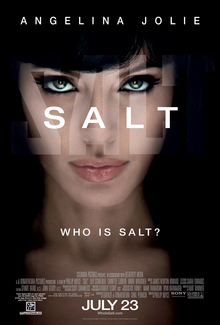
'Salt' a Thrill If Taken With a Grain Of

Movie Review

Salt
Directed by Philip Noyce
Starring Angelina Jolie, Liev Schreiber and Chiwetel Ejiofor
@@@@

Last week, I saw, liked and lauded Inception, not just for being quite good but for being entirely original at a time when most big budget summer movies are sequels or based on pre-existing properties.

While 'Salt,' isn't nearly as novel nor rewarding, it is--much to my surprise when Roger Ebert raved about it--a really well-done and suspenseful summer action movie that is similarly fresh (i.e. not a known-franchise film, although it clearly aspires to become one).

Angelina Jolie looks great, supposedly performed many of her own stunts (and got hurt doing so) and excels at keeping the audience guessing, to a degree, about the allegiances and motivations of Evelyn Salt, a spy with exceptional physical abilities, not so unlike Jason Bourne. The script, written by Kurt Wimmer & Brian Helgeland and to my knowledge not based on a comic book hero or character from a string of hit novels, was originally penned with Tom Cruise in mind to star as Edwin Salt. But according to Wikipedia, Cruise passed on the project because Edwin Salt wasn't a whole lot different than Ethan Hunt, his character from the Mission: Impossible franchise.

Although Salt opened with a $36 million weekend box office take, trailing Inception in its second week, I think Cruise's decision and Jolie's inclusion turned out to be a good thing for the movie. Jolie plays the role with a sleek power--though if this photo to be believed, perhaps she may be a bit too thin in real life--not so unlike the action heroes she portrayed in Wanted and Tomb Raider, but with a bit of vulnerability and a at-times subdued approach that helps sell the suspense about Salt's loyalties.

Certainly, as in most high-action films, there are chase sequences that extend plausibility and even the plot line's realism is more than a tad tenuous, but never to the point of being laughable or too detrimental to one's enjoyment. Unlike Inception, Salt isn't a film with legitimate Academy Award aspirations, and history won't mention it in the same breath. But for a tasty popcorn flick, Salt has just the right flavor.

Tuesday, July 20, 2010

It May Only Be a Dream, but Hollywood Gets It Right

Movie Review

Inception
Written & Directed by Christopher Nolan
Starring Leonardo DiCaprio, Ken Wantanabe, Joseph Gordon-Levitt, Ellen Page, Tom Hardy, Dileep Rao, Cillian Murphy, Marion Cotillard, Michael Caine
@@@@1/2

Sheer originality is in strikingly--yet in large part intentionally--short supply among major Hollywood motion pictures, particularly those expressly made & marketed to clog megaplexes and rake in megabucks (primarily as summertime releases).

As this article does a fairly good job of explaining, the reason that most "blockbusters" are either sequels, franchises, movies based on existing properties (superheroes, comics, bestselling books, video games, toys, old TV shows, etc.) or blatantly derivative of other hit films is that pre-branded movies are surer box office bets. Given the relative short attention span of teenagers (the prime moviegoing audience, especially for summer films), the fact that reporting of weekly box office receipts has become a form of sport, the sparsity of movie stars who can be counted on to "open" movies to big box office returns and the $100+ million that many major movies now take to make and market, it is understandable why studios would rather invest in works with sizable built-in audiences than develop new, daring and possibly more worthwhile pictures aimed at mainstream success.

While Hollywood deserves to be taken to task for often recycling the same old tripe and largely forgetting that people besides teenagers like movies and will see & spread the word about good ones, as has been often said, it is called "show business" and Broadway producers, museum curators and other arts promoters have taken Tinseltown's cue by preferring to serve up the tried & true. Though disheartening to those who value artistic merit--for which originality can be a major ingredient--this kind of thinking seems to make fiscal sense.

Which serves to make a movie like Inception--and Warner Bros. investing $160 million in it--worth celebrating, even before you get to whether it is good or not. Sure, WB wants to stay tight with Christopher Nolan, director of The Dark Knight and the next Batman installment, and thinks he can become a name-brand, movie-opening director such as Steven Spielberg, James Cameron, Peter Jackson or M. Night Shyamalan (whose The Last Airbender is up to $115 in box office take despite some of the worst critical and composite fan reviews in recent memory). But the studio is to be commended for putting summer blockbuster support behind Inception, a wholly original script that Nolan supposedly worked on over 10 years, going back to when he was finishing Memento.

It's also nice to note that Inception had a $60 million opening weekend. While this is less than Iron Man 2, Shrek Forever After, Toy Story 3 or Twilight: Eclipse, it was "better than estimated" and extremely strong for a film not based on a known property. Inception did benefit from particularly strong reviews, advance word-of-mouth and Nolan's impressive track record, but its complex storyline didn't lend itself to particularly accessible trailers.

The plot--which in a nutshell involves a guy (DiCaprio) with the ability to invade people's dreams to extract private information for duplicitous gains now being hired (along with a heist-caper-like team) to plant information--probably will require DVD viewings with Director's Commentary to really understand all that is going on. Maybe then I will up my rating to @@@@@ as upon a first viewing there were parts where I was getting lost and the 2-1/2-hour movie began to feel a bit long.

It wasn't flawless or even quite the best new movie I've seen this year (that would be the Argentinean Foreign Language Oscar winner, A Secret in Their Eyes), but I highly recommend it. Nolan, whose low-budget Memento was my second favorite movie of the '00s and who made what is possibly the best superhero movie ever in The Dark Knight (though I might argue Spider-Man 2), is to be applauded for the audacity of his vision and the ability to bring it to many screens at a theater near you.

In the realm of live-action, blockbuster-type Hollywood movies--and therefore excluding the many imaginative Pixar films, Avatar and indie/small-budget/foreign films--Inception is the most satisfyingly original movie since The Matrix (from 1999, the year that also brought the similarly novel The Sixth Sense).

Again, it might be too good to fully appreciate on a first viewing (or it may well become more flawed the deeper one looks), and while I have no problem with well-done popcorn movie franchises--last year's Star Trek re-imagining was quite stellar and Watchmen had some nice visual verve--not only was Inception a great movie to watch, it is a great movie to know can still get made.

However infrequently and if seemingly only in a dream.