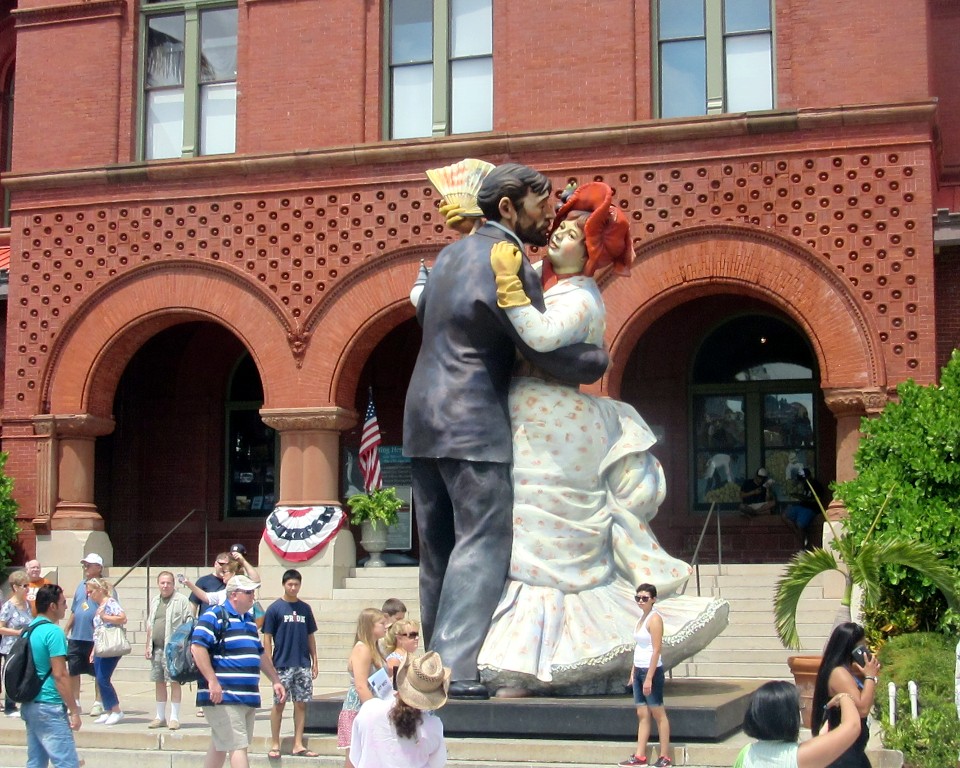
Buffalo, New York
Niagara Falls, Ontario
Visited May 8-11, 2019
Although nearby Niagara Falls still seems to successfully attract travelers from near and far--and I did visit for a day and overnight--visual evidence did not suggest Buffalo to be much of a tourist mecca.
During the days and into the evenings, the city's downtown streets were eerily quiet--nearly desolate--and with apologies to many restaurants I didn't visit and some that I did, Tim Hortons was demonstrably the food emporium that most beguiled me. (We do not have any Tim Hortons "bake shop" locations near Chicago; I should also note that a lifelong allergy to poultry meant that I didn't seek out Buffalo Wings.)
Although I enjoyed my trip to Buffalo and Niagara Falls--and have long enjoyed exploring gritty, not-overtly-touristy American cities such as Pittsburgh, Cleveland, Columbus, Dayton, Detroit, Kansas City, St. Louis, Grand Rapids, Milwaukee, Louisville, etc.--I'd hard-pressed to tell you Buffalo makes for a beautiful visit.
 But in the right context, turning oneself onto "The City of Light" can be quite satisfying.
Being there without a car--I flew in on a Wednesday and home on a Saturday--meant I didn't much explore places that public transportation (NFTA, which worked well) or an economical Uber could easily get me to and from.
Hence, I saw just the edges of the Frederick Law Olmsted-designed Delaware Park, and not the
adjoining and said-to-be-beautiful Forest Lawn Cemetery or Buffalo Zoo, only briefly and externally the Richardson Olmsted Campus--featuring a rather striking former sanitarium--and never Canalside and its old Navy battleships along the Buffalo River near Lake Erie.
I also noted some glorious architecture downtown and around Buffalo, and Niagara Falls is one of the most majestic sights on Earth, so I don't mean to imply that there isn't any striking scenery, more that you need to look for it.
And while there aren't a ton of "A+" travel guide attractions, I found that Buffalo worked quite well as a "wraparound destination."
 As is the case for most of my domestic travel, my impetus for going to Buffalo at the time I did was a spectator event.
One of my favorite rock bands of all-time--The Who--played the city's KeyBank Arena early on their current Moving On Tour (accompanied by an orchestra) and though I would also wind up seeing them closer to home, I thought this would make a good jumping off point for visiting Buffalo.
I'd been to--or more accurately, through--the northern New York city twice before, in 1993 and 1999, having visited Niagara Falls both times, but had never before spent any significant time exploring Buffalo.
This time, I would also wind up seeing a musician I never had--Bruce Cockburn--and the city seems to regularly draw great concert acts at venues large and small. Cockburn played Asbury Hall at Babeville, which is in a converted church whose rebirth was overseen by Buffalo native, singer Ani DiFranco.
 If you're a rock music lover like me, search the Pollstar.com website to see who's playing where and when--not just in Buffalo--while the city also appears to have a rather vibrant theater scene of local & touring shows. (See BuffaloTheatreGuide.com as well as the Buffalo News' guide to what's playing.)
Sports fans should already know that Buffalo is home to the NFL's Bills--who play at New Era Field in the suburb of Orchard Park--and the NHL's Sabres, primary tenant of the KeyBank Center.
Neither of those teams will be suiting up again for a few months, but minor league baseball's Buffalo Bisons are the AAA-affiliate of the Toronto Blue Jays and play in Sahlen Field downtown, which looked pretty cool from the outside. (The team's origins date back to 1877.)
Throw in the venerable Buffalo Philharmonic Orchestra, which plays at historic Kleinhans Music Hall, and you should readily be able to find some kind of live event to stimulate you to shuffle off to Buffalo.
Many will imaginably wish to seek out Buffalo Wings--said to be invented at the still-existing Anchor Bar in 1964--while those with a sweet tooth (and a car, as I didn't get there) may want to check out Parkside Candy, which has stood since 1927.
 But beyond the impetus of The Who, my reasons for wanting to visit Buffalo were essentially three-fold.
I primarily wanted to see the Albright-Knox Art Gallery, the Darwin D. Martin House by Frank Lloyd Wright--and also, if time allowed, which it did, Graycliff, another FLW house--and Niagara Falls.
A bit curiously, in 2015, I had learned about the existence and fine collection of the Albright-Knox Gallery--Buffalo's major art museum--during a visit to the Milwaukee Art Museum.
Though the MAM has a fine permanent collection in its own right, it was hosting an exhibition titled Van Gogh to Pollock: Modern Rebels Masterworks from the Albright-Knox Art Gallery, which you can read about here.
Impressed by the strength of the traveling highlights, I was assured at the time that the Albright-Knox wasn't temporarily shuttered and maintained a strong collection beyond what it had let go for the show.
I've been to over 150 art museums worldwide and always like to take note of others I should visit, and the Albright-Knox instantly put itself on such a list.
 After flying into Buffalo Wednesday morning and catching the NFTA #24 bus from Buffalo Niagara International Airport to my Hotel @ the Lafayette by Wyndham downtown--the ride along Genessee Street exposed me to some hardscrabble sections of the city, but I appreciated that--the first place I went after check-in and a brief stop at Tim Hortons was Albright-Knox (via bus #20).
Any chance to see great art is a life-enhancing joy, and I would unequivocally recommend that anyone visiting Buffalo stop by the Albright-Knox, but I can't say I was substantially more wowed by their collection than from the introduction in Milwaukee.
There were certainly some fine pieces I hadn't seen in that exhibition, but again a bit oddly, the best were paintings borrowed from the stellar Detroit Institute of the Arts, which I've visited multiple times. In Buffalo, these were part of an exhibition called Humble and Human: An Exhibition in Honor of Ralph C. Wilson, Jr.
 Wilson, who passed in 2014 at age 95, was the longtime owner of the Buffalo Bills, and a native of Detroit who maintained his primary residence in that area. So the exhibit, which closed on May 26, honored him with paintings from both the Albright-Knox and DIA, including a great Van Gogh portrait.
Supposedly, Wilson had a rather valuable art collection and it would make sense for him to have been a benefactor of Albright-Knox, but I didn't note any of the paintings in the exhibit having been donated by him.
Still there was some great stuff, within the exhibition and beyond, though primarily in a modern art realm. And that which I had seen before.
Nevertheless, I'm glad I got to the Albright-Knox Art Gallery, enjoyed my visit and am happy to note the museum will soon undergo a major expansion.
After visiting the museum, I strolled just a short ways into Delaware Park, but noted its beauty and took some photos of a replica of Michelangelo's David, albeit from afar.
 I did not have time, on Wednesday or otherwise, to visit the nearby Burchfield Penney Art Center--which features the works of Buffalo's Charles E. Burchfield, known for his watercolors.
Also in the area but beyond my purview is the Buffalo History Museum, and while my Uber driver kindly took me past the Richardson Olmsted Campus to take a few quick pix, I'm sorry I didn't have time for a stroll nor tour.
Connected to the Hotel @ the Lafayette--said to be one of the country's grandest once upon a time, but now more solid than spectacular--was the Lafayette Brewing Company.
I didn't try their beer, nor as explained above, any Buffalo wings, but enjoyed their Beef on Weck sliders.
This sandwich is also something of a Buffalo tradition, featuring roast beef on a kummelweck roll, which is topped with kosher salt and caraway seed and accompanied by horseradish and au jus.
Right up my alley, and I enjoyed it enough to eat at Lafayette Brewing again the next night, when I had a Strawberry Salad.
Although I really only knew his name, and vague plaudits, I went to see Bruce Cockburn on Wednesday evening and very much enjoyed him and the Babeville venue. (See my review of the show here.)
Besides the Albright-Knox, the main thing I wanted to see in Buffalo itself was the Darwin D. Martin House, designed by Frank Lloyd Wright and completed in 1905. (website)
 I'm a huge admirer of Wright's work, and have seen dozens of his homes from the outside, and taken tours of at least 30 houses and buildings that are (or were) open to the public.
The Martin House--created for an executive of Buffalo's Larkin Company--is said to be one of FLW's greatest creations, and my 2-hour tour included the Barton House on the same lot, a conservatory connected by a long pergola and a gardener's cottage.
Photos were not allowed within the houses, but the main home in particular is spectacular, and I very much valued my visit.
 There was landscaping work going on, but I learned this was the last part of a years-long renovation project.
Fairly close to the Martin House Complex are two privately-owned Wright-designed houses, not open to the public. I saw the exterior of the Walter Davidson House but not the William R. Heath House.
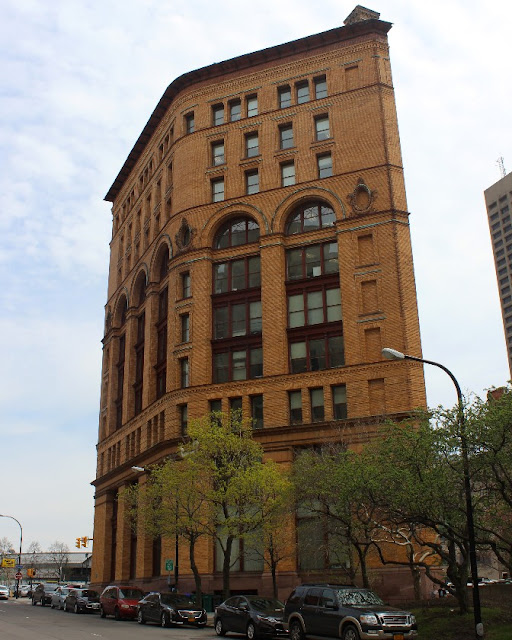
Frank Lloyd Wright's first architectural employer, Louis Sullivan, is also represented in Buffalo with the striking red Guaranty Building downtown.
I'll include a photo at the bottom of this post, as well as one of the interior of Buffalo City Hall--seen at the very top of this article--which is one of most beautiful examples of Art Deco I've ever seen.
It was designed by John Wade and George Dietel and completed in 1931.
Other grand buildings in downtown Buffalo include the Erie County Clerk, St. Joseph Cathedral & Rectory, Buffalo Savings Bank (now a branch of M&T Bank) and The Electric Tower.
Thanks to the NFTA's #40 bus, running out of Buffalo's Metropolitan Transportation Center just around the corner from my hotel, getting to Niagara Falls took only $2.00 and about an hour.
 The bus dropped me off at a Welcome Center on the USA side--I had booked a Howard Johnson's on the Canadian side--but though the weather was a bit cool and my backpack a tad heavier than idyllic, I valued my walk though the Niagara Falls State Park to and across the Rainbow International Bridge.
When I was there, on May 10-11, the iconic Maid of the Mist boat ride through the Falls from the U.S. side wasn't yet open for the season, but is now until early November (I've been on it previously).
But the state park offers a nice vista to see the American Falls close up, while once you cross the bridge to Canada, the view of both the American Falls and the Horseshoe Falls is majestic. (It is possible to stroll further on the U.S. side than I did.)
On the Ontario side, I did go into the Hard Rock Cafe, noted the Casino Niagara and eventually walked through the gauntlet of kitschy attractions on Clifton Hills (such as Ripley's Believe It or Not and a few wax museums).
But particularly with limited time, the best thing to do in Niagara Falls is to see--and appreciate--the waterfalls, and I took a long walk alongside the closest guardrail (from Rainbow Bridge to Table Rock Welcome Center), taking thousands of photos along the way.
 For those far more intrepid than me, a Zipline seemed like it could be rather fun, and--particularly with no boats running--at Table Rock I did pay to visit the Journey Under the Falls, which provides an up-close glimpse of the Falls to really fathom their power (literally and figurative, in terms of the hydro-electricity).
After eventually making my way to my hotel, I ate at AG, one of just three restaurants in Niagara Falls that AAA rates 4-diamonds (there are no 5-diamond places).
I had an excellent 3-course meal including Charred Octopus Salad, Beef Tenderloin and a Sea Salt Toffee Crème Brûlée.
It was terrific and satisfying, if not quite as exquisite (or expensive) as past gourmet splurges.
 Though I was sleepy, leg weary and somehow developed substantial pain in my right heel, I was convinced by the Howard Johnson's desk clerks that seeing the Falls lit up at night was worth the effort.
Heading down Clifton Hill, I decided to ride the SkyWheel, a giant Ferris Wheel with enclosed cars allowing for good views of the falls.
Unfortunately, once aboard, I had a scare with my digital SLR having a memory card error, but I made do with my iPhone.
The set-up wasn't that good for photography anyway, but it was still a nice ride. And the camera issue seemed to resolve itself post-trip, without losing any files.
 I also walked to the edge of the falls at night, and again the next morning, which was much sunnier than the day before.
The #40 bus got me back to downtown Buffalo before Noon, with several hours before my evening flight home.
So although it wasn't cheap, I decided to take an Uber to the Graycliffe Estate, another Frank Lloyd Wright designed house about 25 minutes down the Lake Erie coast. (Buffalo doesn't have an Uber Pool option, though if it weren't the weekend, a NFTA bus could've gotten me close to Graycliff.)
Also designed for Darwin D. Martin about 25 years later, at a point when FLW was down on his luck and even wanted by the law, the 1928 house provided an intriguing contrast.
 Wright trademarks like vast, sunlit interior spaces, earth-tone coloration and cantilevered overhangs were present, but there were no art glass windows and the front door was neither hidden nor ornate.
There are actually three separate structures on the property, but the main house was designed so that one could see through to the lake.
The house required a massive--and per some observers, impossible--restoration project in recent years.
So it was particularly cool that my tour happened to be led by architect Pat Mahoney, who was a principal member of the restoration team. I really enjoyed the insights he provided.
 Sadly, one of Frank Lloyd Wright's most notable non-residential works, the Larkin Administration Building--of the company that employed Darwin D. Martin--only survived in Buffalo from 1906 to 1950. (A couple minor wall remnants still stand, but I didn't see them.)
Nonetheless, it was wonderful to be able to tour two related yet distinct homes designed by America's greatest architect.
All in all, it was a really enjoyable few days in Buffalo and Niagara Falls.
This probably isn't the best-written travelogue, as I flirted with writing it as a personal travel recap and also as a more universal travel guide, and thus the tone may be imprecise in both regards.
 But other than perhaps seeing the old navy ships docked at Canalside, catching shows that weren't in town when I was or eating Buffalo Wings, I can't think of much to recommend that I didn't myself do.
Though I guess on another visit, I'd explore the local history a bit more.
It may not be the greatest place on Earth, and certainly not the most glamorous, but I truly enjoyed my time in Buffalo--including a brief jaunt to Niagara Falls--and with a somewhat similar "wraparound" itinerary, so might you.
---




All photos by Seth Arkin, copyright 2019. Please do not repost without permission and attribution.

Being there without a car--I flew in on a Wednesday and home on a Saturday--meant I didn't much explore places that public transportation (NFTA, which worked well) or an economical Uber could easily get me to and from.
Hence, I saw just the edges of the Frederick Law Olmsted-designed Delaware Park, and not the
adjoining and said-to-be-beautiful Forest Lawn Cemetery or Buffalo Zoo, only briefly and externally the Richardson Olmsted Campus--featuring a rather striking former sanitarium--and never Canalside and its old Navy battleships along the Buffalo River near Lake Erie.
I also noted some glorious architecture downtown and around Buffalo, and Niagara Falls is one of the most majestic sights on Earth, so I don't mean to imply that there isn't any striking scenery, more that you need to look for it.
And while there aren't a ton of "A+" travel guide attractions, I found that Buffalo worked quite well as a "wraparound destination."

One of my favorite rock bands of all-time--The Who--played the city's KeyBank Arena early on their current Moving On Tour (accompanied by an orchestra) and though I would also wind up seeing them closer to home, I thought this would make a good jumping off point for visiting Buffalo.
I'd been to--or more accurately, through--the northern New York city twice before, in 1993 and 1999, having visited Niagara Falls both times, but had never before spent any significant time exploring Buffalo.
This time, I would also wind up seeing a musician I never had--Bruce Cockburn--and the city seems to regularly draw great concert acts at venues large and small. Cockburn played Asbury Hall at Babeville, which is in a converted church whose rebirth was overseen by Buffalo native, singer Ani DiFranco.

Sports fans should already know that Buffalo is home to the NFL's Bills--who play at New Era Field in the suburb of Orchard Park--and the NHL's Sabres, primary tenant of the KeyBank Center.
Neither of those teams will be suiting up again for a few months, but minor league baseball's Buffalo Bisons are the AAA-affiliate of the Toronto Blue Jays and play in Sahlen Field downtown, which looked pretty cool from the outside. (The team's origins date back to 1877.)
Throw in the venerable Buffalo Philharmonic Orchestra, which plays at historic Kleinhans Music Hall, and you should readily be able to find some kind of live event to stimulate you to shuffle off to Buffalo.
Many will imaginably wish to seek out Buffalo Wings--said to be invented at the still-existing Anchor Bar in 1964--while those with a sweet tooth (and a car, as I didn't get there) may want to check out Parkside Candy, which has stood since 1927.

I primarily wanted to see the Albright-Knox Art Gallery, the Darwin D. Martin House by Frank Lloyd Wright--and also, if time allowed, which it did, Graycliff, another FLW house--and Niagara Falls.
A bit curiously, in 2015, I had learned about the existence and fine collection of the Albright-Knox Gallery--Buffalo's major art museum--during a visit to the Milwaukee Art Museum.
Though the MAM has a fine permanent collection in its own right, it was hosting an exhibition titled Van Gogh to Pollock: Modern Rebels Masterworks from the Albright-Knox Art Gallery, which you can read about here.
Impressed by the strength of the traveling highlights, I was assured at the time that the Albright-Knox wasn't temporarily shuttered and maintained a strong collection beyond what it had let go for the show.
I've been to over 150 art museums worldwide and always like to take note of others I should visit, and the Albright-Knox instantly put itself on such a list.

Any chance to see great art is a life-enhancing joy, and I would unequivocally recommend that anyone visiting Buffalo stop by the Albright-Knox, but I can't say I was substantially more wowed by their collection than from the introduction in Milwaukee.
There were certainly some fine pieces I hadn't seen in that exhibition, but again a bit oddly, the best were paintings borrowed from the stellar Detroit Institute of the Arts, which I've visited multiple times. In Buffalo, these were part of an exhibition called Humble and Human: An Exhibition in Honor of Ralph C. Wilson, Jr.

Supposedly, Wilson had a rather valuable art collection and it would make sense for him to have been a benefactor of Albright-Knox, but I didn't note any of the paintings in the exhibit having been donated by him.
Still there was some great stuff, within the exhibition and beyond, though primarily in a modern art realm. And that which I had seen before.
Nevertheless, I'm glad I got to the Albright-Knox Art Gallery, enjoyed my visit and am happy to note the museum will soon undergo a major expansion.
After visiting the museum, I strolled just a short ways into Delaware Park, but noted its beauty and took some photos of a replica of Michelangelo's David, albeit from afar.

Also in the area but beyond my purview is the Buffalo History Museum, and while my Uber driver kindly took me past the Richardson Olmsted Campus to take a few quick pix, I'm sorry I didn't have time for a stroll nor tour.
Connected to the Hotel @ the Lafayette--said to be one of the country's grandest once upon a time, but now more solid than spectacular--was the Lafayette Brewing Company.
I didn't try their beer, nor as explained above, any Buffalo wings, but enjoyed their Beef on Weck sliders.
This sandwich is also something of a Buffalo tradition, featuring roast beef on a kummelweck roll, which is topped with kosher salt and caraway seed and accompanied by horseradish and au jus.
Right up my alley, and I enjoyed it enough to eat at Lafayette Brewing again the next night, when I had a Strawberry Salad.
Although I really only knew his name, and vague plaudits, I went to see Bruce Cockburn on Wednesday evening and very much enjoyed him and the Babeville venue. (See my review of the show here.)
Besides the Albright-Knox, the main thing I wanted to see in Buffalo itself was the Darwin D. Martin House, designed by Frank Lloyd Wright and completed in 1905. (website)

The Martin House--created for an executive of Buffalo's Larkin Company--is said to be one of FLW's greatest creations, and my 2-hour tour included the Barton House on the same lot, a conservatory connected by a long pergola and a gardener's cottage.
Photos were not allowed within the houses, but the main home in particular is spectacular, and I very much valued my visit.

Fairly close to the Martin House Complex are two privately-owned Wright-designed houses, not open to the public. I saw the exterior of the Walter Davidson House but not the William R. Heath House.
Frank Lloyd Wright's first architectural employer, Louis Sullivan, is also represented in Buffalo with the striking red Guaranty Building downtown.
I'll include a photo at the bottom of this post, as well as one of the interior of Buffalo City Hall--seen at the very top of this article--which is one of most beautiful examples of Art Deco I've ever seen.
It was designed by John Wade and George Dietel and completed in 1931.
Other grand buildings in downtown Buffalo include the Erie County Clerk, St. Joseph Cathedral & Rectory, Buffalo Savings Bank (now a branch of M&T Bank) and The Electric Tower.
Thanks to the NFTA's #40 bus, running out of Buffalo's Metropolitan Transportation Center just around the corner from my hotel, getting to Niagara Falls took only $2.00 and about an hour.
 The bus dropped me off at a Welcome Center on the USA side--I had booked a Howard Johnson's on the Canadian side--but though the weather was a bit cool and my backpack a tad heavier than idyllic, I valued my walk though the Niagara Falls State Park to and across the Rainbow International Bridge.
When I was there, on May 10-11, the iconic Maid of the Mist boat ride through the Falls from the U.S. side wasn't yet open for the season, but is now until early November (I've been on it previously).
But the state park offers a nice vista to see the American Falls close up, while once you cross the bridge to Canada, the view of both the American Falls and the Horseshoe Falls is majestic. (It is possible to stroll further on the U.S. side than I did.)
On the Ontario side, I did go into the Hard Rock Cafe, noted the Casino Niagara and eventually walked through the gauntlet of kitschy attractions on Clifton Hills (such as Ripley's Believe It or Not and a few wax museums).
But particularly with limited time, the best thing to do in Niagara Falls is to see--and appreciate--the waterfalls, and I took a long walk alongside the closest guardrail (from Rainbow Bridge to Table Rock Welcome Center), taking thousands of photos along the way.

After eventually making my way to my hotel, I ate at AG, one of just three restaurants in Niagara Falls that AAA rates 4-diamonds (there are no 5-diamond places).
I had an excellent 3-course meal including Charred Octopus Salad, Beef Tenderloin and a Sea Salt Toffee Crème Brûlée.
It was terrific and satisfying, if not quite as exquisite (or expensive) as past gourmet splurges.

Heading down Clifton Hill, I decided to ride the SkyWheel, a giant Ferris Wheel with enclosed cars allowing for good views of the falls.
Unfortunately, once aboard, I had a scare with my digital SLR having a memory card error, but I made do with my iPhone.
The set-up wasn't that good for photography anyway, but it was still a nice ride. And the camera issue seemed to resolve itself post-trip, without losing any files.
 I also walked to the edge of the falls at night, and again the next morning, which was much sunnier than the day before.
The #40 bus got me back to downtown Buffalo before Noon, with several hours before my evening flight home.
So although it wasn't cheap, I decided to take an Uber to the Graycliffe Estate, another Frank Lloyd Wright designed house about 25 minutes down the Lake Erie coast. (Buffalo doesn't have an Uber Pool option, though if it weren't the weekend, a NFTA bus could've gotten me close to Graycliff.)
Also designed for Darwin D. Martin about 25 years later, at a point when FLW was down on his luck and even wanted by the law, the 1928 house provided an intriguing contrast.

There are actually three separate structures on the property, but the main house was designed so that one could see through to the lake.
The house required a massive--and per some observers, impossible--restoration project in recent years.
So it was particularly cool that my tour happened to be led by architect Pat Mahoney, who was a principal member of the restoration team. I really enjoyed the insights he provided.

Nonetheless, it was wonderful to be able to tour two related yet distinct homes designed by America's greatest architect.
All in all, it was a really enjoyable few days in Buffalo and Niagara Falls.
This probably isn't the best-written travelogue, as I flirted with writing it as a personal travel recap and also as a more universal travel guide, and thus the tone may be imprecise in both regards.

Though I guess on another visit, I'd explore the local history a bit more.
It may not be the greatest place on Earth, and certainly not the most glamorous, but I truly enjoyed my time in Buffalo--including a brief jaunt to Niagara Falls--and with a somewhat similar "wraparound" itinerary, so might you.
---


All photos by Seth Arkin, copyright 2019. Please do not repost without permission and attribution.