Thursday, May 15, 2014

Not So Simple Simon: Excellent 'Lost in Yonkers' Found in Skokie -- Chicago Theater Review

Theater Review

Lost in Yonkers
a play by Neil Simon
directed by Devon de Mayo
Northlight Theatre, Skokie
Thru June 8
@@@@1/2

By almost every measure, Neil Simon has had about as much success as a playwright could have.

Dozens of his plays have been successful on Broadway, including Barefoot in the Park, The Odd Couple, Plaza Suite and The Sunshine Boys.

Three have won Tony Awards. Several others have been nominated and/or otherwise decorated. Many of his works have been turned into movies--usually with him doing the screenwriting--and he's received four Oscar nominations, including for The Goodbye Girl, which wasn't based on a play.

In addition to plays and movies, he's served as book writer for classic musicals like Sweet Charity, Promises, Promises and They're Playing Our Song

Before he started writing plays, he was a comedy writer for two pioneering TV legends, Sid Caesar and Phil Silvers.

And at age 56, Neil Simon became the only living playwright to have a Broadway theater named after him, way back in 1983, in conjunction with the opening of one of his most famed plays, Brighton Beach Memoirs.

Biloxi Blues would follow--and win a Tony--then Broadway Bound. And in 1991 came the play I saw at Northlight yesterday, Lost in Yonkers, which won the Tony and a Pulitzer Prize, and which many regard as his best play.

Yet--without my ever having been a theatrical scholar--it seems that when "the greatest American playwrights of all-time" are considered, the now 86-year-old Simon is never mentioned in the same sentence as the Holy Trinity of Eugene O'Neill, Arthur Miller and Tennessee Williams.

And should a Mount Rushmore of playwrights ever be sculpted, I doubt Neil Simon would even be Teddy Roosevelt.

Again, this is just presumptive conjecture, but I imagine the names Edward Albee, William Inge, Clifford Odets, Thornton Wilder, Horton Foote, David Mamet, Sam Shepard, August Wilson and Lanford Wilson might be mentioned to complete the foursome before anyone says Simon.

This is probably because Neil has had the misfortune of largely being a comedic writer and becoming hugely popular (and not always a critics darling).

I am not well-versed enough in his entire oeuvre to cogently argue his merits versus any of the aforementioned legends. But based on Lost in Yonkers--which is really terrific at Skokie's Northlight Theatre--as well as The Odd Couple, which I saw there a couple years ago, plus a few other plays and movies I've seen over the years, I definitely think Neil Simon belongs in the conversation.

If not carved into stone.

Even in terms of my wanting to see Lost in Yonkers at Northlight, Simon's comedic legacy nearly worked against him.

I knew I had seen and liked the play before, but was surprised in checking my "Shows Seen" database that it was way back in 2000 at the Village Theatre of Glen Ellyn. Though I couldn't recall many specifics, I remembered it being a humorous piece about two teenage brothers being sent to live with their Grandma.

But I didn't really feel I needed to see it again until I noted rave reviews, both from my mom and the Tribune's Chris Jones.

So I availed myself of a $20 day-of-show ticket and took in a matinee of Lost in Yonkers surrounded mostly by senior women not unlike the 83-year-old Ann Whitney, who gives a remarkable performance as Grandma.

Not to imply, let's hope, that the grandmothers in the audience are anywhere near as mean as the one onstage.

For as was either iterated or reiterated, Lost in Yonkers isn't foremost a comedy about two teenage boys in 1942, who are likely representative of Simon himself.

It is a drama--with many humorous lines--about how and why a woman is so stern with her children and grandchildren, years after having immigrated from Germany.

One of her sons, Eddie (Timothy Edward Kane), is the father of 15-year-old Jay (Alistar Sewell) and 13-year-old Arty (Sebastian W. Weigman). He is a recent widower who has to leave his sons with his mom so he can work to pay back debts incurred by his wife's illness.

Already living with Grandma is her developmentally-challenged daughter Bella (Linsey Page Morton), and two of her other children with issues of their own--Louie (Erik Hellman) and Gert (Anne Fogarty)--round out the play's cast.

The acting at Northlight, under the direction of Devon de Mayo, is outstanding throughout.

Whitney and Morton are should-win-awards sensational, Sewell and Weigman are delightful as the sardonic brothers and Kane, Hellman and Fogarty are all well beyond stellar.

It's no surprise to me, as I've often attended shows at Northlight, but the acting in Skokie is routinely as good as anywhere you'll find in Chicago, and that includes (but in no way disrespects or diminishes) the Goodman, Steppenwolf, TimeLine and Court theaters.

The set design by Grant Sabin is also tremendously impressive.

So while I can't pinpoint just what is keeping me from awarding this production a full @@@@@, you should consider this a ardent rave and avid recommendation.

Not for a fun Neil Simon comedy, but for a forceful family drama about as compelling as The Glass Menagerie, A Long Day's Journey Into Night, August: Osage County or just about any written by anyone.

Perhaps Simon is a head below Mssrs. Miller, O'Neill, Williams and a handful of others, but at his best there aren't many ever much better.

And with due deference to more inventive Albee and the more acerbic Mamet, if Gutzon Borglum returns from the great beyond and finds a mountain in Times Square to start carving, I wouldn't object if Neil Simon were 4-ever Broadway bound.

Wednesday, May 14, 2014

Damon Albarn's 'Everyday Robots' Blurs Line Between Stately and Sleepy -- Album Review

Album Review

Damon Albarn
Everyday Robots
@@@1/2
Spotify link

After repeatedly listening to Damon Albarn's rather muted and contemplative solo album since its release a fortnight ago--when I actually bought the CD despite being able to hear it unfettered through Spotify--I appreciate the quality of the effort.

Both observational about the travails of the digital age and introspective about Albarn's own life, Everyday Robots sounds like much more than a tossed-off project to fill time between reconvening Blur, re-creating Gorillaz, putting together supergroups like The Good, The Bad and the Queen and writing operas such as 2012's Dr. Dee.

For those willing to take the time, there is much here to like. The title track about how "we are everyday robots on our phones," lead single "Lonely Press Play" also about digitized isolation, an upbeat song (the only one) about a baby elephant called "Mr. Tembo"--see video below--and the closing Brian Eno collaboration "Heavy Seas of Love" attest that one of the prime progenitors of BritPop can still write songs both lovely and affecting.

But in full, Everyday Robots is just too sonically dour--in comparison to many of its songs, slower Blur cuts like "This Is a Low," "Death of a Party" and "No Distance Left to Run" are positively lilting--for me to truly enjoy and embrace it. At least as of yet.

I don't know that this is an album I will come back to often, but as I only came to fully appreciate the brilliance of Blur years after their 1990s heyday--in part because Albarn's meditative, heavily Anglo-tinged tunes didn't saturate American shores like those of their more overt rivals Oasis--I wouldn't be too shocked if I increase my esteem for it over time.

At this point I consider Everyday Robots a great album to play as background music at a dinner party attended by musically literate people, but not an album I find truly great in the acute sense.

Appreciating that if Albarn wanted to make a Blur album he would have--with undoubtably much greater sales, especially in the UK--I can't condemn Everyday Robots for being more the album he wanted to make than the one I wanted to hear. (Blur, who hasn't released a full album new material since 2003, supposedly did some studio recording in between concert dates as recent as this January, but no firm album plans have been cited.)

Given my esteem for Albarn--primarily through Blur; I don't know much Gorillaz--I'm glad I sought out and bought his first solo album in a pop vein. As I said above, there is much to like, even appreciate.

Just not enough to love.

---
Here's the new video for "Mr. Tembo," featuring the baby elephant that was the song's inspiration:

Sunday, May 11, 2014

Celebrating a Milestone in Pageviews with a Gift of the Elvi

Believe me, in the grand scheme of substantial web traffic, 500,000 total pageviews is rather small potatoes. I imagine the top blogs get that in a month, if not a day.

And I know Pageviews don't necessarily constitute Visitors, or especially readers, as the counter includes repeat visitors, my views, accidental tourists and those who come via Google Image Search and don't stay.

Nonetheless, I was happy to note that--as I slept--the odometer rolled over 500,000 total pageviews. And so I had a little fun at my expense, paying homage to this album cover. (And yes, I know I would more aptly be in a jumpsuit from the Fat Elvis days.)

Enjoy. And thanks for visiting.


Saturday, May 10, 2014

Hello Yellow Brick Road: Onstage, The Wizard of Oz is Rather Wonderful -- Chicago Theater Review

Theater Review

The Wizard of Oz
a stage musical featuring songs from the movie
and new ones by Andrew Lloyd Webber and Tim Rice
Cadillac Palace, Chicago
Thru May 11
@@@@1/2

As I watched a much better than anticipated stage production of The Wizard of Oz from the back row of the Cadillac Palace, I felt bad for anyone who did not have a smile on their face--or at least in their heart--for a good part of the evening.

For I am far from the only one who was properly brainwashed in childhood by the classic movie that turns 75 this year, and I was singing (mostly silently), humming and finger tapping away with Dorothy and her pals.

With first-rate performers--most hailing from Canada, where this touring production germinated based on a recent London staging--including Danielle Wade in the central role (she was selected through a Canadian reality TV show), it was both a sentimental and acute pleasure to hear buoyant renditions of "Ding-Dong! The Witch is Dead," "Follow the Yellow Brick Road," "We're Off to See the Wizard" "The Merry Old Land of Oz" and several other classic choral numbers, plus a sterling version of "Over the Rainbow" by Wade.

And as opposed to what I may have suspected--at least before reading Chris Jones' rather upbeat review on ChicagoTribune.com--this isn't some slapdash stage re-enactment of the movie simply to entice kids of all ages with easy brand-name product. I believe that's been done before with this cherished title, and I've never been much inspired to check it out onstage. The movie would seem to remain more than adequate.

But a funny thing happened on the way to the Emerald City:

Andrew Lloyd Webber got involved.

Sir Andrew newly adapted The Wizard of Oz for the London stage in collaboration with Jeremy Sams--who directed it in the West End in early 2011, then in Toronto and now on the current U.S. Tour.

Even more notably for musical theater buffs, to supplement the great movie songs by Harold Arlen and E.Y. Harburg, Webber wrote a good handful of new tunes together with lyricist Tim Rice.

Webber and Rice famously wrote Joseph and the Amazing Technicolor Dreamcoat, Jesus Christ Superstar and Evita together, but only one minor musical--that I hadn't known of until this moment--since, and that was in 1986. Of course, they also had great success separately; Webber most notably with Cats and The Phantom of the Opera; Rice with Chess and The Lion King.

So just for curiosity's sake, this trip to Oz was rather substantive.

And while the new songs aren't as joyous or great as those from the MGM film, much of Stephen Schwartz' Wicked or the best of Webber and/or Rice's oeuvre--I could have listened to them in advance on Spotify but didn't--they also aren't duds and serve to help make The Wizard of Oz work as live theater.

"Nobody Understands Me" and "Wonders of the World" help flesh out the pre-Oz Kansas scenario, while the Wizard's (Jay Brazeau) Act 1 closer "Bring Me the Broomstick" and "Already Home" near the end of the show have appealing flourishes reminiscent of Webber & Rice's more famed work.

That said, Act 2 suffers a bit for its scarcity of readily-hummable songs from the movie.

But along with strong vocal performances--most notably from (besides Wade) Broadway vet Jacqueline Piro Donovan as the Wicked Witch of the West and Jamie McKnight as the Scarecrow--the production values of this Canadian Equity tour are very impressive.

The sets and costumes--both credited to Robert Jones--should satisfy those with a fond affinity for the movie, yet stand on their own originality as well. The choreography by Arlene Phillips is stellar, particularly in enabling the ensemble to embody Munchkins with believability.

Director Sams employs some very clever touches--including some wonderfully sardonic crows that mock Scarecrow--and along with Wade as Dorothy, her little dog too (the astonishingly well-trained Nigel as Toto) is quite delightful.

So there are plenty of good reasons for you--with or without young ones--to be off to see the wizard, but this largely wonderful Wizard of Oz is only in Chicago through Sunday.

Given the full balcony on Thursday night, perhaps Dorothy should stick around longer before clicking her heels and heading home (or more accurately to St. Louis, where the tour goes next).

But discount tickets for some weekend shows are currently listed on both HotTix and Goldstar.

So if you still can, come out, come out wherever you are.

It certainly won't replace the movie in your memory, or perhaps even in your children's affection, but this really good Wizard should grant your wish for terrific live entertainment quite suitable--even delightful--for all ages. 

Thursday, May 08, 2014

All Things Must Pass: On the End of Hot Doug's and the Admirable Antithesis of Conventional Wisdom

"After all is said and done
I did alright, I had my fun 
I will walk before they make me run"
-- "Before They Make Me Run"
    The Rolling Stones

On the front page of Wednesday's Chicago Tribune, just below the story about the calamitous near-term effects of climate change, is a large photo and article about a hot dog stand planning to shut down.

This may not ordinarily seem like front page news, but in the case of Hot Doug's, I have no argument with it being so. 

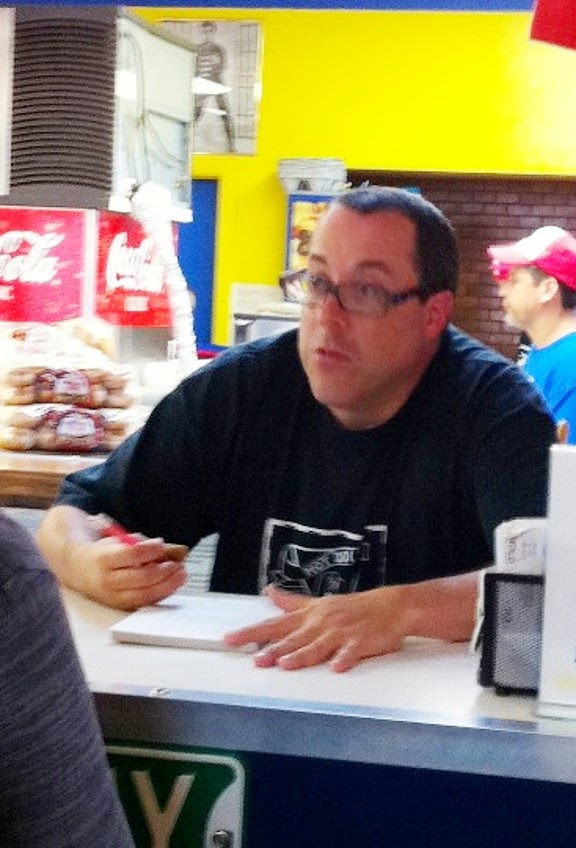
Because for 13 years--though I've only known of it for seven--"the sausage superstore and encased meat emporium" run by Doug Sohn at the corner of Roscoe and California has been among the very best, most distinctive places in Chicago.

Of any kind. 

This goes well beyond wildly unique tubular beef creations--such as those that feature wild boar, yak, kangaroo and foie gras, just a few of the current specials--or that Doug himself has personally taken the order of every customer who has walked through his door.

It's because, without meaning to go all Sinatra on you, Doug Sohn did things his way.

And it's nice to note, he still is. 

Understandably, the gist of the Tribune article by Kevin Pang regarding Sohn's announcement that he will close Hot Doug's for good on October 3 is that devoted patrons--almost all who have undoubtedly, like me, stood in line for 30 minutes or much more just to get lunch--are terribly sad about the news. 

This mournful sentiment was also reflected by every post and comment that hit my Facebook news feed. 

Yet while I have greatly enjoyed all of my visits to Hot Doug's--perhaps once or twice a year since 2007--and have lavished praise on it here and elsewhere, the way that Sohn has operated his business can only bring a smile now that he is opting out, not a tear.

I mean this in the way that I still miss seeing Calvin & Hobbes and The Far Side on a daily basis, but am glad that I had the chance...and greatly admire the decisions of their creators (Bill Watterson and Gary Larson, respectively) to stop on their own terms and go out on top, in spite of leaving untold millions on the table. 

Sohn has always been nice and engaging when I've ("finally!") reached the counter at Hot Doug's, and may recognize my face at this point--thanks perhaps to my also buying a signed copy of his restaurant's namesake book after an event at the Skokie Public Library--but we do not know each other in any real sense. 

So I do not pretend to have any keen insight about how nice, cool, altruistic or genuine he really is, or what has prompted any decision he has made, but perceptions alone make Doug Sohn one of my heroes.
At a time when I feel there is a whole lot inordinately wrong with America, Doug is a prime example of what's right. 
First of all, for anyone who wants to mistake my derision of the corruptive evils of capitalism--given an oligarchical system that serves the corporatocracy and mega-rich while screwing over the rest of the citizenry--as hatred for or envy of those who become successful, my admiration for Sohn renders such assumptions as being a bunch of bullshit.

For he is a self-made success story that stands as an antithesis to conventional make-every-last-buck-you-can-even-if-you-don't-need-it thinking.

Doug is a trained chef who had the novel idea of bringing his culinary expertise to the corner hot dog stand, long a staple of Chicago cuisine. 

Those who only admire that he owns a hugely popular establishment with lines out the door may not give enough creedence to the fact that he started anew after a fire destroyed the first Hot Doug's location (in Roscoe Village), that he isn't exactly in a buzz-worthy location and the reality that MOST RESTAURANTS FAIL. 

I have no idea at this point if Doug's net worth is 1, 2, 3, 4, 5, 6, 7, 8 or 9 figures, and couldn't care less, but even if I knew him to have made $50 million off Hot Doug's, I would be nothing but happy for him. 

He deserves whatever wealth he has earned: he took a chance, became successful due to his talent, imagination and graciousness, seemingly never sacrificed quality or his own integrity and, presumably, made a lot of money. 

Which, adding to my admiration, he now seems to be saying is enough for him. At least in terms of the sure source of considerable income that is his sole restaurant. 

In Pang's article, Sohn is quoted as saying, "I'm not burnt out; it's just time."

There is no mention of plans to sell Hot Doug's to another operator.

Though he assuredly could have opened additional locations, at his library talk he said that was never a consideration.

The restaurant is open from 10:30am-4pm Monday through Saturday, clearly missing out on vast additional income.

When Doug has taken a vacation or other time off, he has closed Hot Doug's. 

So while I would have to surmise that Doug Sohn is somewhere, somehow justifiably rather proud of the financial
success--and resultant freedom--his gourmet sausage emporium has engendered, I'm proud to note that mercilessly squeezing out every last possible penny seems far from his primary motivation. 

I imagine this will continue to be true in whatever Doug's next endeavor may be. So far he isn't saying, but per Pang's article he is "99 percent sure it won't be in the restaurant industry."

All I know is that if it's possible for me to support his next enterprise, I will. 

I'll also send or give this blog post to Doug, hoping he may read it, for I want him to know that while I will greatly and genuinely miss Hot Doug's--after hopefully getting there a couple more times--I can't help but happily applaud his decision (and I'm sure my doctor will as well).

And while I nearly concur with his t-shirt slogan--though it may be time to buy a cool new one--that:

"There are no two finer words in the English language than 'encased meats,' my friend."

 ...my vote would be for two others:

Enjoy life.

Doug, I hope you do, until October 3, 2014, and even more so thereafter. Thanks for all the great wieners and so much more.

Long may you run. Or perhaps more pleasurably, walk.

Wednesday, May 07, 2014

Transcendyently Evergreen: 'Buyer & Cellar' Finds Hilarity in Babs' Basement -- Chicago Theater Review

Theater Review

Buyer & Cellar
by Jonathan Tolins
starring Michael Urie
Broadway Playhouse, Chicago
Thru June 15
@@@@

Buyer & Cellar, a one-man show written by Jonathan Tolins and starring Michael Urie--who originated it Off-Broadway and is now out on tour--has one of the most imaginative premises of any theatrical work I've ever seen.

Derived from the non-fictional oddity of Barbra Streisand having created a streetscape of shops to house her vast prized possessions underneath a barn on her Malibu estate--as featured and photographed by Harper's Bazaar in 2010--Buyer & Cellar is a (supposedly) made up story of a fledgling actor who is hired to man Babs' basement mall, despite it decidedly never being open to the public.

Urie, known but not to me for his role on TV's Ugly Betty, is outstanding as Alex More, who over 100 minutes beguiles the audience by recalling his interactions with Streisand--who occasionally comes down to "shop"--and his boyfriend Barry. 

I do not often laugh out loud, even in seeing the greatest of comedians, but Buyer & Celler--which is well-directed by Stephen Brackett--elicited several overt guffaws between Urie's mannerisms, his apt emulating (though not impersonating) of Streisand and much hilarity in Tolins' script, including numerous theatrical and cultural references. 

(As the show will run for several weeks at Chicago's Broadway Playhouse at Water Tower Place, I think it best not to detail any specific jokes or commentary; best that you hear it all fresh.)

While I have high regard for Streisand's brilliant singing, impressive acting & directing career and seemingly some of her politics, I do not have the fascination or adoration that may make Buyer & Cellar even more blissful for the more deeply devoted.

In other words, while I laughed a lot, I never really got "verclempt."

And perhaps part of what prompts my @@@@ rating (rather than 5), and strong if not quite insistent recommendation, is this one-man show's misfortune of coming within a week of me seeing astonishing, large-scale productions of The Sound of Music and Les Miserables

Though Urie absolutely deserved his instant and emphatic standing ovation, and I can't cite anything substantive about how Buyer & Cellar could be any better, I just didn't love it on the same level as a truly outstanding musical, play, concert or even comedian, and can't deny I started looking at my watch about 30 minutes in. 

Interestingly, I was about to suggest that many who may not love grand musicals as I do might have a happier night at the theater with sly, intimate and irreverent (but also reverent) Buyer & Cellar. But it would seem grand musicals and Ms. Streisand are part & parcel. (And if you're oblivious to the musical Gypsy, I'd suggest studying up before heading to Water Tower Place.)

That said, I realize that many theater patrons do not have Broadway in Chicago subscriptions nor get to as much live entertainment as I do.

Rather, one may simply hear of a show and think, "That sounds like something I'd like."

Especially if that's the case with Buyer & Cellar--which is entirely a comedy monologue, not a musical--I can't imagine it will disappoint you. 

In addition to being tremendously funny, it is also rather poignant and touching.

Heck, it may even shine an astute spotlight on the way we were, back in the day when malls were commonplace within one's home.

Monday, May 05, 2014

24601derful: Drury Lane Oakbrook Stages a Fully Masterful 'Les Misérables' -- Chicago Theater Review

Theater Review

Les Misérables
Drury Lane Oakbrook
Thru June 8
@@@@@

"It's as good as Broadway," was the first thing I heard when the lights came up at Intermission, from the woman sitting next to me, although she was actually speaking to her two companions.

So I turned to her and said, "I saw it last year in London and this is every bit as good."

When I returned to my seat for the start of Act 2, the man sitting on the other side of me asked, "Did you say you saw it in London and this is just as good?"

To which I explained that there was something really cool about seeing Les Misérables in London, where the original production has been running since 1985, and that there--as on Broadway and in downtown Chicago theaters on multiple tours--it can be presented on a considerably grander scale.

But without being able to recall with any exactitude the vocal timbre or acting quality from character to character, I don't think that had I seen the Oakbrook performance in London I would have loved it any less--or vice-versa any more.

And it--my pick for the best musical of all-time, but my second favorite (behind The Producers)--was absolutely fantastic in London, as well the last time I saw it in Chicago, in a revamped, slightly smaller version for the 25th Anniversary U.S. Tour. I have also seen the show on Broadway and several other times in Chicago.

So it is really saying something to note how thoroughly terrific it is at the Drury Lane Oakbrook.

Not this should sound all that surprising to those--including a large subscriber base--who have patronized (in a good way) the venerable venue now in its 30th year in operation, or those who know that Drury Lane Theatres have been part of the Chicagoland scene since 1949.

Although DRO has a smaller proscenium stage than at large Broadway, West End or Chicago theaters, it has a capacity around 950, which is more than several official Broadway theaters and within 150 seats of many others. All the seats for Les Miz looked filled on Sunday evening, and extrapolated over 80 performances, that's up to 76,000 people who may see this show, many more than a typical 2-week downtown run of a non-blockbuster Broadway tour reels in.

So the stellar work regularly being presented at Drury Lane Oakbrook under the auspices of Kyle DeSantis, who took over after his legendary grandfather Tony passed away in 2007, shouldn't shock those who have paid attention.

Over the past few seasons, I have seen sublime, world-class renditions of Ragtime, Cabaret, Singin' in the Rain, Sweeney Todd, Hairspray, The Sound of Music and Next To Normal, and I no longer live 15 minutes away, as I did when I first went to DRO in 2001.

Yet something about the suburban location, the theater being housed within a multi-use banquet facility and the reasonable ticket prices may prompt some incredulity about Drury Lane staging Broadway-quality productions. (Though prices have increased with the quality of the shows, Les Misérables can be seen for $45 through the DRO box office and considerably less on Goldstar, my option.)

I am sure there are many avid musical theater lovers in Chicago who will go to New York--where Les Miz has been remounted--or London before they even contemplate heading to Oakbrook Terrace.

That's their loss.

And while I hope those attending the four parties simultaneously taking place at Drury Lane--on arriving, I saw many dressed to the nines--had the time of their lives, I feel a bit bad that they were oblivious to the magnificence taking place just a few yards away.

Though spatial restrictions didn't allow the scenery to quite match that of Les Miz in London, on Broadway or on tour, it the best and most elaborate set I've every seen at DRO. The staging didn't need to be quite as inventive as at Marriott Lincolnshire--where I saw a spectacular in-the-round production in 2008--but it's nonetheless rather brilliant.

Rachel Rockwell is probably Chicago's best musical theater director this side of Gary Griffin and she makes several clever choices I don't recall being previously incorporated into Les Misérables, which only adds to the emotional heft of Victor Hugo's famed storyline and Claude-Michel Schonberg's astonishing musical score. (Alain Boublil is credited as the original musical's co-creator, with Herbert Kretzmer writing the English lyrics.)

Though I always innately admire the work of set and lighting designers, here it was so good as for me to make a point of noting and citing Scott Davis and Greg Hoffman, respectively. Video projections to support the set, created by Sage Marie Carter, were also superb, as was the costuming by Erika Senase and Maggie Hoffman.

The 16-member orchestra, under the musical director of Roberta Duchak and conducted by Ben Johnson sounded strong if--likely due to spatial limitations--not as robust as larger ones in bigger venues.

Yet while all the people behind the scenes and in the pit undoubtedly contribute greatly to just how great this production is, it is the cast and their vocal prowess that most acutely renders apt the comparison to London and Broadway.

Ivan Rutherford, who plays Jean Valjean here, has played the role on Broadway, as well as on tour and at other regional theaters, more than 2,000 times in total.

He is terrific, and delivers "Bring Him Home" as well as I can recall.

Only devout Les Miz lovers may truly get this, but a large part of how I perceive any production of the show--from Broadway to high schools, where I've also seen it--is in how well the spotlight numbers are delivered.

And every one at Drury Lane is excellent, including Jennie Sophia (Fantine) singing "I Dreamed a Dream," Mark David Kaplan and Sharon Sachs (the Thernadiers) on "Master of the House," Quentin Earl Darrington's (Javert) "Stars," Skyler Adams and Emily Rohm (Marius and Cosette) dueting on "In My Life/A Heart Full of Love" and Christina Nieves (Eponine) emoting "On My Own."

This doesn't even include the best voice of the whole bunch, Travis Taylor as Enjolras, who spearheads the trio of great choral numbers at the end of Act I. Though I've only seen Taylor in supporting roles around Chicago--Sweeney Todd at DRO, Now and Forever, an Andrew Lloyd Webber revue at the Marriott Lincolnshire--each time he has demonstrably stood out enough for me to remember his name and wonder why he isn't a leading man on Broadway.

The child actors rotate performances, but the ones I saw--Charlie Babbo as Gavroche, Ava Morse as Young Cosette--were also splendid.

I'm running out of unused adjectives, but I think I've made my point.

Les Misérables is one of the greatest artistic works of both the 19th and 20th century--the 2012 movie is also wonderful--and while I suspect the musical will play grand opera houses in years to come, it is now being licensed to regional theaters.

It cannot be an easy musical to do justice, but the Drury Lane Oakbrook more than does.

If you love Les Miz, it is well-worth the $36 (incl. fees) I paid to see how well it translates here.

And if you've never seen the show--like the guy next to me, who loved it but wondered if he was seeing it in representative form--this is a truly marvelous introduction.

Either way, you'd be folly to "Miz" it. 

For "at the end of the day," culture and community are what will save us from artifice and avarice. Les Misérables not only promotes this notion, but when staged terrifically--as here--best exemplifies it.


Thursday, May 01, 2014

From the Very Beginning, 'The Sound of Music' is an Absolute Joy at the Lyric -- Chicago Theater Review

Theater / Opera Review

The Sound of Music
by Rodgers and Hammerstein
Lyric Opera of Chicago
Thru May 25
@@@@@

Since 1999, I have seen a few hundred musicals on stage, several multiple times.

Until 2011, The Sound of Music was the most famous musical I had never seen live, never having noted an opportunity. So that summer I made a point of catching one of just two performances by Chamber Opera Chicago at the Athanaeum Theater.

It was terrific. Even better, later that same year, was an outstanding production at Drury Lane Oakbrook.

Now, a year after it presented--wondrously--Rodgers and Hammerstein's Oklahoma, the Lyric Opera of Chicago is staging another of the duo's masterpieces. (A third, Carousel, is already slated for next spring.)

And The Sound of Music within one of the world's great opera houses is simply sublime.

Let's start at the very beginning, a very good place to start.

Wednesday night, I arrived at the Civic Opera House just before 7:00pm, thinking the curtain was at 7:30, typical for the venue.

But an usher was urgently letting people know the performance would start in just three minutes. Oops! And my friend Paolo, who had earlier picked up the tickets--bought through Goldstar for just $35 for back of the main floor, for a show every bit as good as on Broadway--wasn't yet there.

Luckily, just as I was starting to panic--opera house policy typically doesn't allow entry (or even re-entry) during acts, but was more lenient for this atypical, non-subscription musical theater production--Paolo arrived and we got to our seats before the orchestra began.

And from the very first notes of the overture, several things were readily apparent.

The scenery, with a set design by Michael Yeargan, was fantastic.

Broadway veteran Jenn Gambatese made for a sweet, spry, funny, well-sung and generally terrific Maria.

The vocal quality throughout the cast--comprised of opera stars like Christine Brewer (Mother Abbess) and Elizabeth Futral (Elsa), Broadway performers like Gambatese and Edward Hibbert (Max) and some familiar local performers filling the ensemble--was routinely superlative. (For most part, the vocal stylings were not operatic.)

Betsy Farrar was particularly terrific as Liesl, the oldest of the von Trapp children, all of whom were embodied delightfully.

The full orchestra conducted by Rob Fisher sounded magnificent.

And though he doesn't have a Broadway-caliber singing voice (though he once played Billy Flynn in Chicago), let alone one to envelope an opera house, Billy Zane--of Titanic movie fame--brought ample panache and star power as Capt. von Trapp.

Actually, during Act I, when the Captain is rather petulant and dismissive, I felt like I was watching a portrayal akin to Zane's haughty and derisive Cal Hockley in Titanic.

And having seen Gambatese in a touring version of Wicked just last fall, plus my sense that her speaking and singing voice sounds similar to Kristin Chenoweth (who was in the original Wicked), I couldn't help think that the Maria who had arrived at the von Trapp's door was really the good witch Glinda.

But the odd connections in my head did nothing to distract or diminish what was a truly sensational production in every aspect.

Not only did it gloriously illustrate just how genius Mssrs. Rodgers and Hammerstein were as songwriters--
before latecomers finished shuffling in, we had heard the title song, "Maria," "My Favorite Things," "Do Re Mi," "Sixteen Going on Seventeen" and more, with classics like "So Long, Farewell" and "Climb Ev'ry Mountain still to come.

And as with each time I've seen "Oklahoma," "South Pacific," "The King and I" and "Carousel," I was reminded just how daring and pointed the musical duo often were in their messaging--in this case aided by book writers Howard Lindsay and Russel Crouse.

It's easy to think of R&H as the quintessential creators of show tunes that were not only popular but populist, but the story of a family daring to defy the Nazi regime and lose friends over it isn't without a fair amount of depth and gravitas.

As someone who has vast appreciation for the greatness of the Lyric Opera but has never emotionally embraced "opera" in its typical sense like I have "Broadway," I believe musical theater miracles like The Sound of Music fully fit within American opera houses.

Yet, especially given the myriad venues throughout Chicagoland where great musical theater is presented, I applaud the Lyric for staging Oklahoma, Sound of Music and Carousel--with 2 more Rodgers & Hammerstein gems to come--outside its subscription series. 

While I think the term "opera" can embrace great musical theater, I respect lovers of Puccini, Verdi, Wagner and Mozart who may not want fewer of the classic operas in their subscription packages.

But with a Broadway-level director like Marc Bruni (he's currently helming Beautiful: The Carole King Musical on the Great White Way), stars like Gambatese, Zane and more, plus a glorious orchestra, set design and costumes, Chicago is getting a version of one of the greatest musicals of all-time every bit as good as would be expected in Times Square or London's West End.

With discounted tickets as low as $21 each (for select performances) on Goldstar, and more than 20 performances remaining, there's no reason musical lovers--and open-minded opera lovers--shouldn't climb ev'ry mountain to get to this production.

Given that the Chicago Shakespeare Theater has presented a series of sublime Sondheim musicals and the Lyric in the midst of showcasing the remarkable Rodgers & Hammerstein canon, all Chicago needs is for the Goodman to follow this summer's production of Lerner & Loewe's Brigadoon with My Fair Lady and Camelot, and perhaps Steppenwolf to add yearly takes on Kander & Ebb.

It may be May and the weather still sucks, but there's nowhere consistently warmer that presents
world-class theater with greater regularity than Chicago.

Thus, when Mother Nature or whatever else dictates that I simply remember my favorite things, shows like the Lyric's The Sound of Music will come mirthfully to mind.

And then I--despite the cold, rainy weather--"won't feel so bad."

Monday, April 28, 2014

A Year After Roger's Death, Ebertfest a Celebration of Life Itself

"When I go to the movies, I have an out-of-body experience. If the movie is working for me, to some degree I am that person on the screen. I forget my social security number, I don't know where I parked my car, I am having vicariously an experience that happened to someone else, and that makes me a better person--or it can make me a better person.

I sincerely believe that to see good films, and to see important films, is one of the most profoundly civilizing experiences that we can have as people."

-- Roger Ebert
   From a video clip screened before every film
   at the 16th Annual Roger Ebert's Film Festival
   in Champaign, Illinois April 23-27, 2014

In 1997, Roger Ebert--at that point well-known as the longtime film critic of the Chicago Sun-Times and co-host of a syndicated movie review TV show (under various names) with his Chicago Tribune counterpart, Gene Siskel--hosted a screening of 2001: A Space Odyssey at the Virginia Theater in Champaign, IL, near the campus of his alma mater, the University of Illinois. This correlated to a connection between the U of I and 2001's HAL computer, which you can read about on Wikipedia.

After that screening, per suggestions from the school, Ebert began an annual film festival at the venue, which is also close to Roger's hometown of Urbana. 

It was initially dubbed Roger Ebert's Overlooked Film Festival, as Ebert hand-picked movies that he felt deserved greater attention. 

Although my best friend has long lived in Urbana and I've visited him and his wife in many different years, I never thought to travel to the festival until 2010.

That was a few years after cancer and several unsuccessful jaw surgeries had left Roger disfigured and unable to eat, drink or speak. 

By that time, "Overlooked" was dropped from the title of Roger Ebert's Film Festival and it seemingly became more colloquially known simply as "Ebertfest." (Festival website)

According to Wikipedia, this didn't really reflect a change in philosophy so much as eliminated the need for explanation when films that didn't exactly fit the definition of "overlooked"--such as movies shown prior to their official release--were included.

But in my mind, simplifying the name just more directly honored the hometown hero, especially as he courageously faced daunting health challenges.

In the face of those challenges, Ebert astonishingly increased the volume of his voice, even though unable to speak.

While writing even more movie reviews than he had before, Roger became a prolific blogger about many personal and social issues, utilized Facebook and Twitter better than anyone else I've yet observed and wrote an acclaimed biography, Life Itself (which I haven't read in full).

In other words, by the time of his death on April 4, 2013, Roger Ebert had gone from a highly popular, esteemed and Pulitzer Prize-winning film critic famous for his harangues with Siskel--who died in 1999--to one of America's most astute and important social commentators, one who I sorely miss. Though I also acutely miss him as a film critic, for there is no other reviewer I read and respect with regularity.

Ebert also came to serve as the epitome of a public figure dealing with a debilitating, disfiguring illness with the utmost in dignity, courage, grace and openness.

Not only did he continue to write, more and--by many accounts--better than ever, but through a cover story in Esquire magazine, an interview with Oprah, appearances at Ebertfest (where I saw him in 2010 & 2011) and even a book signing I was lucky enough to attend, Roger was not afraid to show his mangled, jawless face, which amazingly always seemed to have a smile on it.

This transparency continued with the filming of a documentary based on his autobiography, Life Itself. Acclaimed director Steve James (Hoop Dreams, The Interrupters) didn't begin with thoughts he would be documenting the last month's of Roger's life, but rather recapping Ebert's impressive career, compelling biography, inspiring perseverance and the love & support of his remarkable wife, Chaz.

But more bad news about the recurrence of cancer continued to get worse during James' filming, and yet Roger and Chaz continued to let the cameras capture many scenes that would be hard for anyone to watch even had Ebert remained alive.

And though Chaz bravely emceed Ebertfest last year, just three weeks after Roger had died, opening the 16th Annual Roger Ebert's Film Festival 2014 with Life Itself was incredibly poignant, touching, sad, celebratory, inspirational and also a truly magnificent movie. 

The festival has typically run from Wednesday night through Sunday afternoon, but though I had attended Ebertfest in 2010, 2011 and 2013, I had always gone down to Champaign-Urbana merely in time to catch a couple movies on Saturday.

Certainly I missed out on many great movies, and top tier special guests who would speak both before their films and more extensively after, but I just enjoyed being there, for the movies I did see, the experience and to pay homage to its host and namesake. (Though last year this became just the latter, Chaz has continued on as a wonderful host.)

This is true again in 2014, but instead of going on the weekend--when there was also a marathon happening in town--I decided to get there for the opening of the fest, and Life Itself.

I'm glad I did.

I would give the documentary @@@@@, and the same to Short Term 12, the second of three films I saw on Thursday before heading home Friday morning.

That 2013 movie stars Brie Larson, who gives an outstanding performance as a young supervisor of a group home for troubled kids.

Larson was at Ebertfest for the screening along with co-star Keith Stanfield, enthusiastically snapped pictures of the audience to share with her director (Destin Daniel Cretton) and participated in a couple of panel discussions at the Illini Student Union, which I didn't attend.

Almost all of the movie introductions by Chaz, post-show Q&A sessions and panel discussions can be viewed through the Ebertfest YouTube Channel.

So in addition to the guests I saw live--including James, Larson, Stanfield, director Jem Cohen of the movie Museum Hours and comedian Patton Oswalt, who accompanied Young Adult--I've now watched director Bennett Miller discuss Capote starring his close friend Philip Seymour Hoffman, and Spike Lee who was there in part to salute Ebert for being an early champion of Do the Right Thing. I also intend to watch Ebert friend and favorite, Ramin Bahrani, who directed fest selection Goodbye Solo, and Oliver Stone, who was there with Born on the Fourth of July.

It was certainly fun to see the hilarious Oswalt speak at length about Young Adult and his reverence for Ebert, who (to paraphrase) "inspired young actors and filmmakers in a way Velvet Underground and early Metallica demo tapes had spawned a new crop of rock musicians."

I didn't much care for one of Oswalt's rather humorless interviewers, and while I never saw a healthy Ebert serve as a moderator for his guests, I perceive the post-show discussions as an area in which the ongoing festival needs to improve.

I clearly can forgive Chaz for being overcome with emotion after Life Itself, but too many of the conversations felt slapdash or just not all that interesting.

Meaning no disrespect, this included the one with Jem Cohen, whose Museum Hours is a quality film, but a bit too slow and non-narrative for me to really love. And I was truly hoping to, given that it revolves around a security guard at Vienna's Kunsthiorisches art museum, which I visited last summer.

In full disclosure, I had trouble staying awake during the 1:00pm Thursday screening, but I suspect that may be more causal than coincidental, given that I was fine for the later showings of Short Term 12 and Young Adult.

But despite this being the first Ebertfest that Roger had no part in programming, Museum Hours felt like a movie he would have enjoyed and endorsed. (RogerEbert.com contributor Kevin Lee certainly did, and was part of the post-show discussion.)

Thus I valued seeing it at Ebertfest, even if I can't say I loved it on a first viewing. For now I'll give it @@@1/2.  

I had seen Young Adult once before, and think Charlize Theron (along with Oswalt) is terrific in it, and not quite as despicable as often described in playing a prom queen who cluelessly returns to her hometown in hopes of reprising a high school romance. I'd probably give it @@@@.

Even with some better than others, all 4 movies I saw, plus Do the Right Thing, Capote, Goodbye Solo and Born on the Fourth of July, which I've seen previously, definitely deserve a Thumbs Up. (I also hope to soon see another fest entry, Wadjda, from Saudi Arabia.)

Though not huge hits, and the sort of movies made too infrequently now, Do the Right Thing and Born on the Fourth of July probably can't be considered overlooked. And Steve James is still prepping Life Itself for a theatrical release.

But even without Roger's warmhearted acuity in identifying films deserving of greater attention, and perhaps an increasing inclusion of big names and better-known movies, Roger Ebert's Film Festival should be in good hands for years to come, namely those of Chaz Ebert and Festival Director Nate Kohn.

For more than any other theme or rationale for inclusion, it seems the movies of Ebertfest 2014 were predominantly about, appropriately, life itself.

And if this continues in future years, as I have to imagine it will, the incredible spirit of Roger Ebert will live on.

And not just at the movies. 


Sunday, April 27, 2014

Discovering Columbus, plus a Basket Building & More in Newark, Ohio, and the Birthplace of Aviation in Dayton

I recently took a road trip to Columbus, Ohio.

Actually, it was a Thunder Road trip, as I was motivated primarily by the chance to see a Bruce Springsteen concert. I am a huge fan and so far the Boss has not booked any shows in Chicago in 2014. You can read my review of his Columbus show here, which includes several statistics about the number of times I've seen Springsteen and other entertainers.

I drove to Columbus from my home near Chicago on a Tuesday, and other than checking into my motel, didn't do anything much that day except get to the concert at Nationwide Arena, and see a bit of the Arena District and the Short North area, which has some fun exterior artwork.

Wednesday morning I drove about 40 miles east to Newark, Ohio, primarily to see and photograph the Basket Building, which is the headquarters of the Longaberger Basket Company.

But in wandering to downtown Newark, I was pleasantly surprised by a charming courthouse square that not only had a grand old courthouse in which I was allowed to view a courtroom, but a beautifully-renovated classic old theater, the Midland, and a small Louis Sullivan-designed building for the Home Building Association. I lucked my way into being able to see and photograph the interior of both of these.

Back in Columbus, I ate at Katzinger's Deli in German Village, where I also got some pastries at the Pistacia Vera bakery, which is the #1 rated restaurant in Columbus on TripAdvisor, despite not actually being one.

I took a brief drive through the campus of Ohio State University and prior to visiting the Columbus Art Museum, which was solid if not spectacular, I loved visiting the nearby Topiary Park, which has recreated my favorite painting (Seurat's Sunday Afternoon on the Isle of La Grande Jatte, housed at the Art Institute of Chicago) in shrubbery.

I also took some pictures of Columbus' replica of Columbus' Santa Maria ship, which currently seems to be moored in a construction zone, as well as the Ohio State Capitol.  

That evening I had dinner with a friend I've known since Kindergarten, who now lives in the Columbus area with his family. We ate at a local chain called the Rusty Bucket, which was pretty good.

The next day I went to Dayton, for the first time, which is a bit over an hour east of Columbus.

I was intending to get home that evening, which I did, so didn't stop at the National Museum of the U.S. Air Force, which I had read good reviews about, nor Frank Lloyd Wright's Westcott House in Springfield, Ohio, which I didn't know about until I got home.

But as it was, I spent considerably more time in Dayton than I was intending, but I really liked what I saw.

This included the Dayton Aviation Heritage National Historical Park, with a museum housed in a building in which the Wright Brothers ran a print shop, and one of the brothers' bicycle shops, though not the one in which they devised the first airplane (that one is at the Henry Ford Museum and Greenfield Village in Dearborn, Michigan).

Even better was the Carillon Historical Park. This features a collection of historic buildings signifying Dayton's past, including one housing the Wright Flyer III, the first plane to achieve sustained flight. But there is also a terrific museum that educated me on Dayton's proud history of industrial achievement, including companies that became NCR and Delco, and the creation of the pop-top can. The animatronics production featuring the Wright Brothers and other early industrialists was one of the best I've ever seen.

Much like the Toledo Museum of Art, the Dayton Art Institute is a much better art museum than one might suspect in a city the size of Dayton.

I ran out of time to visit Shapiro's Deli in Indianapolis, but all-in-all it was a really good trip, even beyond another sensational show by Springsteen. And I even left myself reasons to return.

I'll put my photo gallery of Columbus, Newark and Dayton after a page break, so click below if you want to see it but can't.

All photos by Seth Arkin. Please do not re-post without attribution. 

Wednesday, April 23, 2014

Musically Supreme 'Motown' is Well-Worth the Temptation, but Not a Truly Great Musical

Theater Review

Motown: the Musical
written by Berry Gordy
Oriental Theater, Chicago
Thru August 9
@@@1/2

The music of Motown is the stuff of Miracles. 

And Temptations, Four Tops, Supremes, etc., etc., etc.

And with plenty of it performed, well, over the course of nearly 3 hours, by talented young singers and dancers emulating--if understandably never quite matching--Smokey, Diana, Martha, Marvin, Michael, Stevie, et. al.--Motown: the Musical can't help but provide considerable delight.

When it opened on Broadway just over a year ago, reviews hailed the wonderful, oft-infectious music, but noted that even for a "jukebox musical," the book (i.e. narrative) was flimsy at best.

But the fans didn't care, making Motown a huge hit in NYC.

And now out on tour, where night one in Chicago was filled to capacity and an extension already announced, it seems the public just can't get enough of the classic sounds of Motown.

Well, the fans are right and the critics are right.

If you love Motown, the music of the legendary Detroit record label--and really, if you don't, I'm not sure what's wrong with you--you'll spend a good part of the evening at Motown: the Musical singing, dancing and clapping along. 

But especially if you are a regular and somewhat discerning theatergoer, you'll also note that the narrative--written by the man much of it is about, Motown founder Berry Gordy--lacks much depth and novelty as the biography of Motown is told in rather cursory fashion.

At the end of Act I, I thought Motown felt like a @@@@ (out of 5) musical, with so much great music as to be thoroughly entertaining--with strong performances by Clifton Oliver as Berry Gordy, Allison Semmes as Diana Ross, Nicholas Christopher as Smokey Robinson, Jarran Muse as Marvin Gaye and groups of performers embodying the Temptations, Four Tops, Contours, Supremes, Martha & the Vandellas and others--but a rather flimsy book. I learned almost nothing about any of the artists themselves, or the context in which the music was created in Detroit in the 60s.

But Act II, though shorter, really tended to drag on with far too much focus on the business struggles of the Motown label in the late 70s/early 80s, well after Gordy had moved the company to Los Angeles.

Leon Outlaw, Jr. was terrific as a young, Jackson 5 fronting Michael, Elijah Ahmad Lewis reminded us how great Stevie Wonder is and Semmes was well-sung as Diana Ross--who will be around the corner at the Chicago Theatre next week--but even the narrative about Berry and Diana's romantic relationship didn't do all that much to inform or excite. It all kind of felt like Behind the Music Lite.

And to be honest, despite more than 60 songs (many only performed in part), I left the theater thinking of many more I would have liked to have heard, perhaps instead of some performed. This doesn't even count Michael Jackson's "Billie Jean," which was recorded for Epic and though the clear highlight of the Motown 25 TV show--which opens and closes Motown: the Musical--wasn't included or even referenced.

The bottom line is that for just $10 as part of my Broadway in Chicago upper balcony subscription, Motown was well worth my time and money, and I'm glad I saw it. If you can get a ticket at a price you can live with, there's enough to like--even love--that you shouldn't regret it.

But I think the truth is that if Motown: The Musical was set up as simply a pair of imagined performances--from say 1965 and 1973--featuring the best of Motown, with just a bit of biography, it would have been even more satisfying.

Or if Gordy had deferred to another book writer to turn his legendary story into a truly compelling musical. 

Happy 100th Birthday, Wrigley Field! -- Celebrating a Century of Splendor (and Futility)

Today, April 23, 2014 is the exact 100th anniversary of the first game played at Wrigley Field.

Except that the stadium wasn't named Wrigley, and the Cubs weren't involved.

The ballpark was initially named Weeghman Park, and its first home team was the Chicago Federals (a.k.a. the Whales) of the short-lived Federal League.

The team was owned by Charles Weeghman, who had the park built, only to have the league and his team disband after the end of the 1915 season.

He would then buy the Cubs, who had already existed for several years but had played at West Side Park, and moved them to Weeghman Park for the 1916 season.

Weeghman's fortunes declined and by 1919, William Wrigley owned the Chicago Cubs. But their home field would officially become known as Wrigley Field until the start of the 1927 season. (Wikipedia: History of Wrigley Field)

And the rest is history.

Much of it sad, from a baseball standpoint, as the Cubs would never win a World Series there, at least not yet--since moving to Wrigley they played in 5, but lost all of them.

Weeghman Park, 1914
Still, Wrigley Field is still unabashedly one of my very favorite places on Earth, and among the top places
I'd recommend to Chicago visitors.

I won't be at the game Wednesday, but did go this past Sunday, when the Cubs got crushed by the Cincinnati Reds.

A selection of photos I took--most to commemorate the 100th anniversary--is below.

But first I will regale you with some of my favorite memories of Wrigley Field.

These are specifically tied to being at the park, not just rooting for the Cubs. A few are of specific games, but since I have nowhere near the majestic memory of my friend Dave--who can recall dates and scores of games across several decades--only in extreme cases are my memories of acute results or star players I may have gone to see. And as you'll see, there are many eras cited, rather than specific days.

Wrigley Field in 1970
These aren't ranked, but are roughly in chronological order.

-- My First Game - I don't have a ticket stub or anything approaching certainty, but I believe I first (at least knowingly) went to Wrigley Field in 1975, at the age of 6, with my maternal grandparents for a doubleheader against the Pittsburgh Pirates. I don't recall it being the 4th of July, but per Baseball-Reference, that was the only doubleheader against the Pirates not conflicting with the school year. So I'll go with July 4, 1975 as my first (and second) Cubs game at Wrigley. The Cubs won both.

-- Early Games - I have no evidence until a ticket stub from July 27, 1983 ($3.00 for bleacher seats) but
know that I went to a good handful of Cubs games before that with my family, school field trips, camp outings and, likely by the age of 11, with just my friend Jordan via the Skokie Swift and Red Line. A highlight came in '77 or '78, when at a game thanks to either my dad's workplace or the B'Nai Brith, we got to go on the field after the game and meet Ernie Banks (by then retired) and Cubs pitcher Ray Burris, who both gave me autographs.

-- 1984 - Unlike most Cubs fans, I was never raised to dislike the White Sox, and was delighted to finally see a Chicago team make the playoffs in 1983. But 1984 was a special season for Cubs fans, as the team made the playoffs for the first time in 39 years. According to my ticket stubs, I went to 5 regular season games. A couple undoubtedly were with Jordan, but that summer I worked as mailroom messenger for a Loop law firm and my supervisor took me to a game on August 6, where we sat right behind the Cubs dugout. The Cubs beat the Mets and Dwight Gooden 9-3.


-- The Vending Years (1985-89) -- During high school and college, I sold Pepsi and peanuts as a seat vendor at Wrigley (and also Comiskey). I was a pretty lousy vendor, not only because I would watch part of the games, but when it was hot and I sold Pepsi, I couldn't help but make over $100 per game, which wasn't bad for a teenager. There was a good camaraderie with other vendors, including my high school friend Mark. He started vending in 1984, prompted me to sign up and though now a teacher, still vends most weekend Cubs games. Four specific vending-era memories follow:

-- Pete Rose Ties Ty Cobb - September 8, 1985 - In a game against the Reds that ended 5-5 (called on account of darkness as there were no lights), Pete Rose had two hits that gave him a career total of 4,191, tying Ty Cobb's longstanding record. A few days later (not at Wrigley) he would break it. 

-- Michael Jordan scores 63 against the Celtics - April 20, 1986 - Though vending, I spent a good chunk of the Cubs game watching the Bulls on a TV at a beer stand atop the first base grandstand section.

-- Let There Be Light - 8/8/88 and 8/9/88 - It was pretty cool to be at Wrigley for the first ever night game, even though the one on August 8 started, stopped due to heavy rain and never counted. But as a vendor, I was back the next night, for the first official game under the lights.

-- The Playoff Game I Didn't Get To - October 4, 1989 - I graduated from college in May 1989, but unable to find employment in my field, continued to vend that summer until taking a job as a bank teller in Evanston. In advance, I asked my boss if I could leave early on the night of the first Cubs/Giants playoff game, but was told "No" because I had asked him in front of other employees. After my shift that day, my parents tried to drive me to Wrigley, but due to traffic we were too late for me to get in the vending gate. The next day's game was a 3pm start, so I didn't go to that one either.

-- The Harry Caray Years - 1982-98 - Likely more significant for watching the games on TV, but Harry's rendition of "Take Me Out to the Ballgame" was always fun.

-- 1998 and the Sammy Sosa Years - In retrospect, I'm sheepish about how wholeheartedly I rooted for Sammy Sosa in 1998 and in following seasons, but I can't deny that I did. And chemically-enhanced or not, it was pretty awesome to see his mammoth home runs. I recall seeing a pair on June 20, 1998, a Cubs playoff season.

-- Kerry Wood's First Comeback - May 6, 2000 - After striking out 20 in just his 5th game in 1998 (I wasn't there) and winning Rookie of the Year, Wood spent the entire 1999 season on the Disabled List. I was there for his first game back.

-- Roger Clemens' Bid for 300 Wins - June 7, 2003 - This was a Saturday game, and the one before was the first time the Yankees had played at Wrigley since 1932, when Babe Ruth called a home run shot. So the Yankees being in town was big in itself, but Roger Clemens was aiming for his 300th win and pitching against Kerry Wood and the second-place Cubs. There was palpable excitement, but the game was marred when Cubs first baseman Hee-Seop Choi got hurt on a popup and lay motionless for minutes. It wasn't much fun watching a game thinking I may have seen someone die. And I can't recall my emotions when the Cubs came back to beat Clemens and deny his historic win. It would've been a big victory for the Cubs and I've come to despise Clemens, but it would have been history.

-- Game 6 - October 14, 2003 - You can read this recollection I wrote on the 10th anniversary of what may be the saddest moment in Wrigley history (aside from actual tragedies). But the feeling I had around the 7th inning is likely the best I've ever felt at Wrigley. I should note that I had attended Game 3 of the Division Series at Wrigley, in which Mark Prior and the Cubs beat Greg Maddux and the Braves. And I also went to Atlanta for Game 5, which turned out to be the Cubs only playoff series clincher since 1908. Still, Game 6 of the NLCS hurt.

-- Cubs vs. Sox - I like the Cubs more than the White Sox and would root for them to win a Crosstown World Series. Short of that I am also a Sox fan, heretical as it may be. So though I innately cheer for the Cubs against the White Sox, there have been times when I haven't minded the Sox winning if more beneficial to their overall season. I've been to 13 Cubs/Sox games overall, including 9 at Wrigley. The Cubs have won 6 of these.

-- Opening Day - April 12, 2010 - This is the only opener I've been to at Wrigley Field.

-- Anthony Rizzo Walk-off Homer - July 29, 2012 - Though since two straight 3-and-out playoff appearances in 2007 & 2008, the Cubs have been perpetually lousy, I still enjoy going to a handful of games each season (after my vending years, I've never gone to all that many). One of the more memorable of late came when Anthony Rizzo beat the Cardinals with a walk-off 2-run homer. 

-- Concerts - Given how much I relish Wrigley, it not surprisingly has become my favorite venue for
concerts since it began hosting them in 2005. I've seen The Police (2007), Billy Joel & Elton John (2009), Paul McCartney (2 shows in 2011), Roger Waters (2012), Bruce Springsteen (2 shows in 2012; on night 2 I touched both the ivy and Bruce) and Pearl Jam (2013), which because of rain the show ended at 2:00am, perhaps the latest there has ever been public activity at Wrigley Field.

-- April 20, 2014 - As I mentioned above, I went to Wrigley for the first time this season on Sunday, with my friend Dave. There was nothing special about the game; the Cubs looked awful. But it was a beautiful day, the kind that reiterates that there is no place I'd rather be. And I took these photos (and a few of those above):