Showing posts with label Technology. Show all posts

Sunday, September 08, 2013

The Erosion of Associative Learning (and Its Detrimental Effects)

Many moons ago, back before anyone had the ability to do anything, because cell phones, smartphones, the internet, email, text messaging, Facebook, personal computers and cable TV had yet to be invented, or were still in their infancy, I was a high school freshman.

I don't remember much about freshman year except for my friend Jordan being thrown out of Ms. Hall's Algebra class, and he'll probably say I have the story wrong. So this is representative, not explicitly real, but bear with me.

Let's say in my World History class I was assigned to do a report on Belgium.

Since the high school library was reserved for playing origami football, which consisted of folding sheets of paper into triangles that could be flicked for field goal attempts, this would involve riding my bike through the streets of Skokie to the library on a Saturday morning.

Along the way, I would likely stop to get something to eat and also visit Record City, to see what new albums were on the racks.

Once at the library, on route to the collection of encyclopedias at the back of the second floor, I would pass numerous books on display and on shelves, and probably be prompted to check something out, which has dual connotations in a library.

While World Book was always my encyclopedia of choice, there was also Encyclopedia Britannica, Funk & Wagnalls and several other multi-volume sets.

Even if I took merely the “B” volume of World Book back to a table, before or after I honed in on Belgium, it was certainly within reason that I might notice entries on “The Beatles” or “bees” or “baseball” or “Barcelona” or “Beethoven” or “Harry Belafonte” or “ballet” or the “Battle of Gettysburg” or “bass guitar” or—well, you get the idea.

Nowadays—and I should give the caveat that without kids of my own, my speculation certainly lacks much acute awareness of today's teenage tendencies, but is based a bit on observations of a niece and two nephews—kids doing a report on Belgium would presumably just go to Wikipedia or Google or other online resources (I was surprised to learn that World Book has an online encyclopedia for which schools can secure access) and search for “Belgium.”

And though information on millions of other subjects is instantly accessible, unless teens—or even adults—are prompted for a reason to explore something they weren't looking for, they probably won't.

Hence, while more information is more instantly available to more people than ever before in history, my sense is that this is actually resulting in people generally knowing less, not more.


Technology, in Itself, Isn't a Bad Thing, but...

Let me say, before I completely convince you that I'm a curmudgeonly technophobe, that I love modern technology, at least on a personal level.

I love the expediency that text messaging can provide. I like being able to watch entire television series with nothing more than a few clicks. I like always having “my music” with me. I like sharing my blog posts on Facebook and occasionally offering some witticism that makes me feel glib. I like using the Kindle app to read books on the train. I like buying replacement ink cartridges for my printer in 1-click. I like referencing IMDB during movies (at home).  And not a day goes by when I'm not looking something up on Wikipedia.

I also understand that most people are going to embrace the technology that is available—and the simplicity it often brings—and that young people who have grown up with such omnipresent technology aren't going to actively seek out the “analog” predecessors to the digital age.

There is not much reason I can think of to tell a 16-year-old to use a phone book, physical road map or—except for those really interested in learning the nuances of photography—a film camera. Many things that once were ubiquitous are now largely obsolete, and no tears need to be shed in the name of progress, even for us sentimentalists.
But my guess is that most 16-year-olds, unless imparted with certain passions by their parents, cannot name the four Beatles, or likely a Beatles album.
They probably don't recognize the names Sandy Koufax, Joe Louis, Milton Berle, Leonard Bernstein, Humphrey Bogart, Stan Laurel, Ian Fleming, Jonas Salk, Shirley Temple, Scott Joplin, Orson Welles or Louis Armstrong.
“So what?” you might say, “those were all people of a different age.”

Yes, but that's my point.

The heyday, if not full lifespan, of everyone I named was largely before “my time.” Yet, I'm pretty certain I knew who all of those people were before I went off to college at 17. And while I certainly came to know about many more people, topics, interests & pursuits in, and since, college, I don't know how many of those—or similar—once household names would even be recognized by the average 30-year-old today.

The Lack of Personal Passions Can Have
Not-So-Superfluous Repercussions


Before I ramble on, let me throw out a few caveats. I have always had a curiosity about entertainment, culture and creative arts, and I don't mean to imply that in order to have a fulfilling life, people—of any age—must share my passions. Though I do believe having a passion for something—astronomy, birds, fashion, architecture, tennis, the Civil War, Scrabble, etc., etc.—can not only be quite gratifying, but even emotionally nourishing.

And though I believe—without a shred of scientific research—that modern technologies have likely detrimentally impacted what I have termed “associative learning,” i.e. discovering something of interest you weren't intentionally seeking, even with this erosion seeming particularly acute among younger generations never weaned on roaming through record stores (see this somewhat related piece) or flipping through physical dictionaries, I'm not saying that the internet is solely responsible.

Also, while I don't think they provide quite the same type of peripheral information-ingesting and interest-prompting that physical encyclopedias, book/record stores, newspapers, magazines, bulletin boards, etc. once did, I should note that websites like Amazon, Pandora, Netflix, Spotify and, less actively, Wikipedia do try to turn users onto things not overtly sought.

And, theoretically, Facebook, Twitter and other web vehicles have exponentially mushroomed the concept of "word of mouth." Though I can't recall the last time I've seen anyone recommend a good book.

Hopefully, in this day of ubiquitous text messaging, status reporting and headphone wearing, people--including parents and kids--still occasionally communicate verbally...and even share interests and ideas.

For interpersonal interaction can be even more influential than encyclopedias, magazines, etc. in introducing one to possible new interests and passions.

Parents, aunts, uncles, teachers, other adults and even friends of the same age can hugely influence a child's sphere of interests, and even their interest in having interests. It's no accident that the early-twentysomething daughter of a friend of mine older than me loves Cream and Hendrix and old blues players.

My father certainly influenced my interest in baseball, Broadway musicals and more, and introduced me to Bridge on the River Kwai before I hit high school. And an aunt who always seemed to be traveling the world is undoubtedly part of why I so love to do so. Her apartment was always filled with books and travel mementos, and I directly trace my desire to visit Australia—which I did in 2001—to having seen a photo of the Sydney Opera House in one of her Time-Life books over 20 years earlier.

But, without being a parent nor having much conversation about this with those who are, my perception is that even interpersonal enlightenment seems not to burn as bright as it once did.

The reasons for this could likely fill a whole other essay, and I won't dig deep into them here. Certainly the advent of electronic communication, personal entertainment devices and myriad distractions have likely cut down on verbal interaction--and overt bonding moments--between parents and teenage children.

It's hard to imagine a dad influencing, perhaps even passively, his kids to watch, say, The Honeymooners, as it would have been 30 years ago, when reruns would've been on 1 of 10 available VHF or UHF channels, not a lot harder to find among hundreds of cable channels and infinite other viewing options.

I also think there's something to entertainment choices being so abundant, and thereby fractionalized, that fewer things become part of the mass zeitgeist, or at least noticed by a hefty portion of the population. Parents who grew up with Elvis, the Beatles, Stones and/or Dylan would be conceivably more likely to introduce their kids to their--and in some ways, everyone's music--than, say, 40-year-old parents of teenagers today. Because with the parents being teens between '86-'92, perhaps they don't feel the need to expose their children to Ratt or Extreme or The Outfield or Fine Young Cannibals or Bananarama or Milli Vanilli or whoever they were listening to. And all of those artists were in heavy rotation on MTV, and thus fairly mainstream. With music options in the internet age even far more individualized, there's likely to be even fewer common touchstones passed down from generation to generation.

How Cultural Literacy Can Provide a Psychological Foundation

Shocking, I know, but I never spent much time going to high school parties, or hanging out on Chicago's Lincoln Avenue (or other bar-besieged “hot spots”) or even dating a whole lot. Thus, I had plenty of time and some kind of "chicken or egg" inclination to read books, watch old movies, listen to—and constantly explore--music and otherwise indulge my creative curiosities.

Hypothesizing that some of the popular and/or stoner kids, frat boys and bar sceners may now be blissful, well-adjusted adults, I'm not saying that the only route to “happiness” involves exploring the various components of the “Paul is Dead” hoax from years ago. Especially as it's rather difficult to spin an MP3 backwards.

But I don't believe it's coincidence that despite not having, in the past and/or present tense, many of the
traditional trappings of happiness, success, fulfillment, etc.--popularity, romance, great jobs, wealth, a wonderful physique, big house, fancy car, spouse, children or even a pet—I have generally been pretty happy and, without meaning to suggest there is anything wrong with doing so, have never used psychiatric or recreational drugs, nor indulged much in alcohol.

Understanding that behavioral health issues have myriad underlying factors, I don't mean to over-imply that the seeming dearth of associative learning--and the resulting lack of life-sustaining pursuits and passions--is a significant factor in tragic number of suicides, substance addictions, cases of depression or even just insecurities and self-esteem issues among teens, young adults and, well, everyone.

But it's quite likely I wouldn't be here if I didn't have Bruce Springsteen or a good book or a classic movie to turn to when things weren't going so great, or even when I would've otherwise just been bored.

i.e., There's nothing wrong with Facebook in itself, but if it's all you have, life can be a bit harder to face, particularly through the tough times.

Encourage Looking Beyond the Instant to Find Other Interests

I certainly can't turn back the clock, and I'm not suggesting all households start subscribing to physical newspapers again (though it couldn't hurt) or that physical bookstores be supported by the government if no longer fiscally viable.

But though I admittedly have more consternation than answers, I do think there are ways to encourage a re-acclimation to associative learning.

With apologies to parents and teachers and librarians and others who are already actively trying to expand the “field of focus” among young people, I believe moms, dads and educators need to expressly stimulate additional interests, as the days of seeing other encyclopedia entries or perusing record stores is long gone.

Part of this whole diatribe was prompted by hearing that one of my nephews had to do a report on a famous person. I forget who his subject was, but I thought this was pretty cool, even if his point of reference was WorldBook.com. But when I asked if he would be reading his report to the class, he said no, that wasn't part of the assignment.

So instead of learning about 30 great, famous and/or interesting people, he learned about just one. The solution to this seems pretty obvious, though I'm not naïve enough to think that if kids hear a classmate's report on Charlie Parker, they're instantly going to become bebop afficianados.

But if you know a teen who loves 'The Hunger Games,' recommend that they look up Wilma Rudolph or Jesse Owens on Wikipedia.

If they like Jay-Z or whatever rap star I should be naming, suggest they seek out Grandmaster Flash, or even Gil Scott-Heron, on Spotify.

If they go to high school football games, bring up clips of Walter Payton, Jim Brown and Joe Namath on YouTube.

If they've seen Wicked on stage or liked the Les Miserables movie or watch Glee, show them Singin' in the Rain, My Fair Lady and West Side Story, or even take them to other live shows. 

If they love seeing the latest superhero blockbusters, find a Bruce Lee movie on Netflix or Amazon.

And if they spend excessive time staring into space--when not staring at their phones--download a book by Carl Sagan or Stephen Hawkins to their smartphone. 

You see, the tools to support associative learning are more readily available—and easily accessible--than ever.

What needs a good bit of updating for the digital age, however, is the power of suggestion.

---
If You Want to Know...Learn

In the spirit of stimulating associative learning, I thought I'd conclude this by throwing out 30 names that I'm glad I've come to know.

I'm not saying these are all people that everyone needs to know--and certainly not teenagers, as my awareness of many came much later--nor necessarily the foremost practitioners in their respective fields.

But depending on your age and interests, there may be several names below with which you're unfamiliar; as they have all enriched my existence to some degree, perhaps you'd like to learn more about some.

Each name is linked to their Wikipedia entry, with an additional "(more)" link that provides examples of their work. I've also written about many of these people here, so just use the search field at right if interested in what I had to share.

In turn, in addition to providing comments on my thoughts above, I'd be happy to hear of people and topics that I may be oblivious to, especially as my focus is heavily on practitioners of entertainment and athletic arts. And even in those fields, I'm either largely or completely unaware of any active painters, poets, sculptors, cartoonists, columnists, jazz musicians or classical composers I should be paying attention to.

So feel free to bookmark this, and return to expand your horizons--and mine--when time and inclination allow. And, just maybe, share it with your kids.

Gary Larson (more)
Norman Lear (more, "All in the Family")

Wednesday, September 26, 2012

Not a Contradiction of Conscience, Just the Apple of My iPhone

My iPhone 5 arrived from China yesterday and has already supplanted my iPhone 4 as the single best product I have ever owned.

Mind you, the home button of my iPhone 4 had become largely unresponsive and the battery seemed to drain almost completely every single day, even with only moderate use. Also, when I spoke without using a headset, people often couldn't hear me.

So durability may not have been the 4's finest feature, but this is how I justify—to myself—why I needed to order a 5, which shipped from China because I didn’t care enough to bother camping out at an Apple Store.

Of course, an even truer reason is that I have loved my iPhone since I got the initial version in December 2007, then upgraded to the 4 in June 2010—never bothering with the 3, 3S or 4S. Being qualified for an upgrade, I candidly couldn’t resist acquiring the newest and coolest edition.

Is it absolutely necessary? Of course not. I lived without an iPhone for 39 years and without any cell phone for roughly 30, and in some ways was probably better off for it.

Will it make me cooler, smarter, richer or happier? No, no, no and not substantially.

Is it worth the $200 it cost? Depends on how you look at it. If the choice was between getting an iPhone 5 and covering my mortgage, paying for prescriptions or buying food, of course it wasn’t necessary. But if you consider that I don’t have a home phone and that in 2012, I’ve spent $0 on shoes, outerwear, small appliances and computer software, almost nothing on office supplies, under $50 on alcohol (for home use or at any & all venues/establishments), less than $200 on new clothes and basically nothing on bank account/ATM fees, if the iPhone 5 falls into the Household/Personal Supplies & Services category, I think I’m well under budget.

Yet a friend asked me--jokingly, but I've heard this line of reasoning elsewhere--given how disdainful I am about the devastation wreaked by the "corporatocracy," don't I feel any moral compunction enriching the most successful corporation on Earth? Perhaps now even more so given the worker riots at an iPhone factory in China.

Similar, but much more venomous incredulity, has been spewed in the direction of Occupy protesters and other activists. "They hate the rich, but yet they have iPhones," goes the logic (I used the term loosely). "Don't they see the irony of buying into what they're supposedly protesting."

Simply put--without proper knowledge to loop in the dissension of the Chinese protesters or their reasons--this line of thinking is silly, even stupid. I don't speak for anyone else or what they may believe, but, in short:
My ire over the (used as shorthand) "1%" has never been about envy, wealth, living well, non-egregious/elitist materialism, consumerism or even uncorrupted capitalism.
What I--and imaginably others--repudiate is corruption, fraud, rampant greed & tax avoidance among those with at least tens of millions, and a lack of both humanity and fairness.
This is a bit tangential, but recently it was revealed that Mitt Romney said something to the extent of not caring about the "47%" of Americans who don't pay taxes and mooch off the government (his incorrect statistic and insinuations, not mine). While all of my liberal friends lambasted this line of thinking, I imagine there were other people who shared Mitt's derision over perceived freeloaders. That's their right, even if I find such elitism repugnant, but it also ignores the truth that numerous Wall Street millionaires, even billionaires, would have lost everything they had--by losing bets they consciously made--if not for being bailed out by the government. So by Mitt's logic, it would seem the system should provide a safety net for the rich, but not basic sustenance for the poor.

So what I really want is a fair playing field, not for companies to fail or rich people to vaporize.
I have no problem whatsoever with anyone who earns a fortune honestly and earnestly, based on intelligence, effort, talent and/or ingenuity, and gives their fair share back to society through taxes and charitable contributions.
In fact I admire it.
While I don’t care much about overt materialism, and have never aspired to Mercedes or mansions, I certainly like being able to enjoy my life. Who wouldn’t?

Obviously, this means different things to different people, in terms of how they spend whatever money they have to be spent in discretionary ways. Some people like fancy shoes or pricey jeans. Some people think it’s important to send their kids to parochial schools. Some people easily drop $50 or more on a night of casual drinking.

As long as it’s legal and doesn’t harm anyone else, I certainly don’t begrudge anyone what they wish to spend their money on. And I’d be the last to advocate that we all must live spartan lifestyles in order to be soulfully satisfied.

This blog certainly portrays my passion for attending a wide array of live events, and occasionally my love of travel. While I try to do both as inexpensively as possible—with ticket discounts, accumulated airline miles, alternatives to paying for parking, willingness to sit in the cheap seats, etc.—clearly these are areas where I spend a fair share of money.

But any parent who has ever had to pay for just one child to get braces has likely outspent my yearly entertainment and travel outlay in an area in which I’ve never had to.

And especially in being once again gainfully—and gratefully—employed (at least for now), well, I don’t think I have to belabor my justification for spending $200 on a new iPhone.

As for further enriching the corporatocracy or buying into a system I think is largely nefarious, perhaps I am guilty of some inconsistency of conscience--and I certainly don't condone the gross mistreatment of workers in the name of profit, if such was the case at the Foxconn factory in China--but I see no ethical dilemma in my purchasing a new iPhone, nor anyone with reasonable means to do so. 

As I said at top without meaning to be hyperbolic, the iPhone is the best product I've ever owned. From the initial launch in 2007, which literally changed the face of all subsequent technology, no product has been better designed, or concept more magnificently executed beyond expectations, than the iPhone. Sure, there have been a few minor engineering missteps, but over intervening 5 years, Apple has made quantum leaps in making the iPhone even better. 

When I got my iPhone 4 in 2010, I was shocked by how much sleeker and cooler it was than my iPhone Classic, which had seemed sublime in every way upon release.

Now, with the iPhone 5 in my hands, I am stunned by how clunky the iPhone 4 appears in comparison. 

To patronize, and yes reward, a company that makes a brilliant, revolutionary product and then keeps improving upon it has absolutely no relevancy to my chagrin about the damage done by the people at Goldman Sachs, AIG, Lehman Brothers, Bank of America, Merrill Lynch, etc., who made, then lost fortunes by playing casino games with synthetic CDOs and the like. (For a good briefer on some of the people and practices that deserve to be despised, check out Matt Taibbi's writings for Rolling Stone.)

Does this mean I believe that everyone at Apple is a wonderful, benevolent soul doing all they should for the common good? Or that Apple itself is entirely virtuous and pure? Heck no, and while his contributions to the world of technology were astonishing, I've long gleaned that the late, great Steve Jobs wasn't always a wonderful guy.

But he sure as heck deserved to get rich, even more so than he did. He essentially created the personal computer, the Macintosh, the operating system nicked by Microsoft, Pixar, the iMac, iPod, iTunes, iPhone, iPad and more. Capitalism should reward someone like that, even exorbitantly, and I have no problem further enriching Apple for continuing to do great work. They've become uber-successful because they've deserved to, not because they bilked their clients or pushed numbers around and wound up destroying a huge chunk of the world's wealth.

Besides, the iPhone 5 is just damn cool. And I like it.

Thursday, March 22, 2012

Extra! Extra! Read a Rather Conflicted and Convoluted Piece, Of Journalism

It's not like I had much say in the matter of when I was born, but excepting, perhaps, the physiological desirability of youth, I'm glad I grew up on the far side of the digital divide.

This isn't to say I have a disdain for modern technology. Quite to the contrary, I readily embrace the expediency, inter-connectivity and environmental benefits provided by the internet, e-mail, cell phones, text messaging, Facebook, blogging, mp3's, Netflix streaming, Google, online maps, YouTube, e-books, iPods, iPads, iPhones, Kindles, digital cameras and other ubiquitous technologies that have largely arisen in the last 10-20 years.

But while it might seem rather arbitrary to the younger folks, I feel fortunate to be old enough to recall when the primary means of acquiring music was the vinyl record, as the cover art (and even the sequencing of album sides) was as much a part of the artistry as the music itself. And shopping for records--at Record City on Oakton Street--was one of the cooler experiences of my youth.

I also can see genuine benefits to growing up when the cost of making a long-distance phone call was still something that had to be considered. When I was away at college or subsequently lived in L.A., I couldn't share my every thought, instantly, with everyone. Thus I looked forward to more substantive, periodic telephone conversations with family and friends. Hard for even me to believe, but I actually wrote people letters. (Couldn't help but think of this pertinent song, "We Used To Wait," by Arcade Fire; nowadays waiting to express yourself, even in a darkened theater, seems quite foreign to many.)

Believe me, I'm aware that every generation can shake its head at how much easier, or just different, new technologies have made things for younger generations. When I see old paintings--such as the one at right by Canaletto of Venice in the 18th century, where the buildings look as they do today but the people are dressed in wigs and tailcoats--sometimes I wonder how people back then filled their days, with no television, no phones, no computers, no cars (not that the latter have much need even today in Venice), etc.

But while realizing I may sound like a fossil, I genuinely believe there are detrimental effects that accompany the benefits provided by the advancements of the digital age. One of these is the erosion of cursory or associative learning due to the simplified processes of finding the specific information one is seeking.

Recently, one of my nephews told me he had to do a school report on Johann Sebastian Bach for his junior high class. This seemed pretty cool, as each student was to do a research report on a different creative genius, something I fully endorse in the name of cultural literacy (although I would have advocated the reports being read out loud, so each kid could learn something about 30 innovators, not just one, but this wasn't the case).

There still appears to be an academic snobbery about Wikipedia--oft shown to be just as reliable, if sometimes flawed, as other reference sources--but I was told the kids could use WorldBook.com and another online source. In today's times, I can't really argue with this methodology. But when I was a kid--oy vey!--to do a report on Bach would involve riding my bike a few miles though the streets of Skokie to the library (perhaps stopping at Record City or elsewhere) and then walking past numerous stacks (where maybe some books or magazines might catch my eye) to the reference section at the back of the second floor.

And then even in pinpointing the World Book "B" volume, I might notice articles on baseball or ballet or The Beatles or beetles or Barcelona or backgammon or James Baldwin or birds or bees or blues or bebop or something else that might distract me from learning about Bach, but also conceivably teach me much else in the process. (I was surprised to learn that World Book is still printed, but given Encyclopedia Britannica recently ending its print edition, who knows how much longer actual World Books will exist.)

Now certainly, all the topics I just mentioned can be readily found online, likely covered in much more depth than they were in World Book circa 1980. With Google Earth, one can take a virtual tour of Barcelona and see all its Gaudi splendors in 3D. Anyone interested in backgammon can go to Pogo.com or other game sites and play beginners to masters from around the globe. And any kid with access to Spotify can hear any song the Beatles ever recorded in a matter of seconds.

But accessibility is one thing; the prompting of curiosity is another. And that's the bridge that may not be as readily crossed, if my suspicions hold a grain of salt. Undoubtedly, a child's parents, teachers, friends and siblings play a major part in expanding the sphere of awareness--as they always have--but my guess is that most current high schoolers don't know all or even several of the following names:

Humphrey Bogart, Buddy Holly, Vincent Van Gogh, Shirley Temple, Alfred Hitchcock, Roberto Clemente, Janis Joplin, Scott Joplin, Abbott & Costello, Ginger Rogers, Joe Louis, James Dean

This isn't shocking, nor even particularly distressing, but I'm pretty certain I--and most of my contemporaries--knew all of the above by my mid-teens, despite their fame (and often full life-span) coming prior to my birth or conscious awareness.

So although there are--unequivocally--many advantages borne from modern technology, there are also a number of consequences, some less obvious or acutely related than others. I talked to a few people to gather some insights for this post and no sooner had one friend--Laurence Mesirow, who writes in depth about related topics on his Techno Turmoil blog--shared his opinion that "People aren't living in the world, they're living in their screen," another--Paolo Palazzi-Xirinachs--posted this on Facebook:


To me, there is a definite connection, although it's not as if meanness and thoughtless have only developed in the past 20 years. But I do perceive--at the risk of sounding like a "Get off my lawn!" grump--that...
Our electronic hallucinogens, interconnected isolation and (anti-)social networking-inspired delusions of self-importance have served to not only erode cultural literacy, but public decorum & decency as well.
Now I realize that the three of you who might still be reading this--abbreviated attention spans are yet another consequence of the digital age, along with the aforementioned delusions of self-importance--may be saying at this point, "Wait, I thought this was going to be a piece about journalism."

It is, albeit in my convoluted, roundabout way. And while I'm certain that my college journalism professors would have given this piece an "F" for so circuitously introducing the topic, I believe all of the above helps to explain why I continue to subscribe to a daily newspaper. Although the impetus for writing this piece was recently considering canceling my subscription to the Chicago Tribune.

As evidenced by getting some daily editions where the sections combine to be less than a centimeter thick, the Tribune is a shadow of what it used to be. And for the 4-day a week subscription I was getting since returning to live in Skokie in 2007, with a slated price jump I would soon be paying about 4 times what I did when I started.

Especially for someone still looking for my next employment opportunity, it was getting hard to justify paying so much for something that, to a certain extent, is replicated for free online. Certainly, there is no shortage of ways to get "news" these days.

But excepting the three days/week gap since fall 2007, I have never not gotten a daily newspaper. Growing up at my folks' house, also in Skokie, there was a Chicago Tribune every morning. When I went to college at NIU in DeKalb, I always subscribed to the Trib and when I moved to Los Angeles from 1990-1992, I subscribed to the Los Angeles Times. Since being back in the Chicago area since 1993, including the 12 years I lived in Glen Ellyn, I've always subscribed to the Tribune.

This is due to more than inertia. I have always loved journalism--I was on my high school newspaper, minored in Journalism at NIU, have written numerous professional press releases over the years and consider this blog a form of personal journalism--and have found reading a newspaper to be an essential part of my everyday life.

Though I never made my living directly from the news media, I very much did so indirectly as for many years I was a copywriter specializing in recruitment advertising. I can honestly say that my words have been published in every major newspaper in the country and many smaller ones as well.

One of my favorite newspaper
recruitment ads that I wrote
I certainly can see how the reduction in the size of the Tribune, the slow death march of newspapers in general--longstanding papers like the Rocky Mountain News and the Seattle Post-Intelligencer have either entirely ceased to exist or ended print production--and my own career struggles are interrelated.

When the internet became the primarily vehicle for help wanted ads (on CareerBuilder, Monster and elsewhere), as well as general classified ads (on Craigslist) and automotive advertising, newspapers had no choice but to shrink. And with the lower cost of internet recruitment advertising combined with drastically reduced hiring caused by the recession, those of us gifted in creatively promoting job openings through newspaper display ads, well, we're sitting here writing overwrought blog pieces about the decline of newspapers.

According to Clay Shirky, a Professor of New Media at NYU quoted in the recent documentary, Page One: Inside the New York Times:
"Reduction in ad revenue couple with competition for attention, both at the same time, had turned this [the decline of newspapers and rise of online news outlets] from a transition to a revolution."
But just as I've always believed, economics aside, that newspaper Help Wanted sections are a more commanding (and importantly visceral) venue for advertisers to place and job seekers to peruse job ads--similar to my encyclopedia example above, in a printed classified section you see a spectrum of ads, some of which may catch your eye due to how they're designed and/or worded, rather than simple listings of search results--I believe the news sections of print publications continue to offer something of vital importance.

Yes, reflecting the somewhat superfluous tastes of the public these days, the Tribune seems to include a surplus of celebrity news or fluff pieces, and they no longer employ any news or sports columnists that I care to read on a regular basis. But on any given day, in looking through the news, local, business, sports and arts sections, I find interesting articles to read that I never would have noticed online.

For example, in today's Chicago Tribune--which, ironically, I had to read at my mom's house since my paper was missing--I read the piece on front page (shown above) about the lag in Chicago tourism and also the one on how the FTC is cracking down on online ads designed to look like legitimate news stories.

Although I've never been a big reader of the editorial pages, I enjoyed the Commentary piece at left by syndicated columnist Leonard Pitts about Bruce Springsteen--"the new Bruce Springsteen album, "Wrecking Ball," captures more raw emotional truth about the state of the American dream than any politician ever could"--and in the Business section, I noted a small sidebar piece about how there will be new paperwork required for people collecting unemployment benefits.

As always, I took a look at the obituary stories--not the death notices, but the articles about notable people (usually non-celebs) who have passed. These are often great sources of interesting tidbits you don't readily find on the internet.

Whereas the Sports section was always the one I grabbed first in my younger days, now I don't spend much time with it, as the news here is the most readily duplicative of what can be easily seen on the net.

Whether on a weekday or a Sunday, the A&E section is often where I spend the most time; I like the Tribune's theater critic Chris Jones and movie critic Michael Phillips, and though some of the feature pieces can be rather fluffy, there's usually something worthwhile.

Today I liked reading Patrick Goldstein's piece about recent movie & TV flops (John Carter, Luck, Terra Nova) created by notable directors and a story about a longtime Chicago music event programmer, Michael Orlove, who is taking a position with the NEA in Washington.

My favorite piece today, though far from the most newsworthy, was the one shown at right. It's about how the Parents Television Council has its knickers in a bunch over the marked increase in the utterance of "penis" and "vagina" on broadcast television.

In the piece by T.L. Stanley, Tim Winter, President of the PTC, says, "It's a broader reflection of the progression of raunch." But Marty Kaplan, a USC entertainment and media professor, suggests, "Words that you can hear in any 10th grade biology class are probably the most benign end of the spectrum. I don't think there's a danger of growing up culturally malformed by hearing those words."

This last article was actually written for the L.A. Times, which is also owned by the Tribune Company. Online it is on LATimes.com, but not ChicagoTribune.com, so this is a case of something only readers of the print Tribune would come across.

All told, I spent less than 30 minutes reading everything I cared to in today's Chicago Tribune; that's about average for a daily edition. I find a bit more to read on Sunday, though there is also an increase of fluff. I acutely miss the old Chicago Tribune magazine that would have in-depth articles about a given cover subject. I also miss, though they've been gone for many years, Calvin & Hobbes and The Far Side; there are no comic strips I read anymore, though I know many value print papers for the daily dose of Doonesbury, Dick Tracy, Blondie, etc., as well as the crossword puzzle, Sudoku and Jumble.

It's been said--I believe in Page One--that newspapers are printed at a loss to the publishers. Even with higher subscription rates and news stand prices, it costs more in ink, paper, delivery services and personnel than publishers recoup from newspaper sales. The real revenues have always come from advertising, and although every newspaper has an online edition for which advertising is sold, according to the just published Pew Center State of the News Media study:
"In 2011, losses in print advertising dollars outpaced gains in digital revenue by a factor of roughly 10 to 1."
Consider this information found on the Newspaper Association of America website: In 2005, newspaper ad revenues across the United States, including both print and digital, were $49.4 billion, with only $1.5 billion coming from online advertising. By 2011, online advertising on newspaper sites had doubled, but still only amounted to $3.2 billion total. Print revenue has shrunk to less than half of what it was just 6 years prior, with $20.6 billion bringing total print + online newspaper advertising revenues to $23.9 billion, or roughly 52% less than 2005.
See full chart here
Understanding that newspaper publishing is a business despite news reporting often seeming like something of a civic service, with numbers like the above and circulation figures that show the Tribune selling about 42% fewer print copies than it did 20 years ago--that it still averages 425,000 in daily circulation is actually a bit surprising--it isn't hard to grasp the economic realities that have affected the quality of the product.

As a newspaper junkie, I like the Newseum in Washington, DC and regularly
check their online gallery of Today's Front Pages (The New York tabloids are
always fun.) Kiosko.net is a similar site and also offers a great iPhone app.
Like businesses in many sectors, news rooms across the world have experienced rampant layoffs. The Tribune Company is still under bankruptcy protection, somewhat due to financial choices beyond my comprehension, but undoubtedly caused in part due to the drop in advertising and circulation. In turn, the Chicago Tribune employs fewer columnists, foreign correspondents, reporters and photographers, and its quality is indisputably diluted.

So when, following periodic price increases over the years, they were going to charge me $208/yr. for the 4-day/wk. service I began at $52/yr., I was--despite very much wanting to support newspapers just on principal--intending to cancel my subscription. Though I understand why they had to charge more for an inferior product just to stay in business, I couldn't justify the increased expense.

But the Chicago Tribune made the mistake of messing with my mom first.

As a daily subscriber for at least the 45 years she has lived in Skokie, my mom noticed a recent doubling of her Tribune subscription rate. Resigned to canceling her subscription if the new rate was enforced, she Googled "Chicago Tribune Subscription Offers," entered her zip code and found--direct from the Tribune--an offer amounting to half of what she had been paying and a quarter of the new rate she'd been billed. So she called up the Tribune (1-800-TRIBUNE), they honored the rate shown online and thus, she cut her expenditure in half rather than seeing it doubled.

No wonder the company went bankrupt.

When I was on the verge of canceling, I did the same thing--over the phone, for me, they wouldn't honor the rate posted online, so I just signed up as a new customer and canceled my existing rollover--and am now back to getting the Chicago Tribune delivered to my door 7 days a week for less than I was paying for 4 days. (I could've saved even more with the 4-day price shown online, but I like getting the paper every day and to the extent I can, I like supporting the existence of print newspapers.)

Historic newspapers adorn the walls of the Magazine Museum,
4906 W. Oakton St. in Skokie, IL
As Bob Katzman, who used to run news stands in Chicago and now owns a back-issue magazine emporium in Skokie--I wrote about it here--says:

"I think it's sad that the generation of people who would tuck a newspaper under their arm and go read under a tree is nearing extinction.
"When I look at things on paper, things pass easier into my consciousness than when looking at a screen."
This is echoed by my friend Paolo Palazzi-Xirinachs, for whom a physical newspaper has been a lifelong constant and was once an editor for The Harvard Crimson:
"Newspapers foster a sense of community that electronic mediums don’t."
Although like me, Paolo predominantly gets his breaking news online these days, he also notes that "newspaper reporting is generally much more in depth and it backfills certain information gaps in other reporting."

So while we all want maximum value for our dollar, especially me especially now, and it's unlikely that print newspapers will ever again be what they once were, it's also unlikely that online news dissemination will ever sufficiently replace what I get from the daily paper.

And thus I--even if a bit conflicted about it--continue to get it. While hoping I can for years to come.

Sunday, February 13, 2011

With the iPhone Now On Verizon, A Guide to Apps iLike Best

I have had an iPhone since December 2007, six months after Apple introduced its first generation model with service exclusively on AT&T.

The first gen iPhone served me very well and I never felt compelled to upgrade to the 3G or 3Gs versions, but last June got an iPhone 4 upon its release, largely because the battery life on my first one had dissipated sharply.

Not only has the iPhone been my only phone since I've owned one--I've never installed a land-line at my condo--but I have found it to be, both the 1G and now the 4G, the best engineered piece of machinery I have ever owned.

Lately I've had some weird connectivity issues when using Speed Dial, but nothing extreme, and although I've read about the popularity of Android-based phones, I can't currently perceive ever wanting a different model cell phone, especially if Apple continues to set the curve when it comes to innovation and industrial design.

Funny thing is, especially given the topic of this post, is that if you were to ask why iLove my iPhone, I would probably say that the apps (applications that can be installed) add a great deal of fun and functionality. Yet, in being truthful about how I predominantly use my iPhone, I would say: 1) to make phone calls 2) to check email and Facebook, although for email I prefer to check Hotmail through the Safari browser, not use the iPhone's built-in email interface 3) to browse the internet 4) to exchange text messages, but only about 20 per month and 5) to listen to music I own (i.e. as an iPod).

So in other words, nothing I couldn't have done before.

And yet, I am somewhat of an App Junkie. But only somewhat. For even though I have 89 Apps installed on my iPhone (grouped into categories as at right), I can't say I regularly use too many of them, and the vast majority of them were of the Free Download variety.

So with the iPhone now being newly available on Verizon, in addition to AT&T, I thought I'd share my opinions on the coolest, niftiest and most useful Apps, many of which I think are also available in similar form for Android and other smart phones. I don't have an iPad, but also assume many of the same apps are available for it.

What Constitutes an App?

Interesting question, one my mom asked me not long ago when considering new mobile phone options. I'm not sure what Apple's official definition is, but on their Apps for iPhone page, they open by saying:

The apps that come with your iPhone are just the beginning.

But I don't consider Calendar, Clock, Notes, Calculator or even Maps, Weather, iPod and Phone to be apps. They are just the factory-installed functions, which you access through icons. And even though you can add a Home Screen icon for easy access to any website, which I often do, those aren't apps either.

Although imperfect, my definition of an app would be: a program that adds functionality to your iPhone (or any smart phone) beyond simply accessing a browser-based website or launching one of the phone's pre-loaded capabilities. All apps are represented by icons, but not all icons represent apps. 

Some Apps iLike But Don't Count Among "the Best"

As if my ramblings above don't convolute things enough, even among apps that qualify as such--including some that I use relatively often--there are many that I don't think merit official mention among "my favorite iPhone apps."

For instance, I use the Facebook app all the time, because I enjoy checking and posting onto my Facebook wall. But beyond enabling me to do so, the Facebook app itself isn't particularly inspired or fantastic. Similarly, apps from Amazon, Ebay, Yelp, Meetup.com, IMBD, Goldstar and even Bank of America offer great convenience on the go, but primarily just replicate what makes the websites appealing, and really only save you a click from what you can access through the Safari browser.

Likewise, news/sports/information website-offshoot apps from CNN, ESPN, Sports Illustrated, Google and Wikipedia are valuable, worth having and among those I utilize most, but not spectacular in their own right.

iPhone Apps iLove
These are my picks for the Best iPhone apps. (Note: Categories cited are mine and not necessarily those used in the App Store)

Scrabble (category: Games; cost: $1.99)
I've long been a Scrabble freak and this well-designed app version allows me to play against the computer (at multiple levels; the hardest is extremely tough), friends on Facebook or unknown opponents.

Yours, Vincent (category: Art; Free)
A bit of a memory hog, but really cool for art lovers. With this app, you can see dozens of Van Gogh's paintings from various periods and locations, along with his letters written to brother Theo, some with voice-over narration (albeit not by Vincent himself, of course). Another great art app is simply called Art (the icon is Mona Lisa; cost $0.99), through which you can see works by dozens of artists.

Flixster (category: Movie Info; Free)
Though many options abound for checking movie showtimes and opinions, including the Fandango app through which you can even buy tickets, Flixster is my favorite. It has the quickest & easiest interface, and includes composite ratings from Rotten Tomatoes. Although the IMDB app basically replicates the IMDB.com online database, it is great for quickly getting cast & crew info for any movie.

Dragon Dictation (category: Utilities; Free)
What's the best way to get a head start on a long-winded blog post? Dictate it into this pretty accurate voice transcribing app, and email it to yourself.

Kiosko.net (category: Media; $3.99)
Even in an online & virtual world, I'm still a newspaper junkie. This nifty free app--derived from the Kiosko.net website--lets me see front pages of papers from around the world. It's cool to see what's most pertinent in each region and how unifying stories--such as the Mubarak resignation--are handled by different publications.

RedLaser (category: Comparison Shopping; Free)
Use your iPhone camera to scan the bar code of any product and RedLaser will show you prices at which it's available at various outlets, online & off. I first saw this feature on the Amazon app, but RedLaser makes it a bit more universal. Ironically, I used it to scan a Blu-ray of The Social Network at Walmart, and found that it was cheaper on Walmart.com. Walmart wouldn't match the online price, so I didn't buy it there.

AccuRadio (category: Music; Free)
I have a pretty good music collection on my iPhone (and also older iPods), but sometimes I like to be surprised and/or hear something I don't own. AccuRadio--which is also a great website I discovered in writing this piece on online music resources--feeds free streams from its own "radio" stations in hundreds of genres. I also recommend Wolfgang's Vault (classic concerts), Pandora, Slacker and NPR Music when it comes to free music apps.

Rush (category: Music, $2.99 )
Speaking of music, the erstwhile Canadian power trio may be an acquired taste, but Geddy, Alex and Neil put several of their best songs in the palm of your hand for much less than they would cost to download. A pretty neat interface and tour information, too. R.E.M. also has a decent app.

Ballpark Envi (category: Sports, Architecture; $0.99)
As someone who has been to every current major league ballpark except 3, plus several shuttered ones, I enjoy reminiscing with this app. Photos of every present stadium, and most past ones, are included. I especially enjoy using the "Ken Burns Effect" (the app's term) to create something of a virtual tour. There are also Envi apps with photos and information on many subjects; the free Envi Sampler is a good place to start.

Tap Tap Nirvana (category: Games, Music; $4.99)
The Tap Tap series of games are akin to Guitar Hero, and work well on the iPhone. I love Nirvana and enjoy playing along to many of their great songs. Just the music alone makes this one worthwhile.

Tap DJ (category: Music; $1.99)
I don't know if this is the DJing app shown in a recent iPhone commercial, but that's where I got the idea to download it. I've never "spun" on a DJ turntable console, but this is a fun replication that lets you import songs from your iPhone's iPod collection, onto two turntables. You can mix between them, scratch, speed/slow, alter volumes and even record your creations.

Dictionary.com (category: Reference; Free)
A great free resource for those of us who always like to have a Dictionary and Thesaurus handy. For those traveling or learning another language, Free Translator (by Codesign) is also valuable.

Lose It! (category: Weight Loss; Free)
Unfortunately, I haven't really lost it, but probably because I ceased using this app, through which you can track food/calories consumed and time spent exercising in order to tabulate the needed balance to meet weight loss goals.

AAA Roadside Assistance (category: Help!; Free)
The app from AAA Motor Club makes requesting their roadside assistance services even easier. Once you input profile information, you can ask for needed help (tows, jumps, etc.) with the press of a button. I haven't needed to do this yet, but even over-the-phone AAA is probably the best service provider (both road and customer) I've come across, so I imagine the electronic version is just a boon. The app is free, but service requires AAA membership.

Tetris (category: Games; $1.99)
Admittedly, the purpose of many apps is simply to kill time, and for me, Tetris has always fit the bill, in airports, on planes, even just when unable to fall asleep. The classic game adapts very well to the iPhone.

Paper Toss (category: Games; Free)
This one's really more of a time waster than a time killer, but it's pretty addictive. Who needs Halo when you can spend your time throwing virtual paper into virtual garbage cans, having to gauge wind speed (from a virtual fan) as you do so.

A Few More Apps That iHave (which you may find useful)

American Airlines, LinkedIn, Twitter, TheaterMania, Kindle, OpenTable (dining reservations), Google Earth, Pac-Man, Glow Hockey, Flick Bowling, Netflix (watch movies on your phone), PhoneFlicks (manage your Netflix instant & disc queues), Pocket Piano, Pocket Guitar, Shazam (identify songs), Camera Zoom, WolframAlpha, StubHub, PayPal, MLB At-Bat Lite, Evernote, Genius Scan, Voice Memos, iHandy Level and although I haven't used it much since the World Cup: Vuvuzela.

Saturday, January 15, 2011

Celebrating a Decade of Wikipedia (with the help of Wikipedia)

As evidenced by much of what I write about on Seth Saith, and even more so the tidbits I throw up on Facebook, I enjoy recognizing milestones—birthdays, anniversaries and the like. This isn’t due to any overt sentimentality nor need for vicarious celebration; a living or long-dead celebrity, or historical event, isn’t really all that more important to me on any given day than the other 364.

But milestone recognition and referencing serves as a rather cogent reminder—mainly to myself, but also to anyone who may care about the things I share—of people and events that have much merited significance or deserve for me to learn more. 

While I already knew that today’s date, January 15, is the actual birthday of Dr. Martin Luther King Jr., I also just discovered that it is also the birthday of (late) musicians like famed drummer Gene Krupa, Lynyrd Skynyrd singer Ronnie Van Zant and the recently passed Captain Beefheart. On the flip side, two disparate but highly acclaimed songwriters, Sammy Cahn and Harry Nilsson, both passed on this day, a year apart (in 1993 and 1994, respectively).

January 15, 2011 is also the 44th anniversary of the first Super Bowl, precisely 112 years since the incorporation of the Coca-Cola Company and the first anniversary of the miraculous landing—by Captain Chesley Sullenberger—of US Airways Flight 1549 in the Hudson River, resulting in the survival of all 155 people on-board.

Not coincidentally, today is also the 10th anniversary of the source of all this knowledge (trivia? minutia?): Wikipedia.

Yes, on January 15, 2001, what has become the world’s predominant encyclopedia and 8th most popular website, first went online.

Sometimes it's hard to remember life before Wikipedia, although I clearly do. In fact, when considering possible detrimental effects of the all-too-instant and frequently impersonal Internet age, I often wonder if Wikipedia makes it too easy for people—especially those without another point of reference—to instantly find what they seek while eliminating the residual benefits I gained from riding my bike to the library, walking past the stacks of books and perusing the encyclopedia far beyond my assigned subject.

But while I worry that a desirable balance between the analog and digital world is forever slipping away, my opinion about Wikipedia, in and of itself, is 110% favorable.

I visit Wikipedia.org virtually every day, often several times per day, both on my desktop and through its handy iPhone app. There is rarely a movie I watch, a play I attend, a book I read, a band I discover, an artist I recall or a blog article I write that isn't enhanced by learning more through Wikipedia. If I'm confused about a movie's plot, the Wikipedia article helps explain it. If I'm curious about where an author's or artist's given work fits into his or her entire oeuvre, Wikipedia fills me in. If something "based on actual events" leaves me wondering where the line was blurred between fact and fiction, Wikipedia sets me straight.

And beyond simply looking things up on Wikipedia, I've come to also love it for what I've drawn upon here: discovering milestones. On the main page (in English or many of its 257 active language editions), there is an "On This Day" section through which you can find Events, Births, Deaths, Holidays and Observances. Such as it being John Chilembwe Day in Malawi.

I know that Wikipedia has its detractors and skeptics--probably out-of-work encyclopedia salesmen--but studies have shown that the accuracy of articles on Wikipedia holds up against Encyclopedia Britannica and other sources, despite their being compiled and edited by the general public. It's never smart to take any single source as 100% gospel truth, but I've yet to find any substantive reasons not to believe what I read on Wikipedia.

Jimmy Wales
Larry Sanger
Of the billions of websites in existence, Wikipedia is probably my favorite--excepting SethSaith.com, of course--or at least the one I find most useful. So on its 10th anniversary, which is being celebrated in myriad ways around the world wide web, I thank and salute its founders, Jimmy Wales and Larry Sanger--though I doubt either is starving, they are to be applauded for not selling or commercializing Wikipedia, which could have easily made them billionaires--and all who have contributed to making Wikipedia the phenomenal resource it is today.

Ironically, I learned that today was Wikipedia's 10th anniversary not through Wikipedia itself, but via Time magazine, whose new issue features a "10 Questions With..." piece with Jimmy Wales. Like much on Wikipedia, it is well worth reading.

Thursday, November 11, 2010

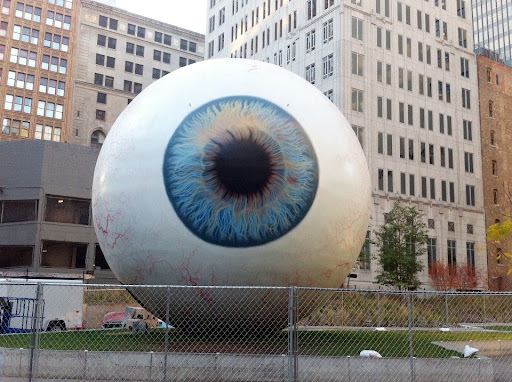
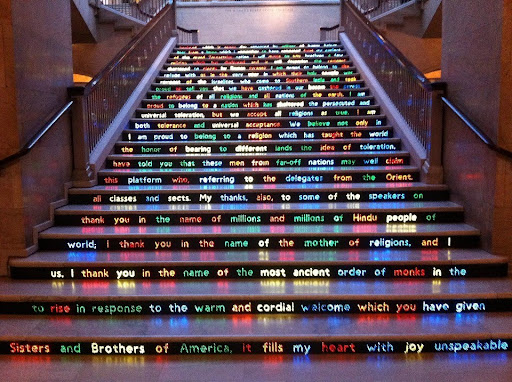
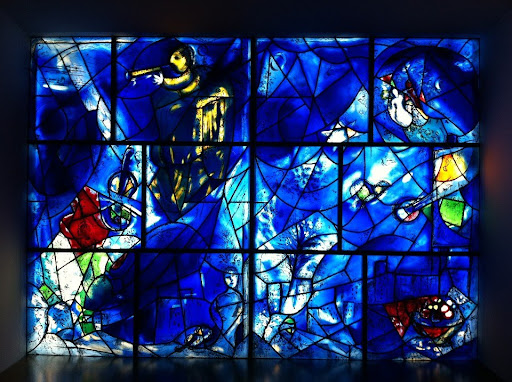
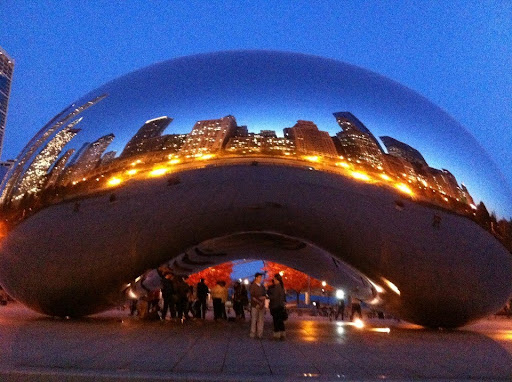
A Last Glimpse of the Eye and other iPhonetographs

OK, so having a camera on my phone isn't exactly news, or even new. But whereas the picture capability was convenient on cell phones past, in many ways it was a mirage. For the image quality was so lousy, you could barely define the result as a photograph, especially for someone who appreciates the virtue of SLR photography.

Nowadays, the photographic quality from my iPhone 4 still isn't quite as good as I might have hoped. Even when not lugging around my first-gen Digital Rebel, I still generally prefer my 6mp Canon point-and-shoot to what I get from the iPhone.

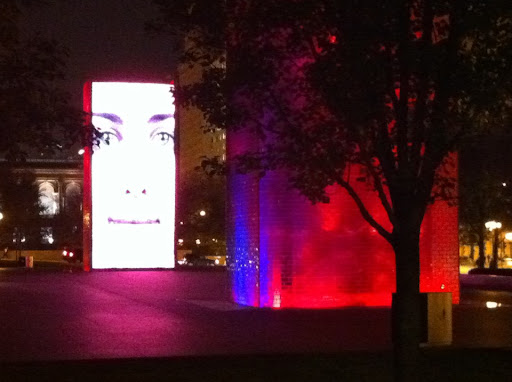
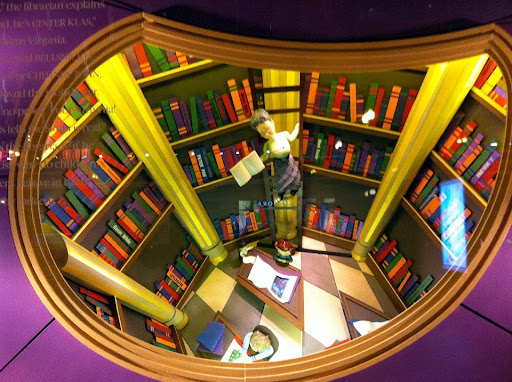
But the other day, I was walking around downtown Chicago before a meeting and took the pictures below with my iPhone. While not high art, I'm pretty pleased with the quality, especially as I've done no cropping and virtually no image enhancement (just a touch of lightening on a couple pix).

---

The Eye. I took this on Tuesday, November 9, 2010 and later read that the next day would be the last that the sculpture by Tony Tasset would be on display. But according to this article, it might be back in the spring.

The words on the stairs of the Art Institute are an installation by Indian artist Jitish Kallat. You can read more about it here.

After being stored away while the Modern Wing was being built, Marc Chagall's America Windows are back on display in the Art Institute, although in a different place than before. More info here.


The Art Institute's Modern Wing, which I still find to be a beautiful waste of space. Taken from the bridge crossing into Millennium Park.

Frank Gehry's Pritzker Pavilion at Millennium Park.

The Bean, or more precisely, Cloud Gate by Anish Kapoor. Although there are always tons of tourists nearby, you can't buy a postcard or sculpture of the Bean due to licensing agreements. You'd think a city in the red might try to work that out.

The Crown Fountain, designed by Jaume Plensa.

Two holiday window displays at Macy's on State Street.