When I was a kid, my father frequently played Broadway musical recordings around the house. I was even taken to some touring musicals while just in grammar school, such as The Wiz, A Chorus Line and The Best Little Whorehouse in Texas (really).
This must have engendered some sort of affinity for the Broadway art form, although rock 'n roll would be my sole music of choice for many years.
As I got older, I did elect to go to an occasional musical of my own volition, but had seen less than 10 as an adult before the year 2000.
Since then, I have become quite a Broadway aficionado and have seen more than 350 performances of at least 200 different musicals.
This list certainly isn't based on any exact science. It is meant to rank my fondness for each musical in terms of the source material, not any specific productions, but particularly spectacular renditions will have undoubtedly influenced my affinity for certain shows.
The ranking is merely of stage musicals--thus Singin' in the Rain, which was only done as a stage work long after the great 1952 movie isn't as high as the film itself would be--although a few shows, such as Grease, are now typically staged with the inclusion of songs written for the movie version.
I've only included musicals I've actually seen on stage, at least once, and there may be some slighting of musicals I last saw long ago. Although I've seen most major musicals, there are a few I haven't, so some omissions may be due to ineligibility, rather than distaste. (I toyed with listing some also rans, but elected not to bother.)
With that said, these are My 100 Favorite Stage Musicals of All-time, which could probably change somewhat on any given day, but seems about right. For now. (To whatever extent the distinction makes sense, "my favorite" does not always correspond to what I think is "the best." For example, I actually think #2, 3, 4, 5 and others are better musicals than #1, but it's my clear favorite.)
1. The Producers
2. Les Misérables
3. West Side Story
4. The Music Man
5. My Fair Lady
6. Sunday in the Park with George
7. Fiddler on the Roof
8. Rent
9. Cabaret
10. Avenue Q
11. Hairspray
12. Evita
13. The Sound of Music
14. Wicked
15. The Lion King
16. Sweeney Todd
17. Spring Awakening
18. Billy Elliot
19. The Visit
20. A Little Night Music
21. A Chorus Line
22. Man of La Mancha
23. Mamma Mia
24. Jersey Boys
25. Follies
26. Fiorello
27. Gypsy
28. The Book of Mormon
29. South Pacific
30. Ragtime
31. Guys and Dolls
32. In the Heights
33. Hello Dolly
34. Carousel
35. Company
36. Camelot
37. Oklahoma
38. The Who’s Tommy
39. Show Boat
40. Mary Poppins
41. Brigadoon
42. Sunset Blvd.
43. Chicago
44. Parade
45. The King and I
46. City of Angels
47. Pacific Overtures
48. Miss Saigon
49. The 25th Annual Putnam County Spelling Bee
50. Bat Boy
51. Side Show
52. Million Dollar Quartet
53. Legally Blonde
54. Beauty and the Beast
55. La Cage Aux Folles
56. Anything Goes
57. Next to Normal
58. Kinky Boots
59. Cats
60. Adding Machine
61. A Christmas Story
62. Spider-Man: Turn off the Dark
63. 42nd Street
64. Oliver
65. Working
66. The Rink
67. Funny Girl
68. Damn Yankees
69. Annie
70. Little Shop of Horrors
71. Singin’ in the Rain
72. Tick, Tick…Boom
73. Thoroughly Modern Millie
74. The Drowsy Chaperone
75. Passion
76. Man of No Importance
77. Crazy for You
78. Dirty Rotten Scoundrels
79. A Funny Thing Happened on the Way to the Forum
80. A Most Happy Fella
81. Caroline, or Change
82. Dreamgirls
83. Joseph and the Amazing Technicolor Dreamcoat
84. Grease
85. Kiss Me Kate
86. 1776
87. Bounce
88. Urinetown
89. Bye Bye Birdie
90. Curtains
91. Into the Woods
92. Spamalot
93. Daddy Long Legs
94. Mame
95. Merrily We Roll Along
96. Dangerous Beauty
97. Phantom of the Opera
98. Movin’ Out
99. Seussical
100. Wonderful Town
Wednesday, October 24, 2012
Sunday, October 21, 2012
Smashing Pumpkins Reward the Faithful, After Testing Their Patience -- Chicago Concert Review
Concert Review
The Smashing Pumpkins
w/ opening act Anberlin
Allstate Arena, Rosemont, IL
October 19, 2012
@@@@
Although I think Billy Corgan's penchant for petulantly confounding--and even alienating--fans has substantially contributed to the diminished popularity of the Smashing Pumpkins, I can't help but to somewhat feel his pain.
While the Pumpkins are now in their 7th incarnation (8 including Zwan), with Corgan the only original member, on the heels of a strongly-reviewed new album, Oceania--even if I don't quite love it--their first hometown arena show in many a year should've been quite a triumph.
But at the same arena the Pumpkins sold out three times at the height of their fame in 1996--albeit after the tragedy that began to derail it--only a quarter of the seats were sold, plus a general admission main floor.
Due to the stage being set close to center ice and no tickets being sold for the 200 level, I believe the show was officially termed a sellout. In this age, being a band that sells 4,000 tickets is no tragedy--and isn't far from what other '90s alt rock heroes like Soundgarden and Weezer drew to their most recent Chicago area shows.
Yet on my way into the Allstate Arena, I noticed--and imagine Billy may have as well--that this week Justin Bieber is playing two shows there, both of which have long been completely sold out.
Say what you want about Corgan--and believe me, I have--but the guy has written some of the greatest songs of the past 20 years, and based on my scant familiarity with the musical prowess (or lack thereof) of Bieber, I feel it fair to suggest that Billy has more talent in his pinkie than young Justin has in his entire being. While I haven't heard Corgan directly diss Bieber, he does seem to whine about his influential band's growing irrelevance in the face of musical mediocrity.
This is a somewhat justified gripe, even if Billy can come off untoward in making it.
The only rebuttal I'd have is that I imagine Bieber is more forthright in giving his fans what they want in a concert setting. Hence, my first sentence of this post.
While at Friday night's show, Corgan was gracious is his on-stage banter, rather than openly antagonistic as at shows in the past, and the crowd was wildly enthusiastic (and presumably largely comprised of rather avid Pumpkinheads), Billy once again made the show a good bit more challenging than it needed to be.
As I referenced earlier, Oceania enjoyed some good critical press upon its June release. As my review of it indicated, I think it is worthwhile but not fantastic, and a step below the best of the Pumpkins exalted past.
But I didn't need to hear it played live in full, for the concert's first 70 minutes.
I am certainly not advocating a full greatest hits set, although when--after Oceania and a cover of Bowie's "Space Oddity"--the Pumpkins launched into, among others, "Disarm," "Tonight Tonight," "Bullet With Butterfly Wings," "Zero," "Cherub Rock" and "Mayonnaise," all sounded glorious. (See Friday's full setlist on Setlist.fm)
But I'm not sure why Billy--who I can't accuse of taking the easy way out--couldn't just build a setlist around, say, six Oceania songs, a selection of classics and some old album tracks (such as one he did play, "X.Y.U." from Mellon Collie and the Infinite Sadness).
To his credit, over the course of 2-1/2 hours on Friday, Corgan avoided the long, angry vocal harangues (he did banter for a 10 minute stretch, but good naturedly) and over-indulgent extended feedback frenzies of old. The band--now filled out by second guitarist Jeff Schroeder, Nicole Fiorentino on bass (the latest in a string of pretty female bassists that Billy somehow digs up) and Mike Byrne on drums--sounded solid, even stellar, though Byrne isn't quite on par with former drummer Jimmy Chamberlain.
In fact, nothing that was played, even from the entirety of Oceania, sounded bad in itself. The live versions of several Oceania tracks (mainly from the disc's first half) made a good case for the new album being a bit stronger than I previously thought. And the great old songs sounded great.
It's just that the way the show was structured could have been considerably more satisfying.
Even the visual display featuring a huge orb onto which videos were projected (devised by Sean Evans, who has worked with Roger Waters) was impressive, but really not all that necessary.
I realize the contradiction of questioning why an artist who has impressively avoided conventionality can't put on a more conventional rock concert.
And the truth is, I've now seen Billy Corgan on stage 24 times (with seven different incarnations of the Smashing Pumpkins, plus Zwan and on his own) and I can't deny that at this point tracking the melodrama is part of the appeal.
But I just don't know why he goes to such an extent to make people scratch their heads.
I consider the Smashing Pumpkins the 5th best alternative rock band of the past 25 years, and among my 15 favorite rock artists of all time. Although I feel that at this point, Billy might be better off writing film scores and/or composing musicals--both of which he should be great at--while indulging his love of wrestling (he runs Resistance Pro Wrestling), tea (he owns Madame Zuzu's tea house in Highland Park) and poetry, I'll forever love the great Pumpkins music of old--and some of relatively new--enough to pay attention to whatever he does next.
Despite it all, I remain a fan of Corgan and the Pumpkins of whatever makeup, and ultimately found Friday's concert thrilling enough to be well worth seeing (once he got around to playing some self-described "classics").
I just wish Billy didn't have to make things so difficult. As such, what could have been an absolutely phenomenal concert throughout was only partially Smashing.
The Smashing Pumpkins
w/ opening act Anberlin
Allstate Arena, Rosemont, IL
October 19, 2012
@@@@
Although I think Billy Corgan's penchant for petulantly confounding--and even alienating--fans has substantially contributed to the diminished popularity of the Smashing Pumpkins, I can't help but to somewhat feel his pain.
While the Pumpkins are now in their 7th incarnation (8 including Zwan), with Corgan the only original member, on the heels of a strongly-reviewed new album, Oceania--even if I don't quite love it--their first hometown arena show in many a year should've been quite a triumph.
But at the same arena the Pumpkins sold out three times at the height of their fame in 1996--albeit after the tragedy that began to derail it--only a quarter of the seats were sold, plus a general admission main floor.
Due to the stage being set close to center ice and no tickets being sold for the 200 level, I believe the show was officially termed a sellout. In this age, being a band that sells 4,000 tickets is no tragedy--and isn't far from what other '90s alt rock heroes like Soundgarden and Weezer drew to their most recent Chicago area shows.
Yet on my way into the Allstate Arena, I noticed--and imagine Billy may have as well--that this week Justin Bieber is playing two shows there, both of which have long been completely sold out.
Say what you want about Corgan--and believe me, I have--but the guy has written some of the greatest songs of the past 20 years, and based on my scant familiarity with the musical prowess (or lack thereof) of Bieber, I feel it fair to suggest that Billy has more talent in his pinkie than young Justin has in his entire being. While I haven't heard Corgan directly diss Bieber, he does seem to whine about his influential band's growing irrelevance in the face of musical mediocrity.
This is a somewhat justified gripe, even if Billy can come off untoward in making it.
The only rebuttal I'd have is that I imagine Bieber is more forthright in giving his fans what they want in a concert setting. Hence, my first sentence of this post.
While at Friday night's show, Corgan was gracious is his on-stage banter, rather than openly antagonistic as at shows in the past, and the crowd was wildly enthusiastic (and presumably largely comprised of rather avid Pumpkinheads), Billy once again made the show a good bit more challenging than it needed to be.
As I referenced earlier, Oceania enjoyed some good critical press upon its June release. As my review of it indicated, I think it is worthwhile but not fantastic, and a step below the best of the Pumpkins exalted past.
But I didn't need to hear it played live in full, for the concert's first 70 minutes.
I am certainly not advocating a full greatest hits set, although when--after Oceania and a cover of Bowie's "Space Oddity"--the Pumpkins launched into, among others, "Disarm," "Tonight Tonight," "Bullet With Butterfly Wings," "Zero," "Cherub Rock" and "Mayonnaise," all sounded glorious. (See Friday's full setlist on Setlist.fm)
But I'm not sure why Billy--who I can't accuse of taking the easy way out--couldn't just build a setlist around, say, six Oceania songs, a selection of classics and some old album tracks (such as one he did play, "X.Y.U." from Mellon Collie and the Infinite Sadness).
To his credit, over the course of 2-1/2 hours on Friday, Corgan avoided the long, angry vocal harangues (he did banter for a 10 minute stretch, but good naturedly) and over-indulgent extended feedback frenzies of old. The band--now filled out by second guitarist Jeff Schroeder, Nicole Fiorentino on bass (the latest in a string of pretty female bassists that Billy somehow digs up) and Mike Byrne on drums--sounded solid, even stellar, though Byrne isn't quite on par with former drummer Jimmy Chamberlain.
In fact, nothing that was played, even from the entirety of Oceania, sounded bad in itself. The live versions of several Oceania tracks (mainly from the disc's first half) made a good case for the new album being a bit stronger than I previously thought. And the great old songs sounded great.
It's just that the way the show was structured could have been considerably more satisfying.
Even the visual display featuring a huge orb onto which videos were projected (devised by Sean Evans, who has worked with Roger Waters) was impressive, but really not all that necessary.
I realize the contradiction of questioning why an artist who has impressively avoided conventionality can't put on a more conventional rock concert.
And the truth is, I've now seen Billy Corgan on stage 24 times (with seven different incarnations of the Smashing Pumpkins, plus Zwan and on his own) and I can't deny that at this point tracking the melodrama is part of the appeal.
But I just don't know why he goes to such an extent to make people scratch their heads.
I consider the Smashing Pumpkins the 5th best alternative rock band of the past 25 years, and among my 15 favorite rock artists of all time. Although I feel that at this point, Billy might be better off writing film scores and/or composing musicals--both of which he should be great at--while indulging his love of wrestling (he runs Resistance Pro Wrestling), tea (he owns Madame Zuzu's tea house in Highland Park) and poetry, I'll forever love the great Pumpkins music of old--and some of relatively new--enough to pay attention to whatever he does next.
Despite it all, I remain a fan of Corgan and the Pumpkins of whatever makeup, and ultimately found Friday's concert thrilling enough to be well worth seeing (once he got around to playing some self-described "classics").
I just wish Billy didn't have to make things so difficult. As such, what could have been an absolutely phenomenal concert throughout was only partially Smashing.
Saturday, October 20, 2012
"I Love Lucy" Live on Stage is Likable if Not Quite a 'Ball' -- Chicago Theater Review
Theater Review
"I Love Lucy" Live on Stage
Broadway Playhouse, Chicago
Thru November 11
@@@1/2
Unlike millions of people a bit older than me—but not just—I have never loved Lucy.
This is much less a matter of distaste than non-subjective disinterest. More ‘just because I never bothered’ than due to any active avoidance, throughout my 44 years I have only seen a handful of episodes of I Love Lucy or any subsequent Lucille Ball sitcoms, and none recently enough to have any recollection of what happened on them.
This isn’t to say that I don’t have regard for Lucy's tremendous comedic talents or the cultural importance of her vastly successful shows. It’s just that as opposed to many others who have seen “I Love Lucy” Live on stage—as I did Thursday night at Chicago’s Broadway Playhouse—I didn’t have a highly acute point of comparison.
Plus, logic would suggest that Sirena Irwin, who plays Lucy Ricardo, has to be pretty darn talented to be cast in the role but unlikely to be a precise replica of Ball, one of the most gifted and beloved comedians and actresses of all time.
So as a pair of I Love Lucy episodes were re-created before my eyes, I didn’t waste much effort trying to discern how closely Irwin and Bill Mendieta (as Ricky Ricardo) matched the real Lucy and Desi.
All that mattered was whether I was being sufficiently entertained.
And I would say I was, although from a financial value standpoint, it helped that I Love Lucy was included in my Broadway in Chicago subscription series. For me, it wouldn’t have been worth the $67-$82 regular tickets seem to be running.
While I can see the appeal of this show—which enacts two actual teleplays as if the episodes were being shot within the Desliu Productions studios—for avid fans of I Love Lucy and/or for groups of friends looking to share a fun night out, as live theater it’s a solid step below several of the other great choices at this busy time in Chicago (Sunday in the Park with George, Kinky Boots, 33 Variations, Sweet Bird of Youth, Good People, just to name a few).
After a studio emcee played by Ed Kross welcomes the audience in affably cheesy 50’s fashion and introduces Irwin and Mendieta as Lucy and Ricky—without ever mentioning the names Lucille Ball or Desi Arnaz; must be some kind of legal thing—the ersatz Ricardos are joined by Fred and Ethel Mertz (Curtis Pettyjohn, Joanna Daniels) in a live rendition of “The Benefit.”
This is an episode in which Ricky is asked by Ethel to sing at a charity benefit show and Lucy loops herself in despite being a terrible singer. What happens on-stage is fun—with all the characterizations seeming fine for someone with a scant point of reference—but I doubt it would make anyone who remembers the original episode forget it.
The second episode that was performed—”Lucy Has Her Eyes Examined”—was also rather enjoyable, as it featured a live band accompanying Ricky singing his signature “Babalu.”
While the episode re-creations were certainly the centerpiece of “I Love Lucy” Live on Stage—which is staged and directed by Rick Sparks—what actually made the whole thing a bit more intriguingly anthropological were the enactments of classic commercials that accompanied the shows (from Brylcream, Alka-Seltzer, Chevrolet, etc.), as well as a medley of popular songs from the age performed between the two episodes.
Not only was it fun for me to see the involvement of actors I’ve long seen on local stages—George Keating and Richard Strimer among them—but it was interesting to be reminded anew what commercials used to be like. And as I said to my friend Paolo during the song medley, which was pleasantly performed but showcased rather saccharine, sanitized melodies, “This is why Elvis blew people’s minds.”
As much as the production serving as a likable but not life-changing tribute to one of America’s greatest entertainers and works of entertainment, “I Love Lucy” Live on Stage was an enjoyable glimpse into an age gone by, for both better and worse.
IMHO, there are several better live entertainment options in Chicago right now than this fun but slight piece of nostalgia, but if you think you want to see it, I wouldn’t tell you not to tune-in. And given that the Broadway Playhouse was packed on a Thursday night, many weeks into the run, it seems there are a whole lot of people who still love Lucy.
"I Love Lucy" Live on Stage
Broadway Playhouse, Chicago
Thru November 11
@@@1/2
Unlike millions of people a bit older than me—but not just—I have never loved Lucy.
This is much less a matter of distaste than non-subjective disinterest. More ‘just because I never bothered’ than due to any active avoidance, throughout my 44 years I have only seen a handful of episodes of I Love Lucy or any subsequent Lucille Ball sitcoms, and none recently enough to have any recollection of what happened on them.
This isn’t to say that I don’t have regard for Lucy's tremendous comedic talents or the cultural importance of her vastly successful shows. It’s just that as opposed to many others who have seen “I Love Lucy” Live on stage—as I did Thursday night at Chicago’s Broadway Playhouse—I didn’t have a highly acute point of comparison.
Plus, logic would suggest that Sirena Irwin, who plays Lucy Ricardo, has to be pretty darn talented to be cast in the role but unlikely to be a precise replica of Ball, one of the most gifted and beloved comedians and actresses of all time.
So as a pair of I Love Lucy episodes were re-created before my eyes, I didn’t waste much effort trying to discern how closely Irwin and Bill Mendieta (as Ricky Ricardo) matched the real Lucy and Desi.
All that mattered was whether I was being sufficiently entertained.
And I would say I was, although from a financial value standpoint, it helped that I Love Lucy was included in my Broadway in Chicago subscription series. For me, it wouldn’t have been worth the $67-$82 regular tickets seem to be running.
While I can see the appeal of this show—which enacts two actual teleplays as if the episodes were being shot within the Desliu Productions studios—for avid fans of I Love Lucy and/or for groups of friends looking to share a fun night out, as live theater it’s a solid step below several of the other great choices at this busy time in Chicago (Sunday in the Park with George, Kinky Boots, 33 Variations, Sweet Bird of Youth, Good People, just to name a few).
After a studio emcee played by Ed Kross welcomes the audience in affably cheesy 50’s fashion and introduces Irwin and Mendieta as Lucy and Ricky—without ever mentioning the names Lucille Ball or Desi Arnaz; must be some kind of legal thing—the ersatz Ricardos are joined by Fred and Ethel Mertz (Curtis Pettyjohn, Joanna Daniels) in a live rendition of “The Benefit.”
This is an episode in which Ricky is asked by Ethel to sing at a charity benefit show and Lucy loops herself in despite being a terrible singer. What happens on-stage is fun—with all the characterizations seeming fine for someone with a scant point of reference—but I doubt it would make anyone who remembers the original episode forget it.
The second episode that was performed—”Lucy Has Her Eyes Examined”—was also rather enjoyable, as it featured a live band accompanying Ricky singing his signature “Babalu.”
While the episode re-creations were certainly the centerpiece of “I Love Lucy” Live on Stage—which is staged and directed by Rick Sparks—what actually made the whole thing a bit more intriguingly anthropological were the enactments of classic commercials that accompanied the shows (from Brylcream, Alka-Seltzer, Chevrolet, etc.), as well as a medley of popular songs from the age performed between the two episodes.
Not only was it fun for me to see the involvement of actors I’ve long seen on local stages—George Keating and Richard Strimer among them—but it was interesting to be reminded anew what commercials used to be like. And as I said to my friend Paolo during the song medley, which was pleasantly performed but showcased rather saccharine, sanitized melodies, “This is why Elvis blew people’s minds.”
As much as the production serving as a likable but not life-changing tribute to one of America’s greatest entertainers and works of entertainment, “I Love Lucy” Live on Stage was an enjoyable glimpse into an age gone by, for both better and worse.
IMHO, there are several better live entertainment options in Chicago right now than this fun but slight piece of nostalgia, but if you think you want to see it, I wouldn’t tell you not to tune-in. And given that the Broadway Playhouse was packed on a Thursday night, many weeks into the run, it seems there are a whole lot of people who still love Lucy.
Wednesday, October 17, 2012
With Pointedly-Rendered 'Sunday in the Park with George,' Chicago Shakespeare Theater Paints a Masterpiece -- Chicago Theater Review
Theater Review
Sunday in the Park with George
a musical by Stephen Sondheim and James Lapine
directed by Gary Griffin
Chicago Shakespeare Theater
Thru November 11
@@@@@
There are few musicals I’ve ever attended with greater anticipation of absolute delight than Chicago Shakespeare Theatre’s current production of Stephen Sondheim’s Pulitzer Prize winner from 1984, Sunday in the Park with George.
It isn’t just that Sunday… is one of my all-time favorite musicals and the one I like best from Sondheim, my favorite composer (excepting West Side Story, for which he wrote the lyrics, but not the music).
And it’s not simply that the show is a (fictional) dramatization of the creation of my all-time favorite painting—the Art Institute’s miraculous “A Sunday Afternoon on the Island of La Grande Jatte”—by one of my very favorite artists, Georges Seurat. Or that Sondheim and book writer James Lapine use Seurat’s pointillist masterpiece to explore the creative process—long a topic of fascination for me—on a more universal level (with “Finishing the Hat” being the greatest song ever written about artistic creation and the sacrifices that accompany it).
While I have seen productions of Sunday in the Park with George on five previous occasions—including on Broadway, as a concert rendition at Ravinia with musical luminaries Patti Lupone, Michael Cerveris and Audra MacDonald and in 2002 in Chicago Shakespeare’s Studio Theatre under the direction of Gary Griffin, who also helms this version and has become a nationally-renowned director—my expectations for this one were stoked well before seeing reviews labeling it “perfect” and “flawless.”
As far as I’m concerned, the Chicago Shakespeare Theater could be renamed the Chicago Sondheim Theater, for I have never seen a play by the Bard there, but all of CST’s Griffin-directed musicals by the maestro: Pacific Overtures, Sunday…, A Little Night Music, Passion, Follies—which was fantastic last fall and just won a slew of Jeff Awards honoring the best of Chicago theater—and now Sunday again.
All of the previous Shakespeare/Sondheim productions were terrific, even better than their Broadway counterparts, which is why I was willing to spend considerably more than I typically do to see a show, and why I was so eagerly excited.
But unlike many occasions when extensive anticipation, acclaim and hype are met with a certain degree of letdown, if not outright disappointment, CST’s rendition of Sunday in the Park with George is every bit as good as I could have hoped and better than I’ve ever seen.
With sublime songs, compelling (if somewhat complex) themes, outstanding singing, impressive musicianship and inventive visuals, this production is about as artistically resplendent as theater gets.
Of course, my opinion is abetted by my affinity for Seurat, his painting, Sondheim and questions of creative inspiration and sacrifice.
I know every lyric that was sung and have an appreciation for the way Sondheim masterfully mimics Seurat’s pointillist painting style in his score. Over time, I have even come to better appreciate the considerably lesser second act, which seems like something of an afterthought following the outright glorious first act.
And I still wish cheaper tickets could be had, although the Courtyard Theater was virtually full on a Tuesday night, so I can’t really blame CST for not offering discounts. (In the audience I noticed a few creative-types from other local theaters and I nearly bumped into Dennis De Young on the way to my seat.)
Shockingly, Sunday in the Park with George opens on a Sunday in a park with George(s) Seurat—wonderfully played and exquisitely sung by Broadway vet Jason Danieley—sketching his aptly named muse, model and girlfriend, Dot (a beguiling Carmen Cusack). At the very beginning, it sounded like Cusack was imbuing Dot with a southern accent for some strange reason, but this was a trivial quirk that didn’t persist nor detract.
Each song in Act I expands on George’s relationship with his art and Dot—with his priorities being in that order—while also weaving in the other characters who will be included (per Sondheim and Lapine’s imagination) in the finished painting.
With shrewd lyrical insight on what an artist—particularly a groundbreaking one like Seurat, and of course, he himself—faces both internally and externally, Sondheim introduces us to another, more traditional (and disdainful) artist, as well as various others (servants, soldiers, a boatman, even a couple of dogs) gathered on the La Grande Jatte for eternity. The act closing “Sunday” harmoniously arranges all the subjects in their spots on Seurat’s grand canvas, and is simply one of the most brilliant songs ever composed.
The 90-minute first act could really be a show unto itself, but Griffin and Danieley do a nice job of making Act 2—set 100 years after the first and revolving around Seurat’s great-grandson, also named George—seem not as clumsy as it sometimes does. And the second act songs themselves are still fantastic, including “It’s Hot Up Here,” “Putting It Together,” “Children and Art” and a reprise of “Sunday.”
All in all, it was a magnificent rendition of one of the best musicals ever written.
Tickets are hard to come by and thus not cheap; I haven’t seen any discounts offered on HotTix or Goldstar (though perhaps in the extension week from Nov. 6-11, things might loosen a bit). But if you want to treat yourself, make a 'point' of catching Chicago Shakespeare’s production of Sunday in the Park with George.
Like the painting itself, it’s nothing short of a masterpiece.
Sunday in the Park with George
a musical by Stephen Sondheim and James Lapine
directed by Gary Griffin
Chicago Shakespeare Theater
Thru November 11
@@@@@
There are few musicals I’ve ever attended with greater anticipation of absolute delight than Chicago Shakespeare Theatre’s current production of Stephen Sondheim’s Pulitzer Prize winner from 1984, Sunday in the Park with George.
It isn’t just that Sunday… is one of my all-time favorite musicals and the one I like best from Sondheim, my favorite composer (excepting West Side Story, for which he wrote the lyrics, but not the music).
And it’s not simply that the show is a (fictional) dramatization of the creation of my all-time favorite painting—the Art Institute’s miraculous “A Sunday Afternoon on the Island of La Grande Jatte”—by one of my very favorite artists, Georges Seurat. Or that Sondheim and book writer James Lapine use Seurat’s pointillist masterpiece to explore the creative process—long a topic of fascination for me—on a more universal level (with “Finishing the Hat” being the greatest song ever written about artistic creation and the sacrifices that accompany it).
While I have seen productions of Sunday in the Park with George on five previous occasions—including on Broadway, as a concert rendition at Ravinia with musical luminaries Patti Lupone, Michael Cerveris and Audra MacDonald and in 2002 in Chicago Shakespeare’s Studio Theatre under the direction of Gary Griffin, who also helms this version and has become a nationally-renowned director—my expectations for this one were stoked well before seeing reviews labeling it “perfect” and “flawless.”
![]() |
| Photo Credit: Liz Lauren |
All of the previous Shakespeare/Sondheim productions were terrific, even better than their Broadway counterparts, which is why I was willing to spend considerably more than I typically do to see a show, and why I was so eagerly excited.
But unlike many occasions when extensive anticipation, acclaim and hype are met with a certain degree of letdown, if not outright disappointment, CST’s rendition of Sunday in the Park with George is every bit as good as I could have hoped and better than I’ve ever seen.
With sublime songs, compelling (if somewhat complex) themes, outstanding singing, impressive musicianship and inventive visuals, this production is about as artistically resplendent as theater gets.
![]() |
| Photo Credit: Liz Lauren |
I know every lyric that was sung and have an appreciation for the way Sondheim masterfully mimics Seurat’s pointillist painting style in his score. Over time, I have even come to better appreciate the considerably lesser second act, which seems like something of an afterthought following the outright glorious first act.
And I still wish cheaper tickets could be had, although the Courtyard Theater was virtually full on a Tuesday night, so I can’t really blame CST for not offering discounts. (In the audience I noticed a few creative-types from other local theaters and I nearly bumped into Dennis De Young on the way to my seat.)
Shockingly, Sunday in the Park with George opens on a Sunday in a park with George(s) Seurat—wonderfully played and exquisitely sung by Broadway vet Jason Danieley—sketching his aptly named muse, model and girlfriend, Dot (a beguiling Carmen Cusack). At the very beginning, it sounded like Cusack was imbuing Dot with a southern accent for some strange reason, but this was a trivial quirk that didn’t persist nor detract.
Each song in Act I expands on George’s relationship with his art and Dot—with his priorities being in that order—while also weaving in the other characters who will be included (per Sondheim and Lapine’s imagination) in the finished painting.With shrewd lyrical insight on what an artist—particularly a groundbreaking one like Seurat, and of course, he himself—faces both internally and externally, Sondheim introduces us to another, more traditional (and disdainful) artist, as well as various others (servants, soldiers, a boatman, even a couple of dogs) gathered on the La Grande Jatte for eternity. The act closing “Sunday” harmoniously arranges all the subjects in their spots on Seurat’s grand canvas, and is simply one of the most brilliant songs ever composed.
The 90-minute first act could really be a show unto itself, but Griffin and Danieley do a nice job of making Act 2—set 100 years after the first and revolving around Seurat’s great-grandson, also named George—seem not as clumsy as it sometimes does. And the second act songs themselves are still fantastic, including “It’s Hot Up Here,” “Putting It Together,” “Children and Art” and a reprise of “Sunday.”
All in all, it was a magnificent rendition of one of the best musicals ever written.
Tickets are hard to come by and thus not cheap; I haven’t seen any discounts offered on HotTix or Goldstar (though perhaps in the extension week from Nov. 6-11, things might loosen a bit). But if you want to treat yourself, make a 'point' of catching Chicago Shakespeare’s production of Sunday in the Park with George.
Like the painting itself, it’s nothing short of a masterpiece.
Monday, October 15, 2012
'A Wanted Man' Gets You In Its Grasp -- Book Review
Book Review
A Wanted Man
a Jack Reacher novel
by Lee Child
@@@@
A Wanted Man isn’t a great book.
It’s certainly quite far from being fine literature and I can’t really say that the story is truly compelling.
I wouldn’t even call it a first-class thriller, even in the not always exalted realm of page turners. There was a twist midway through that I thought was rather suspect, and the outcome isn’t particularly surprising (especially for anyone who’s read any of Lee Child’s novels revolving around Jack Reacher).
But it is a great read.
Before having my crack at a reserve copy from the Skokie Public Library, I was surprised at how many scathing user reviews I was seeing on Amazon, with several 1-star slams coming from readers claiming to have been longtime fans of the Reacher series.
If such reviews came from legitimately dismayed Reacher Creatures, I don’t understand what they were expecting nor why they were so grievously disappointed. Having read all 16 of Lee Child’s previous thrillers featuring Jack Reacher, an ex-military policeman turned nomadic superhero-of-sorts, sure, some are a bit better than others. And though I’d be hard pressed to recall any specifics of the previous books, all devoured well within a week, I don’t think I’d put A Wanted Man in the very upper echelon.
But at the very least, it accomplished what Child’s past works—like those by my other favorite thriller writer of recent years, Harlan Coben—have: it made me want to read it at any moment I had time to spare.
One night, rather than go out to a play I was thinking of seeing, I opted to stay in and read A Wanted Man. Likewise on other evenings, instead of watching a DVD that was due back to the library the next day or paying close attention to a baseball playoff game, I chose to read the book because I acutely wanted to find out what would happen next and how it would end.
I can’t say I learned a whole lot, although through Reacher, Child always includes some interesting societal insights, trivial tidbits and an occasional mindbender (such as how you can easily speak for a full minute while knowingly not saying a word that includes the letter “a”).
And though I could provide a minor synopsis of the plot, it doesn’t really matter except to say that A Wanted Man finds Reacher hitchhiking through the Plains states and getting entwined in some nefarious doings for which he has to come to the rescue.
As I mentioned above, Child employs a twist about halfway through that seemingly comes out of nowhere, but it doesn’t really derail things so much as to simplify them.
At this point, all of Child’s books go straight to #1 on the New York Times Best Sellers list, and A Wanted Man is no exception. But the series is primed to get even more exposure when the first film adaptation, titled Jack Reacher and starring Tom Cruise in the title role (despite Reacher being 6’5" on paper), is released near Christmas.
The movie is based on 2005’s One Shot; that’s a really good one (as my friend Dave recently confirmed) and it’s not as if the Reacher series needs to be read in order. So while, IMHO, there’s no reason to avoid A Wanted Man if you’re a fan of the Jack Reacher series, if you can’t get it at your library and/or prefer waiting for the paperback, start with One Shot, or Killing Floor (the first book to be released) or The Affair (the book preceding A Wanted Man, now in paperback and set earlier than any previous Reacher story).
But if you are a Reacher devotee, puzzled perhaps by the plethora of poor reviews on Amazon, I say ignore them. It may not be a masterpiece, it may not be a great book, but in library parlance, A Wanted Man is well-worth checking out.
A Wanted Man
a Jack Reacher novel
by Lee Child
@@@@
A Wanted Man isn’t a great book.
It’s certainly quite far from being fine literature and I can’t really say that the story is truly compelling.
I wouldn’t even call it a first-class thriller, even in the not always exalted realm of page turners. There was a twist midway through that I thought was rather suspect, and the outcome isn’t particularly surprising (especially for anyone who’s read any of Lee Child’s novels revolving around Jack Reacher).
But it is a great read.
Before having my crack at a reserve copy from the Skokie Public Library, I was surprised at how many scathing user reviews I was seeing on Amazon, with several 1-star slams coming from readers claiming to have been longtime fans of the Reacher series.
If such reviews came from legitimately dismayed Reacher Creatures, I don’t understand what they were expecting nor why they were so grievously disappointed. Having read all 16 of Lee Child’s previous thrillers featuring Jack Reacher, an ex-military policeman turned nomadic superhero-of-sorts, sure, some are a bit better than others. And though I’d be hard pressed to recall any specifics of the previous books, all devoured well within a week, I don’t think I’d put A Wanted Man in the very upper echelon.
But at the very least, it accomplished what Child’s past works—like those by my other favorite thriller writer of recent years, Harlan Coben—have: it made me want to read it at any moment I had time to spare.
One night, rather than go out to a play I was thinking of seeing, I opted to stay in and read A Wanted Man. Likewise on other evenings, instead of watching a DVD that was due back to the library the next day or paying close attention to a baseball playoff game, I chose to read the book because I acutely wanted to find out what would happen next and how it would end.
I can’t say I learned a whole lot, although through Reacher, Child always includes some interesting societal insights, trivial tidbits and an occasional mindbender (such as how you can easily speak for a full minute while knowingly not saying a word that includes the letter “a”).
And though I could provide a minor synopsis of the plot, it doesn’t really matter except to say that A Wanted Man finds Reacher hitchhiking through the Plains states and getting entwined in some nefarious doings for which he has to come to the rescue.
As I mentioned above, Child employs a twist about halfway through that seemingly comes out of nowhere, but it doesn’t really derail things so much as to simplify them.
At this point, all of Child’s books go straight to #1 on the New York Times Best Sellers list, and A Wanted Man is no exception. But the series is primed to get even more exposure when the first film adaptation, titled Jack Reacher and starring Tom Cruise in the title role (despite Reacher being 6’5" on paper), is released near Christmas.
The movie is based on 2005’s One Shot; that’s a really good one (as my friend Dave recently confirmed) and it’s not as if the Reacher series needs to be read in order. So while, IMHO, there’s no reason to avoid A Wanted Man if you’re a fan of the Jack Reacher series, if you can’t get it at your library and/or prefer waiting for the paperback, start with One Shot, or Killing Floor (the first book to be released) or The Affair (the book preceding A Wanted Man, now in paperback and set earlier than any previous Reacher story).
But if you are a Reacher devotee, puzzled perhaps by the plethora of poor reviews on Amazon, I say ignore them. It may not be a masterpiece, it may not be a great book, but in library parlance, A Wanted Man is well-worth checking out.
Labels:
Book Reviews,
Jack Reacher,
Lee Child,
Skokie Public Library
Sunday, October 14, 2012
'Black Watch' Deploys Impressive Regimentation, But Isn't Quite a 'Must-See' -- Chicago Theater Review
Theater ReviewBlack Watch
Presented by Chicago Shakespeare Theatre
at the Broadway Armory, Chicago
Thru October 21, 2012
@@@@
I will never really know what war is like.
No matter how many times I’ve seen war discussed and depicted in every imaginable form of media—including some rather acute recent films such as The Hurt Locker, Lebanon, Restrepo, Body of War and Hell and Back Again—I’ll never be able to truly identify with the tension, terror, torment, tragedy, tedium and tactics a soldier encounters, likely on any given day.
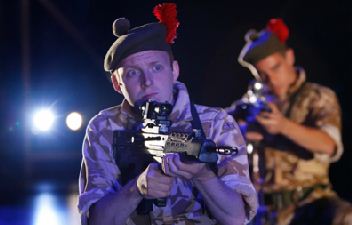
Although I am sure that there have been previous plays about war—including both the battlefield and the repercussions—nothing readily comes to mind as being quite like Black Watch. If nothing else, it is the first theatrical production I’ve ever seen in an armory, or at least a building that used to be one.
Aptly, the show—a touring production by the National Theatre of Scotland presented for the second straight year by Chicago Shakespeare Theatre—has as its venue the Broadway Armory. For both theatrical nomenclature and topical relevancy, where better to put on a play about war?
Written by Gregory Burke and directed by John Tiffany, the play—though it’s not quite a traditionally-structured one—revolves around a group of mostly young soldiers from Scotland who are in the legendary Black Watch regiment of the British Army.
Black Watch troops were deployed to Iraq in 2004, for a somewhat vague mission supporting U.S. operations, and the script explores what the Scottish soldiers face during and after combat, including the lack of a clearly defined enemy or any acute sense of purpose since their own country was never attacked or threatened.
![]() |
| Photo Credit: Manuel Harlan |
That said, and with respect to the scads of critical acclaim Black Watch has garnered since it debuted in 2006—the Tribune’s Chris Jones just gave this rendition 4 stars (out of 4), as he did last year—I didn’t quite love it. And other than to those who are particularly fascinated by the subject matter, I don’t think that I would emphatically recommend it.
To begin with, although it is a compelling work staged in a unique matter, it isn’t a perfectly executed piece of theater. Less than a day after seeing Black Watch—which I watched rather intently—I couldn’t tell you the names of any of the characters or how each of the soldiers stood out from one another. And though I got (or so I think) that during post-war scenes that take place in a pub, a journalist/filmmaker/playwright(?) was interviewing the surviving soldiers, even this was a bit hazy.
While I respect that this is a Scottish play, properly employing Scottish actors—and all appeared to be rather adept—given their heavy brogue, there were numerous lines I couldn’t understand (and almost all were a struggle). And if you discount that about 25% of the dialogue consisted of some variation of the f-word and/or the c-word, that left an even smaller amount of the 2-hour show cogently comprehensible, let alone truly captivating.
No question, there were a number of moving, empathetic moments and towards the end things got fairly riveting, but though Black Watch explores uncommon territory for a stage work—and provides a fine overview of the titular regiment—as a glimpse into the realities of war, the show didn’t really provide insights with as much acuity (or even less) than Hurt Locker, Saving Private Ryan, Platoon or even M*A*S*H.
While the confusion, conflicting emotions and anguish of the soldiers was adequately portrayed, in sum and to a lesser extent individually, in large part Burke’s script illustrated that young men stuck in the desert for months on end spend a lot of time talking about sex.
![]() |
| Photo Credit: Manuel Harlan |
Tickets for Black Watch seem to be readily available through HotTix and if you’re looking for heavy insights in a historic venue, the show is definitely worth your time and money.
But whereas other reviewers tend to imply this is a show not to be missed, given the plethora of other appealing options in Chicago theaters right now—Kinky Boots, 33 Variations, Sweet Bird of Youth, Sunday in the Park with George, Good People, Metamorphosis, Moment and more—I tend to think it can.
Saturday, October 13, 2012
With Crazy Horse at Full Gallop, Still the Neil Young of Old -- Chicago Concert Review
Neil Young and Crazy Horse
with opening act Los Lobos
United Center, Chicago
October 11, 2012
@@@@@
About 15 years ago, toward the end of the Chicago Bulls’ 6-championship run, I wrote an ad promoting a personal appearance at a local Chevy dealer by Bulls center Bill Wennington (now their radio color man). It said:
“Come meet one of the greatest (Canadian-born) players in NBA history.”
Although Bill certainly had a solid career, and was a contributor to the Bulls’ last 3 titles, in the NBA he was far from a superstar. So my parenthetical, though visually scaled back to add a bit of facetious humor, was absolutely essential to making the sentence otherwise true.
Such would not be the case in this sentence:
Neil Young is one of the greatest (Canadian-born) rock musicians of all-time.
In fact, not only is the statement true without the “Canadian-born” modifier, but with it, “one of” becomes unnecessary and “musicians” becomes singular.
On Thursday night at Chicago’s United Center, Neil Young—who was born in Toronto in 1945, moved to Los Angeles in 1966 to co-found Buffalo Springfield, has long lived in Northern California, came on stage to a recorded (not by him) version of “Star Spangled Banner” and performed a new tune proclaiming his pride at being “Born In Ontario”—aptly demonstrated why he is a national treasure in two countries.
Following a terrific hourlong opening set by Los Lobos, then a fun interlude in which white-coated “mad scientists” uncovered the oversized amps depicted on 1979’s Rust Never Sleeps album cover and a respectful rendition of the anthem, Young plugged in his Old Black guitar and with his longtime (but not constant band) Crazy Horse, he filled the UC with glorious, feedback-drenched brilliance.
The next time Jack White wants to walk offstage after just 55 minutes, he should be forced to sit atop a megawatt amp and watch as four guys well into their 60s rip him a new sphincter with 2 non-stop hours of raging vehemence.
Young, guitarist Frank “Poncho” Sampedro, bassist Billy Talbot and drummer Ralph Molina played just 13 songs—many lasting over 10 minutes—but made every one count, from Buffalo Springfield’s “Mr. Soul” to late ‘70s classics like “Powderfinger” and “Hey Hey My My (Into the Black),” as well as five brand new songs that all sounded superb.
Most of the new ones were from Psychedelic Pill, a new Neil Young and Crazy Horse collaboration that releases on October 30 (Neil omitted playing the title song, though it’s been in most recent setlists). If you merely look at the United Center setlist—on Setlist.fm or Sugarmtn.org—you may think “no “Heart of Gold?”, no “Rockin’ in the Free World?”” But the new songs—and the extended interplay they engendered among the clearly-enjoying-themselves Crazy Horse—were strong enough to not only complement “Cinnamon Girl,” “F*cking Up” and a sublime solo rendition of “The Needle and the Damage Done,” (video below) but even at times felt more compelling than the classics.
I’m not saying the new, 15 minute burner “Walk Like a Giant” is quite as good as “Down By the River,” but having heard the latter live in the past, the former felt equally fulfilling in a similar vein. On the solo acoustic “Twisted Road,” Young pays tribute to Bob Dylan and other influences, and after it, Neil took to a piano to debut a new song that seemingly isn’t even on Psychedelic Pill (the main refrain was “she’s a singer without a song she's living”; YouTube clip).
For the sole encore, I would have preferred “Like a Hurricane,” but Young played it at the gig before and in rotating show closers, went with “Tonight’s The Night.” This was more of a slow burn but got pretty fantastic by the end.
Obviously, Neil Young has written many more great songs than he could possibly play in 2 hours. Or even 5. But while I feel some artists are unnecessarily sparing with their greatest hits, much of Young’s appeal—beyond his wonderful lyrics, still pristine voice and tremendously influential guitar roar—comes in being iconoclastic. At an age where he could easily relaxing on his ranch and—with his legacy more than secure—largely just indulging his passion for model trains, he’s still writing and releasing high-quality music.
And instead of touring on a pure greatest hits act or another lucrative CSNY reunion, he’s playing far more emblematic shows like he did Thursday night, to a respectable—and appreciative—but well short of sold out audience.
So even if he opts not to play it, or selected other relics from his prodigious past, as long as Neil Young actually is still rockin’ in the free world—especially with his Crazy Horse compadres—that’s good enough for me.
---
Here's a clip of "The Needle and the Damage Done" that I shot. Particularly given that I was in the 3rd deck, I think Neil's voice on it sounds fantastic.
Monday, October 08, 2012
Symphony of the Season: Photos of Fall Colors
I certainly don't purport to be Ansel Adams, not least because the nature photos I typically take are abuzz with color rather than in melancholic black and white.
I also spend a good bit more time photographing--or just traveling to see--cities and splendors created by man. But I certainly relish natural beauty and in the Chicagoland area, there are three times each year when I am likely to take hundreds of photos I've taken many times before.
In early June, I captured a kaleidoscopic display of freshly bloomed flowers, mainly roses, at the Chicago Botanic Garden, which I posted here.
And though it is a bit harder to plan for or access idyllic shooting locations, fresh snow on trees can make for exquisite pictures, perhaps a bit more in an Ansel Adams vein.
But I particularly love the explosion of color when autumn rolls around. For many years I lived close to the Morton Arboretum, and found that late October was a phenomenal time for catching a festival of colorful trees. I haven't made it out that way this year, but with the leaves already changing colors and even falling off trees, I made a point of strolling through the Ned Brown Preserve (also known as Busse Woods) along Golf Road near Schaumburg (it seems to be officially in Elk Grove Village).
With several trees already bare, or close to it, I may have been a tad late in my photographic foray, but here are a few of my best recent shots of fall foliage. (All photos copyright Seth Arkin 2012)
I also spend a good bit more time photographing--or just traveling to see--cities and splendors created by man. But I certainly relish natural beauty and in the Chicagoland area, there are three times each year when I am likely to take hundreds of photos I've taken many times before.
In early June, I captured a kaleidoscopic display of freshly bloomed flowers, mainly roses, at the Chicago Botanic Garden, which I posted here.
And though it is a bit harder to plan for or access idyllic shooting locations, fresh snow on trees can make for exquisite pictures, perhaps a bit more in an Ansel Adams vein.
But I particularly love the explosion of color when autumn rolls around. For many years I lived close to the Morton Arboretum, and found that late October was a phenomenal time for catching a festival of colorful trees. I haven't made it out that way this year, but with the leaves already changing colors and even falling off trees, I made a point of strolling through the Ned Brown Preserve (also known as Busse Woods) along Golf Road near Schaumburg (it seems to be officially in Elk Grove Village).
With several trees already bare, or close to it, I may have been a tad late in my photographic foray, but here are a few of my best recent shots of fall foliage. (All photos copyright Seth Arkin 2012)
Sunday, October 07, 2012
I've Seen (All) 'Good People' ... So Satisfied? Yes, Particularly at a Great Value -- Chicago Theater Review
![]() |
| Photo Credit: Michael Brosilow |
Good People
by David Lindsay-Abaire
Steppenwolf Theatre, Chicago
Thru November 11, 2012
@@@@
Even though Good People is the first play by David Lindsay-Abaire that I've seen, I was already fairly well convinced that he is an excellent playwright.
For the film Rabbit Hole, which Lindsay-Abaire adapted from his Pulitzer Prize-winning drama of the same name, was one of my favorite films of 2010 (even though I didn't see it until January of the following year).
Good People, which likewise enjoyed a Tony-nominated Broadway run, further reiterates my regard for Lindsay-Abaire, even I didn't find its current Steppenwolf production quite as riveting, or as good, as Rabbit Hole (at least per the film version).
Based in hardscrabble South Boston--where Lindsay-Abaire grew up--with forays into the leafy Boston suburb of Chestnut Hill, Good People centers around a middle-aged woman named Margaret, richly embodied by Marian Mayberry.
As the play opens, Margaret is fired from her $9.20/hr. clerk job at a Dollar Store by--as the photo at top depicts--her much younger supervisor, Stevie, in the back alley. Though I think that most viewers would concur that the termination is merited and that Stevie is blameless, we nonetheless feel considerable empathy for 'Margey,' especially upon learning that she is a single mother caring for a severely retarded adult daughter (who we never see).
![]() |
| Photo Credit: Michael Brosilow |
Though I won't go into any more storyline details, there are enough plot points to keep the play engaging throughout, though it doesn't really kick into high gear until midway through Act 2.
Lindsay-Abaire gives us much to think about, as evidenced by a lively post-show discussion following Saturday's matinee, including issues concerning class, community, friendship, wealth, race, the choices & sacrifices we make and an abiding desire to be seen as "good people" that can simultaneously drive our actions while being at odds with them.
I was largely prompted to check out Good People by Chris Jones' 4-star (out of 4) review in the Tribune. I'm glad I did, particularly in taking advantage of Steppenwolf's generous Twenty at $20 same-day ticket discount program.
![]() |
| Photo Credit: Michael Brosilow |
All the more reason opting for readily-available discount tickets--through Steppenwolf, HotTix or Goldstar--could make a play about the things in life we value one that's especially good, people.
---
In case you're curious about my title for this post, "I've Seen All Good People" is a song by the British band Yes that has absolutely nothing to do with the play, but whose lyrics I couldn't help but reference.
Recent Albums Fail to Transcend Great Expectations
September served as a pretty robust reminder that suggestions of rock ‘n’ roll being dead are greatly exaggerated.
In addition to attending nine concerts, including some pretty terrific ones—Bruce Springsteen, Elvis Costello, Peter Gabriel, Slash, Maximo Park; click to see my reviews—I bought more new compact discs in a given month than I have in years.
These include works by five longtime favorite artists and one relatively rare newer act that intrigues me.
And especially in having read press/Amazon reviews and/or heard emphatic personal recommendations about each that ranged from strong to scintillating, I had great expectations for these recent albums:
Bob Dylan – Tempest
Bob Mould – Silver Age
Dinosaur Jr. – I Bet on Sky
The Killers – Battle Born
Green Day – Uno!
Band of Horses – Mirage Rock
So I would like nothing more than to tell you that these are all brilliant new releases, with each being a must-have addition to your music library. Except for my relatively nascent appreciation of Band of Horses, all of these are artists I have loved for a long time, and though none would qualify as complete unknowns, Dinosaur Jr. and Bob Mould have long been personal favorites despite never filling hockey arenas.
But with the caveat that I’ve come to realize that I sometimes don’t come to properly appreciate an album until it’s been around awhile, so far, after listening to each of these albums a good number of times, I can’t call any of them phenomenal.
Unless you are already an avowed fan of the given artists, I wouldn’t recommend that you spend any money—or much time—on their latest albums. And even if, like me, you are a hardcore fan, I don’t know that much here will surpass your regard for these acts’ past output or considerably enhance their oeuvre.
That’s not to say each—and all—of them don’t have merits. It’s hard for me to calibrate exact ratings for each album in “a pretty good but not nearly their best nor truly essential” sort of way—which helps to explain this combined review post.
But on the Seth Saith @@@@@ rating scale, each album likely merits @@@1/2 to @@@@.
Which doesn’t mean that you should avoid them like the plague or cringe if you happen to hear any of their songs. Each of the albums has moments that comfortably remind of the artist’s past glories, but relatively little that has me saying “I’d rather listen to this than the stuff I’ve loved in the past.”
Take for example, Bob Mould’s Silver Age. Before I heard the album itself, I heard—and read—great things about it, from heavy-duty Mould fans, the music press (see MetaCritic) and numerous glowing reviews on Amazon, where it currently has a 5-star composite rating. The common thread that runs through many of the reviews is that the new disc is Mould’s best work in years and harkens back to Copper Blue, a terrific album he released in 1992 under the auspices of Sugar—his second great power trio, following Hüsker Dü.
But while Silver Age’s 10 songs all feature the searing guitars that epitomize many of Mould’s best and most emblematic songs, including several of those on Copper Blue, they suffer from a sameness. Not just in comparison with Mould’s past, but among each other. All of them blister and burn in a way that makes each enjoyable enough—conceivably even more so in concert—but none are melodically or musically distinct enjoy to elevate to the level of Copper Blue’s “Helpless,” “If I Can’t Change Your Mind,” “Hoover Dam” or “The Act We Act.”
Even a song like “Needle Hits E,” which was left off Copper Blue, is a more enjoyable listen than anything here, as are “Your Favorite Thing,” “Underneath Days” and Egooverride,” to name just a few other hard-charging songs from Mould’s Sugar and solo incarnations.
Similarly, there are several not unpleasant songs from Dinosaur Jr., The Killers and Green Day, but even some of the better ones—”Don’t Pretend You Didn’t Know,” “Miss Atomic Bomb” and “Nuclear Family,” respectively—would have a hard time playlist-supplanting “Out There,” “This River is Wild” or “Armitage Shanks,” to name a few tunes that don’t even quite top the artists’ back catalogs. I didn’t cite The Killers’ new “Runaways” just now because I do think it is a true standout, on par with their best, but I’m not even sure it doesn’t just “sound a lot like” The Killers at their best.
The Green Day and Killers albums are two that I was most looking forward to, and perhaps with time their virtues will become more pronounced, but without going through them song-by-song, both records tend to bore me more than thrill me. Neither makes me eager to throw it on at any time, which a great album should.
There are some nice tunes on Band of Horses’ Mirage Rock—“Knock Knock,” “Heartbreak on the 101”—and I think they do enough to justify my interest among a (to my awareness) uninspiring crop of relatively recent vintage rock bands, but it’s also already become an album I listen to infrequently. Part of the problem is that rather than doing much rocking, most of the songs settle into an easy going Eaglesque groove.
Even Dylan’s Tempest, which garnered some @@@@@ reviews, isn’t an album I find myself putting on for pleasure. Yes, there are a number of quality songs from the old master, enough to make the album essential for Dylan disciples, but thus far Tempest isn’t making me forget Time Out of Mind, let alone approaching Highway 61 Revisited, Blonde on Blonde, Blood on the Tracks or much else from Mr. Zimmerman’s glorious past.
I know I have friends who are loving Tempest, and I’m sure there are fans of each of these artists/albums who would vociferously avow that they’re far beyond run of the mill.
Of course, my opinion doesn’t matter; only yours does and my regard for any or all of these albums may change over time. But though it's possible I'm being too harsh, I recently went back to a couple other somewhat disappointing 2012 releases from longtime personal favorites--Alejandro Escovedo - Big Station; The Smashing Pumpkins - Oceania--and neither convinced me anew that they stand with these great artists' very best work.
So while The Killers' second album Sam's Town is an example of one I later came to really love despite not doing so initially, at this point I suspect that none of the six recent albums I bought will stand--at least to me--as paragons of the phenomenal from acts that have previously achieved that apex.
In addition to attending nine concerts, including some pretty terrific ones—Bruce Springsteen, Elvis Costello, Peter Gabriel, Slash, Maximo Park; click to see my reviews—I bought more new compact discs in a given month than I have in years.
These include works by five longtime favorite artists and one relatively rare newer act that intrigues me.
And especially in having read press/Amazon reviews and/or heard emphatic personal recommendations about each that ranged from strong to scintillating, I had great expectations for these recent albums:
Bob Dylan – Tempest
Bob Mould – Silver Age
Dinosaur Jr. – I Bet on Sky
The Killers – Battle Born
Green Day – Uno!
Band of Horses – Mirage Rock
So I would like nothing more than to tell you that these are all brilliant new releases, with each being a must-have addition to your music library. Except for my relatively nascent appreciation of Band of Horses, all of these are artists I have loved for a long time, and though none would qualify as complete unknowns, Dinosaur Jr. and Bob Mould have long been personal favorites despite never filling hockey arenas.
But with the caveat that I’ve come to realize that I sometimes don’t come to properly appreciate an album until it’s been around awhile, so far, after listening to each of these albums a good number of times, I can’t call any of them phenomenal.
Unless you are already an avowed fan of the given artists, I wouldn’t recommend that you spend any money—or much time—on their latest albums. And even if, like me, you are a hardcore fan, I don’t know that much here will surpass your regard for these acts’ past output or considerably enhance their oeuvre.
That’s not to say each—and all—of them don’t have merits. It’s hard for me to calibrate exact ratings for each album in “a pretty good but not nearly their best nor truly essential” sort of way—which helps to explain this combined review post.
But on the Seth Saith @@@@@ rating scale, each album likely merits @@@1/2 to @@@@.
Which doesn’t mean that you should avoid them like the plague or cringe if you happen to hear any of their songs. Each of the albums has moments that comfortably remind of the artist’s past glories, but relatively little that has me saying “I’d rather listen to this than the stuff I’ve loved in the past.”
Take for example, Bob Mould’s Silver Age. Before I heard the album itself, I heard—and read—great things about it, from heavy-duty Mould fans, the music press (see MetaCritic) and numerous glowing reviews on Amazon, where it currently has a 5-star composite rating. The common thread that runs through many of the reviews is that the new disc is Mould’s best work in years and harkens back to Copper Blue, a terrific album he released in 1992 under the auspices of Sugar—his second great power trio, following Hüsker Dü.
But while Silver Age’s 10 songs all feature the searing guitars that epitomize many of Mould’s best and most emblematic songs, including several of those on Copper Blue, they suffer from a sameness. Not just in comparison with Mould’s past, but among each other. All of them blister and burn in a way that makes each enjoyable enough—conceivably even more so in concert—but none are melodically or musically distinct enjoy to elevate to the level of Copper Blue’s “Helpless,” “If I Can’t Change Your Mind,” “Hoover Dam” or “The Act We Act.”Even a song like “Needle Hits E,” which was left off Copper Blue, is a more enjoyable listen than anything here, as are “Your Favorite Thing,” “Underneath Days” and Egooverride,” to name just a few other hard-charging songs from Mould’s Sugar and solo incarnations.
Similarly, there are several not unpleasant songs from Dinosaur Jr., The Killers and Green Day, but even some of the better ones—”Don’t Pretend You Didn’t Know,” “Miss Atomic Bomb” and “Nuclear Family,” respectively—would have a hard time playlist-supplanting “Out There,” “This River is Wild” or “Armitage Shanks,” to name a few tunes that don’t even quite top the artists’ back catalogs. I didn’t cite The Killers’ new “Runaways” just now because I do think it is a true standout, on par with their best, but I’m not even sure it doesn’t just “sound a lot like” The Killers at their best.
The Green Day and Killers albums are two that I was most looking forward to, and perhaps with time their virtues will become more pronounced, but without going through them song-by-song, both records tend to bore me more than thrill me. Neither makes me eager to throw it on at any time, which a great album should. There are some nice tunes on Band of Horses’ Mirage Rock—“Knock Knock,” “Heartbreak on the 101”—and I think they do enough to justify my interest among a (to my awareness) uninspiring crop of relatively recent vintage rock bands, but it’s also already become an album I listen to infrequently. Part of the problem is that rather than doing much rocking, most of the songs settle into an easy going Eaglesque groove.
Even Dylan’s Tempest, which garnered some @@@@@ reviews, isn’t an album I find myself putting on for pleasure. Yes, there are a number of quality songs from the old master, enough to make the album essential for Dylan disciples, but thus far Tempest isn’t making me forget Time Out of Mind, let alone approaching Highway 61 Revisited, Blonde on Blonde, Blood on the Tracks or much else from Mr. Zimmerman’s glorious past.
I know I have friends who are loving Tempest, and I’m sure there are fans of each of these artists/albums who would vociferously avow that they’re far beyond run of the mill.
Of course, my opinion doesn’t matter; only yours does and my regard for any or all of these albums may change over time. But though it's possible I'm being too harsh, I recently went back to a couple other somewhat disappointing 2012 releases from longtime personal favorites--Alejandro Escovedo - Big Station; The Smashing Pumpkins - Oceania--and neither convinced me anew that they stand with these great artists' very best work.
So while The Killers' second album Sam's Town is an example of one I later came to really love despite not doing so initially, at this point I suspect that none of the six recent albums I bought will stand--at least to me--as paragons of the phenomenal from acts that have previously achieved that apex.
Wednesday, October 03, 2012
Beyond Plenty of Well-Heeled Fun, 'Kinky Boots' Shows a Whole Lot of Sole -- Chicago Theater Review
Kinky Boots
a new musical with
book by Harvey Fierstein
music/lyrics by Cyndi Lauper
directed & choreographed
by Jerry Mitchell
Bank of America Theatre, Chicago
Thru November 4
@@@@1/2
Chicago is a wonderful, widely-embracing theater town. Which is why our fair city is often selected by producers for “out-of-town tryout” runs of shows that are—or so it is hoped—headed for Broadway. Just in this century, The Producers, Spamalot, Movin’ Out and The Addams Family are among the musicals Windy City audiences have been the very first to see.
For us theater aficionados (and self-perceived critics), getting to see a Pre-Broadway World Premiere is a pretty big deal, even if the show will be vastly altered—as with Movin’ Out and The Addams Family—and/or remain lousy—e.g. The Pirate Queen, Sweet Smell of Success, All Shook Up—by the time it gets to Broadway and beyond.
So, while appreciating the current economic climate and that the marquee names involved aren’t appearing onstage, it was somewhat disconcerting that the balcony of Chicago’s Bank of America Theatre was considerably undersold for the very first public performance of Kinky Boots, a bona fide world premiere musical that already has a date set—April 4, 2013—for its Broadway opening.
But à la acknowledging the many devoted White Sox fans who showed up to support the team down the stretch despite rolling my eyes at all the accompanying empty seats, I applaud the audience on Tuesday night that gave a well-deserved standing ovation to what is already one of the best new musicals of the last few years.
I don’t condemn anyone for not yet rushing out to see Kinky Boots, which is based on a 2005 movie I'd never heard of, but if you read this and presumably much higher profile rave reviews and still stay away, don’t call yourself a lover of the Broadway art form or whine that new musicals all too frequently merely co-opt popular franchises and familiar songs.
![]() |
| Jerry Mitchell, Harvey Fierstein, Cyndi Lauper |
The music and lyrics here were composed by Cyndi Lauper, who may not seem like an obvious choice given that she had never before written for the stage—and didn’t even write some of her mid-‘80s hits (including “Girls Just Want To Have Fun”). But although a couple of Kinky Boots’ full score of original songs have a synth-pop sheen, Lauper proves herself rather adept at writing satisfying showtunes.
This isn’t so shocking given that she has maintained a stylistically-diverse career for years since the apex of her fame, but I doubt many hearing songs such as “The Most Beautiful Thing” or “Sex Is In the Heel” would necessarily think that they “sound like Cyndi Lauper.”
Upon a first encounter, the melodies themselves—at least most of them—don’t quite drive the show’s appeal as much as the unique storyline and strong leading performances, but beyond being enjoyably complementary, a good number of tunes truly stand out, including the two named above, plus “Hold Me In Your Heart” (something of this show’s “I Am What I Am” from La Cage Aux Folles) and the ebullient closer “Raise You Up/Just Be.”
Set in the north of England, Kinky Boots is about a young man named Charlie Price (appealingly played by Broadway veteran Stark Sands) who unsuspectingly inherits his family’s longstanding shoe factory, only to discover that it’s about to go under. I’ll be sparing on plot specifics, but through an encounter with a drag queen named Lola—Billy Porter, who I predict will win next year’s Tony Award for best actor in a musical—Charlie hits upon the idea of manufacturing high-heeled boots with the stability to suit transvestites and drag queens (the distinction is explained), unlike traditional women’s footwear.
![]() |
| Billy Porter and Stark Sands |
Not to mention, a whole lot of fun.
Kinky Boots might have been made for walking tall in one’s own skin (and whatever makeup may be applied), but the high energy affair also makes for a thoroughly entertaining evening.
With the caveat that I saw its very first performance, I don’t think the show quite merits a full @@@@@, particularly because I believe there are a number of musicals from the past decade or so that are a bit better, including several that espouse similar “champion your individuality, even in the face of adversity” themes—Hairspray, Wicked, Billy Elliott, Spring Awakening, even Mitchell’s Legally Blonde, to name just a few.
But if just a day into its official existence, Kinky Boots can stand quite proudly on its own two feet, I feel safe in suggesting that this is a show—if not the next Tony winner, at least a nominee—you (yes, you) really should “tryout.” Especially as all of this week’s upcoming performances are discounted on HotTix ($45-$50 + fees for choice seats) and balcony tickets priced at $30-$35 should seemingly be available at the door for most shows (Ticketmaster's interactive seat map makes it easy to get a good idea of availability before you go).
Monday, October 01, 2012
Luminous Diane Lane Elevates 'Sweet Bird of Youth' in Fine-Feathered Fashion -- Chicago Theater Review
Theater Review
Sweet Bird of Youth
a play by Tennessee Williams
directed by David Cromer
Goodman Theatre, Chicago
Thru October 28
@@@@
The last act is the most dramatically rich and strongly embellishes the themes and storylines of Chance’s desperation and self-denial, and that for better or worse, Alexandra del Lago is at heart an actress, reconfiguring the Princess' vulnerabilities and viciousness around the vacillation of her cues.
Originally done on Broadway in 1959 starring Paul Newman and Geraldine Page—who reprised their roles in the 1962 movie—Sweet Bird of Youth is frequently referenced as a play about fading beauty. This isn't inaccurate, but hand-in-anguished-hand, the show is just as much a meditation on fleeting purpose.
Though far from his worst play—and if Camino Real wasn’t it, I don’t want to see it—I still don’t feel Sweet Bird of Youth approaches Tennessee Williams’ very best. And while the multiple stage sets are all quite impressive, if David Cromer put a substantive personal stamp on this production, I’m not astute enough to have appreciated it.
But abetted by strong performances throughout, including by Wittrock in the true leading role, Diane Lane’s star turn—in both her fictional portrayal and an impressively authentic performance—is what truly makes this Sweet Bird soar.
Sweet Bird of Youth
a play by Tennessee Williams
directed by David Cromer
Goodman Theatre, Chicago
Thru October 28
@@@@
Though this is far fainter praise than Sweet Bird of Youth deserves, if nothing else it is eons more enjoyable than the last Tennessee Williams play I saw at the Goodman Theatre. Whereas Camino Real, just three mainstage productions ago, was an abstract—and completely incomprehensible—mess that nearly caused me to cancel my subscription, Sweet Bird of Youth not only helped to prompt my renewal, but proved to be redeemingly entertaining if itself imperfect.
I had initially seen Sweet Bird in a critically-acclaimed production at Chicago’s Artistic Home theater a couple years ago. Then too, I thought the play was worthwhile, but a solid notch below Williams’ holy trinity of The Glass Menagerie, A Streetcar Named Desire and Cat on a Hot Tin Roof (though at the time I hadn’t yet seen the latter).
Ostensibly, the play is about a wanton gigolo pushing 30 named Chance Wayne who returns to his Gulf Coastal hometown in hopes of reclaiming the glories of his youth—both figurative, in terms of being the town’s hottest young stud and aspiring actor, and more literally concerning an ex-girlfriend named Heavenly.
Chance’s ticket to ride—again both literally and figuratively—back into St. Cloud is a no longer quite so glamorous movie star named Alexandra Del Lago, who has dubbed herself the Princess Kosmonopolis.
As reflected by the show’s ticket design, printed before the Goodman’s casting was announced, Chance is rather clearly the play’s central character, with his ever-loosening grip on a meaningful existence being what I see as the drama’s essence.
Without any disrespect to the fine Artistic Home production, there I felt the interaction between Chance and Princess—including almost exclusively in an hourlong first act (of 3)—wasn’t all that compelling and would’ve preferred more direct confrontation between Chance, Heavenly and her controlling, belligerent father, Tom “Boss” Finley, a powerful local politician.
But then the Goodman and noted director David Cromer cast Diane Lane, a real-life glamorous movie star who at 47 is a few years beyond above-the-title leading roles, and the dynamic changed. And not just in the design of the promotional materials (see the program cover above).
Quite frankly, while Broadway and TV veteran Finn Wittrock is quite good as Chance and spends much time displaying his impressive physique, the still luminous Lane is the primary reason one should seek a ticket to Goodman’s production.
At least through binoculars from the balcony, the actress long-acclaimed as one of Hollywood’s most beautiful looked quite lovely, even with Princess Kosmonopolis intended to appear rather addled and past her prime. But far from being merely eye-pleasing, Lane—and it’s been a pretty good year for that marquee surname at Goodman—demonstrated that she’s also a terrific stage actress.
Though the story is still primarily Chance’s, the paramount performance is Lane’s—not just due to her fame coming in, though the real-life parallels are hard to ignore and add gravitas—and served to better justify why Williams devotes so much time to the let’s-use-each-other relationship between Chance and the Princess.
While the play, and performances, sufficiently entertain throughout, Act I—comprised almost solely of Chance and the Princess in a hotel room—feels a bit long and talky. For both dramatic and pragmatic reasons, it seemingly might have made more sense to weave the 20-minute Act II into Act I with a split stage approach.
As it stands—and as explained in Chris Jones’ Tribune review; I can’t claim to have noticed—Cromer supposedly redistributed a chunk of Williams’ second act into Act III here. With my Swiss cheese memory not enabling me to specifically recall how this was handled at Artistic Home, I can't intelligently comment on how this choice altered the play's arc, but having two 15-minute intermissions sandwich a 20-minute second act seemed somewhat silly.
The last act is the most dramatically rich and strongly embellishes the themes and storylines of Chance’s desperation and self-denial, and that for better or worse, Alexandra del Lago is at heart an actress, reconfiguring the Princess' vulnerabilities and viciousness around the vacillation of her cues.
Originally done on Broadway in 1959 starring Paul Newman and Geraldine Page—who reprised their roles in the 1962 movie—Sweet Bird of Youth is frequently referenced as a play about fading beauty. This isn't inaccurate, but hand-in-anguished-hand, the show is just as much a meditation on fleeting purpose.
Though far from his worst play—and if Camino Real wasn’t it, I don’t want to see it—I still don’t feel Sweet Bird of Youth approaches Tennessee Williams’ very best. And while the multiple stage sets are all quite impressive, if David Cromer put a substantive personal stamp on this production, I’m not astute enough to have appreciated it.
But abetted by strong performances throughout, including by Wittrock in the true leading role, Diane Lane’s star turn—in both her fictional portrayal and an impressively authentic performance—is what truly makes this Sweet Bird soar.
Subscribe to:
Posts (Atom)