Saturday, January 19, 2013

Seemingly, A Browsing Pastime is No Longer in Store

Of all the potential causes for personal and/or societal consternation, learning that the Best Buy near Old Orchard will cease to exist after February 3rd would not seem to be of grave concern (though the store does sit on land formerly belonging to a cemetery).

Not only am I not in the market for any new electronics or appliances, and whatever music and movies I still acquire in physical form can easily be shopped for online, but this leaves just four Best Buys within a 15-minute drive from my home (assuming none of those are also slated for closure).

While it was nice having a Best Buy—likely the store at which I’ve most shopped over the years—within 3 minutes of home, and I hope the store’s employees can be redeployed to nearby locations, I can’t
work up much vexation over an overexpanded retail corporation being forced to downsize.

But the news—and yes, I realize Best Buy sells much more than movies and music—bothers me on the heels of reading that the British music chain HMV, with 230 stores and 92 years in business, is “going into administration,” meaning that it has essentially collapsed financially and is looking for a buyer. None of its stores have yet closed, and perhaps can be saved, but I enjoyed browsing HMV in London, where—like in America—Tower Records and the Virgin Megastore went bust years ago.

I also read that Barnes & Noble began closing selected stores—in San Francisco, Philadelphia, Washington, D.C., Seattle, Chicago, Austin, Manhattan and Dallas—after a slow holiday 2012 sales season. And it seems that the spectre of B&N completely evaporating, like its old rival Borders, isn’t far-fetched.
So I ask you, where is a guy supposed to go to kill some time—and yes, buy some stuff? Especially, a guy like me who doesn’t drink coffee or (much) beer, isn’t supposed to eat ice cream or donuts and enjoys browsing, and buying, books, magazines, movies and music.
I used to love going to Tower Records, where they had a huge selection of CDs and DVDs, many great discounts, listening stations and pretty much every magazine ever published. But they went out of business in 2006.

Though in Chicago, the Virgin Megastore wasn’t nearly as convenient, it was cool to browse whenever I was on North Michigan Avenue.

In either Borders or Barnes & Noble, I could easily kill an hour perusing their vast selections, including great shelves of bargain books, of which I bought many. I think I got a book containing large color images of every Van Gogh painting for like $20. So it pains me whenever I see an empty, or converted, Borders store and I’ll really rue the day Barnes & Noble disappears.

And though Best Buy’s inventory of CDs (at its stores) is far short of Tower’s or Virgin’s, it is, or at least was, far more extensive than what you could find at Target or Walmart. Their prices on new release CDs and DVDs (and Blu-Rays) are invariably lower than anywhere else, and beyond often going to Best Buy to purchase a specific new album or film, it is also a store in which I can simply browse.

Not just for music and movies, but also to see what may be new in computers or printers or TVs or stereo equipment, etc., etc.

Certainly I recognize the changes in content distribution, and the resulting economic realities, that have caused bookstores, record stores and DVD retailers to dwindle and perhaps eventually disappear (though Best Buy is likely a separate case as a full-line retailer of computers, electronics and major appliances).

Although I will always value attractive and imaginative packaging as part of the popular music art form, and am old school enough to just like having a physical CD (with artwork, liner notes and lyrics), DVD or book, I realize that the quarterians—my term for those age 25 and under—deal primarily in digital music, movies and books, with or without paying anything.

So it doesn’t take a genius to deduce why huge stores with high rents and vast inventories of physical books, music, movies and magazines are going the way of the dinosaur. Even though I loved going to these stores, I probably proportionately never spent enough to keep them afloat, and of late have not only been buying less media, but doing it more so on Amazon or even iTunes.

But just because I understand why stores, and chains, like Tower Records, Borders, Barnes & Noble, Virgin Megastore, HMV and Best Buy may no longer be viable—either at all or in their current form—doesn’t mean I have to like it. (Though I do understand and respect the perspective of independent book and record store owners who were harmed, or even decimated, by these retail goliaths. But I can't deny I liked going to the big stores.)

And while sounding like a fossil clinging to a past that no longer exists, I believe there are cultural and commercial ramifications.

First, I think we are losing our shared sense of place and lessening human interaction in ways that aren’t good, but I won’t belabor this thought here.

But I also can’t tell you how many books and CDs I’ve bought because I noticed them in a store, and it’s highly unlikely I ever would have come across most of them online. Sure, they’re available on Amazon, but I wouldn’t have known to seek them out. I still like browsing physical merchandise, which goes back to my penchant for distinctive packaging.

While acknowledging that younger people haven’t been as indoctrinated into browsing for physical books, movies, music, etc.—and therefore don’t know what they may be missing—I wonder if HMV’s high profile stores in London (and ones like them in other big cities) could conceivably still exist, but primarily to promote digital purchases.

Of course, this would mandate a change in retail economics. Instead of stores and chains simply buying product from record companies, movie studios and publishers and then reselling them as their means of existing, the manufacturers/marketers would have to subsidize the existence of an HMV or Barnes & Noble so that shoppers could become aware of new & intriguing books, CDs, DVDs—even if they prefer to download a file rather than buy items in the store.

Given the cost of store rents and employees and the realities of Profit & Loss statements and other fiscal management factors, this idea seems somewhat impractical. Unless Apple (and perhaps similarly, Google and Microsoft) gets involved.

What if Apple leased space in each of its Apple Stores for publishers, etc., to showcase their physical media in order to drive digital downloads, which could be done right in the store.

And as this article notes, Amazon has already been considering opening bricks 'n mortar stores, in part to boost its sales through what Jeff Bezos calls “me-too product offering(s).”

Something like this could be a potentially smart solution. For though I like my physical books, CDs, DVDs and magazines, I’ve gone to electronic versions in some cases and realize that there are environmental benefits to greatly eliminating the need for packaging materials.

But I’m still convinced there are marketing and cultural awareness benefits to capturing our attention and interest via products and/or displays we encounter, including in cursory and passive ways.

And at the very least, the continued—if modified—existence of stores in which I can browse would serve to give me someplace to go.

Thursday, January 17, 2013

Greatness in Our Midst: Lionel Messi and Magnus Carlsen

I have a particular fascination with transcendent greatness, especially, but not only, within artistic realms. And I frequently find myself whining or pining over the relative scarcity of contemporary exemplars of such.

But just because I can’t cite a painter like Picasso, a saxophonist like John Coltrane or a cartoonist like Charles Schultz who exists within our midst, it doesn’t mean that there aren’t prime paragons of greatness, even genius, to be acknowledged and appreciated.

Last weekend, football fans got to watch two of the greatest quarterbacks who ever lived—Tom Brady and Peyton Manning—and perhaps the greatest linebacker, Ray Lewis (though I can't really say I admire him). This coming weekend, Brady and Lewis will square off.

In basketball, Lebron James--who just became the youngest player ever to amass 20,000 NBA points--and Kobe Bryant--who had held that mark and is poised to become the NBA's 4th all-time leading scorer this season--continue to play at historic levels.

But the purpose of this post is to focus your attention—and more of mine—on the superhuman accomplishments of Lionel Messi and Magnus Carlsen. At the age of 25 and 22, respectively, both have achieved transcendent greatness. And then some.

Photo credit: Christopher Johnson, Wikipedia
If you’re already well aware of both these men, you can probably stop reading here. I am admittedly not enough an aficionado of either of their realms—soccer for Messi, chess for Carlsen—to tell you anything much beyond what can be read on Wikipedia (Messi; Carlsen).

So yes, this brief tribute will be somewhat cursory in nature, but at a time when I whine and pine over a scarcity of true virtuosity (of recent vintage), it seems proper to expand my purview.

Lionel Messi is an Argentinean who has been playing top-level professional soccer for Barcelona since 2004 (when he was 17). For the past four years, he has won the Ballon d’Or, which honors the best “football” player in the world. In 2010, France Football’s Ballon d’Or (recognizing the European player of the year) and FIFA’s World Player of the Year merged into one award, but no previous player had earned either (or both) "player of the year" awards for more than 3 different years.

Messi has now been named the best player of the year for 4 straight years, and was the runner up for FIFA’s World Player of the Year the two prior.

Unfortunately, I don’t know enough about soccer to tell you what makes Messi so great, other than that he scores more than anyone else. Historically so. In the calendar year 2012, Messi scored 91 goals (including within La Liga (Spanish league) and Champions League games, as well as those played for Argentina), shattering the record of 85 that had stood for 40 years).

Thanks to the magic of YouTube, you can see all 91 of his goals from 2012—including 2 or 3 from the same game, several times—here (my favorite is goal #51):


And as this Bleacher Report article shares, Messi also gets more assists than almost anyone else. Though I know soccer can't be directly compared to hockey, I believe that's what made Wayne Gretzky so transcendent. Not just his ability to score goals, but to set up many, many more goals with his phenomenal passing ability.

I asked a friend who's an avid soccer fan what makes Messi so good. He couldn't cite any one specific thing, saying that Messi has phenomenal footwork and dribbling ability, but that so do a lot of guys who don't achieve as much. And though that Messi is a "once in a generation player" who outclasses--on the pitch and off--recent superstars like Ronaldinho, Zidane and Ronaldo, one shouldn't minimize the boost he gets from playing for Barcelona, which is consistently among the very best teams in the world.

I don’t pretend to have the perspective to intelligently suggest where Messi might place among the all-time best—Pele, Diego Maradona and Zidane being some names typically cited as such. My soccer fanatic friends are convinced that Messi has put himself into the “best ever” conversation, but articles I’ve read—including this one—seem to suggest that unless, or until, he wins a World Cup with Argentina, that will be held against him.

Barring injury he’ll have that chance in 2014, when the next World Cup is held in Brazil. But although his presence may make Argentina a legitimate contender, I don’t think many will be surprised if they don’t win.

I’ll leave Messi’s historical stature for others to argue. All I know is that what he has done, steadily now for 5+ years, has been astonishing, unprecedented and worthy of attention, no matter how much or how little, you (or I) may care about 'football.'

And even in America, I’d have to assume Messi is a household name compared to Magnus Carlsen.

I likely only know who Carlsen is due to a 60 Minutes piece (click here to see it) that called him “The Mozart of Chess.” But although I have never been much of a chess player, much less a student of the game, it is an arena that fascinates me. Chess, at the level that the best players play it, seems to combine scientific and artistic genius in ways that few other activities do.

And although it’s hard to imagine being as good as Tom Brady or Lebron or Tiger, it’s much much harder to imagine being as good as Magnus Carlsen.

Don’t ask me for the details—I know less about chess than I do about soccer—but chess players have their prowess compared according to rating system utilized by FIDE, the world chess federation. According to Wikipedia, as of November 2012, 809 chess players in the world have a rating above 2,500. Virtually of these, and others, have earned the title International Grandmaster, of which 1,380 now exist.

Any of these Grandmasters could likely play and win 20 simultaneous games against skilled recreational players, without looking at the boards. Yet from what I understand, only about 10 of them would have any chance of beating Carlsen—at least over a series of games—who at 22 has a FIDE rating of 2861, the highest ever.

Carlsen, a Norwegian, is not the World Chess Champion as he’s never played for the title (currently held by Viswanathan Anand, who he played to a draw just today in the Tata Steel Chess Tournament), but in December won the London Chess Classic for the 3rd time in the last 4 years. This is what boosted his rating to 2861, besting that of longtime champion Garry Kasparov, who many experts consider the greatest chess player of all-time.

Again, I have no idea if Carlsen is—or ever will be—better than Kasparov or Bobby Fischer. Or why.

But like Messi, for him to even be in that conversation at such a young age, means that he is doing something transcendent.

No, a brilliant chess player or even soccer player, does not brighten my existence the way a truly outstanding rock band or composer or comedian might.

But it is nice to know that there is still newfound greatness to be newly found—and celebrated—especially when from all I've gleaned, Messi and Carlsen seem to be good guys. Unlike some who are dominating the headlines these days.

Wednesday, January 16, 2013

The Chicago Dining World Tour: My Favorite Cajun Joint (and presumably the President’s)

Dixie Kitchen & Bait Shop
Cajun
825 Church St, Evanston, IL
847.733-9030
www.dixiekitchenevanston.com/evanston.html

Much of the intent behind my Chicago Dining World Tour is to prompt myself to discover, and explore, cuisines and restaurants that are foreign to me.

But as I explained in the piece inaugurating this gastro-ethnic excursion, my dining habits have routinely included various international and regional flavors, with a majority of restaurant meals being devoured at something other than a straightforward “American” restaurant.

So even without newfound “Global Dining” intent, some of the places I eat at will be restaurants with which I’ve long been familiar, and have even frequented and favorited. And as appropriate, I’ll include these in my blog series, for even if they aren’t all that novel to me, they still merit spotlighting.

One such place is the Dixie Kitchen & Bait Shop in Evanston, which is my favorite Cajun restaurant in the Chicago area. (Though I actually might prefer the food and ambience at Maple Tree Inn in Blue Island, but it’s a bit pricier and much further from home, so I don’t get there nearly as often.)

The Dixie Kitchen also has a location in Lansing and used to have one in Hyde Park, which in 2001 was highlighted on WTTW’s Check, Please! by Barack Obama, then an unknown Illinois state senator. That show was replayed days shy of his presidential inauguration in 2009, and although I had previously dined at Dixie Kitchen—the one in Evanston—that was what started me going with greater frequency and fondness.

Over what by now much be at least a dozen visits, I have primarily ordered the same thing: Blackened Catfish from their Meat n’ Three portion of the menu, which comes with cole slaw, corn muffin and two side dishes. I almost always choose fried sweet plantains and mashed sweet potatoes.

But the other day when I visited Dixie Kitchen with my friend Dave before catching a movie at the nearby Century Evanston, I changed things up. I got Blackened Tilapia—largely because the catfish is no longer $1 cheaper—along with the cole slaw, corn muffin, fried sweet plantains and mashed sweet potatoes. It was good, although I prefer the consistency of the blackened catfish and think I will return to it on my next visit.

Dave went with his traditional choice, BBQ Peel N' Eat Shrimp off the Starters menu, and was once again quite satisfied. Of course, we both wolfed down plenty of johnnycakes, which are delicious cornmeal pancakes that Dixie Kitchen provides complimentarily to each table.

It was, as usual, a quite filling and fulfilling meal, to the point that I didn’t even consider getting any snacks at the movie.

Trying to be somewhat calorie conscious, I also didn’t order dessert, but have in the past enjoyed the pecan pie, peach cobbler and beignets, as well as a Bourbon Street Hurricane to drink. Other entrees I’ve had and liked include the Trout Pecan and Seafood Pasta, but the Blackened Catfish is my clear favorite.

Ironically, as I was writing this, I got an email from Dixie Kitchen alerting me that the Obama Check, Please! episode will be replayed on WTTW-Channel 11 at 8:00pm this Friday, January 18, in honor of his second inauguration. Incidentally, while an Obama quote from that show used to adorn the back of the t-shirts of Dixie Kitchen’s servers—something to the effect that DK offers good food at good prices—I noticed that the quote is no longer there.

So I can’t say for sure that Dixie Kitchen still has President Obama’s endorsement, but I assure you it continues to have mine. Stop in sometime and I’m fairly certain they’ll do right Bayou.

Tuesday, January 15, 2013

Digging 'The Motherf**ker with the Hat' -- Chicago Theater Review

Theater Review

The Motherf**ker with the Hat
a play by Stephen Adly Guirgis
Steppenwolf Theatre, Chicago
Thru March 3
@@@@

As one is well-reminded on every visit, Steppenwolf Theatre features an impressive ensemble including many marquee names—John Malkovich, Gary Sinise, Joan Allen, Gary Cole, Laurie Metcalf, John Mahoney, William Petersen and more—the first four of whom haven’t been seen on its stage in many a year.

So it’s interesting that coming off a year in which Steppenwolf’s productions did not match the Goodman Theatre’s for star power—i.e. Nathan Lane, Brian Dennehy and Diane Lane—in staging The Motherf**ker with the Hat, Steppenwolf opted to bring in noted TV actor Jimmy Smits to play the role of Ralph.

I’m not saying that Malkovich, Sinise, Cole or Petersen should’ve played the role; none may have been ideal for a character Stephen Adly Guirgis’ script seemingly imbues with urban flavor. But along with noting that on Broadway—where the show, like here, was directed by Steppenwolf ensemble member Anna D. Shapiro—Ralph was played by Chris Rock, after seeing the show at a Sunday matinee, it seems somewhat noteworthy that…

Jimmy Smits is not the star.

This isn’t to say that he isn’t good, nor physically imposing nor that Ralph doesn’t get substantial stage time. But considerably more central is the character of Jackie, played in Chicago by John Ortiz.

And while Smits is good, Ortiz is superb.

Photo credit: Michael Brosilow, steppenwolf.org
This isn’t all that surprising when one notes that A) Guirgis claims to have written the role for Ortiz as part of New York’s LAByrinth Theater Co., which Ortiz co-founded with Phillip Seymour Hoffman, and B) Ortiz can be seen doing terrific work as Bradley Cooper’s best friend in the Oscar nominated movie Silver Lining’s Playbook.

Competing with Ortiz for the best thing about The Mofo with the Hat—with no disrespect meant to Smits or the other three cast members, who are all demonstrably stellar, nor the script itself—is Todd Rosenthal’s amazingly inventive and functional set design, which seamlessly rotates and flips between three different apartment interiors.

The first flat is the one that Jackie—an ex-con and recovering addict—shares with his beautiful but drug-addled girlfriend Veronica, sassily played by Sandra Delgado. Their lives intertwine with Ralph (Smits), who is Jackie’s AA sponsor and married, tempestuously, to Victoria (Sandra Marquez). The third apartment belongs to Jackie’s cousin Julio (Gary Perez), who seems to be both outwardly gay and outwardly married to a woman, although we never see her.

The 100-minute play works as a series of dialogues—and occasional trialogues—between Jackie and Veronica, Jackie and Ralph, Ralph and Victoria, Jackie and Julio (and Ralph), etc., in the various apartments.

There is much humor and much profanity, and in presenting people suffering under the weight of addiction and the economy yet struggling for love, in modern-day non-Manhattan NYC, The Motherf**ker with the Hat is never less than entertaining. Especially if you can snag a $20 day-of-show discount ticket like I did—Steppenwolf still graciously offers 20 for each performance, even with a star like Smits in tow—I recommend that you see it.

Photo credit: Michael Brosilow, steppenwolf.org
But on a first encounter with this piece, after which I valued Steppenwolf’s regular post show discussion, I’m not sure I properly appreciated whatever depth was beneath the surface. I understand that Guirgis is showing us that regardless of one’s station in life, the same issues with which we can all identify—love, friendship, loyalty, family, truth, etc.—still apply.

And I think I get the point that regardless of the reasons for the bleakness of one’s situation, it is pretty universal to fight through it. The problem I had with The Motherf**ker with the Hat is that although I liked all the performances, I’m not sure I liked any of the characters enough to really care what might happen to them after the play ends.

In other words, I liked the drama as it was unfolding, but wasn’t left with much to ponder afterwards. Which is why this Motherf**ker gets @@@@ and not more.

Monday, January 14, 2013

It's Nice To See Grant Hart 'Back from Somewhere' -- Chicago Concert Review

Concert Review

Grant Hart
w/ opening acts Jeremiah Webb and Ripley Caine
Red Line Tap, Chicago
January 12, 2013
@@@1/2

I was born in 1968, so I didn't start paying much attention to music of my own accord until the late '70s, at which point John Lennon was pretty much laying low and Paul McCartney (with Wings) was releasing hit songs like "Silly Love Songs," "With a Little Luck" and "Goodnight Tonight."

So while I was already well-indoctrinated to the brilliance of the Beatles--though probably not yet spinning "Revolution 9" backwards at my friend Jordan's house--I have to admit that at the time Lennon was slain in December 1980 (shortly after releasing Double Fantasy), my wrongful perception was that McCartney had been  "the main Beatle."

Similarly, having not been aware of HĂ¼sker DĂ¼ during their existence--sorry, but I was listening to the Scorpions, Ratt and Dokken in the mid-'80s (along with, more proudly, Springsteen, Zeppelin and the Kinks)--I think I first paid attention to their legacy after getting hooked on Bob Mould's great 1992 album with Sugar, Copper Blue, which I initially heard sometime in 1993.

In subsequently getting all of HĂ¼sker DĂ¼'s highly acclaimed albums from the '80s, I expected to be wowed by much more of Mould's material. And I was. But I soon discovered that only half the songs were written and sung by him; the other half--with plenty of songs I liked just as much as Mould's--were composed and sung by Grant Hart, the band's drummer.

Though I have now noted that Hart went on to lead a band called Nova Mob and has released some solo albums, I have never heard any of his music outside of Husker Du and never noted any live appearances by him. Whereas I have seen Mould six times and have virtually all the music he's released.

So my eyes perked up when I saw a friend mention on Facebook that Grant Hart would be performing in Chicago on Saturday night. Especially in discovering that the venue--the Red Line Tap--was only about 20 minutes from home and tickets were just $10, I eagerly opted to check him out.

Based on the listing on the venue's website, I didn't know if Hart would be performing with a band or solo. I also expected him to look something like he does in the photo.

Turns out, he played alone with just an electric guitar--following enjoyable solo acoustic sets by Jeremiah Webb and Ripley Caine--and except for his singing voice, was largely unrecognizable compared to any old images I had seen.

Far be it from me to criticize anyone's appearance or fashion choices, but it looks like Hart might be borrowing Anthony Kiedis' stylist of late, albeit with more of a John Waters mustache.

But even if he didn't instantly look like a guy who helped to change the face of indie and alternative rock, over an 85-minute, 23-song performance Hart played enough HĂ¼sker DĂ¼ chestnuts--plus some enjoyable other material--to provide an adequate reminder of his legacy.

While even Mould probably couldn't be considered a household name these days--if ever--he seemingly can sell out a show or two at the 1,150 capacity Metro anytime he comes to Chicago.

So to see his old bandmate--the McCartney to his Lennon, or vice-versa--performing in front of about 50 people for $10 a head was both a bit sad and stirring at the same time.  

Though there was nothing to suggest a lack of professionalism, the show felt less like a concert than just a guy playing some songs in a small room.

Hart opened with a song called "You're the Reflection of the Moon on the Water," which I didn't know, but a few songs in he pulled out the first HĂ¼sker DĂ¼ song of the night (at least as far as I recognized, though merely by the lyrics), "The Girl Who Lives on Heaven Hill."

Occasionally Hart would ask the crowd if they had requests, which would bring a torrent of people shouting HĂ¼sker DĂ¼ song titles. He played a few, and declined to do others (such as "Books About UFOs"). Other than "The Girl Who Lives on Heaven Hill," the Husker songs that I could identify were "She Floated Away," "Don't Want to Know If You Are Lonely," "Green Eyes," "It's Not Funny Anymore," and the show closing "Never Talking to You Again."

But much else of what he played sounded solid as well, including songs such as "Admiral of the Sea," "California Zephyr," "Barbara," "Little Miss Information" and "My Regrets." Three of these--plus his opening song--came from 2009's Hot Wax album, which AllMusic.com notes came after "years of addiction," but which served as an "overdue reminder that there were two excellent songwriters in HĂ¼sker DĂ¼."

So hopefully, Grant Hart is still getting back to where he once belonged, and it was heartening to know that, even at a rather rudimentary level, he remains active.

If you didn't arrive at the Red Line Tap with an appreciation of who Grant Hart was, you might not have been wowed; not only were his solo versions devoid of Husker Du's manic energy, but--though his voice was largely in good stead--some of his vocal phrasings recircuited the originals.

But I imagine that most people there were well aware of Grant Hart's history--and his place in rock 'n roll's--likely even more fervently than I. So while I can't proclaim it a truly outstanding rock concert--though for just $10 it was well worthwhile even at face value--in ways that went beyond the performance itself, it was rather robustly satisfying. Or I guess you could say, Grant's re-emergence was good for the Hart. And soul.

--
A brief snippet of Grant Hart performing Green Eyes, shot by me:  
A Spotify playlist of Husker Du songs by Grant Hart, as well as a few of his solo songs:

Sunday, January 13, 2013

The Chicago Dining World Tour: Enjoying a 'Taste of Cuba'

Taste of Cuba Cafe
Cuban
3918 W. Touhy Ave., Lincolnwood
847.674.2822
www.tasteofcubacafe.com

After inaugurating my newfound initiative to eat around the world in Chicago by visiting the Argentinean restaurant Tango Sur, the next stop on my local world tour wound up being Taste of Cuba in Lincolnwood.

This was my first visit to Taste of Cuba, a friendly storefront cafe with 6 or 7 tables, but not my first taste of Cuban food.

I have enjoyed the 90 Miles Cafe at both their Chicago locations, used to go to a now defunct Cuban restaurant at Kimball & Peterson and when in Milwaukee in September, liked a place there called Cubanitas. I've also enjoyed the food service counter in the back of La Unica, a Cuban bodega on Devon.

So I was somewhat familiar with Cuban cuisine, primarily in the realm of Lechon (roasted pork) and Cubano (ham, pork, Swiss cheese) sandwiches as well as some appetizers. And I was therefore aware that Cuban food is considerably less spicy--pretty much devoid--than I would have suspected.

On Friday night, I went to Taste of Cuba for dinner with my mom and we were both very pleased with our experience in all regards: food, service and price.

I ordered Ropa Vieja, which the menu cites as a House Specialty and describes as "Roasted steak braised in a slow simmered creole sauce with sweet peppers, onions and garlic!"

Though what I got, accompanied by sweet plantains (my choice of side) and rice, was tasty, it wasn't quite as exciting as I inferred from the menu. As shown at right, the Ropa Vieja is basically a pile of seasoned shredded beef, with some peppers and onions mixed in. It seemed to me that some accompanying tortillas--or the Cuban equivalent--would've been appropriate, or that Ropa Vieja might work well on a sandwich (I don't see one listed).

Nonetheless, it fit the bill as something I've never eaten before and found both interesting and enjoyable.

Even better was a Steak Jibarito my mom ordered and let me share. I'm familiar with the Jibarito as a Puerto Rican specialty I had loved at Taste of Chicago, and subsequently from Borinquen restaurant, but it's not surprising it also fits within Cuban cuisine.

A Jibarito is a sandwich that uses fried plantains in lieu of bread, with your choice of filling. The steak we had was terrific.

I think my mom would agree, that especially given the relatively low price, this was one of the best dinners out we've had in awhile. It was made even better by service that wasn't just fast, but positively cheerful.

Taste of Cuba is just steps away from what may be my favorite Mexican restaurant in the area, Wholly Frijoles, and I think I first noticed the former on a trip to the latter. But Taste of Cuba may well merit a return visit even before I circumnavigate the world of Chicago dining cultures, and I certainly would recommend it to anyone looking forward to Havana great meal at a good price.

Friday, January 11, 2013

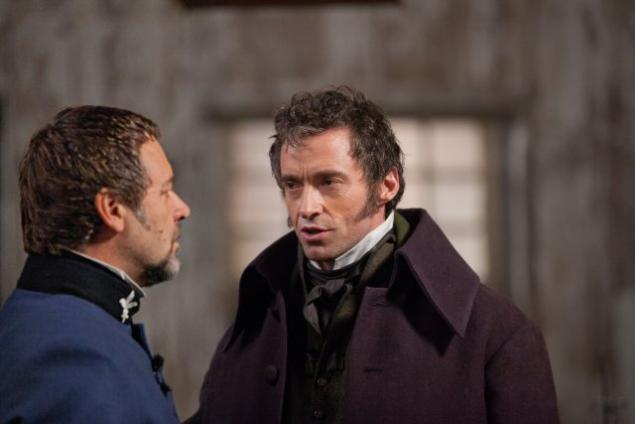
Manning the Barricades on Behalf of Les Misérables

Les Misérables, the movie based on the hit musical, was released in America on Christmas. I saw the second showing of the day at a local theater, with family and friends, electing to see Les Miz rather than Django Unchained, which I saw later that week.

I went into Les Miserables with great expectations—coincidentally referencing another classic work of 19th century literature, published just a year before the Victor Hugo tome dropped in 1862—as the stage musical is one of my all-time favorites (officially #2 on this list) and, IMHO, the best piece of musical theater ever created.

But I also entered the movie with a good bit of wariness.

Having in November seen a sensationally well-sung touring version of the musical, which I’ve taken in numerous times, I was skeptical about the vocal chops of the movie’s stars, particularly Russell Crowe, but also to varying degrees, Hugh Jackman, Anne Hathaway, Amanda Seyfried, Sacha Baron Cohen, Helena Bonham Carter and others.

Also, while advance buzz for the movie seemed to generally be strong, not only had recent stage-to-screen adaptations of cherished musicals like The Producers and Rent been relatively disappointing, but some critics—including Michael Phillips in my local Chicago Tribune—had truly trashed Les Miserables.

In giving the film 1-1/2 stars out of 4, Phillips wrote “Too little in this frenzied mess of a film registers because [Director Tom] Hooper is trying to make everything register at the same nutty pitch.”

But I went to the movie on Christmas and I loved it. To the point of ranking it #6 on my list of Best New Movies I Saw in 2012.

This isn’t to say that I thought everything about it—particularly the singing—was absolutely exquisite. For pure vocal prowess, the recent DVD of the 25th Anniversary Concert of Les Miserables or a touring production or the one playing in London is likely a good step greater.

Crowe actually sang a bit better than I expected, but a bit short of phenomenally, while Jackman—who has solid stage musical credits—sounded a bit thinner of voice than I would’ve thought. Hathaway was very good—she, like Jackman, has now earned an Oscar nomination—but perhaps over-emoted a touch, while Seyfried's singing was solid if not quite sensational.

But while this may sound like I’m being hypercritical, or even negative, in truth the slightly-below-pristine movie star singing did very little to detract from my tremendous overall enjoyment of Les Miserables on screen.

Over nearly 2 hours and 40 minutes that for me never dragged, Hugo’s classic storyline, the score by Claude-Michel Schönberg and the adaptation and lyrics by Alain Boublil and Herbert Kretzmer all retained their power to glorious effect. And whatever quibbles some critics had about not only the singing, but Hooper’s camerawork and editing choices, were for me rendered inconsequential.

When I walked out of the theater, I was already looking forward to Les Miserables being released on DVD so I could add it to my collection and watch it again.

But while the Les Miz movie has certainly seemed to have its fair share of champions among friends, the public and the press—it garnered a Best Picture Oscar nom—over the past few weeks, I became aware of a good number of people who truly hated it.
In Time magazine, Richard Corliss wrote, “This is a bad movie.”

Nick Digilio, a WGN Radio host and avowed movie buff, put it on his list of Worst Movies of 2012, as did Michael Phillips.

David Edelstein of New York Magazine called it “tasteless bombardment.”

In Entertainment Weekly, Lisa Schwarzbaum opined that “this fake-opulent Les Miz made me long for guillotines.”

In her New York Times review, Manohla Dargis referred to Hooper’s directorial approach as being “bludgeoning and deadly.”

And in the most vitriolic harangue I’ve yet encountered, David Denby wrote in the New Yorker, “I had never seen the show or heard the score; I came to the material fresh, without preconception, and throughout the entire hundred and fifty-seven minutes I sat cowering in my seat, lost in shame and chagrin. This movie is not just bad (“bombast,” as Anthony Lane characterized it in a wonderful review in the current issue of the magazine). It’s terrible; it’s dreadful. Overbearing, pretentious, madly repetitive.”
Certainly, I realize and respect that everyone—and especially professional critics—are going to have different viewpoints on things, and if it’s their job (or even just wont) to share them, they should be nothing but candid about their opinions.

And when someone as esteemed as Richard Corliss finds fault with Hooper’s technical approach—writing “…when Hooper pulls back for the big view, his camera style switches from mesmerized single takes to catch-as-catch-can choppiness. The barricade scenes are filled with rapid, indiscriminate vignettes of the protesters; the shots don’t build, they just pile up—I can’t help but appreciate that he’s assessing things with a much more trained eye than I.

Especially as someone who openly espouses my opinions on this blog, with which I imagine and respect that many people may disagree, I generally take a “to each their own” philosophy. Some people hate musicals. Some people hate Springsteen. Some 5547 people have given Citizen Kane a “1” rating (out of 10) on IMDB. We all have our opinions and we’re all entitled to them.

To wit, I recently watched Persona, an Ingmar Bergman film that the British Film Institute ranks as the 17th best film ever. I could see the unique movie's merits, but nowhere to that extent. And though they often tend to be lumped together, I am far less a fan of Phantom of the Opera—or even Boublil and Schönberg ’s Miss Saigon—than I am of Les MisĂ©rables.

So it’s not like I don’t get that variances of opinion—and even seeming inconsistencies among our
own—are not just normal, but in many ways valuable, even essential.

Yet while I wouldn’t even say that outright slams are the majority—Metacritic cites only 2 purely negative critics' reviews out of 41 total, though 15 are “mixed” rather than positive—I found myself somewhat puzzled by exactly what had made Denby and the other naysayers so miserable.

So the other day, after work, I went to see Les Miserables again.

And I went specifically looking to be bothered by the camera angles and close-up shots that bounced around and subpar singing and an overload of empty bombast. I was looking for evidence to feel sheepish about my longstanding regard for Les Miz, a musical Denby says “was a killer for girls between the ages of eight and about fourteen,” with music that “is juvenile stuff—tonic-dominant, without harmonic richness or surprise.”

Well, with the caveat that I never purport to know what the hell I’m talking about, in seeing Les Miserables on screen for a second time, with the express purpose to focus on its supposed flaws, I wound up feeling the same way about it as I did the first time.

I loved it.

Sure, I can appreciate where some of the criticisms are coming from. Much of the music is overtly anthemic and tugs at your heartstrings. The score is filled with musical motifs that repeat ad nauseum. It seems somewhat odd that Javert (played by Crowe) seemingly has no other purpose in life than to hunt Valjean (Jackman), and the way the two characters (and others) constantly cross paths across France every few years seems too conveniently coincidental. As noted above, the stars' singing voices are likely a touch below prime Broadway or West End caliber. And yes, at a few points, the camera seemed to jump around more than it may have needed to.

Etc., etc., etc.

Still, there really wasn’t a moment within the 157 minutes that I didn’t like. By and large, the movie follows the book of the musical, which condensed the action of a 1,000+ page epic novel that takes place over about 20 years into a cohesively compelling 3-hour show. Hooper and his editors made a few sequencing alterations, and there are a couple points where you may wonder why so-and-so is suddenly here and then there, but in my estimation, everything holds together much more than it doesn’t.

The performances are good, the songs are luscious and for someone who loves the stage version as much as I do, the movie is every bit as good as I could’ve hoped. Understanding that in show “business,” movies are made to make money, I get—and agree with—why movie stars were employed, rather than perhaps lesser-known Broadway vets with better singing voices.

And if, as it seems Denby would suggest, I am mistaking attractive artifice for true beauty, so be it.

I’ll happily squint if it means deriving as much pleasure (and yes, uplift) as I have from Les Miserables, on stage, and now, on screen.

And if you hate Les Miserables, c’est la vie.

Do you hear the people sing?

Tuesday, January 08, 2013

The Chicago Dining World Tour: A is for Argentina

The other day I had an idea.

One that someone with more initiative than I could probably develop into something a good bit more substantive, whether a dedicated blog, a YouTube series, newspaper articles, a Meetup group or whatever.

Have at it.

The idea is this: On a regular basis—perhaps once per week but maybe just once a month—I will eat at a restaurant in the Chicago area representing a different country, ethnicity or cuisine. And without intending to post full-fledged restaurant reviews, I will likely recap many of these dining experiences on Seth Saith.

Yeah, I know, it’s not that spectacular an idea and someone has probably done it before. And even without trying to embark on a Chicago Dining World Tour, I rather routinely eat at Italian, Mexican, Chinese, Thai, Japanese and Cajun restaurants.

Within the past few years, I have also visited local places serving Afghan, Jamaican, Puerto Rican, Cuban, Polish, Greek, Persian/Mediterranean, Bosnian/Serbian, Peruvian, Lebanese, Indonesian, Ethiopian, Turkish, Vietnamese and Spanish food. And I’ve sampled other ethnicities at Taste of Chicago, which has led to me going to the restaurants themselves.

But it dawned on me that in the great melting pot that is Chicago, there are numerous other cultures represented in restaurants that I should try. Without yet delving too deep into research, I’ve discovered (on the internet) local places that serve Guatamalan, Belizean, Austrian, Venezuelan, Lithuanian, Belgian, Costa Rican, Moroccan, Romanian, Filipino food and beyond, plus other not so exotic cuisines like French, German and Korean.

So I should have no problem readily finding somewhere new—in local and global terms, simultaneously—to try, and while keeping an eye on sensible cost outlay and caloric intake, that’s what I intend to do.

Though I mentioned my idea to family and friends who expressed interest in accompanying some of my flavorful explorations—please be in touch if you would like to—I didn’t know when, where or with whom I would begin my world tour of Chicago restaurants.

But on Sunday, I made plans to meet my friend Dave for a movie at the Music Box—we saw Sister, a movie from Switzerland made in French; it was pretty good—and in discussing where to meet for lunch beforehand, he suggested Tango Sur, an Argentinean restaurant just up the street to which I had never been.

Tango Sur
Argentinean
3763 N. Southport, Chicago
(773) 477-5466
www.tangosur.net

At 12:30 on a Sunday, Dave and I were the only patrons in the older storefront section (there are two), so as you’d hope, the service was pretty good. The prices for entrees were generally about $15 and up, a bit more than I wanted to spend for lunch, especially in trying to diet.

So I stuck to the appetizer section of the menu and got two empanadas—one with ground beef, one with spinach & cheese, both very good—and a Tortilla de Papa, something of an egg soufflĂ© or omelette with potatoes and onions (shown below). I only ate about half of it; it tasted fine but was a bit dry and not something I’d likely order again.

Dave went with the Churrasco—a 12-oz. sirloin that a friend had recommended—and reported it to be quite good. Perhaps I should have ordered that for myself.

I noted a few other items on the menu that I might order, likely more so for dinner. We were offered the opportunity to see the dessert tray, but this point, no pie for me Argentina.

The dĂ©cor at Tango Sur—including a map of South American, a display of record albums by (presumably) Argentinean artists and a pretty cool illustration taking up a full wall (shown below)—was appealing in a kitschy sort of way, and albeit without any other customers, the ambience was quite comfortable.

I am not necessarily looking to explore countries/cultures in alphabetical order, but Tango Sur turned out to be “A” good way to begin my gastroethnic journey.

On the right occasion, I wouldn’t be opposed to going back, but for now I look forward to traveling on to another international destination in the Chicagoland area.

Please let me know if you have any suggestions—or interest in joining me, somewhere close at hand but with a worldly flavor.

--
Because my idea for a Chicago marketing piece has a slogan that seems rather apt, I'll gratuitously include it here:

Concept, design and slogan © 2012 Seth Arkin, all rights reserved

Thursday, January 03, 2013

Whatever Happened to the Creative Cluster and "Can You Top This?" Artistic Competition?

“In 1966 Eric Clapton was the undisputed king of rock guitar in Britain. That was until Hendrix turned up on the scene. Jimi had only been in England for a week, yet there was already talk of this amazing American guitarist who had been creating a storm in London's blues clubs. In a particularly over confident gesture Hendrix asked if he could jam with Cream at their gig at Central London Polytechnic. Hendrix took the stage and tore through a version of 'Killing Floor' in double time. Cream soon regretted allowing him to join them. Hendrix's outrageous stage antics and dazzling guitar playing caused Clapton to leave the stage in a state of shock. He asked Chas Chandler afterwards "Is he always that fucking good?" (http://www.bbc.co.uk/music/sevenages/events/blues-based-rock/hendrix-jams-with-cream/)
“Raphael's work in the Vatican Stanze was open to the curious; while Michelangelo left strict orders that no visitors were to be allowed in the Sistine Chapel. Michelangelo, busy as a bee himself, consumed with a daunting task, apparently had little interest in Raphael’s work. But Raphael had an interest in his. Raphael paid a secret visit aided by the pope to view Michelangelo’s ceiling in progress. So profoundly did it affect him that he returned to his work in the Stanza della Segnatura (the pope’s private library), where he proceeded to pay tribute to Michelangelo by incorporating a seated figure of Michelangelo in the foreground of his masterpiece fresco, The School of Athens.” (Brenda Harness, Art Historian; http://www.finearttouch.com/Renaissance_Rivals_Raphael_and_Michelangelo.html)
“[Martin] Scorsese entered the Hollywood scene with peers like George Lucas, Steven Spielberg, and Francis Ford Coppola. Together, they were known as the "Film School Generation," (though Spielberg was actually a dropout) contributing highly to the "New Hollywood Movement" also known as the "American New Wave." These four stormed into Hollywood and quickly made their mark. Along with other filmmakers characterized in the New Hollywood Movement, they brought artistic integrity back into mainstream cinema and changed the way the game was played.” (Luke Hickman; http://bluray.highdefdigest.com/news/show/HDD_Study_Hall/Martin_Scorsese/
Luke_Hickman/Fun_Stuff/HDD_Study_Hall_Martin_Scorsese/8168
)
“On a visit to Los Angeles in April, Paul McCartney played [Brian] Wilson a song from [Sgt. Pepper’s Lonely Hearts Club Band], "She's Leaving Home"; later Wilson was said to be "deeply affected" by hearing a tape of another song, "A Day in the Life". Directly afterward, Smile was abandoned, and Wilson would not return to complete it until 2004, when it was released as a Brian Wilson album of the same name. Van Dyke Parks later noted, "Brian had a nervous collapse. What broke his heart was Sgt. Pepper." (http://en.wikipedia.org/wiki/Brian_Wilson)
“Though The Beatles stayed fairly up to date on popular music in the early 1960s, Bob Dylan wasn't on their radar until the spring of 1964, a full year after The Freewheelin' Bob Dylan established the young songwriter as American folk music's premier voice. Once the band heard that record, during a tour of France, it had an immediate impact on them. "For three weeks in Paris, we didn't stop playing it," Lennon would later say. "We all went potty about Dylan." The band's early hits, though deceptively complex, were clearly intended for a teenybopper audience more interested in dancing to backbeats than listening to poetry and acoustic guitars. After hearing Freewheelin', The Beatles—and especially John Lennon—were inspired to write more mature, narrative-driven folk songs in the manner of their new hero.” (Scott Beauchamp and Alex Shephard; http://www.theatlantic.com/entertainment/archive/2012/09/bob-dylan-and-john-lennons-weird-one-sided-relationship/262680/)

Through this blog, I spent the last two weeks extoling the music, theater and films that not only entertained me throughout 2012, but in large part sustained me.

Still, on days when I don’t have anything more acute to annoy me, I routinely find myself perplexed by what I perceive as a relative scarcity of newfound artistic brilliance pervading entertainment and cultural realms.

The seeming paradox isn't lost on me and I do not mean to disregard myriad examples of creative excellence exhibited by talented individuals in many fields, nor denigrate the wide variety of performances and creations that truly do enrich my life.

From actors amazing me within storefront theaters, to poets garnering rapt attention at public readings, to painters, photographers and sculptors peddling their wares at art fairs, to rock, jazz, blues, classical and other musicians making people smile—somewhere—every night of the year, and even to TV shows I enjoy week-after-week, there are innumerable “great artists” out there, who I admire and appreciate, many even without any direct awareness.

But while realizing the triteness of perpetually kvetching about how things used to be better, I genuinely believe that when it comes to transcendent artists of recent vintage with a modicum of mainstream relevance, it’s possible we may be at a historically low ebb. (Take a look at my Best Concerts of 2012 and Best Albums, and you'll notice a preponderance of old, or at least well-established, artists, rather than new ones.)

I’m not sure why this is, although I have to imagine the internet is somehow to blame, between splintering our attention, sensationalizing the superficial, simplifying the educational & creation process, abbreviating artistic gestation and aggrandizing the pursuit of the almighty dollar far above any aesthetic appreciation.

Yet this still doesn’t explain to me why I can only name a relative paucity of new artists—perhaps emerging since the turn of the century—who have a fair amount of mainstream acclaim, or who are, to my awareness and assessment, worthy of it.

Practitioners in the following realms used to be widely celebrated, but...
who can you name that has come to attention within the past 10 years or so and shown signs of historic significance in these areas: rock band, jazz musician, folk singer, classical musician, classical composer, Broadway composer, painter, sculptor, poet, movie director, movie star, stand-up comedian, cartoonist, photographer, dancer, architect, playwright and journalist?
If you can cite 10 names, combined, I’d be impressed.

Now, I realize that “historic significance” is open to interpretation and hard to judge without some chronological distance. And I really don’t know if people like Miles Davis, Allan Ginsburg, Roy Lichtenstein, Lenny Bruce, Joan Baez and Leonard Bernstein were truly household names. Perhaps their stature has grown once their legacies were shown to endure.

And I certainly realize my gripes are nothing new. Generation after generation, throughout history, has likely derided the relative fatuousness of subsequent ones. But my point here is really to point out that whether during the actual Renaissance or as exemplified by artistic torrents ranging from Impressionism to Bebop to the first 25-year surge of rock ’n roll, truly transcendent (or even just great) artists rarely developed or existed in a vacuum.

As illustrated by the anecdotes that opened this piece, talented creators—including many of the most historically exalted—have been inspired by their peers. And although nowadays, extraordinary gifted artists will still occasionally rise above the din, I really don’t see much evidence of what I call the “creative cluster effect,” in which great painters or authors or rock bands or movie directors engage in a (real or merely perceived) game of “Can you top this?”

Take for just one example, rock music in the 1960s. The Beatles exploded on the scene, having themselves been influenced by Elvis, Buddy Holly, Chuck Berry, Gene Vincent and other American rock pioneers. After the Beatles came to America in 1964, bands like The Kinks, The Rolling Stones, The Dave Clark 5, Herman’s Hermits, The Hollies, The Yardbirds and The Who would soon follow, and all these years later, much of the music made by these artists still holds up.

Of course, you also had Motown going on, with the Supremes and the Miracles and the Temptations and on and on, as well as other American vocal groups such as the Beach Boys and the Four Seasons. And with the rising tide of Vietnam in the background, Bob Dylan’s reverence for Woody Guthrie helped spur him to bring activism to pop music, with songs like “Blowin’ in the Wind,” “The Times They Are A-Changing” and “Masters of War.”

Over the next decade or so, these artists would directly or indirectly, and perhaps a bit coincidentally, push each other to musical heights that—in breadth and depth, within pop music genres—haven’t been topped since. As referenced at top, Dylan prompted the Beatles to get more political. And the Beach Boys’ brilliant Pet Sounds album clearly helped to inspire Sgt. Pepper’s, upon whose release the breakdown of Brian Wilson showed just how seriously the artists were about competing with each other.

After 2012, a year when I was hard-pressed to compile my Best Albums list with 10 releases I really liked (or at least that I can imagine caring about 5 years hence), it’s hard to fathom a year like 1967.

Take a look at the Wikipedia page for “1967 in Music” as well as the year’s page on the “Best Ever Albums” website. 1967 saw the release of two new albums, each, by the Beatles, Stones, Doors, Jimi Hendrix and Traffic, plus masterpieces from The Velvet Underground, Love, Cream, Leonard Cohen, Jefferson Airplane, Dylan, The Kinks, The Who, The Moody Blues and more.

One of the more astonishing things to think about is that the Are You Experienced? album by the Jimi Hendrix Experience—on which Hendrix introduced a plethora of new sounds—was only a decade removed from Buddy Holly’s astonishing yet much more musically quaint output. Does anything today sound that much different from 2002?

I truly believe the period from 1955-1980 represents a rock ’n roll renaissance that likely will never be seen again. Narrowing it down even just to 1964-1975, the amount of great musical artists who came of age—besides those already mentioned, the Byrds, Creedence, CSN, Neil Young, Elton, Bowie, Queen, Springsteen, Stevie Wonder, Marvin Gaye, Otis Redding, The Faces, Santana and many others—is rather mindblowing.

Now, I realize that we may very well be in the midst a “Creative Cluster” in the genre of Electronic Dance Music, which isn’t rendered inconsequential by the fact that I don’t care about it.

Similarly, even though it’s also a bit beyond my own personal tastes, I would argue that “Dramatic TV Series created by Cable TV Channels” may be our greatest Creative Cluster of the moment, with shows like Mad Men, Breaking Bad, Game of Thrones, Dexter, True Blood, The Walking Dead, Sons of Anarchy, etc. supposedly being among the best on TV. It also seems possible that dramatic television is the only artistic genre currently at an all-time peak. (Though for TV itself, I prefer the ’70s sitcom cluster with All in the Family, M*A*S*H, The Mary Tyler Moore Show, The Jeffersons, Sanford & Son, Taxi, Happy Days, Laverne and Shirley, Mork & Mindy, etc.).

Further countering my own hypothesis, which seems to hold up best largely in the realm of pop music, perhaps the ongoing Technology Cluster that has Apple, Google, Facebook, Microsoft and Amazon continually playing the “Can you top this?” game will go down in history as something of a Renaissance in its own way.

I guess it’s possible that we can only have a certain amount of Creative Clusters at the same time, and they come and go. I mean, if the 1930’s had a cluster of historically significant classical music composers, or the 1970s a cluster of museum-level fine artists, I can’t say that the practitioners of such readily come to mind.

So perhaps it’s just a matter of time before another Nirvana-Pearl Jam-Soundgarden-Alice in Chains-Smashing Pumpkins cluster comes along, or maybe in time I’ll eventually see the Tarantino-Fincher-Aronofsky-Coen Bros. cluster as estimable as the Coppola-Scorsese-Spielberg-Lucas cluster of the early ’70s.

In sum, I’m not really sure what my conclusion is, just that something seems lacking.

Inspiration, perhaps.

Tuesday, January 01, 2013

The Best of 2012: Photos of the Year (and a bit of a Recap)

Happy 2013. I hope the New Year is a great one for you, and that 2012 was as well.

It was pretty good for me, or so I think now. Of course, it helps that I ended the year employed for the first time in the last 4 years and for just the third time in the last 8.

Not that I'm taking anything for granted, nor that things were ever too terrible when I wasn't working--due to the tremendous support of family and friends, as well as the various interests I document on this blog--but with hopes that the outlook has improved (or will soon) for millions of others who have been unemployed or underemployed for far too long, I can't deny that having a decent job certainly feels better than the alternative.

Certainly, it was far from a perfect year. Not only were far too many people, myself included for the first 8 months, tormented by the economy but the number of people horrifically killed--in movie theaters, in places of worship, in shopping malls, in elementary schools, in subway stations, on city streets, etc., etc.--was absolutely heartbreaking.

I was also saddened by what seemed like a great number of deaths among great musicians, including Whitney Houston, Adam Yauch, Levon Helm, Robin Gibb, Donna Summer, Etta James, Duck Dunn, Davy Jones, Dave Brubeck, Fontella Bass and others.

So in trying to live each day as best I can, as I alluded to above I am extremely grateful for the great friends and close family that brighten my world, and for the opportunity to explore arts, culture, entertainment, sports and more to the extent I do.

If you just stumbled upon this blog post somehow, you may be interested in my recent Best of 2012 lists, covering my favorite Albums, Concerts, Plays, Musicals and Movies of the past 12 months.

In no small part, my worldview and happiness were enhanced by seeing four great Springsteen shows (including a phenomenal pair at Wrigley Field) and awesome concerts by the likes of Neil Young, Elvis Costello and the Who, as well as The Hives, Dinosaur Jr. and Willie Nile. I saw sensational renditions of musicals such as Les Miserables, Sunday in the Park with George and The Book of Mormon, but also relished taking in a number of inspiring community theater productions. I saw actors like Nathan Lane, Brian Dennehy and Diane Lane live on stage without having to leave Chicago. I took a deep dive into documentaries, watching 80 different ones, and also truly explored Charlie Chaplin for the first time ever, watching nearly all of his major films. I went to some Cubs games, several Sox games and even a Cubs/Sox game.

Although I didn't get a chance to travel far in 2012, I nonetheless valued what I saw and did in places like Detroit, Davenport, Louisville, Urbana, Milwaukee and Lake Geneva. 

If you want some measure of my year, primarily as a spectator, I put up this gratuitous post (mainly for my own documentation) of 2012 By The Numbers.

But for a bit more illustrative look back at 2012, I went through my photo files from this year and of more than 59,000 photos taken, I compiled the gallery below. Some I picked because I really liked the photo itself, others for the place or activity they represent. Even with 52 photos--I'll do a "page break" after the first 5--it's not meant as a comprehensive summary of my year, but more so a celebration of some things I did and enjoyed. And while my photos rarely include personal acquaintances, many of them are innately included in this "Snapshot of 2012."

All photos by Seth Arkin. Copyright 2012. Please do not re-use without attribution, and preferably permission.

Amidst my Charlie Chaplin exploration, I went to Chicago's old Essanay Studios, where he shot one movie in
late 1914 or early 1915 in what is now an auditorium bearing his name and likeness at St. Augustine College.
Click to see a piece I wrote on Modern Times and a follow-up on my Chaplin foray.
In March, I went to Medieval Times for the first time. It was quite a knight.
I never actually bought anything at Evanston's longstanding Bookman's Alley, but always liked that it existed.
It doesn't anymore, having shut its doors sometime in mid-2012.
Like the Rolling Stones did in 1964, my friend Dave and I ventured to 2120 S. Michigan Ave.,
home of Chess Records' primary studios and now, Willie Dixon's Blues Heaven Foundation.
Speaking of classic recording studios, on an April trip to Detroit for a Springsteen show, I once again visited
the Motown Museum. I was quite interested in learning about the Funk Brothers, who played on hundreds of hits.


2012 By the Numbers

Movies
Total Watched: 282
New movies: 50
Documentaries: 80
Foreign Films: 38


Live Events
Total: 110

Total Theater: 49
Musicals: 30
Plays: 19

Opera: 2
Comedy: 2
Jazz: 2
Other Genres: 5

Rock Concerts: 36
Springsteen: 4

Sporting Events: 16
Cubs: 4
White Sox: 8
Bulls: 1
Bears: 1
Other: 2


Places Visited
Detroit
Quad Cities
Milwaukee
Urbana
Lake Geneva
Louisville

Museums: 19
Art Museums: 5
Ballparks: 4


TV/Books
TV shows followed: 12
Books read in full: 5


Blog
Articles written/posted: 165
Pageviews in 2012: 123,390


Photographs Taken: 59,401
Music albums purchased: 24