All photos by Seth Arkin with copyright per year taken. Please do not post without attribution.
Monday, May 30, 2016
A Photographic Memorial to Heroes
With great appreciation for all who served and sacrificed, here is a brief collection of photographs to remember the true meaning of Memorial Day.
All photos by Seth Arkin with copyright per year taken. Please do not post without attribution.
Wednesday, May 25, 2016
Goodman Gives 'The Sign in Sidney Brustein's Window' a Good, If Not Entirely Discernible, Reading -- Chicago Theater Review
Theater Review
The Sign in Sidney Brustein's Window
a play by Lorraine Hansberry
directed by Anne Kauffman
Goodman Theatre, Chicago
Thru June 5
@@@1/2
In his considerably more glowing review of Goodman Theatre’s new production of Lorraine Hansberry’s oft-overlooked 1964 drama, The Sign in Sidney Brustein’s Window, the Chicago Tribune’s outstanding theater critic Chris Jones posits:
I certainly don’t doubt that the judgment of 1960s critics, and audiences, might have been influenced by racism, sexism, chauvinism, elitism and various other isms, and I always have high regard for Jones opinions—including about this play.
But based on my take, and that of at least a few other crowd members Sunday night, I don’t know that mixed reactions to this complex dramatic work—conceivably both in 1964 and now—should automatically be ascribed to petty thinking, snobbery or racial divides.
If anything, after seeing the 3-hour play, I surmised that audiences of yore well may have been more attuned to long, complex dramas with numerous thematic threads than today's simpletons like me who prefer 90-minute one acts with tight narratives—or perhaps 2 hours with an intermission.
This isn’t to say that the length of Sidney Brustein is inherently a flaw or drawback, but I had trouble getting my head around all that Hansberry has unfolding, not so much in terms of understanding it as much as ever excitedly embracing it.
Where A Raisin in the Sun focused on a family on Chicago’s South Side that faces both overt and covert racism when as they plan to relocate to a white neighborhood—based on real events involving Hansberry's own family—The Sign in Sidney Brustein's Window is primarily an observation of white Greenwich Village liberals/activists.
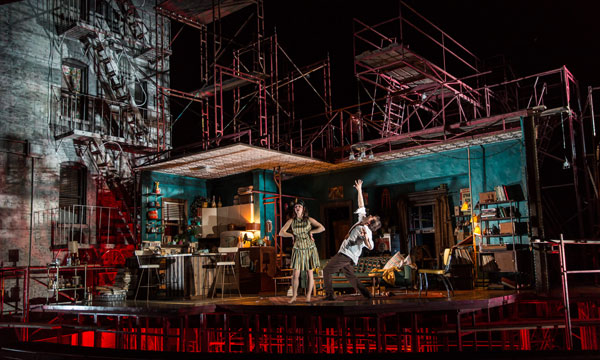
Excepting elements of the on-stage apartment designed by Kevin Depinet (record albums, the lack of countertop appliances, etc.) and some iconic mid-‘60s references--Margaret Mead, Joan Baez, his is a play a modern viewer might well surmise had been written recently, by a skilled writer of almost any background.
As such, it could be seen as a more impressive work of fiction, observation and satire on Hansberry’s part than Raisin, and clearly the work of a gifted author whose race, gender, age and terminal illness inform the play but doesn’t define it
Yet as presented at the Goodman under the direction of Anne Kauffman, while I found it to be quite watchable—with the quality of Hansberry’s dialogue quite estimable; there are numerous fantastic lines—but never quite riveting.
As such, I was left with the sense that a shrewdly culled 2 hours of its 3 might have made for a really scintillating play, but that it was all a bit too much to ravenously digest.
Stanley Brustein (Chris Stack, here) is a Jewish Manhattanite who had run an unsuccessful local establishment called Walden Pond—“it isn’t a nightclub!” he repeatedly exists—and has now purchased a small progressive newspaper.
His gentile wife Iris (Diane Davis) is a waitress, with two sisters, haughty Mavis (Miriam Silverman) and, at least per societal mores in 1964 if not still, vocationally naughty Gloria (Kristen Magee).
Also factoring in are Alton (Travis A. Knight), an activist friend of Sidney who is proudly black but light-skinned enough to be presumed white, David (Grant James Varjas), a gay playwright who lives upstairs from the Brusteins, Max (Phillip Edward Van Lear), an African-American artist who gets little stage time but one of the show's most powerful lines--"You revolutionaries are all the same; you start out full of fire and end up full of shit."--and Wally O'Hara (Guy Van Swearingen), a local politician running against the established "machine" whose campaign sign is the one in Sidney Brustein's window.
As referenced, there are plenty of threads that have prominence, including Sidney's somewhat wavering ideals, Iris' frustration over a stalled acting career, ongoing bickering between the two and an unpopular romance between Alton and Gloria, the latter of whom doesn't appear at all in Act I but nearly dominates Act II.
These enable Hansberry to comment on marital discord, race relations, dreams that don't come true and other weighty matters, but in sum seem to diffuse the primary thread: the change Wally O'Hara's seemingly progressive campaign seems to represent and spectrum of Sidney's actions/emotions pertaining to it.
And given the current election year, I doubt I was the only one thinking about Bernie Sanders and his supporters—which include me—as the truth and consequences of O'Hara's bid unfold.
So there is much to admire about The Sign in Sidney Brustein's Window, including understanding how it fits into Lorraine Hansberry's unfortunately abbreviated oeuvre--though it's worth noting that her ex-husband Robert Nemiroff finished a few other of her plays after her death, including Les Blancs, of which there is currently an acclaimed London production--and appreciating its considerable contemporary resonance.
There are also, as noted above, a number of tremendously powerful and insightful lines of dialogue, including:
- "Keep your conscience to yourself. It's the only form of compassion left."
- "Since I was eighteen I belonged to every committee to save. to free, to abolish, preserve, reserve and conserve that ever was. And the result is that the mere thought of a "movement" to do anything chills my bones. "
- "In this world there are two kinds of loneliness: with a man and without one."
And the final line of the play, which I won't reveal, seems to represent Hansberry commenting on her own upcoming death, albeit with a sense of hope for the future.
So I wholeheartedly applaud the Goodman for introducing me to this play, and furthering my awareness of perhaps the greatest playwright ever to come out of Chicago.
However, my reaction to The Sign in Sidney Brustein's Window, simply as a piece of dramatic entertainment put before me in 2016, is, well, a good bit more mixed.
The Sign in Sidney Brustein's Window
a play by Lorraine Hansberry
directed by Anne Kauffman
Goodman Theatre, Chicago
Thru June 5
@@@1/2
In his considerably more glowing review of Goodman Theatre’s new production of Lorraine Hansberry’s oft-overlooked 1964 drama, The Sign in Sidney Brustein’s Window, the Chicago Tribune’s outstanding theater critic Chris Jones posits:
“White, male critics in New York in 1964 simply could not get their heads around a black woman from Chicago showing such extraordinary range.”Jones is supplying a reason for the relative obscurity of Hansberry’s play, which followed her monumental A Raisin in the Sun—the first Broadway play to be written by an African-American woman—but his comment also seems to correspond with Goodman Artistic Director Robert Falls saying in his printed introduction to the piece that "When Sidney Brustein finally opened on Broadway in October, 1964, its reception from both audiences and critics was decidedly mixed." (The show would run for just 3 months and close on June 12, 1965, the same day Lorraine Hansberry’s died from cancer at age 34.)
I certainly don’t doubt that the judgment of 1960s critics, and audiences, might have been influenced by racism, sexism, chauvinism, elitism and various other isms, and I always have high regard for Jones opinions—including about this play.
But based on my take, and that of at least a few other crowd members Sunday night, I don’t know that mixed reactions to this complex dramatic work—conceivably both in 1964 and now—should automatically be ascribed to petty thinking, snobbery or racial divides.If anything, after seeing the 3-hour play, I surmised that audiences of yore well may have been more attuned to long, complex dramas with numerous thematic threads than today's simpletons like me who prefer 90-minute one acts with tight narratives—or perhaps 2 hours with an intermission.
This isn’t to say that the length of Sidney Brustein is inherently a flaw or drawback, but I had trouble getting my head around all that Hansberry has unfolding, not so much in terms of understanding it as much as ever excitedly embracing it.
Where A Raisin in the Sun focused on a family on Chicago’s South Side that faces both overt and covert racism when as they plan to relocate to a white neighborhood—based on real events involving Hansberry's own family—The Sign in Sidney Brustein's Window is primarily an observation of white Greenwich Village liberals/activists.
Excepting elements of the on-stage apartment designed by Kevin Depinet (record albums, the lack of countertop appliances, etc.) and some iconic mid-‘60s references--Margaret Mead, Joan Baez, his is a play a modern viewer might well surmise had been written recently, by a skilled writer of almost any background.
As such, it could be seen as a more impressive work of fiction, observation and satire on Hansberry’s part than Raisin, and clearly the work of a gifted author whose race, gender, age and terminal illness inform the play but doesn’t define it
Yet as presented at the Goodman under the direction of Anne Kauffman, while I found it to be quite watchable—with the quality of Hansberry’s dialogue quite estimable; there are numerous fantastic lines—but never quite riveting.
As such, I was left with the sense that a shrewdly culled 2 hours of its 3 might have made for a really scintillating play, but that it was all a bit too much to ravenously digest.
Stanley Brustein (Chris Stack, here) is a Jewish Manhattanite who had run an unsuccessful local establishment called Walden Pond—“it isn’t a nightclub!” he repeatedly exists—and has now purchased a small progressive newspaper.
His gentile wife Iris (Diane Davis) is a waitress, with two sisters, haughty Mavis (Miriam Silverman) and, at least per societal mores in 1964 if not still, vocationally naughty Gloria (Kristen Magee).
Also factoring in are Alton (Travis A. Knight), an activist friend of Sidney who is proudly black but light-skinned enough to be presumed white, David (Grant James Varjas), a gay playwright who lives upstairs from the Brusteins, Max (Phillip Edward Van Lear), an African-American artist who gets little stage time but one of the show's most powerful lines--"You revolutionaries are all the same; you start out full of fire and end up full of shit."--and Wally O'Hara (Guy Van Swearingen), a local politician running against the established "machine" whose campaign sign is the one in Sidney Brustein's window.
As referenced, there are plenty of threads that have prominence, including Sidney's somewhat wavering ideals, Iris' frustration over a stalled acting career, ongoing bickering between the two and an unpopular romance between Alton and Gloria, the latter of whom doesn't appear at all in Act I but nearly dominates Act II.
These enable Hansberry to comment on marital discord, race relations, dreams that don't come true and other weighty matters, but in sum seem to diffuse the primary thread: the change Wally O'Hara's seemingly progressive campaign seems to represent and spectrum of Sidney's actions/emotions pertaining to it.
And given the current election year, I doubt I was the only one thinking about Bernie Sanders and his supporters—which include me—as the truth and consequences of O'Hara's bid unfold.
So there is much to admire about The Sign in Sidney Brustein's Window, including understanding how it fits into Lorraine Hansberry's unfortunately abbreviated oeuvre--though it's worth noting that her ex-husband Robert Nemiroff finished a few other of her plays after her death, including Les Blancs, of which there is currently an acclaimed London production--and appreciating its considerable contemporary resonance.
There are also, as noted above, a number of tremendously powerful and insightful lines of dialogue, including:
- "Keep your conscience to yourself. It's the only form of compassion left."- "Since I was eighteen I belonged to every committee to save. to free, to abolish, preserve, reserve and conserve that ever was. And the result is that the mere thought of a "movement" to do anything chills my bones. "
- "In this world there are two kinds of loneliness: with a man and without one."
And the final line of the play, which I won't reveal, seems to represent Hansberry commenting on her own upcoming death, albeit with a sense of hope for the future.
So I wholeheartedly applaud the Goodman for introducing me to this play, and furthering my awareness of perhaps the greatest playwright ever to come out of Chicago.
However, my reaction to The Sign in Sidney Brustein's Window, simply as a piece of dramatic entertainment put before me in 2016, is, well, a good bit more mixed.
Monday, May 23, 2016
Peter Wolf + Ike Reilly Deliver an Evening Worth Talking About -- Chicago Concert Review
Concert Review
Peter Wolf and the Midnight Travelers
w/ opening act Ike Reilly
Park West, Chicago
May 21, 2016
@@@@
(No Photography allowed in the show, so pix below aren't by me.)
I've always been a fan of loquacious lead singers.
Beyond typical stage patter like "Hello Chicago" (or wherever), "Thank you" and/or the occasional "This one's from our new album," I enjoy it--and usually find concerts more emotionally enriching--when the frontman/woman, or solo artist, shares a bit more with the audience.
I'm not looking for pace-killing filibustering--and have at times wished for a bit less talking--but generally relish when favorites like Bruce Springsteen, Eddie Vedder, Dave Grohl, Shirley Manson and others share insightful song introductions, recollections of past visits to the city, brief commentary on current events, humorous anecdotes and the like.
Although I attended Saturday's concert at the Park West primarily to hear them sing--and found their music quite enjoyable--the evening with Peter Wolf (and his backing band The Midnight Travelers) and opening act Ike Reilly was all the more pleasurable for showcasing two world-class stage talkers.
After a cheeky Italian-accented introduction by his pal David Pasquesi--a first-rate improviser with TJ & Dave and also a terrific theater actor--Reilly delivered a nice 35-minute set focusing heavily on new songs.
But as he rather knowingly remarked as an opening act--though I was clearly far from the only fan of his in attendance--"They're all new to you."
Playing solo acoustic--he rocks more forcefully with The Ike Reilly Assassination, but comes across well on his own--Ike demonstrated his songwriting prowess from the get-go with a song seemingly called "It's Too Late Now." (I may have some of the titles wrong.)
Then the stories started, with Reilly relaying how he had lived in Rome in the early '90s with Pasquesi, Joel Murray (brother of Bill) and Chris Farley. Back in Chicago, the other three became members of Second City while Ike developed his musical chops and worked as a doorman at the Park Hyatt hotel...for 12 years.
This led into the terrific "A Job Like That" off Ike Reilly's 2015 album, Born on Fire.
Mentioning his friend and fellow Libertyville native Tom Morello--who I think owns the record label Ike is on--Reilly revealed that he (himself, not Morello) is working on a new album with master harmonica player Jason Ricci, shared some details of a bad gig he had played just that morning and told of exploring abandoned missile sites in Vernon Hills in his youth, leading into a new song called "Meet Me at the Missile Site."
Now 70 years old, the headliner Peter Wolf is best known for being the lead singer of the J. Geils Band from 1967-1983, when the Boston group became a pretty popular live and AOR act before breaking up soon after achieving their biggest success with "Centerfold" off 1981's Freeze Frame album. (They have occasionally reunited and I saw them open for Bob Seger in 2014.)
Freakishly thin and looking a good bit like Howard Stern, Wolf's biography includes a short early DJ stint, briefly studying art at the University of Chicago, adopting the nickname "the Wolfa Goofa," being roommates in Boston with future director David Lynch and marrying & divorcing actress Faye Dunaway in the 1970s.
Little of which he mentioned onstage at the Park West, while still having a lot to say, verbally and musically.
Peter Wolf's new album, A Cure for Loneliness--following 2010's excellent Midnight Souvenirs--generally features slower songs with traces of country, soul and other intermingled genres, rather than the blues-tinged rock of J. Geils' heyday.
With a veteran band that looked liked the essence of "No Bullshit," Wolf ran through a nice smattering of mostly mid-tempo songs ("Wastin' Time," "Growin' Pain," "Some Other Time, Some Other Place," "Rolling On," "Fun For Awhile" and others) that went over well in the comfortable environs of the Park West. (See a recent Peter Wolf setlist here that includes all the songs played in Chicago, albeit with a few minor sequencing changes)
Wolf spoke of recording with Mick Jagger on "Nothing But the Wheel," collaborating with songwriter Will Jennings in a story that included a turkey exploding in a microwave, introduced "Cry On More Time" as one of the first songs he wrote with the J. Geils Band, paid tribute to late Chicago legend Curtis Mayfield leading into the Impressions-type groove of "Peace of Mind"--though I heard more of The Temptations in it--and effused about his early passion for listening to the radio and coming to love Sam Cooke, the Everly Brothers and other cornerstone artists.
Clearly a man who relishes music far beyond his own making, Wolf gave a brief bio of singer/songwriter Don Covay before a cover of "The Usual Place," talked about bluegrass icon Bill Monroe in teeing up a version of "When My Blue Moon Turns to Gold Again" that segued into a similarly-styled rendition of J. Geils Band's "Love Stinks," and paid homage to Merle Haggard with a song they had recorded together, "It's Too Late For Me."
Late in the show came a barrage of choice rockers from the J. Geils canon--"Homework," "Give It To Me," "Looking for a Love" and the show-closing "Must of Got Lost"--as well as the terrific "I Don't Wanna Know" from Midnight Souvenirs.
With two of my best friends alongside in a pleasant, seated venue I enjoy but haven't much attended, it all made for a highly enjoyable night of music.
And storytelling.
Although I greatly admired Wolf's tributes, recollections, ramblings and performance--including very much his stylistic breadth--my @@@@ rating categorizes the show as excellent but something shy of mind-blowing.
Not knowing his reasons for avoiding it, I felt a romp through "Centerfold"--or "Freeze Frame"--might have heightened the fun factor amid some of the mellower songs, especially as "Love Stinks" was delivered differently than the rambunctious original, although intriguingly so.
But it was abundantly and delectably clear that Wolf loves to entertain, in multiple connotations of the word.
And to educate, largely about the power of rock 'n roll. Which, along with the perception that he is of a dying breed, makes me recommend seeing him for reasons that go well beyond the fine music he continues to make.
On a Saturday night in Chicago, with a crack band whose members' names I couldn't quite catch and can't readily find, Peter Wolf--along with Ike Reilly--delivered a good old fashioned rock concert that truly talked the talk.
Peter Wolf and the Midnight Travelers
w/ opening act Ike Reilly
Park West, Chicago
May 21, 2016
@@@@
(No Photography allowed in the show, so pix below aren't by me.)
I've always been a fan of loquacious lead singers.
Beyond typical stage patter like "Hello Chicago" (or wherever), "Thank you" and/or the occasional "This one's from our new album," I enjoy it--and usually find concerts more emotionally enriching--when the frontman/woman, or solo artist, shares a bit more with the audience.
I'm not looking for pace-killing filibustering--and have at times wished for a bit less talking--but generally relish when favorites like Bruce Springsteen, Eddie Vedder, Dave Grohl, Shirley Manson and others share insightful song introductions, recollections of past visits to the city, brief commentary on current events, humorous anecdotes and the like.
Although I attended Saturday's concert at the Park West primarily to hear them sing--and found their music quite enjoyable--the evening with Peter Wolf (and his backing band The Midnight Travelers) and opening act Ike Reilly was all the more pleasurable for showcasing two world-class stage talkers.
After a cheeky Italian-accented introduction by his pal David Pasquesi--a first-rate improviser with TJ & Dave and also a terrific theater actor--Reilly delivered a nice 35-minute set focusing heavily on new songs.
But as he rather knowingly remarked as an opening act--though I was clearly far from the only fan of his in attendance--"They're all new to you."
Playing solo acoustic--he rocks more forcefully with The Ike Reilly Assassination, but comes across well on his own--Ike demonstrated his songwriting prowess from the get-go with a song seemingly called "It's Too Late Now." (I may have some of the titles wrong.)
Then the stories started, with Reilly relaying how he had lived in Rome in the early '90s with Pasquesi, Joel Murray (brother of Bill) and Chris Farley. Back in Chicago, the other three became members of Second City while Ike developed his musical chops and worked as a doorman at the Park Hyatt hotel...for 12 years.
This led into the terrific "A Job Like That" off Ike Reilly's 2015 album, Born on Fire.
Mentioning his friend and fellow Libertyville native Tom Morello--who I think owns the record label Ike is on--Reilly revealed that he (himself, not Morello) is working on a new album with master harmonica player Jason Ricci, shared some details of a bad gig he had played just that morning and told of exploring abandoned missile sites in Vernon Hills in his youth, leading into a new song called "Meet Me at the Missile Site."
Now 70 years old, the headliner Peter Wolf is best known for being the lead singer of the J. Geils Band from 1967-1983, when the Boston group became a pretty popular live and AOR act before breaking up soon after achieving their biggest success with "Centerfold" off 1981's Freeze Frame album. (They have occasionally reunited and I saw them open for Bob Seger in 2014.)
![]() |
| Photo from Peter Wolf's recent show in Ann Arbor. Photo Credit: Ken Settle / Oakland Press |
Little of which he mentioned onstage at the Park West, while still having a lot to say, verbally and musically.
Peter Wolf's new album, A Cure for Loneliness--following 2010's excellent Midnight Souvenirs--generally features slower songs with traces of country, soul and other intermingled genres, rather than the blues-tinged rock of J. Geils' heyday.
With a veteran band that looked liked the essence of "No Bullshit," Wolf ran through a nice smattering of mostly mid-tempo songs ("Wastin' Time," "Growin' Pain," "Some Other Time, Some Other Place," "Rolling On," "Fun For Awhile" and others) that went over well in the comfortable environs of the Park West. (See a recent Peter Wolf setlist here that includes all the songs played in Chicago, albeit with a few minor sequencing changes)
Wolf spoke of recording with Mick Jagger on "Nothing But the Wheel," collaborating with songwriter Will Jennings in a story that included a turkey exploding in a microwave, introduced "Cry On More Time" as one of the first songs he wrote with the J. Geils Band, paid tribute to late Chicago legend Curtis Mayfield leading into the Impressions-type groove of "Peace of Mind"--though I heard more of The Temptations in it--and effused about his early passion for listening to the radio and coming to love Sam Cooke, the Everly Brothers and other cornerstone artists.
Clearly a man who relishes music far beyond his own making, Wolf gave a brief bio of singer/songwriter Don Covay before a cover of "The Usual Place," talked about bluegrass icon Bill Monroe in teeing up a version of "When My Blue Moon Turns to Gold Again" that segued into a similarly-styled rendition of J. Geils Band's "Love Stinks," and paid homage to Merle Haggard with a song they had recorded together, "It's Too Late For Me." Late in the show came a barrage of choice rockers from the J. Geils canon--"Homework," "Give It To Me," "Looking for a Love" and the show-closing "Must of Got Lost"--as well as the terrific "I Don't Wanna Know" from Midnight Souvenirs.
With two of my best friends alongside in a pleasant, seated venue I enjoy but haven't much attended, it all made for a highly enjoyable night of music.
And storytelling.
Although I greatly admired Wolf's tributes, recollections, ramblings and performance--including very much his stylistic breadth--my @@@@ rating categorizes the show as excellent but something shy of mind-blowing.
Not knowing his reasons for avoiding it, I felt a romp through "Centerfold"--or "Freeze Frame"--might have heightened the fun factor amid some of the mellower songs, especially as "Love Stinks" was delivered differently than the rambunctious original, although intriguingly so.
But it was abundantly and delectably clear that Wolf loves to entertain, in multiple connotations of the word.
And to educate, largely about the power of rock 'n roll. Which, along with the perception that he is of a dying breed, makes me recommend seeing him for reasons that go well beyond the fine music he continues to make.
On a Saturday night in Chicago, with a crack band whose members' names I couldn't quite catch and can't readily find, Peter Wolf--along with Ike Reilly--delivered a good old fashioned rock concert that truly talked the talk.
Wednesday, May 18, 2016
Even Without Its Leading Lady, Sarah Siddons Society Award Concert & Presentation Provides Plentiful Rewards -- Recap
Theater Event Recap
Sarah Siddons Society
Actor of the Year Award Presentation
Honoring Brian D'Arcy James and Sutton Foster
(Foster not present)
Pick Staiger Concert Hall
Northwestern University
May 16, 2016
(Note: This is a recap, not a typical theater review. Photography was forbidden at the event, so I was not able to take & share photos as I did for the 2015 Sarah Siddons Society award presentation honoring Jessie Mueller.)
The first words spoken at the Sarah Siddons Society’s Actor of the Year award ceremony Monday night served to essentially erase my principal reason for attending.
In welcoming the audience to Northwestern University’s Pick Staiger Hall, Communications Dean Barbara O’Keefe quickly announced that Sutton Foster—one of two Broadway stars being honored by the SSS—was unable to attend due to a personal emergency.
Certainly, in the scheme of things, this constitutes a relatively minor disappointment, even for those of us who are big fans of Foster—and from the sound of it, there were plenty in attendance. Whatever emergency she is dealing with is obviously far more consequential than my slight inconvenience, and I truly hope everything works out for the best.
And though she is a fabulous performer I was looking forward to seeing yet again, Foster was seemingly only slated to perform 2-3 songs within the 90-minute program. While she was clearly missed, the Sarah Siddons Society and its artistic director Dominic Missimi nonetheless put on a enjoyable event highlighted by her co-honoree, Brian D’Arcy James, a Northwestern grad and likewise a bona fide Broadway star.
Benefiting the erstwhile Chicagoland-based organization that took its name from a reference in the movie All About Eve and provides scholarships to Theater students attending Northwestern, Roosevelt and DePaul Universities and Columbia College, the revue-type show featured several excellent performances.
A group of current Northwestern students performed a customized version of “Raise the Roof” from Broadway’s The Wild Party to salute both Foster and D’Arcy James, who each appeared in productions of the Andrew Lippa-composed musical. A video tribute from Lippa then ran.
Besides D’Arcy James, the program also showcased NU alums Christine Mild (a 2002 SSS scholarship recipient), Michael Mahler (a 2003 recipient who played two compositions from his original musicals Hero and October Sky), Devin De Santis and Kate Baldwin, a Broadway star currently leading Lyric Opera’s The King and I.
In various combinations, the Northwestern students and alums sang a nice selection of songs from musicals in which Foster (Thoroughly Modern Millie, Little Women, Anything Goes, Violet) and D’Arcy James (Titanic, Hamilton (off-Broadway), Sweet Smell of Success) have starred.
All of these impressed, with "I Get a Kick Out of You" (from Anything Goes) led by Adhana Reid being a particular standout.
Along with Foster, also absent despite being listed in the printed program were composer Jeanine Tesori—who wrote the score for, among others, Thoroughly Modern Millie, Violet and Shrek the Musical, the last of which starred both D’Arcy James and Foster—and Sun-Times columnist Bill Zwecker, who was to read some video testimonials to the two honorees alongside Porchlight Theatre artistic director Michael Weber.
The affable Weber rendered Zwecker not sorely missed—notwithstanding a somewhat questionable joke about Bill being out bike riding with Sinead O’Connor—as he read effusive statements about Foster and/or D’Arcy James from Broadway colleagues.
These included directors Kathleen Marshall, Jason Moore, Michael Mayer, Casey Nicolaw and actor Christian Borle, who currently co-stars with D’Arcy James in Something Rotten. I noted that neither he nor Weber mentioned that Borle had also appeared with BDJ in the TV show Smash and had previously been married to Sutton Foster. (I wondered if this may have made for a slightly awkward moment had she been present.)
On a night off from The King and I, Kate Baldwin delivered a sparkling rendition of “Hello, Young Lovers” from that show—accompanied, as was everyone, by music director Ryan T. Nelson and an orchestra comprised of NU students and alums—before delivering a sweet introduction to the man with whom she co-starred in a musical adaptation of the film Giant.
Alongside some of the Northwestern students, D’Arcy James then demonstrated the resplendence of his leading man voice in a run-through of “God I Hate Shakespeare” from Something Rotten.
Broadway producer Barbara Whitman took the place of Jeanine Tesori in introducing—albeit in absentia—Sutton Foster, lauding her “triple threat” singing, dancing and
acting talents, two Tony Awards and storybook rise from an out-of-town
understudy in Thoroughly Modern Millie to its Broadway star…and ultimately one of the most renowned stage performers of this century.
I likewise hold Foster in extremely high regard, having loved her on Broadway in Thoroughly Modern Millie, The Drowsy Chaperone and Anything Goes, as well in concert at Chicago’s Broadway Playhouse in 2011.
She has also been kind enough to fulfill a couple of my requests to autograph ticket stubs by mail, and her television work (on Bunheads, Younger and soon the Gilmore Girls Netflix reprise) has also made her seem super cool.
As I said above, I hope her personal emergency proves not too dire, and I understand why her participation in the festivities was precluded.
Yet with no lasting perplexity, I still must note that this adds to a rather hit-and-miss personal history in terms of ticketed evenings with Sutton.
In March 2003, I ventured to New York with a ticket to Thoroughly Modern Millie, only to have the performance cancelled due to a musicians' strike. (I was fortunately able to get back to NYC that July and catch the terrific show.)
In 2005, I had a ticket to Little Women, only to have it close before my trip to New York. And in 2008, I went to NYC largely to see Mel Brooks’ Young Frankenstein, only to have an understudy cover Foster's Inga role that night.
Still, though I purchased my ticket to the Siddons event in good part due to the inclusion of Foster, not only was the whole evening altogether worthwhile for a good cause, but especially given the venue, there was something apt about D'Arcy James getting even more of the, um, spotlight. (As it was, the SSS giving dual Actor of the Year awards seems unprecedented.)
Not only is the NU alum a first-rate talent who I first saw in the 2002 pre-Broadway Chicago run of Sweet Smell of Success--in a role for which he would win a Tony--and then in a Millennium Park Sondheim concert, Broadway's The Apple Tree in 2007 and regularly on Smash, he is the first person to have been awarded a Sarah Siddons Society scholarship (in 1989) and subsequently an Actor of the Year Award.
After delivering a splendid "Who'd I'd Be" from Shrek, in place and in honor of Foster, he accepted his award from Dominic Missimi--a longtime NU Professor who, along with Theater Dept. Chair David H. Bell, seems to have maintained touch with the actor throughout his career--and Sarah Siddons Society President Marc Kaufman.
In his gracious acceptance speech, Brian D'Arcy James paid tribute to current theater students and three cherished acting teachers: his sister Ann who teaches theater at New Trier High School, Missimi and Bud Beyer, another Northwestern theater professor who in the actor's sophomore year instilled this fundamental tenet:
"Who you are shows through in what you do."
The event then ended, appropriately, with D'Arcy James wonderfully belting out "Let It Sing" from Violet alongside most of the evening's other performers.
Earlier, Missimi read off the names of the 2016 Scholarship Winners--see nearby graphic--and had them stand in the audience for a round of applause.
Hence, although the program was a delight in its honoring and showcasing of Broadway luminaries, perhaps even more rewarding is knowing that it may well help foster (yes, pun intended) future ones.
---
Visit SarahSiddonsSociety.org to learn more about the organization, including opportunities to contribute financially and otherwise.
Sarah Siddons Society
Actor of the Year Award Presentation
Honoring Brian D'Arcy James and Sutton Foster
(Foster not present)
Pick Staiger Concert Hall
Northwestern University
May 16, 2016
(Note: This is a recap, not a typical theater review. Photography was forbidden at the event, so I was not able to take & share photos as I did for the 2015 Sarah Siddons Society award presentation honoring Jessie Mueller.)
The first words spoken at the Sarah Siddons Society’s Actor of the Year award ceremony Monday night served to essentially erase my principal reason for attending.
In welcoming the audience to Northwestern University’s Pick Staiger Hall, Communications Dean Barbara O’Keefe quickly announced that Sutton Foster—one of two Broadway stars being honored by the SSS—was unable to attend due to a personal emergency.
Certainly, in the scheme of things, this constitutes a relatively minor disappointment, even for those of us who are big fans of Foster—and from the sound of it, there were plenty in attendance. Whatever emergency she is dealing with is obviously far more consequential than my slight inconvenience, and I truly hope everything works out for the best.
And though she is a fabulous performer I was looking forward to seeing yet again, Foster was seemingly only slated to perform 2-3 songs within the 90-minute program. While she was clearly missed, the Sarah Siddons Society and its artistic director Dominic Missimi nonetheless put on a enjoyable event highlighted by her co-honoree, Brian D’Arcy James, a Northwestern grad and likewise a bona fide Broadway star.
![]() |
| Click here for a list of previous Sarah Siddons Society award recipients |
A group of current Northwestern students performed a customized version of “Raise the Roof” from Broadway’s The Wild Party to salute both Foster and D’Arcy James, who each appeared in productions of the Andrew Lippa-composed musical. A video tribute from Lippa then ran.
Besides D’Arcy James, the program also showcased NU alums Christine Mild (a 2002 SSS scholarship recipient), Michael Mahler (a 2003 recipient who played two compositions from his original musicals Hero and October Sky), Devin De Santis and Kate Baldwin, a Broadway star currently leading Lyric Opera’s The King and I.
In various combinations, the Northwestern students and alums sang a nice selection of songs from musicals in which Foster (Thoroughly Modern Millie, Little Women, Anything Goes, Violet) and D’Arcy James (Titanic, Hamilton (off-Broadway), Sweet Smell of Success) have starred.
All of these impressed, with "I Get a Kick Out of You" (from Anything Goes) led by Adhana Reid being a particular standout.
Along with Foster, also absent despite being listed in the printed program were composer Jeanine Tesori—who wrote the score for, among others, Thoroughly Modern Millie, Violet and Shrek the Musical, the last of which starred both D’Arcy James and Foster—and Sun-Times columnist Bill Zwecker, who was to read some video testimonials to the two honorees alongside Porchlight Theatre artistic director Michael Weber.
The affable Weber rendered Zwecker not sorely missed—notwithstanding a somewhat questionable joke about Bill being out bike riding with Sinead O’Connor—as he read effusive statements about Foster and/or D’Arcy James from Broadway colleagues.
These included directors Kathleen Marshall, Jason Moore, Michael Mayer, Casey Nicolaw and actor Christian Borle, who currently co-stars with D’Arcy James in Something Rotten. I noted that neither he nor Weber mentioned that Borle had also appeared with BDJ in the TV show Smash and had previously been married to Sutton Foster. (I wondered if this may have made for a slightly awkward moment had she been present.)
On a night off from The King and I, Kate Baldwin delivered a sparkling rendition of “Hello, Young Lovers” from that show—accompanied, as was everyone, by music director Ryan T. Nelson and an orchestra comprised of NU students and alums—before delivering a sweet introduction to the man with whom she co-starred in a musical adaptation of the film Giant.
“Brian D’Arcy James is a national treasure, the nicest man in show business and my friend”...Baldwin enthused, while reminding that in addition to his stellar Broadway career, he was seen in the reigning Best Picture Oscar winner, Spotlight.
Alongside some of the Northwestern students, D’Arcy James then demonstrated the resplendence of his leading man voice in a run-through of “God I Hate Shakespeare” from Something Rotten.
Broadway producer Barbara Whitman took the place of Jeanine Tesori in introducing—albeit in absentia—Sutton Foster, lauding her “triple threat” singing, dancing and
acting talents, two Tony Awards and storybook rise from an out-of-town
understudy in Thoroughly Modern Millie to its Broadway star…and ultimately one of the most renowned stage performers of this century.I likewise hold Foster in extremely high regard, having loved her on Broadway in Thoroughly Modern Millie, The Drowsy Chaperone and Anything Goes, as well in concert at Chicago’s Broadway Playhouse in 2011.
She has also been kind enough to fulfill a couple of my requests to autograph ticket stubs by mail, and her television work (on Bunheads, Younger and soon the Gilmore Girls Netflix reprise) has also made her seem super cool.
As I said above, I hope her personal emergency proves not too dire, and I understand why her participation in the festivities was precluded.
Yet with no lasting perplexity, I still must note that this adds to a rather hit-and-miss personal history in terms of ticketed evenings with Sutton.
In March 2003, I ventured to New York with a ticket to Thoroughly Modern Millie, only to have the performance cancelled due to a musicians' strike. (I was fortunately able to get back to NYC that July and catch the terrific show.)
In 2005, I had a ticket to Little Women, only to have it close before my trip to New York. And in 2008, I went to NYC largely to see Mel Brooks’ Young Frankenstein, only to have an understudy cover Foster's Inga role that night.
Still, though I purchased my ticket to the Siddons event in good part due to the inclusion of Foster, not only was the whole evening altogether worthwhile for a good cause, but especially given the venue, there was something apt about D'Arcy James getting even more of the, um, spotlight. (As it was, the SSS giving dual Actor of the Year awards seems unprecedented.)
Not only is the NU alum a first-rate talent who I first saw in the 2002 pre-Broadway Chicago run of Sweet Smell of Success--in a role for which he would win a Tony--and then in a Millennium Park Sondheim concert, Broadway's The Apple Tree in 2007 and regularly on Smash, he is the first person to have been awarded a Sarah Siddons Society scholarship (in 1989) and subsequently an Actor of the Year Award. After delivering a splendid "Who'd I'd Be" from Shrek, in place and in honor of Foster, he accepted his award from Dominic Missimi--a longtime NU Professor who, along with Theater Dept. Chair David H. Bell, seems to have maintained touch with the actor throughout his career--and Sarah Siddons Society President Marc Kaufman.
In his gracious acceptance speech, Brian D'Arcy James paid tribute to current theater students and three cherished acting teachers: his sister Ann who teaches theater at New Trier High School, Missimi and Bud Beyer, another Northwestern theater professor who in the actor's sophomore year instilled this fundamental tenet:
"Who you are shows through in what you do."
![]() |
| Click here for a list of previous scholarship winners |
Earlier, Missimi read off the names of the 2016 Scholarship Winners--see nearby graphic--and had them stand in the audience for a round of applause.
Hence, although the program was a delight in its honoring and showcasing of Broadway luminaries, perhaps even more rewarding is knowing that it may well help foster (yes, pun intended) future ones.
---
Visit SarahSiddonsSociety.org to learn more about the organization, including opportunities to contribute financially and otherwise.
Monday, May 16, 2016
Keep on Truckin': Steep's 'The Few' Features Several Fine Aspects -- Chicago Theater Review
Theater Review
The Few
a recent play by Samuel D. Hunter
directed by Brad Akin
Steep Theatre Co., Chicago
Thru May 21
@@@@
The Few
a recent play by Samuel D. Hunter
directed by Brad Akin
Steep Theatre Co., Chicago
Thru May 21
@@@@
There are many plays (and movies, books, etc.) whose titles give little clue as to what the show is about. And certainly, most plays are about much more than what a sound byte description can convey.
But in noting that I saw a play called The Few, you would likely be hard-pressed to guess--even if given 20 attempts--the subject matter covered by writer Stephen D. Hunter.
Not only is it somewhat odd that The Few is the title of a play revolving around proprietors of a small newspaper aimed at truck drivers, it may be even stranger that the fictional trucker rag itself is named The Few.
As the dramedy opens, Bryan (Peter Moore) has suddenly returned to The Few’s ramshackle office—housed in a small building he owns—after 4 years away. This surprises and rankles QZ (Dana Black), the romantic and business partner he left behind with nary a word, due to circumstances involving an unseen former third partner named Jim.
Rounding out the three character cast is Matthew (Travis Coe), a gawky 19-year-old who has been working on the paper in Bryan’s absence.
Under the direction of Brad Akin at Steep Theatre—a fine Chicago storefront located under the Berwyn Red Line station—The Few is far from structurally complex, with the entire 100-minute one act consisting of two or three of the characters speaking to each other within a static setting.
And although the narrative concept of a truckers newspaper—which has achieved profitability under QZ and Matthew by becoming filled mostly with personal ads—is rather unique, the major themes Hunter broaches aren’t all that nouveau.
Many a work of theater has touched on ex-lovers re-entering each others’ lives, and the desire individuals often harbor for a sense of community and connection, be they OTR truckers on 7,000-mile runs or anyone.
Though set on the precipice of Y2K, The Few debuted in 2014, and the even greater isolation wrought by the ever-broadening digital age adds understated currency and resonance to the narrative.
Yet in having chosen to catch a Sunday matinee in large part because of stellar reviews, I found The Few to be sufficiently compelling thanks to its trio of characters, and the fine embodiment of each.
While Black overtly imbues QZ with embittered ire over the reappearance of Bryan, she never bristles past the point of ongoing interaction between the two feeling believable, or completely devoid of warmth.
Moore, one of the founders of Steep Theatre Co., seems perfect as a rather literate former trucker
who has found himself a bit lost several years down the road.
And Roe’s Matthew is a well-enacted glimpse of the awkwardness many face on the edge of adulthood, burdened with familial strife and a sexual orientation his parents harshly fail to accept.
With just a week left in the run, I wouldn't profusely insist you get to one of The Few remaining performances. But if, like me, you find yourself looking for something to see, you wouldn't go too wrong if inclined to venture to Steep. (Especially with HotTix likely available for under $20).
This Midwest Premiere is a nice piece of storefront theater that fits well into Steep's intimate confines. It may not change your life, but even if you've never been a trucker or a journalist, it quite possibly could--in a variety of ways--reflect it.
Not only is it somewhat odd that The Few is the title of a play revolving around proprietors of a small newspaper aimed at truck drivers, it may be even stranger that the fictional trucker rag itself is named The Few.
As the dramedy opens, Bryan (Peter Moore) has suddenly returned to The Few’s ramshackle office—housed in a small building he owns—after 4 years away. This surprises and rankles QZ (Dana Black), the romantic and business partner he left behind with nary a word, due to circumstances involving an unseen former third partner named Jim.Rounding out the three character cast is Matthew (Travis Coe), a gawky 19-year-old who has been working on the paper in Bryan’s absence.
Under the direction of Brad Akin at Steep Theatre—a fine Chicago storefront located under the Berwyn Red Line station—The Few is far from structurally complex, with the entire 100-minute one act consisting of two or three of the characters speaking to each other within a static setting.
And although the narrative concept of a truckers newspaper—which has achieved profitability under QZ and Matthew by becoming filled mostly with personal ads—is rather unique, the major themes Hunter broaches aren’t all that nouveau.
Many a work of theater has touched on ex-lovers re-entering each others’ lives, and the desire individuals often harbor for a sense of community and connection, be they OTR truckers on 7,000-mile runs or anyone.
Though set on the precipice of Y2K, The Few debuted in 2014, and the even greater isolation wrought by the ever-broadening digital age adds understated currency and resonance to the narrative.
Yet in having chosen to catch a Sunday matinee in large part because of stellar reviews, I found The Few to be sufficiently compelling thanks to its trio of characters, and the fine embodiment of each.
While Black overtly imbues QZ with embittered ire over the reappearance of Bryan, she never bristles past the point of ongoing interaction between the two feeling believable, or completely devoid of warmth.
Moore, one of the founders of Steep Theatre Co., seems perfect as a rather literate former trucker who has found himself a bit lost several years down the road.
And Roe’s Matthew is a well-enacted glimpse of the awkwardness many face on the edge of adulthood, burdened with familial strife and a sexual orientation his parents harshly fail to accept.
With just a week left in the run, I wouldn't profusely insist you get to one of The Few remaining performances. But if, like me, you find yourself looking for something to see, you wouldn't go too wrong if inclined to venture to Steep. (Especially with HotTix likely available for under $20).
This Midwest Premiere is a nice piece of storefront theater that fits well into Steep's intimate confines. It may not change your life, but even if you've never been a trucker or a journalist, it quite possibly could--in a variety of ways--reflect it.
Saturday, May 14, 2016
Pithy Philosophies #28
Seth Saith:
Always celebrate your birthday quite happily and contentedly.
For it's better to be whatever age you are than not.
Always celebrate your birthday quite happily and contentedly.
For it's better to be whatever age you are than not.
Thursday, May 12, 2016
Ours Go to 11, Volume 8: My Favorite Chicago Rock 'n Roll Artists
A former colleague recently reached out to see if I might want to contribute to In the Loop, a magazine and website primarily focused on music in Chicago.
As time and opportunity allow, I will hopefully cross-post concert reviews, share my opinion on notable new albums, perhaps supply some theater reviews and offer up other pertinent writings.
This new possibility has prompted me to put together this quick-list of My Favorite Chicago Rock 'n Roll Artists.
I was initially going to dub it a ranking of "The Best" Chicago Rock Artists of All-Time, but in seeking some nominations to consider from Facebook friends, I realized that hard-to-argue acts like Curtis Mayfield, Ministry, Shadows of Night, etc., aren't exactly in my wheelhouse. Nor are esteemed hip-hop acts such as Kanye West, Common, Lupe Fiasco, etc.
And even in calling this a list of "rock" acts per my personal tastes, some blues legends seem to merit inclusion, which fans of rap, house, pop, R&B, soul, etc. might see as inconsistent. So feel free to include whoever you want on your list.
I'm not considering as eligible Illinois acts from outside the greater Chicagoland area--Cheap Trick, REO Speedwagon, etc.--nor those that never spent much of their careers locally, even if born & raised here (the band Chicago and Earth, Wind & Fire, for example).
Just to reiterate, this is a list ranking my favorites. Hence, any omissions shouldn't be seen as slights, just not as cherished by and/or familiar to me.
Who's on your list? These are my picks:
1. The Smashing Pumpkins
2. Wilco
3. Buddy Guy
4. Styx
5. Smoking Popes
6. Liz Phair
7. Material Issue
8. Chamber Strings
9. Urge Overkill
10. Veruca Salt
11. Off Broadway
Honorable Mention
Muddy Waters
Curtis Mayfield in & beyond The Impressions
Fall Out Boy
Shoes
Survivor
Screeching Weasel
Mike Bloomfield (grew up in Glencoe and cut his teeth in Chicago clubs, though perhaps akin to Tom Morello, not really an artist who spent much of his career in Chicago)
To learn more about any of these artists, see Wikipedia, AllMusic.com, YouTube and Spotify. And please, share your list.
Wednesday, May 11, 2016
Etc., etc., etc.: Siam Mightily Impressed, If Not Royally Smitten, by Lyric's 'The King and I' -- Chicago Theater / Opera Review
Theater / Opera Review
The King and I
Lyric Opera of Chicago
Thru May 22
@@@@
@@@@
I have attended more than enough "musicals" and "operas" to understand the connotative differences.
At least in the U.S. and U.K., musicals are almost always performed in English, yet while operas can be if written as such, they're usually sung in Italian, German, French, Russian or the tongue employed by the composer and librettist. (At domestic opera houses, English supertitles are routinely projected, so one can follow the storyline.)
And though I can't really explain it well, musical and especially vocal styles differ among the two idioms, with "opera voices" suggesting a more grandiose delivery not often employed in Broadway musicals.
Opera is also defined by being entirely sung, without any spoken dialogue, but even though a show like Evita has virtually no speaking, it is considered a musical, not opera.
I have only been going to Chicago's esteemed Lyric Opera within the 21st century--a few years as a subscriber but mostly ad hoc--but recall just two "musicals" being done within its 8-title season: Sweeney Todd and Show Boat.
I found both of these excellent, and don't recall overt audience grumblings, but with many more Chicagoland venues and troupes staging musicals than operas, it's possible some in the Lyric's large subscriber base expressed a strong preference for more traditional operas as part of their season packages.
For beginning in 2013 with Oklahoma, the Lyric has been presenting masterworks of the Rodgers & Hammerstein canon--but as a 9th show, outside standard subscription packages.
As someone who appreciates opera--and is regularly wowed by the Lyric's production values--but loves musicals, I have found Oklahoma, The Sound of Music and Carousel to be absolute joys.
Yet while I found Lyric's take on The King and I, replicating a 2014 production by the Theatre du Chatelet in Paris, to be excellent on many levels--musically, vocally, visually, etc., etc. (the et ceteras are a spoken motif in the show)--the tenor of my appreciation is more akin with most operas I am glad to see, rather than magnificent musicals I wholeheartedly embrace.
This isn't because it was performed operatically; stylistically it felt like a musical, with vocal calibers and production values largely on par with Broadway, where a revival continues to run.
And as with all of the Lyric's productions, whether operas or musicals, it is a lavish affair with beautiful scenery (by set designer Jean-Marc Puissant) and vivid, resplendent costumes by Sue Blaine.
But with great respect for the genius of Richard Rodgers and Oscar Hammerstein II, whose works I have largely come to love--and admire for unsuspected but substantial social activism--even more in recent years, The King and I is not quite on par with The Sound of Music, Oklahoma, Carousel or South Pacific (the latter not yet done at Lyric).
Though it has a lovely score with a great overture and several nice songs, only three tunes are really the type of hummable classics one associates with Rodgers and Hammerstein: "I Whistle a Happy Tune" (near the beginning), "Shall We Dance?" (near the end) and especially "Getting to Know You."
First brought to Broadway in 1951, written specifically as a starring vehicle for Gertrude Lawrence, The King and I musicalizes the 1944 novel by Margaret Landon, Anna and the King of Siam, which semi-fictionalizes a true story. In 1862, a British widow named Anna Leonowens went to Siam (now Thailand) with her young son, Louis, at the invitation of King Mongkut, who wanted her to teach his numerous children and wives the English language and British customs.
At the Lyric, Anna--originated by Lawrence on Broadway and played by Deborah Kerr in the 1956 movie--is well-performed by Broadway vet (and Northwestern grad) Kate Baldwin.
Quite iconically, the King of Siam was initially played on Broadway, in the movie and on subsequent tours/revivals by Yul Brynner. Here he is embodied by Paolo Montalban, who is generally likable in embodying the haughty, stubborn and slowly progressive monarch, and who does a particularly nice job on the solo "A Puzzlement."
Yet while there is nothing categorically wrong with Montalban's performance, or the possibility of a older woman being smitten by a younger man, not only does this King seem considerably younger than Anna here, or as others--most notably Brynner--have played him (thereby depleting the role of some gravitas), but even on the main floor of the Civic Opera House and aided by binoculars, I never discerned much chemistry between the two leads.
This certainly isn't reason enough to avoid this King and I--and I definitely enjoyed it much more than not.
It's also possible that following a full work day and a 90-minute drive into the city, there were other factors that made the 3-hour performance feel laborious at times. Though the show within the show of "The Small House of Uncle Thomas"--a ballet led by the exquisite Ali Ewoldt as Tuptim--is largely delightful, it started to run on a bit too long.
There are several other fine performances--by Alan Ariano (The Kralahome), Rona Figueroa (Lady Thiang), Sam Simahk (Lun Tha), Charlie Babbo (Anna's son Louis) and loads of other adorable kids--and many high-quality if not as overtly mirthful R&H songs: "My Lord and Master," "Hello, Young Lovers," "We Kiss in a Shadow," "I Have Dreamed," etc., etc.
But as corroborated by database-enhanced recollections of two prior viewings of The King and I onstage--on a 2004 tour starring Sandy Duncan and, a bit ironically given my spiel about opera above, in Danish in Copenhagen in 2008, which wasn't abetted by subtitles, leaving me largely to appreciate the melodies and basic outline--I regard this as a quite good musical, with some wonderful songs and lasting resonance in its messaging, but not quite a monumental one.
I would end by saying that, regardless of this not quite providing the delight of Lyric's past Rodgers & Hammerstein renditions, it would in no way dissuade me from seeing South Pacific next year, but supposedly due to audience survey feedback, that storied title has been shelved for 2017 in favor of Lerner & Loewe's My Fair Lady.
But, assuming I'm able, I'll definitely be there for the Henry Higgins-Eliza Doolittle musical cage match, and would enthusiastically vote for the Lyric bringing other "musical" titles--Les Miserables, The Phantom of the Opera, West Side Story, etc., etc.--to its opera stage.
The Rodgers & Hammerstein musicals at Lyric have seemed to be well-attended and fervently-applauded, substantiating my thought that these opera house "musical" productions are about as finely-crafted as any anywhere.
So especially if you love The King and I, perhaps even more than me, it'd be a royal shame if you miss this if merely for all the sumptuous resplendence, the choreography (by Penny Hickey), the score played by the Lyric's wondrous full orchestra conducted by David Chase., the performances...
Etc., etc., etc.
This isn't because it was performed operatically; stylistically it felt like a musical, with vocal calibers and production values largely on par with Broadway, where a revival continues to run.
And as with all of the Lyric's productions, whether operas or musicals, it is a lavish affair with beautiful scenery (by set designer Jean-Marc Puissant) and vivid, resplendent costumes by Sue Blaine.
But with great respect for the genius of Richard Rodgers and Oscar Hammerstein II, whose works I have largely come to love--and admire for unsuspected but substantial social activism--even more in recent years, The King and I is not quite on par with The Sound of Music, Oklahoma, Carousel or South Pacific (the latter not yet done at Lyric).
Though it has a lovely score with a great overture and several nice songs, only three tunes are really the type of hummable classics one associates with Rodgers and Hammerstein: "I Whistle a Happy Tune" (near the beginning), "Shall We Dance?" (near the end) and especially "Getting to Know You."
First brought to Broadway in 1951, written specifically as a starring vehicle for Gertrude Lawrence, The King and I musicalizes the 1944 novel by Margaret Landon, Anna and the King of Siam, which semi-fictionalizes a true story. In 1862, a British widow named Anna Leonowens went to Siam (now Thailand) with her young son, Louis, at the invitation of King Mongkut, who wanted her to teach his numerous children and wives the English language and British customs.
At the Lyric, Anna--originated by Lawrence on Broadway and played by Deborah Kerr in the 1956 movie--is well-performed by Broadway vet (and Northwestern grad) Kate Baldwin.
Quite iconically, the King of Siam was initially played on Broadway, in the movie and on subsequent tours/revivals by Yul Brynner. Here he is embodied by Paolo Montalban, who is generally likable in embodying the haughty, stubborn and slowly progressive monarch, and who does a particularly nice job on the solo "A Puzzlement."
Yet while there is nothing categorically wrong with Montalban's performance, or the possibility of a older woman being smitten by a younger man, not only does this King seem considerably younger than Anna here, or as others--most notably Brynner--have played him (thereby depleting the role of some gravitas), but even on the main floor of the Civic Opera House and aided by binoculars, I never discerned much chemistry between the two leads.This certainly isn't reason enough to avoid this King and I--and I definitely enjoyed it much more than not.
It's also possible that following a full work day and a 90-minute drive into the city, there were other factors that made the 3-hour performance feel laborious at times. Though the show within the show of "The Small House of Uncle Thomas"--a ballet led by the exquisite Ali Ewoldt as Tuptim--is largely delightful, it started to run on a bit too long.
There are several other fine performances--by Alan Ariano (The Kralahome), Rona Figueroa (Lady Thiang), Sam Simahk (Lun Tha), Charlie Babbo (Anna's son Louis) and loads of other adorable kids--and many high-quality if not as overtly mirthful R&H songs: "My Lord and Master," "Hello, Young Lovers," "We Kiss in a Shadow," "I Have Dreamed," etc., etc.But as corroborated by database-enhanced recollections of two prior viewings of The King and I onstage--on a 2004 tour starring Sandy Duncan and, a bit ironically given my spiel about opera above, in Danish in Copenhagen in 2008, which wasn't abetted by subtitles, leaving me largely to appreciate the melodies and basic outline--I regard this as a quite good musical, with some wonderful songs and lasting resonance in its messaging, but not quite a monumental one.
I would end by saying that, regardless of this not quite providing the delight of Lyric's past Rodgers & Hammerstein renditions, it would in no way dissuade me from seeing South Pacific next year, but supposedly due to audience survey feedback, that storied title has been shelved for 2017 in favor of Lerner & Loewe's My Fair Lady.
But, assuming I'm able, I'll definitely be there for the Henry Higgins-Eliza Doolittle musical cage match, and would enthusiastically vote for the Lyric bringing other "musical" titles--Les Miserables, The Phantom of the Opera, West Side Story, etc., etc.--to its opera stage.
The Rodgers & Hammerstein musicals at Lyric have seemed to be well-attended and fervently-applauded, substantiating my thought that these opera house "musical" productions are about as finely-crafted as any anywhere.
So especially if you love The King and I, perhaps even more than me, it'd be a royal shame if you miss this if merely for all the sumptuous resplendence, the choreography (by Penny Hickey), the score played by the Lyric's wondrous full orchestra conducted by David Chase., the performances...
Etc., etc., etc.
Sunday, May 08, 2016
Pedal to Floor, Non-Stop Roar: At 55, Bob Mould Continues to Far Exceed the Speed Limit -- Chicago Concert Review
Concert Review
And at the age of 55, he shows no signs of slowing down, as evidenced by a blistering 80-minute set in which there were virtually no pauses between songs, about a dozen total words spoken and only the initial part of Hüsker Dü's "Hardly Getting Over It" late in the show to slightly quell the deafening blast.
While Mould looks to be in better physical shape now than in his 20s, it's interesting to note that 18 years ago, at the age of 37, he claimed the Last Dog and Pony Show tour--the one with Cerveris on-board--was to be his last with an electric band, at the breakneck pace for which he's always been known.
There are too many matters of real concern to even raise an eyebrow at rock stars reneging on the their retirements and such, and I'm quite glad that the Minneapolis native essentially decided in 2005 that "this is what I do, and love, so why not do it, at least sometimes."
A free, outdoor, summertime gig at Millennium Park in 2014 with the same trio was likewise balls-to-the-wall phenomenal, but this Metro show--which I wasn't even planning to attend until friends who were couldn't use their tickets--was particularly fun as it followed a solo electric evening with Bob Mould just last October at Evanston's SPACE.
Though there he also played Hüsker Dü, Sugar and solo chestnuts, the focus of that show was trying out new material before putting it on an upcoming album.
Bob Mould w/ band
w/ opening act J. Robbins
Metro, Chicago
May 6, 2016
@@@@@
Before Friday night, there were 10 rock artists I'd seen live in concert at least 10 times.
Appropriately, Bob Mould now makes that list "go to 11."
I wasn't cognizant enough of Hüsker Dü in real time to have seen Mould with his groundbreaking 1980s power trio, but have seen him perform in several incarnations beginning in 1994 with his second trio, Sugar.
I have seen him alone with an acoustic guitar, solo with an electric guitar, acoustically paired with another guitarist, with a 4-piece band (incidentally with subsequent 2-time Tony Award winner Michael Cerveris on guitar) and, as again on Friday at Metro, with Evanston's Jason Narducy on bass and drummer Jon Wurster rounding out yet another power trio.
Mould has been enjoyable in all forms, but there is nothing--and no one--like him in a full-tilt, band-backed frenzy.
And at the age of 55, he shows no signs of slowing down, as evidenced by a blistering 80-minute set in which there were virtually no pauses between songs, about a dozen total words spoken and only the initial part of Hüsker Dü's "Hardly Getting Over It" late in the show to slightly quell the deafening blast.
While Mould looks to be in better physical shape now than in his 20s, it's interesting to note that 18 years ago, at the age of 37, he claimed the Last Dog and Pony Show tour--the one with Cerveris on-board--was to be his last with an electric band, at the breakneck pace for which he's always been known.
There are too many matters of real concern to even raise an eyebrow at rock stars reneging on the their retirements and such, and I'm quite glad that the Minneapolis native essentially decided in 2005 that "this is what I do, and love, so why not do it, at least sometimes."
A free, outdoor, summertime gig at Millennium Park in 2014 with the same trio was likewise balls-to-the-wall phenomenal, but this Metro show--which I wasn't even planning to attend until friends who were couldn't use their tickets--was particularly fun as it followed a solo electric evening with Bob Mould just last October at Evanston's SPACE.
Though there he also played Hüsker Dü, Sugar and solo chestnuts, the focus of that show was trying out new material before putting it on an upcoming album.
As I wrote then, songs like "The End of Things," "Hold On," "Lucifer and God" and "Black Confetti" held up well against past glories, so it was cool to note they made it onto his terrific new Patch the Sky record, from which the first two songs cited and others made Friday's setlist.
Truthfully, I only started familiarizing myself with Patch the Sky a week before the show, so it's to the credit of his adept songwriting--though also an elemental hard-charging-guitar-driven similarity across much of his material--that new songs like the two mentioned above, plus "You Say You," "Losing Time" and others came across as delectably as four tunes from Sugar's wondrous Copper Blue and several Hüsker Dü gems like "I Apologize," "Celebrated Summer," "Hate Paper Doll" and the closing "Makes No Sense at All." (See Bob Mould's Chicago full setlist here at Setlist.fm)
In fact, I wish more of the new album was included, as "Lucifer and God" and "Pray for Rain" are among my favorites that weren't showcased at Metro.
But while the same can be said about numerous great songs from across Mould's illustrious career--heck, 2012's Silver Age and 2014's Beauty & Ruin are filled with thunderous wonders of which few could be culled, let alone the rest of the solo and band catalogs--the obvious skill, effort and fury he, Narducy and Wurster put into their time onstage makes setlist selections almost immaterial.
Everything sounds great.
And if I didn't hear "Helpless" or "Chartered Trips" or "Egøverride" or "Your Favorite Thing" this time, not only might I next time, but I was delighted that Mould (re)introduced me to a couple Hüsker Dü gems I'd long since forgetten: "Could You Be the One?" and "In a Free Land."
Perhaps one day Bob Mould will truly decide it's time for him to slow down. Even that won't be a tragedy, as his career can already be called legendary and his songwriting craft shines even more in a solo setting.
But if you love loud 'n fast rock 'n roll and have never seen Mould and his companions at full speed, you definitely should while you still can.
At 55, he remains--in my own words--a tour de force of nature.
Though there are a lot of rock artists I love, and love to see live again and again, Bob Mould stands as one I consider singular.
There is no one else quite like him, or who delivers shows with such sheer horsepower.
So here's hoping--to quote one of his very best songs, Sugar's "If I Can't Change Your Mind," which thrilled on Friday--he'll "stay that way until."
Truthfully, I only started familiarizing myself with Patch the Sky a week before the show, so it's to the credit of his adept songwriting--though also an elemental hard-charging-guitar-driven similarity across much of his material--that new songs like the two mentioned above, plus "You Say You," "Losing Time" and others came across as delectably as four tunes from Sugar's wondrous Copper Blue and several Hüsker Dü gems like "I Apologize," "Celebrated Summer," "Hate Paper Doll" and the closing "Makes No Sense at All." (See Bob Mould's Chicago full setlist here at Setlist.fm)
In fact, I wish more of the new album was included, as "Lucifer and God" and "Pray for Rain" are among my favorites that weren't showcased at Metro.But while the same can be said about numerous great songs from across Mould's illustrious career--heck, 2012's Silver Age and 2014's Beauty & Ruin are filled with thunderous wonders of which few could be culled, let alone the rest of the solo and band catalogs--the obvious skill, effort and fury he, Narducy and Wurster put into their time onstage makes setlist selections almost immaterial.
Everything sounds great.
And if I didn't hear "Helpless" or "Chartered Trips" or "Egøverride" or "Your Favorite Thing" this time, not only might I next time, but I was delighted that Mould (re)introduced me to a couple Hüsker Dü gems I'd long since forgetten: "Could You Be the One?" and "In a Free Land."
Perhaps one day Bob Mould will truly decide it's time for him to slow down. Even that won't be a tragedy, as his career can already be called legendary and his songwriting craft shines even more in a solo setting.But if you love loud 'n fast rock 'n roll and have never seen Mould and his companions at full speed, you definitely should while you still can.
At 55, he remains--in my own words--a tour de force of nature.
Though there are a lot of rock artists I love, and love to see live again and again, Bob Mould stands as one I consider singular.
There is no one else quite like him, or who delivers shows with such sheer horsepower.
So here's hoping--to quote one of his very best songs, Sugar's "If I Can't Change Your Mind," which thrilled on Friday--he'll "stay that way until."
Sunday, May 01, 2016
Letts' Look Beneath the Surface: 'Mary Page Marlowe' Provides a Masterful Glimpse of Life, Well, Lived -- Chicago Theater Review
Theater Review
Mary Page Marlowe
a world premiere play
by Tracy Letts
Steppenwolf Theatre, Chicago
Thru June 5
@@@@@
I firmly believe--and as represented in part by this blog, often advocate--that appreciating culture, and attending theater, can make us better people.
Generally, I would espouse this more in a macro sense, in terms of the literacy, perspectives, enrichment, emotional uplift and even psychological sustenance the arts can provide.
Especially in the realm of dramatic theater, individual works can often offer profound insights that adjust our overall outlooks, but in subtler ways, the cumulative effects of seeing a variety of plays--or just a few special ones--may ultimately be more pronounced in shaping our beings.
In 1993, when going to the theater was a rarity for me, I attended a play that may have been well-reviewed at the time, but undoubtedly, the venue being in Evanston near my Skokie home, and the availability of inexpensive tickets, were more greatly motivating factors.
That play was Killer Joe, which was the first play written by Tracy Letts to be produced anywhere. And though I can't acutely recall his performance, it starred Michael Shannon, who today well may be the very best actor working anywhere.
I would continue to go to the theater only sparingly until the 21st century arrived, but it seems plausible that my fondness for Killer Joe somehow factored into my vociferous embrace of the dramatic arts since then. I have now seen over 300 different plays, not counting musicals or operas, etc.
Of those 300+ plays, one that will always stand out is August: Osage County by Tracy Letts, which I saw in 2007 as a World Premiere at Steppenwolf under the direction of Anna Shapiro.
The play would go onto great success on Broadway with much the same cast, including Deanna Dunagan, who probably gave the best dramatic performance I've ever seen onstage. She would win the 2008 Tony Award for Best Actress in a play, while Shapiro garnered Best Direction honors for the Best New Play winner.
Letts, who I've also seen as an actor in several Steppenwolf productions, is now deservedly seen as one of the best playwrights of his generation, having also won the Pulitzer Prize for Drama for August: Osage County. He'salso written Bug, The Man From Nebraska, Superior Donuts and, as world premiering at Steppenwolf, Mary Page Marlowe. (Besides August, I've only seen the last two.)
Since the passing of his mother is said to have factored into the writing of Mary Page Marlowe, I'll mention that Billie Letts was herself a noted author, best-known for her first novel, Where the Heart Is, published when she was well into her 50s.
Now it certainly wouldn't be wrong for you at this point to be wondering when I'm ever going to get around to reviewing Mary Page Marlowe and/or picking up on my opening strain about how watching theater can make us better people.
Well, Tracy Letts' phenomenal new work centers around its fictional title character, played at various stages in her life by six actresses and a non-real baby.
Through Mary Page Marlowe, whose approximately 75 years of life are chronicled in a non-linear series of scenes, Letts seems to be saying that who we are, what we do and how we're (mis)perceived by others--at any point in time--can be hugely affected by previous moments in our lives, large and small.
Hence, perhaps if I'd never gone to see Killer Joe at the Next Theater Lab in 1993, I wouldn't have gone to Steppenwolf to see August: Osage County in 2007, or have been fascinated to note Deanna Dunagan sitting at the next table at Pizza Capri near Steppenwolf--I didn't bother her--on Sunday before the Mary Page Marlowe matinee.
And maybe if I didn't appreciate how immeasurably arts, culture, entertainment and specifically theater has enhanced my being on a macro level, it would be harder to recognize how masterfully Mary Page Marlowe affected my purview on a micro level.
But although it is only 90 minutes compared to August: Osage County's more than 3 hours, and largely lacks the type of overt intensity, hysterics, mayhem and even humor that characterized that play and Killer Joe, I believe Mary Page Marlowe to be the best Tracy Letts play I've ever seen. (Yes, that's saying quite a lot.)
And I really think it could make me a better person, though that probably isn't for me to judge.
The play--for which I was able to get a perfectly acceptable "Pit Seat" in advance for just $30--opens with Mary Page Marlowe, at this point around 40 and played by Rebecca Spence, explaining to her son and daughter that she and her husband have decided to divorce. She, who we later learn is a CPA, will be moving to Lexington, Kentucky from Dayton, Ohio, where her ex will remain, requiring the kids to shuffle among the two locales, with ramifications that will subsequently unfold.
(Note: I will use MPM as an abbreviation for Mary Page Marlowe, the full birth name by which she's mostly referred throughout, despite 3 marriages.)
We next see MPM as a beautiful college student--played by Annie Munch--in the late 1960s, as her roommates read Tarot cards and discuss her boyfriend, desires and dreams, including seeing Paris.
With Carrie Coon--who happens to be Letts' wife and was wonderful in the Gone Girl movie--Caroline Heffernan, Blair Brown, Laura T. Fisher and a baby doll also playing MPM, it's understandable that I was asked if Mary Page Marlowe is akin to I'm Not There, the Bob Dylan biopic in which various actors combine to depict the legendary singer/songwriter.
This isn't a silly analogy, but there was much more artistic symbolism at play in the way that movie's director, Todd Haynes, used Heath Ledger, Richard Gere, Christian Bale, Cate Blanchett, Marcus Carl Franklin and Ben Whishaw to compile Dylan, who was never specifically named in the film.
A more apt comparison would be the way Paul Dano and John Cusack split playing Brian Wilson at younger and older stages of his life in Love & Mercy, perhaps thematically blended with what director Richard Linklater did in creating Boyhood over a 12-year span, allowing the same actors to age and change along with the world around them.
It might've been easy for Letts to tickle the audience with overt references to cultural touchstones throughout MPM's life, but though there is some of this, it is subtler and slyer than, say, mentioning The Beatles, Vietnam or Rubik's Cube.
I'll merely cite Caroline Heffernan delightfully singing "Tammy" by Debbie Reynolds as Mary Page at age 12, and Blair Brown aptly depicting the confusion some in their 60s may have had (or still do) in understanding how to use DVRs.
But Letts, again working with director Anna Shapiro--now also Steppenwolf's artistic director--does a really shrewd job in surveying a life by mixing the relatively mundane (remote controls, 45 rpm singles, hair curlers) with several weighty issues faced by Mary and others, including marital discord, divorce, illness, death, alcoholism and more.
It's to each of the MPM actresses' great credit that the characterization feels believable, seamless and holistic throughout; I realized post-show that I wrongly perceived who was playing Mary at various stages, but that's really a compliment to how well she was woven by all. There are also several fine performances among the 12 "non-Mary" members of the cast, including Amanda Drinkall, Ian Barford, Kirsten Fitzgerald and Alan Wilder, among others.
The likewise glowing reviews of this show by Chris Jones in the Chicago Tribune and Barbara Vitello in the Daily Herald have headlines referencing the title character's life as "unremarkable" and "ordinary."
Yet while this isn't grossly inaccurate--and my strongest takeaway from Mary Page Marlowe is to remember that everyone I encounter has, far beyond my surface impressions, a backstory I know nothing about, which may be extremely admirable, empathetic, tragic, etc.--in addition to the allusions mentioned above, I also couldn't help think of how Beautiful somewhat similarly depicts Carole King as a woman growing through various stages of her life, or be reminded that while truly remarkable, the late Prince was also, obviously, human.
In other words, in many ways the differences between the "ordinary" and the "extraordinary" often aren't all that tremendous.
During a scene in which Coon as MPM is in a psychiatrist's office, expressing regrets over relationships and aspirations that hadn't turned out as hoped, she remarks:
"Someone else could have written my diary."
But when the shrink asks Mary what she thinks her life would look like had she made different choices, she can't really come up with clear re-routings or where else they might have led.
And part of what makes Mary Page Marlowe so very compelling is that Letts avoids letting it become Psych 101, in terms of experiences, environments and decisions presaging consequences in obvious ways.
Sure, depicted substance abuse issues have guessable antecedents, but none are ever clearly delineated, and while some may imagine Mary's string of broken relationships is due to this or that happening in her past, a decision she makes early on seems entirely at odds with what will come later in her life.
I was also struck by--and had corroborated post-show by those a good bit older than me--the relative rarity of a female college student in the 1960s choosing to become an accountant; this was not exactly an "ordinary" choice.
I also wondered if Letts had indicated in his script that Mary Page Marlowe must be white and rather attractive--I don't know if he knew his wife would star in the play--as I could easily imagine this piece hitting quite different notes, yet still being terrific, if the title character was embodied far unlike she is at Steppenwolf.
Anyway, this is a rather long and winding review, but the best plays are the ones that give you plenty of food for thought, and Mary Page Marlowe--though deceptively simple in its narrative if not its structure--is quite the smorgasbord.
Even if the ending feels a bit undernourished. (I might have closed with MPM back as a pre-teen singing "Que Sera, Sera," which will make sense once you see the play.)
Speaking of food, just prior to starting this review, I noticed in the Chicago Tribune that a man named Burt Katz had died. He had run a pizzeria, Burt's Place, that I'd gone to a few times, and without any derision meant, I would have described him as "an iconoclastic curmudgeon with a ZZ Top beard."
But the obituary also reveals a nugget I find truly fascinating. In their 20s, Katz and his wife Sharon--who both went to high school with my mom--went on a yearlong, around-the-world honeymoon road trip, starting in Japan and including driving through Pakistan, Iran and Afghanistan, among other countries.
Who knows what this fostered in ways obvious and clandestine, and how lessons learned, sights seen and experiences experienced affected his first opening Gulliver's pizzeria, and then Pequod's and ultimately Burt's Place? And whatever else he did and accomplished in life.
I'll never know, but it's interesting to think about. And that's what I believe Mary Page Marlowe is ultimately addressing. The assumptions we make based on appearances, at any given point in time, are undoubtedly lacking any real acuity into the lives of others.
Ever changing as they may be.
Mary Page Marlowe
a world premiere play
by Tracy Letts
Steppenwolf Theatre, Chicago
Thru June 5
@@@@@
I firmly believe--and as represented in part by this blog, often advocate--that appreciating culture, and attending theater, can make us better people.
Generally, I would espouse this more in a macro sense, in terms of the literacy, perspectives, enrichment, emotional uplift and even psychological sustenance the arts can provide.
Especially in the realm of dramatic theater, individual works can often offer profound insights that adjust our overall outlooks, but in subtler ways, the cumulative effects of seeing a variety of plays--or just a few special ones--may ultimately be more pronounced in shaping our beings.
In 1993, when going to the theater was a rarity for me, I attended a play that may have been well-reviewed at the time, but undoubtedly, the venue being in Evanston near my Skokie home, and the availability of inexpensive tickets, were more greatly motivating factors.
That play was Killer Joe, which was the first play written by Tracy Letts to be produced anywhere. And though I can't acutely recall his performance, it starred Michael Shannon, who today well may be the very best actor working anywhere.
I would continue to go to the theater only sparingly until the 21st century arrived, but it seems plausible that my fondness for Killer Joe somehow factored into my vociferous embrace of the dramatic arts since then. I have now seen over 300 different plays, not counting musicals or operas, etc.
Of those 300+ plays, one that will always stand out is August: Osage County by Tracy Letts, which I saw in 2007 as a World Premiere at Steppenwolf under the direction of Anna Shapiro.
The play would go onto great success on Broadway with much the same cast, including Deanna Dunagan, who probably gave the best dramatic performance I've ever seen onstage. She would win the 2008 Tony Award for Best Actress in a play, while Shapiro garnered Best Direction honors for the Best New Play winner.
Letts, who I've also seen as an actor in several Steppenwolf productions, is now deservedly seen as one of the best playwrights of his generation, having also won the Pulitzer Prize for Drama for August: Osage County. He'salso written Bug, The Man From Nebraska, Superior Donuts and, as world premiering at Steppenwolf, Mary Page Marlowe. (Besides August, I've only seen the last two.)
Since the passing of his mother is said to have factored into the writing of Mary Page Marlowe, I'll mention that Billie Letts was herself a noted author, best-known for her first novel, Where the Heart Is, published when she was well into her 50s.
Now it certainly wouldn't be wrong for you at this point to be wondering when I'm ever going to get around to reviewing Mary Page Marlowe and/or picking up on my opening strain about how watching theater can make us better people.
Well, Tracy Letts' phenomenal new work centers around its fictional title character, played at various stages in her life by six actresses and a non-real baby.
Through Mary Page Marlowe, whose approximately 75 years of life are chronicled in a non-linear series of scenes, Letts seems to be saying that who we are, what we do and how we're (mis)perceived by others--at any point in time--can be hugely affected by previous moments in our lives, large and small.
Hence, perhaps if I'd never gone to see Killer Joe at the Next Theater Lab in 1993, I wouldn't have gone to Steppenwolf to see August: Osage County in 2007, or have been fascinated to note Deanna Dunagan sitting at the next table at Pizza Capri near Steppenwolf--I didn't bother her--on Sunday before the Mary Page Marlowe matinee.
And maybe if I didn't appreciate how immeasurably arts, culture, entertainment and specifically theater has enhanced my being on a macro level, it would be harder to recognize how masterfully Mary Page Marlowe affected my purview on a micro level.
But although it is only 90 minutes compared to August: Osage County's more than 3 hours, and largely lacks the type of overt intensity, hysterics, mayhem and even humor that characterized that play and Killer Joe, I believe Mary Page Marlowe to be the best Tracy Letts play I've ever seen. (Yes, that's saying quite a lot.)
And I really think it could make me a better person, though that probably isn't for me to judge.
The play--for which I was able to get a perfectly acceptable "Pit Seat" in advance for just $30--opens with Mary Page Marlowe, at this point around 40 and played by Rebecca Spence, explaining to her son and daughter that she and her husband have decided to divorce. She, who we later learn is a CPA, will be moving to Lexington, Kentucky from Dayton, Ohio, where her ex will remain, requiring the kids to shuffle among the two locales, with ramifications that will subsequently unfold.
(Note: I will use MPM as an abbreviation for Mary Page Marlowe, the full birth name by which she's mostly referred throughout, despite 3 marriages.)
We next see MPM as a beautiful college student--played by Annie Munch--in the late 1960s, as her roommates read Tarot cards and discuss her boyfriend, desires and dreams, including seeing Paris. With Carrie Coon--who happens to be Letts' wife and was wonderful in the Gone Girl movie--Caroline Heffernan, Blair Brown, Laura T. Fisher and a baby doll also playing MPM, it's understandable that I was asked if Mary Page Marlowe is akin to I'm Not There, the Bob Dylan biopic in which various actors combine to depict the legendary singer/songwriter.
This isn't a silly analogy, but there was much more artistic symbolism at play in the way that movie's director, Todd Haynes, used Heath Ledger, Richard Gere, Christian Bale, Cate Blanchett, Marcus Carl Franklin and Ben Whishaw to compile Dylan, who was never specifically named in the film.
A more apt comparison would be the way Paul Dano and John Cusack split playing Brian Wilson at younger and older stages of his life in Love & Mercy, perhaps thematically blended with what director Richard Linklater did in creating Boyhood over a 12-year span, allowing the same actors to age and change along with the world around them.
It might've been easy for Letts to tickle the audience with overt references to cultural touchstones throughout MPM's life, but though there is some of this, it is subtler and slyer than, say, mentioning The Beatles, Vietnam or Rubik's Cube.
I'll merely cite Caroline Heffernan delightfully singing "Tammy" by Debbie Reynolds as Mary Page at age 12, and Blair Brown aptly depicting the confusion some in their 60s may have had (or still do) in understanding how to use DVRs.
But Letts, again working with director Anna Shapiro--now also Steppenwolf's artistic director--does a really shrewd job in surveying a life by mixing the relatively mundane (remote controls, 45 rpm singles, hair curlers) with several weighty issues faced by Mary and others, including marital discord, divorce, illness, death, alcoholism and more.
It's to each of the MPM actresses' great credit that the characterization feels believable, seamless and holistic throughout; I realized post-show that I wrongly perceived who was playing Mary at various stages, but that's really a compliment to how well she was woven by all. There are also several fine performances among the 12 "non-Mary" members of the cast, including Amanda Drinkall, Ian Barford, Kirsten Fitzgerald and Alan Wilder, among others.
The likewise glowing reviews of this show by Chris Jones in the Chicago Tribune and Barbara Vitello in the Daily Herald have headlines referencing the title character's life as "unremarkable" and "ordinary."
Yet while this isn't grossly inaccurate--and my strongest takeaway from Mary Page Marlowe is to remember that everyone I encounter has, far beyond my surface impressions, a backstory I know nothing about, which may be extremely admirable, empathetic, tragic, etc.--in addition to the allusions mentioned above, I also couldn't help think of how Beautiful somewhat similarly depicts Carole King as a woman growing through various stages of her life, or be reminded that while truly remarkable, the late Prince was also, obviously, human.In other words, in many ways the differences between the "ordinary" and the "extraordinary" often aren't all that tremendous.
During a scene in which Coon as MPM is in a psychiatrist's office, expressing regrets over relationships and aspirations that hadn't turned out as hoped, she remarks:
"Someone else could have written my diary."
But when the shrink asks Mary what she thinks her life would look like had she made different choices, she can't really come up with clear re-routings or where else they might have led.
And part of what makes Mary Page Marlowe so very compelling is that Letts avoids letting it become Psych 101, in terms of experiences, environments and decisions presaging consequences in obvious ways.
Sure, depicted substance abuse issues have guessable antecedents, but none are ever clearly delineated, and while some may imagine Mary's string of broken relationships is due to this or that happening in her past, a decision she makes early on seems entirely at odds with what will come later in her life.
I was also struck by--and had corroborated post-show by those a good bit older than me--the relative rarity of a female college student in the 1960s choosing to become an accountant; this was not exactly an "ordinary" choice.
I also wondered if Letts had indicated in his script that Mary Page Marlowe must be white and rather attractive--I don't know if he knew his wife would star in the play--as I could easily imagine this piece hitting quite different notes, yet still being terrific, if the title character was embodied far unlike she is at Steppenwolf.
Anyway, this is a rather long and winding review, but the best plays are the ones that give you plenty of food for thought, and Mary Page Marlowe--though deceptively simple in its narrative if not its structure--is quite the smorgasbord.
Even if the ending feels a bit undernourished. (I might have closed with MPM back as a pre-teen singing "Que Sera, Sera," which will make sense once you see the play.)
Speaking of food, just prior to starting this review, I noticed in the Chicago Tribune that a man named Burt Katz had died. He had run a pizzeria, Burt's Place, that I'd gone to a few times, and without any derision meant, I would have described him as "an iconoclastic curmudgeon with a ZZ Top beard."
But the obituary also reveals a nugget I find truly fascinating. In their 20s, Katz and his wife Sharon--who both went to high school with my mom--went on a yearlong, around-the-world honeymoon road trip, starting in Japan and including driving through Pakistan, Iran and Afghanistan, among other countries.
Who knows what this fostered in ways obvious and clandestine, and how lessons learned, sights seen and experiences experienced affected his first opening Gulliver's pizzeria, and then Pequod's and ultimately Burt's Place? And whatever else he did and accomplished in life. I'll never know, but it's interesting to think about. And that's what I believe Mary Page Marlowe is ultimately addressing. The assumptions we make based on appearances, at any given point in time, are undoubtedly lacking any real acuity into the lives of others.
Ever changing as they may be.
Saturday, April 30, 2016
Sensational Saxophone: A Spotify Playlist in Honor of International Jazz Day
For as long as I can remember, I have loved to make compilation albums. Or, in old school parlance, mix tapes.
And, new school, playlists.
My days of filling Maxell, TDK and Memorex cassettes disappeared with the advent of CD-Rs, but at some point I put together a disc of great jazz saxophonists for one of my nephews. I even put together some cover art utilizing images of wonderful jazz paintings by Bruni Sablan, simply for personal use.
The artwork isn't mine to replicate here, but noting that today is International Jazz Day, I was able to find all the tracks to compile into the Spotify playlist below. Obviously there is a lot more music by each of these artists to be found on Spotify, YouTube, etc., and info at AllMusic.com and Wikipedia. But for now, please enjoy:
Sensational Saxophone
Labels:
Jazz,
Music,
Music Compilations,
Playlist,
Saxophone,
Spotify Playlist
Subscribe to:
Posts (Atom)