Tuesday, April 05, 2016

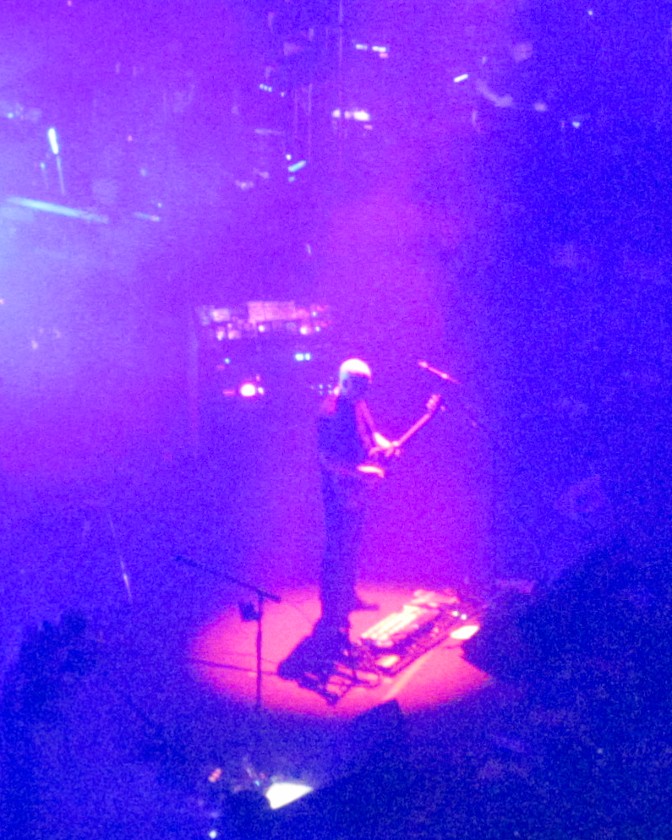
In the Pink: With Floyd Classics and Fine New Solo Work, David Gilmour Comfortably Thrills at the United Center -- Chicago Concert Review

Concert Review

David Gilmour
United Center, Chicago
April 4, 2016
(also performing 4/6 at Auditorium, 4/8 at UC)
@@@@@

I've never known of Pink Floyd and not liked them, but then, when you're 11 and people are singing "We don't need no education," how could you not be smitten.

I'm also aware of just how huge and great the band was, with masterful albums like Dark Side of the Moon and Wish You Were Here, and my best friend long ago made me appreciate the Syd Barrett era in the late '60s.

But if asked over the years to name the biggest, best and/or my favorite rock acts of the '70s, "Pink Floyd" probably wouldn't sputter out as quickly as it should in Pavlovian fashion.

It's possible that I'd mention Bruce Springsteen, Led Zeppelin, David Bowie, Queen, The Ramones, The Clash, Bob Seger, Steely Dan, The Who, The Stones, Van Halen, Rush, Cheap Trick, Tom Petty & the Heartbreakers, Billy Joel, Elvis Costello, Talking Heads and others before thinking to mention Pink Floyd.

I somewhat ascribe this--though it certainly isn't true in all the above cases--to many having kept themselves top of mind through numerous concerts I've seen, even in just the past decade.

But while I saw Pink Floyd with David Gilmour at the helm in 1988 after Roger Waters' departure from the band, and caught Waters' mammoth The Wall tour in 2010 and 2012, I've never seen the full, classic Pink Floyd lineup in concert (Gilmour, Waters, Nick Mason and the late Rick Wright; the also deceased Barrett left the band in 1968).

And I almost assuredly never will, even with a substitute for Wright.

Though the notorious acrimony--and legal battles--between Waters and Gilmour seems to have eased in recent years, with a Pink Floyd reunion at Live 8 in 2005 (while Wright was still alive), the two performing at a charity event in 2010 and Gilmour singing "Comfortably Numb" at a Wall show in 2011, the ship seems to have sailed on any further reunions under the famed Pink Floyd moniker.

While I long held Gilmour producing watered-down, Waters-less Pink Floyd albums against him, I don't think Roger is such a saint yet I ponied up for his mega-successful Wall extravaganzas.

So it only seemed right to see Pink Floyd's masterful guitarist and most euphonious singer on a solo tour while I still could.

And as I found, Monday night at the United Center--the first of 3 shows in Chicago this week--the corollary to Pink Floyd being a bit back of mind due to lesser live exposure, is that more so than cherished songs I've seen/heard performed quite repeatedly ("Baba O'Riley," "Born to Run," "Satisfaction," "Sunday Bloody Sunday," "Hey Jude," etc.), Floyd classics like "Wish You Were Here," "Money," "Us and Them" and more, sounded completely fresh...and absolutely majestic.

Even spiritual.

At 70, Gilmour put on a brilliant performance, demonstrating that he was--and remains--an extraordinary musician and excellent vocalist.

And with several fine cuts from his new solo album, Rattle That Lock--co-produced by Roxy Music guitarist Phil Manzanera, who is part of Gilmour's touring band--accompanying material from sans-Waters PF albums The Division Bell and A Momentary Lapse of Reason, and 9 unarguable Pink Floyd classics, the nearly 3-hour concert was exceptionally well-planned and presented.

Unfolding slowly, like many of Floyd's best songs, the show began a bit after 8 P.M. with "5 A.M.," an instrumental that opens Rattle That Lock, followed by the title track and "Faces of Stone."

Then came, blissfully, "Wish You Were Here," with Manzanera beautifully dueting with Gilmour on acoustic guitar, with bassist Guy Pratt providing accompaniment on Waters' vocal parts (various sidemen helped out throughout the night on songs where Gilmour doesn't exclusively sing the lead; there were also 3 backing singers alongside the excellent band).

A total of 11 songs preceded the set break, with the "Money"/"Us and Them" combo perfectly replicating the Dark Side of the Moon versions, yet still offering live panache. And any time Brazilian saxophonist João Mello played a solo, it brought not only awe and mirthful recall, but yet another reminder of the ingenuity of Pink Floyd's sonic expanse.

New songs "A Boat Lies Waiting" and particularly "In Any Tongue" also came off quite well, as did "High Hopes" from The Division Bell.

After a 15-minute break, the light show was amped up considerably as Gilmour ran through "Astronomy Domine," the first song on Pink Floyd's first album, The Piper at the Gates of Dawn.

Then, appropriately, came the sublime Barrett tribute, "Shine on You Crazy Diamond (Parts I-V)," with Gilmour clearly shining on both guitar and vocals.

"Fat Old Sun," from 1970's Atom Heart Mother was next, and further proving that Gilmour isn't stuck in the past was Rattle That Lock's "The Girl in the Yellow Dress," a jazzy number with Pratt playing stand-up bass that felt akin to forays Sting and Elvis Costello have taken into smoky lounge stylings.

Near-blinding visuals made "Run Like Hell" even more mind-blowing, the clocks of "Time" opened the encores in striking fashion and after a segue into the "Breathe" reprise, "Comfortably Numb" was magnificent, with Gilmour--sumptuous in his lead-playing all night--supremely delivering one of the best guitar solos in rock history. (See the full setlist here.)

I won't say this was as good as a Pink Floyd concert--though "Have a Cigar" is the only classic I acutely missed, and it was sung on Wish You Were Here by Roy Harper, not anyone in the band--but in some ways it was probably better.

Rather than running through an old album verbatim--i.e. The Wall--or embarking on a mercenary reunion tour replete with age-old feuds, Gilmour seemed truly comfortable playing songs from across the past 50 years, including many of recent vintage that held up quite well.

In that way, this show reminded me of the supernatural Robert Plant concert I saw at the Riv in 2014 (and one almost as good on the lakefront last year), where the inclusion of considerable new material combined with a relaxed, amiable vibe to make the Led Zeppelin selections feel that much more transcendently thunderous.

The very best concerts are the ones that enhance your appreciation of what the artist has done before, and what they are doing now.

In making Pink Floyd feel stupefyingly new and mesmerizing again, while not being content to merely rest on his considerable laurels, David Gilmour did just that. 

Wish you were here.

---
Just last week I was able to buy a pair of $105 face value tickets for just $34 on StubHub; by showtime Monday, prices were as low as $12. 

Prices aren't nearly that low for Wednesday's show at the much smaller Auditorium (as the UC welcomes Iron Maiden; I won't be there) and Friday back at the United Center, but if you're a Pink Floyd fan, I highly recommend trying to get there. 

Gilmour is only hitting four North American cities on this tour--L.A., Toronto, Chicago and New York--and has hinted that he may not be long for the road. And sadly, music this good, simply isn't being created anymore.


Sunday, April 03, 2016

Twice as Legendary: Earth, Wind & Fire Add Something Elemental to Twin Bill with (and in) Chicago -- Chicago Concert Review

Concert Review

Chicago
Earth, Wind & Fire
United Center, Chicago
April 1, 2016
@@@@@ (for complete show)
(@@@@1/2 for each act separately)

Last August at Ravinia, I saw the band Chicago for the first time, despite their being an active entity for the entirety of my existence.

With a lot of great songs, and a handful a tad too schmaltzy for my tastes, they delivered a fine show that felt a bit too by-the-book to be exceedingly exciting.

In my @@@@ (out of 5) review, I opined that while I was glad to have added Chicago to my concert roster, I probably should have attended one of their numerous outings with Earth, Wind & Fire, another legendary band with Chicago roots that I had never seen.

Little did I know that opportunity would come, in Chicago album title parlance, just VII months later.

And with my friend Paolo, who has been telling me for years how great Earth, Wind & Fire is live, we got rather decent seats to the United Center for a face value of just $39.50, far less than the $100 face for pavilion seats at Ravinia for Chicago alone--and though I paid only $29 through StubHub for that show, this one was still a relative bargain.

EWF, which Maurice White--who passed away in February after a long battle with Parkinson's Disease--formed with brother Verdine back in 1969-70 after Maurice had been a session drummer with (the city of) Chicago's fabled Chess Records, was inducted into the Rock and Roll Hall of Fame in the year 2000.

Chicago, whose origins date to 1967 at DePaul University, will finally enter the Hall next Friday after being overlooked through many years of eligibility.

With this honor, and the recent loss of Maurice White, Friday's homecoming show of sorts had the specter of being particularly sentimental and special, especially as Chicago still includes four original members (singer/keyboardist Robert Lamm and horn players Lee Loughnane, James Pankow & Walter Parazaider) while bassist Verdine White, singer Philip Bailey and percussionist/vocalist Ralph Johnson remain from Earth, Wind and Fire's early days.

At the United Center, Lamm thanked the "36 million people who voted to put us in the Rock and Roll Hall of Fame," and a photo of Maurice White adorned the video backdrop during an EWF song, but for the most part, both bands were content to let the music speak for their legacies.

And it did so quite powerful, individually and especially when both acts tag-teamed onstage.

Twenty-one combined musicians initially took the stage and began, appropriately, with "Beginnings," from Chicago Transit Authority, the debut album under Chicago's original name (before the real CTA put the kibbosh on it).

The joined forces then played Earth, Wind & Fire's wonderful "In the Stone," demonstrating that this concert pairing makes musical sense, with both bands being forerunners in employing near-orchestral soundscapes with horn sections, multiple percussionists and lead vocal duties split among band members.

Although it's a shame this merits mentioning, there was also something beautiful about seeing the all-white Chicago and mostly-black Earth, Wind & Fire sharing the stage in such harmony and obvious camaraderie, echoed by one of the more diverse concert audiences I've ever been part of.

After Chicago's "Dialogue (Parts I & II)" was done in unison--with Philip Bailey singing some lines, as Lamm and other Chicago vocalists did on "In the Stone"--the stage was ceded to EWF alone for about 75 minutes.

Other than the accurately-titled "Boogie Wonderland," great ballad "After the Love is Gone" and Beatles cover "Got to Get You Into My Life," I admittedly knew most of the songs in the set due to pre-show Spotifamiliarization rather than Paolo's deep-seated fandom, but everything sounded fantastic. 

Even when shown on the video screens--and this was the first concert of dozens attended at the United Center where the Bulls/Blackhawks scoreboard was utilized to show live video; seems an idea other acts should replicate--the soon-to-turn-65 Philip Bailey looked at least 20 years younger, sang terrifically and was a most amiable front man.

"Jupiter," "Serpentine Fire," "Let's Groove" and a wicked bass solo from Verdine White were among the highlights before a brief intermission and Chicago's set.

With Lamm splitting vocal duties with bassist Jason Scheff (who sings the ballads originally sung by Peter Cetera), keyboardist Lou Pardini and assorted others, the setlist was somewhat akin to what I'd heard at Ravinia, including "Introduction," "Questions 67 & 68" and the Ballet for a Girl in Buchanon suite, comprising "Make Me Smile" and "Colour My World" among others.

Including those done in conjunction with EWF, 24 Chicago songs--counting a fine cover of Spencer Davis Group's "I'm A Man"--were performed, as opposed to 32 at Ravinia. But while I missed "Old Days" and "Alive Again," I had no problem with sugary hits "If You Leave Me Now" and "Look Away" being left on the locker room floor. ("Hard Habit to Break," "You're the Inspiration," "Hard to Say I'm Sorry" and "Just You & Me" more than adequately represented the band's penchant for popular yet cloying ballads.)

And Earth, Wind & Fire being on the bill didn't just mean I got to hear another great band and nearly 3-1/2 hours worth of terrific music; I think EWF helped to make Chicago a bit more vibrant, certainly when literally sharing the stage, but even independently.

As noted in my Ravinia review, I've never owned any Chicago albums and that I'd seen over 650 concerts before I got around to seeing them also bespeaks rather middling fandom.

But at the United Center, not only did Chicago reiterate the uniqueness of their horn laden sound in a rock vein--excepting of course their tour mates--along with impressive professionalism, staying power and many a swell tune, they showed why they should have entered the Rock and Roll Hall of Fame long ago.

I've oft read references to punk rock rising in the mid-'70s as a rejection of arena acts like Chicago--as well as Emerson, Lake & Palmer, Yes, Elton John, Led Zeppelin and others--but while I will forever love the Ramones, Clash, Sex Pistols, etc., etc., the sparsity of exciting new rock 'n roll helps me better appreciate good music of any type.

And Chicago, like Earth, Wind & Fire, made plenty of it.

As many reading this blog likely know, I'm a huge Bruce Springsteen fan, and have long known that his earliest tour of arenas (in mid-1973, supporting Greetings From Asbury Park, NJ) came opening for Chicago.

But Friday, more than I ever thought about before, I noted--and mentioned to Paolo--how likely it was that Springsteen gleaned much from the experience, as the soundscape of his subsequent albums, The Wild, The Innocent and The E Street Shuffle and especially Born to Run, is far grander than that of Greetings, and makes greater use of Clarence Clemons' sax playing.

On recent tours--though not his current one--Springsteen has employed a full horn section and extra percussionists, and even just the art of ensuring arena acoustics accommodate such instrumental expanse properly owes an intrinsic debt to what Chicago and Earth, Wind & Fire have been doing for decades.

And the 6-song encore Friday night, with both bands romping through some of their biggest and best songs--"September," "Free," "Sing a Song," "Does Anybody Really Know What Time It Is?," "Shining Star," "25 or 6 to 4"--with festive bouts of dueling sax solos, guitar solos, lead vocal interplay and more, was one of the more ebullient concert experiences I've ever encountered.

I thought it might have been nice if Philip Bailey--his son Philip Bailey, Jr. is now also in the band--openly congratulated Chicago on their Hall induction, and touchingly appropriate for Lamm to voice a sympathetic tribute to Maurice White, but I would assume such sentiments have more earnestly shared in private.

Unlike other co-headlining tours that have seemed mainly driven by commerce--Rod Stewart and Santana--or have intrigued due to the unlikeliness of the pairings--Paul Simon and Sting, the latter soon touring with Peter Gabriel--the Chicago + Earth, Wind & Fire coupling dating back to 2004 seems steeped in genuine musical convergence...and interpersonal affinity.

Though both acts also continue to successfully tour separately, the Heart and Soul 2.0 tour showcased plenty of both while seemingly bringing out the best in one another.

All the more so in the city for which one is named and where both got started. 


Friday, April 01, 2016

Next Year is Here: Seth Saith 2016 Will Be Truly Historic on Chicago's North Side -- Major League Baseball Predictions

Hell will freeze over.

Pigs will fly.

The original Guns 'n Roses will reunite and tour (oh wait, that was already announced, though seemingly sans Izzy and Adler).

Charlie Brown will kick the football.

And this fall, the Chicago Cubs will win the World Series for the first time since 1908.

Yes, 2016 will be the year many have been waiting for their whole lives. And some afterlives. 

And if it isn't, perhaps because this prediction jinxes it--though the Cubs are commonly regarded as the best team in baseball and widely-forecast as champions--just remember that I'm posting this on...

April Fool's Day

So I can claim that I never really meant it, much as I, uh, facetiously picked the Washington Nationals to win it all last year.

(I will take credit for, against most forecasts, coming rather close with my Blue Jays pennant and World Series title pick. And everyone blew it on the Astros.)

Anyway, with a bit more emotional skin in the game than usual, here are:

Seth Saith's Not-So-Fearless Baseball Predictions for 2016

American League East
1. Toronto Blue Jays
2. New York Yankees 
3. Boston Red Sox
4. Baltimore Orioles
5. Tampa Bay Rays

American League Central
1. Detroit Tigers
2. Cleveland Indians
3. Kansas City Royals
4. Chicago White Sox
5. Minnesota Twins

American League West
1. Texas Rangers
2. Houston Astros
3. Los Angeles Angels of Anaheim
4. Seattle Mariners
5. Oakland Athletics

Wild Cards: Yankees over Indians
ALDS: Tigers over Yankees
            Blue Jays over Rangers
Pennant Winner: Blue Jays

AL MVP: Mike Trout, Angels
AL Cy Young: David Price, Red Sox
AL Rookie of the Year: Byron Buxton, Twins
AL Manager of the Year: Jeff Banister, Rangers
White Sox Record: 78-84


National League East  
1. Washington Nationals
2. New York Mets
3. Miami Marlins
4. Philadelphia Phillies
5. Atlanta Braves

National League Central
1. Chicago Cubs
2. Pittsburgh Pirates
3. St. Louis Cardinals
4. Cincinnati Reds
5. Milwaukee Brewers

National League West
1. Arizona Diamondbacks
2. San Francisco Giants
3. Los Angeles Dodgers
4. Colorado Rockies
5. San Diego Padres

Wild Cards: Mets over Giants
NLCS: Cubs over Mets
       Nationals over Diamondbacks
NL Pennant Winner: Cubs

NL MVP: Kris Bryant, Cubs
NL Cy Young: Gerrit Cole, Pirates
NL Rookie of the Year:
Steven Matz, Mets

Manager of the Year: Chip Hale, Diamondbacks
Cubs Record: 100-62


World Series Winner: Chicago Cubs 
(over Toronto Blue Jays)

Wednesday, March 30, 2016

Girl Power: 'Matilda' an Imaginative and Inspiring Ode to Wonderfully "Revolting Children" -- Chicago Theater Review

Theater Review

Matilda: The Musical
Oriental Theatre, Chicago
Thru April 10
@@@@1/2

"To teach the child we must first break the child."
-- stated by Matilda's school principal Miss Trunchbull

"If you always take it on the chin and wear it
You might as well be saying you think that it's OK
And that's not right
And if it's not right, you have to put it right"
-- sung by Matilda in the song "Naughty"

Like previous great musicals about children--Oliver, Annie, Billy Elliot--Matilda, which belongs in the same sentence, features kids who are spunky, idealistic, precocious, British (excepting Annie) and resolved to battle belittling, authoritarian and/or otherwise oppressive forces.

So while it should--and on Tuesday night in Chicago, did--bring a sizable showing of youngsters to the theater, the inherent allegory about standing up against those who would hold you down should resonate with children of every age. Like 47 or 76 or 29 or 88.

The three touring Matildas. Sarah McKinley Austin (center)
starred in the performance I attended; pictured with
Savannah Grace Elmer David and Lily Brooks O'Briant.
Though I wasn't previously familiar with Roald Dahl's beloved 1988 novel on which the musical is based, I loved Matilda: The Musical when I saw it in London in 2013--after passing it up in its nascent West End days in 2011 for, of all things, the truly dreadful Ghost: The Musical--and found it just as good on a National Tour that is playing Chicago's Oriental Theatre for 3 weeks. (Matilda continues to run in London, as well as on Broadway where it opened in 2013.)

With the character of Matilda--a brilliant young girl whose moronic parents call her a boy and far worse--onstage for most of the musical's 2-1/2 hours, three "Tour-tildas" (see the nearby photo and Tribune's Chris Jones' delightful video interview) play the part on a rotating basis.

On the Tuesday beginning the second week of the Chicago run, with a largely full balcony suggesting that the family-friendly show likely should've been booked here longer, Sarah McKinley Austin and her striking blue eyes handled the title role.

Wonderfully.

Several other children in the cast were also terrific, as were the adults, including Quinn Mattfeld as Matilda Wormwood's conniving father, Cassie Silva as her banal, ballroom dance contest obsessed mother, Jennifer Blood as Matilda's teacher Miss Honey, Chicago stage vet Ora Jones as a kindly librarian and David Abeles as Matilda's cruel principal, Miss Trunchbull.

As illustrated by the quotes at top, the manly, malevolent Miss Trunchbull and Matilda's own parents rain down all sorts of nastiness, but she and her schoolmates fight back with aplomb and resiliency through songs like "Naughty," "Bruce," "When I Grow Up" and "Revolting Children."

Those tunes highlight the rock-infused score by composer/lyricist Tim Minchin, which I find reminiscent of Spring Awakening, another modern musical about youthful repression and rebellion, albeit focusing on teenagers.

Though the other numbers move the story along nicely, and "This Little Girl" sung by Jennifer Blood as Miss Honey is rather touching, the relatively few demonstrably terrific tunes serve to keep Matilda from quite the musical heights of Oliver or Annie.

But as with Billy Elliot, there is much truly inspired staging, including the use of playground swings on the fabulous "When I Grow Up," which has young kids being switched out mid-song for older kids, and even an adult or two.

It's always understandable to wonder if the production values of short-run tour stops are watered down from what audiences see in London and New York; I only saw Matilda in the former and don't have the memory to vouch for any exactitude, but with the show's original director Matthew Warchus at the helm, I noticed nothing notably deficient.

Kids speaking, and singing in unison, with British accents make catching all of Minchin's witty lyrics and book writer Dennis Kelly's frequently acidic dialogue a bit tough, particularly up in the balcony--even for those of us who prepped by listening to the cast album on Spotify.

If time allows, I would strongly recommend doing just that, especially to familiarize young attendees with the music, just as many seemed to be with Dahl's story.

To their credit, the show's producers included a crib sheet into the Playbill that defines terms like "chokey," which is a particularly heinous means of punishment used by Principal Trunchbull.

Just another aspect of how Matilda: The Musical goes a bit beyond the norm, not only in the entertainment it provides, but the lessons it tries to teach.

As the program also reveals, the song "Revolting Children" comes late in the show, even more brilliant for following the menacing Trunchbull calling the schoolkids maggots and exhorting that they are revolting.

To which, the children--led by the vociferously reading, clairvoyantly storytelling Matilda--lyrically agree, in a show that should inspire anyone, from 5 to 105, to fight the powers that be.

Or at least aspire to.

"We are revolting children
Living in revolting times
We sing revolting songs
Using revolting rhymes
We'll be revolting children
'Til our revolting's done
And we'll have the Trunchbull
   vaulting

We're revolting!"

-- "Revolting Children"

Tuesday, March 29, 2016

Hard to Figure: Despite Punchy Numbers, New 'Adding Machine' Production Doesn't Equal Fond Memories of the Original -- Chicago Theater Review

Theater Review

Adding Machine: A Musical
The Hypocrites
at Den Theatre, Chicago
Thru May 15
@@@1/2

I really can't explain it, even to myself.

In the 2007, at the now defunct but long estimable Next Theater in Evanston, I saw a world premiere "chamber musical" called Adding Machine that the company's artistic director, Jason Loewith, had written with composer Joshua Schmidt based on a 1923 play by Elmer Rice.

Although I wasn't regularly writing reviews back then, I know that I loved it. I remember discussing it effusively with relatives who had also seen it, and in my "Shows Seen" database, I gave it a 10/10 rating, for both content and performance.

I felt delighted when the Next production, directed by David Cromer, ran Off-Broadway with considerable acclaim the following year, and likely would have seen it if it hadn't closed weeks before a trip to New York.

So I was rather excited in noting that, after having subsequent productions nationwide but none that I noted in the Chicago area, Adding Machine would be presented by the Hypocrites at the Den Theatre.

And so, it is with a fair amount of chagrin, and puzzlement, that I must share that my affinity was much more middling this time around.

I was certainly glad to see the production, found parts of it fantastic--and never formulaic--and in sum would describe it as good.

But having gone into this rendition remembering the original--admittedly without much specificity in terms of songs or plot--as likely the best homegrown work of musical theater I'd ever seen, I ruefully can't rave about Adding Machine as I expected to.

There isn't much obviously subtracting from the Hypocrites' presentation of the material, which depicts a dystopian society in which many people are numbered rather than named, focusing most promising on Mr. Zero, a calculating--in vocation only--worker-bee who is replaced by an adding machine rather than receiving an anticipated promotion after 25 years on the job.

Accompanying the dark themes, this is about as far from a traditional song-and-dance musical as you can get, with one song simply being a recitation of tabulated numbers, whose inventiveness makes it far more stirring than it sounds.

Patrick Du Laney does a fine job as the morose Mr. Zero, Kelli Harrington is well-sung as his wife, Neela Barron is nicely empathetic as an admiring friend--and shines on a torch song called "I'd Rather Watch You"--and Bear Bellinger is great fun as Shrdlu, something of a spiritual adviser after Mr. Zero is punished for a crime of frustration.

Amid a rather dissonant score, Shrdlu's more upbeat songs come across as highlights.

So with a good bit to admire in this Adding Machine, and never a sense that anyone is pushing the wrong buttons, I'm left to wonder if I may have overly liked the Next version or whether something has substantively changed in this one. (Unfortunately, I can't check the tape;)

Without reason to specifically criticize anything I saw on Monday night, I can't help but recall that the Hypocrites take on Into the Woods in 2014 rendered a musical I had loved before and since somewhat well short of wonderful.

And with appreciation for the troupe's use of the Den's intimate space under the direction of Geoff Burton, as well as the talents of the actors/singers and three-piece band, I felt the sound was far too loud--and my hearing is far from pristine--with the overamplification making the discordant music and atypcial lyrics that much harder to ingest.

My disappointment is far less than total, and Adding Machine's innovation + empathetic themes + unique score + fine performances still may equal something well worth your time.

I am not sorry I saw it again, merely wishing I had loved it like I did before and wondering why I didn't--or whether I ever really should have. (Reviews at the time suggest the 2007 show was great; hopefully others like it just as much now).

Hence, while I was hoping to insist musical theater lovers--especially those open to unique variations on the form--roll onto Milwaukee Ave. just north of, appropriately, Division to see Adding Machine, as imperfectly enumerated above the pluses and minuses only tally a less emphatic suggestion. 

Monday, March 28, 2016

Celluloid Heroes: Steppenwolf's 'The Flick' Offers Warmly 'Reel'istic Portrayal of Cinema Workers -- Chicago Theater Review

Theater Review

The Flick
a recent play by Annie Baker
directed by Dexter Bullard
Steppenwolf Theatre, Chicago
Thru May 8
@@@@

My regard for any play often pertains to what I take away from it: new perspectives, insights, things to consider and discuss, admiration for the script, actors, staging, scenery, director, etc.

But one's perception of a theatrical work, or any artistic endeavor for that matter, can be intrinsically altered by what we take into it.

Written by Annie Baker, The Flick--winner of the 2014 Pulitzer Prize for Drama--revolves almost entirely around three employees of a single-screen movie theater that shares the play's name.

Set in Worcester, Massachusetts, the past-its-prime Flick is one of relatively few cinemas nationwide continuing to use a 35mm film projector rather than digital projection.

Although I am a film buff with a deep-seated appreciation for bygone remnants of a more analog age--print newspapers & magazines, record albums with artful cover designs, spoken-word conversations, etc., etc.--the affinity I share with the play's Avery character (terrifically embodied here by Travis Turner) and his love of celluloid is admittedly more reflected on a macro level than a micro one. (i.e. I love old theaters, and the traditions and values they represent, but don't avoid or mentally admonish new ones.)

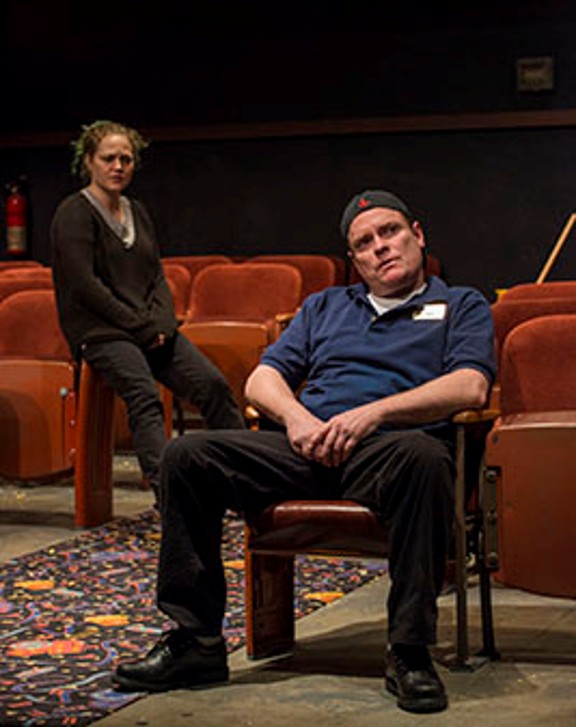
But certainly, I brought identification with, and empathy for, Avery, Sam (an excellent Danny McCarthy) and Rose (the always great Caroline Neff), as they find friendship and burdensome self-worth while sweeping up popcorn and cleaning up shit--sometimes literally--theater patrons mindlessly leave behind for the marginalized and overlooked to devotedly disinfect for a whopping $8.25/hr.

I've never specifically worked at a movie house, but like many with or without college degrees, spent time in sandwich shops, bank teller cages, Kinko's and the like, while currently remaining mired in un- or under-employment.

My attendance at Steppenwolf's upstairs space, where rows of theater seats face rows of theater seats onstage, was in large part motivated by the Chicago Tribune's Chris Jones' rave, 4-star (out of 4) review of The Flick, and greatly facilitated by being able to acquire--especially easily on Easter Sunday--one of the $20 day-of-show discount tickets Steppenwolf generously allots for each performance. (I wound up in the 3rd row, center, undoubtedly amid many who had paid the $78 full price.)

Knowing that the play runs a full three hours--which extends past my comfort zone for non-musicals, and admittedly did here--I made a point of reading an interview with playwright Baker addressing The Flick's length and abundant use of silence as the cinema's employees go about their work without always chattering.

All of the above played into my exploration, understanding and appreciation of The Flick, which I enjoyed and admired, even if seemingly not to the level of Chris Jones and the Pulitzer Prize committee. Although I did seem to like it more than some in the post-show discussion who found it far too long and laborious; the Steppenwolf's supporting literature even noted that during the play's recent Off-Broadway runs, some patrons walked out and even wrote angry letters.

Yet even more acutely in terms of what I "took into" The Flick is coincidentally having just seen Mary-Arrchie's production of David Mamet's American Buffalo, a 1975 single-setting, entirely dialogue-driven play that also chronicles the lives and angst of three articulate yet undervalued and oft-overlooked individuals toiling away in nondescript environs.

Many of the aspects I noted about Donny, Teach and Bobby in my review of American Buffalo just prior to this one--friendship, loyalty, dignity despite their disillusionment, but also obvious imperfections--I also couldn't help noticing in Avery, Sam and Rose, who rebel against their unkindly boss and/or societal injustices in a dishonest way, and two of whom later take a wrongful, yet realistic-feeling, stance regarding the third.

But while The Flick is a slice-of-life play about people on the fringes, conveying to the stereotypically better-heeled Steppenwolf audiences that basic human emotions, longings, insecurities, etc., aren't so different across the socio-economic spectrum, it is also a love letter to film, specifically in terms of both medium and material, but also symbolically regarding the way art, culture, entertainment, hobbies, passions, etc., can be an antidote to the alienation many may feel.

Which essentially echoes my raison d'être.

In the characters of Sam, a 30-something who lives in his parents' basement and longs for love while finding resiliency in the routine and movies offered by the Flick; Rose a college graduate besieged by student debt and a bit beaten down by life but comfortable enough in her own skin to wildly show off hip-hop dance moves to her co-workers; and especially Avery, an introverted 20-year-old African-American (he is written into the script as such) who has presumably had more nourishing relationships with movies than with people and can instantly respond to Sam's 6-degrees-of-separation actor pairings, I involuntarily recalled something else I had just seen in previous days.

Not another play and not a movie--while pausing to suggest my film buff friends see The Flick, if simply for its references to Pulp Fiction, The Wild Bunch, the Coen Brothers, film formats and the merits (or lack thereof) of American Cinema over the past two decades--but a short clip from Freaks and Geeks, a TV show produced by Judd Apatow, which I never watched when it was briefly on from 1999-2000.

After the death of comedian Garry Shandling last Thursday, I learned of his close friendship with Apatow, a now highly successful writer/director/producer to whom he provided guidance and an early show-biz job as a writer on The Larry Sanders Show. The tribute Apatow slyly paid in the Freaks and Geeks scene shown below obviously came long before his mentor's passing, but was shared on social media in recent days.

I find it both extremely beautiful and poignant, and in seeing how The Flick--while also addressing numerous topics and themes--reverently reflects the life-affirming, even life-changing, aspects of art, especially for those of us unsure of ourselves (and really, who isn't?), I couldn't help thinking about it.

And still can't.

Saturday, March 26, 2016

Up and Out: 'American Buffalo' Proves Apt Way to Say Hello, Goodbye to Chicago's Second-Storied Mary-Arrchie Theatre -- Chicago Theater Review

Theater Review

American Buffalo
by David Mamet
directed by Carlo Lorenzo Garcia
Mary-Arrchie Theatre Co., Chicago
Thru April 17
@@@@

Profiles, TimeLine, Redtwist, A Red Orchid, Signal, Steep, Strawdog, Jackalope, Gift, Porchlight, Shattered Globe, Raven, AstonRep, NightBlue, Artistic Home, Eclipse, Pegasus Players, Next, About Face, House, Bailiwick.

These are just some of the storied "storefront" theater companies, present and past, that I've patronized, which--along with somewhat larger local troupes/theaters like Goodman, Steppenwolf, Court, Victory Gardens, Lookingglass, Northlight, etc., regional musical theater houses such as Marriott Theater Lincolnshire, Drury Lane Oakbrook, Paramount Theater Aurora, Theater at the Center in Munster and Mercury Theater, and abundant Broadway (and Pre-Broadway) tours stopping in the Loop--make Chicago perhaps the best, or at least deepest, theater town in the world. (And believe me, I love New York and London, but don't know if their magnificence equally expands far beyond Broadway and the West End.)

But though I have been going to theaters such as those above since the beginning of the 21st century, until Thursday night I had never ascended the steps leading to the Mary-Arrchie Theatre, a quintessential Chicago storefront theater even though it actually resides on the second floor, above a convenience store in Lakeview.

Mary-Arrchie is currently celebrating its 30th anniversary season, but also, regrettably, its last.

The well-worn building in which it resides--and the entire block, which also houses the Strawdog Theatre--is slated to be redeveloped, and M-A founder/artistic director Richard Cotovsky announced last fall that losing their lease will bring his company to an end.

Cotovsky was quoted by the Tribune's Chris Jones as saying:
"It’s not a bad thing,” he said. “It will take the weight off my back. We struggled and we fought to do what we thought was best. And now I can look back and say, ‘Wow, we did all that.’"
Nonetheless, even if not symbolically or ruefully, Mary-Arrchie is going out by spewing a whole lot of profanity.

Of the David Mamet variety, within American Buffalo, a still quite resonant allegory on working class discontent, set--rather appropriately--in a Chicago storefront.

I have seen the 3-man play three previous times, including with Cotovsky playing the role of Donny Dubrow, as he does here, at the Raven Theatre in 2006. That same year, I had seen the originator of the Donny role--J.J. Johnston--in a staged reading at the Goodman alongside the remarkable Mike Nussbaum, and also caught a 2010 Steppenwolf production with Tracy Letts, Francis Guinan and Patrick Andrews.

This somewhat explains, or at least rationalizes, why even in feeling that I should get to Mary-Arrchie before it becomes extinct, I hadn't until the run of American Buffalo was extended, as it's now been twice. A discount ticket via Goldstar also helped prompt action.

I very much enjoyed my pilgrimage, which involved eating at the somewhat similarly named El Mariachi nearby, seeing the honorary Richard Cotovsky Way street sign, climbing the stairs filled with posters of past productions--including the perennial Abbie Hoffman Died for Our Sins--and noting the Howlin' Wolf LPs for sale in the lobby, presumably representing the recorded blues music enveloping the current play.

I believe Mark Vallarta (Teach) and Spenser Davis (Bobby) were just joining Cotovsky in the performance I saw, following Stephen Walker and Rudy Galvan playing the roles for most of the run; last minute rehearsals could be heard before the house was opened. (And with Mamet's incendiary language, it sounded like an argument one wouldn't dare interrupt.)

With as much to appreciate in subtext as at the surface level, American Buffalo can be challenging to optimize, and all three actors merit considerable credit for fine work, which in the case of Vallarta and Davis should only get stronger with a bit more acclimation.

Donny is the proprietor of a resale shop, and set designer John Holt has ensured that the stage is abundantly stuffed with interesting junk.

The entire two-act, two-hour play takes place in the same setting with Donny speaking with his young gofer Bobby and/or cantankerous poker pal Teach throughout, with frequent references to the unseen Ruthie, Grace, Fletcher and a store customer who becomes the planned prey in a low-grade robbery scheme, sparked by his purchase of an American Buffalo nickel.

You can undoubtedly find more astute takes on Mamet's underlying themes, but I see American Buffalo as a snapshot of the hardscrabble underbelly of America--and yes, Chicago--in which friendship and duplicity, distrust and loyalty, desperation and perseverance, day-to-day dignity and criminality, small talk and scheming, etc., etc., all go hand-in-hand.

The beautifully disheveled Cotovsky makes it seem as though the role of Donny was written for him, and Davis handles the Bobby role with aplomb, making him feel unsophisticated but not slow, as often can unnecessarily be the case.

I like what Vallarta does with Teach, infusing more of a sense of low-key desperation than full-tilt combustibility, although this may also lend itself to the action onstage never quite bristling, and then exploding, with quite the force it probably should (though the stagehands who must clean up and reset the scenery every night may strongly disagree).

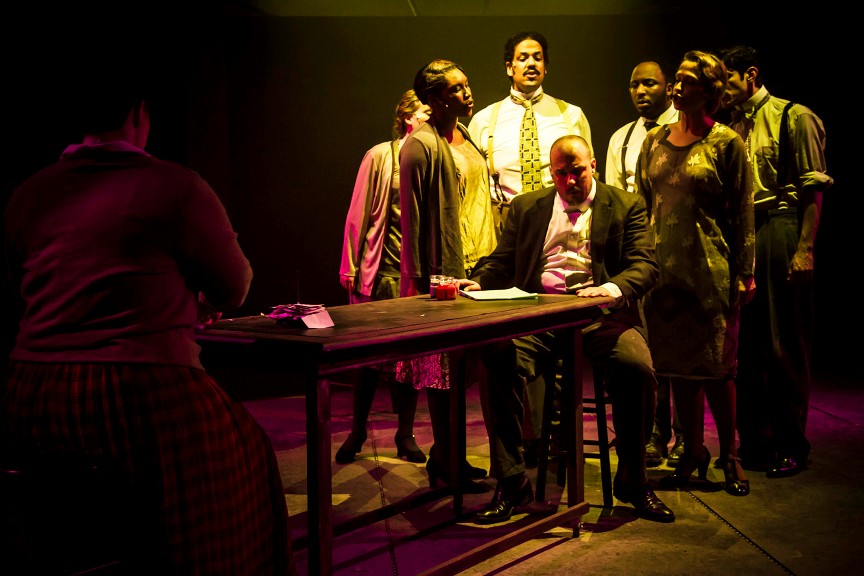
Photo credit: Michael Brosilow.
Actors pictured C and R were not in the performance I attended.
But even though they may have been a bit more finely calibrated over time by the previous actors, and conceivably soon will be by Vallarta and Davis alongside Cotovsky, never did the portrayals feel less than real.

And seeing American Buffalo in the setting I did made if feel even more appropriate as a requiem for the type of Chicago theater company that I wholeheartedly embrace.

I'm sorry I never got to Angel Island, as the theater is named, previously--and won't again. 

But as Richard Cotovsky--who Chris Jones notes is a pharmacist by day--goes on his self-named way with numerous estimable colleagues, I'm glad I got the chance to say both hello and goodbye, and now also thanks, to Mary-Arrchie.

Still, it's always sad to see one of Chicago's most uncompromising cultural institutions go the way of the buffalo.

Tuesday, March 22, 2016

Though Not Without Its Merits, 'The Matchmaker' Fails to Make an Emotional Connection -- Chicago Theater Review

Theater Review

The Matchmaker
by Thornton Wilder
Goodman Theatre, Chicago
Thru April 10
@@@

In books, theater, film and television, the same basic story can be told in multiple versions and variations, with one's abiding affinity often connected to the incarnation first encountered.

Commonly, if a book I like gets turned into a movie, I can't help but rue how much is missing. Beloved films adapted into musicals can be excellent in their own right, but rarely supplant my preference for the celluloid version, except if I saw the musical first, as in the case of The Producers and Hairspray.

To which you may well shout something like, "But The Producers was a movie 30+ years before it was a musical, and Hairspray almost 15, how could you have not seen--and loved--them first? They're both wonderful films!"

And even if it wasn't an imagined rejoinder in my own mind, I wouldn't debate that. Because I'm not insisting one's preferred iteration is necessarily superior, just that it feels that way.

Which is a somewhat convoluted way of getting to my point that as I watched The Matchmaker at Chicago's Goodman Theatre Sunday night, I acutely missed the music of Hello, Dolly!, its famed and fantastic musical adaptation.

Having been heavily indoctrinated to the Barbra Streisand and Walter Matthau movie version of Hello, Dolly! when I was a wee child, I couldn't help but want the characters of Dolly Levi and Horace Vandergelder to break out in song on the Goodman stage.

In fact, I couldn't help sing "Put on Your Sunday Clothes," "Hello, Dolly!" and other chestnuts in my head. And while my regard for this selection in my Goodman subscription series is more middling than for most of their presentations, the theater should nonetheless be rather appreciative that I resisted the urge to belt out tunes from the balcony. (Particularly as I have a singing voice reminiscent of a tortured frog.)

Watching the Goodman's Matchmaker, with a fine, diverse cast under the direction of Henry Wishcamper, I could certainly envision mid-1950s audiences getting a kick out of Thornton Wilder's farce about a curmudgeonly Yonkers merchant enlisting the aid of a matchmaker to pursue a romantic interest in Manhattan, with considerable hijinks involving his two clerks, niece, her suitor, a pair of women working at a millinery shop and others.

Clearly, Wilder--who won the Pulitzer Prize for Drama for both Our Town and The Skin of Our Teeth--was a gifted scribe and the scenarios he creates are fun even sans music, although even he was approaching the material for a second time after his The Merchant of Yonkers had flopped on Broadway in 1938. (The show's basic premise seems to have originated in the first half of the 19th century.)

But not only did The Matchmaker feel, detractingly to me, like Hello, Dolly! minus the buoyant music, little about it felt contemporary, relevant or vital.

Plus, I thought it could well have ended about a half-hour before it did; at 2 hours and 40 minutes it became a bit of a drag.

Recent Tony Award nominee Kristine Nielsen is good as Dolly, Allen Gilmore makes for a not-so-nice and cantankerous Horace, Postell Pringle is swell as Cornelius Hackl--the chief clerk Vandergelder promotes to chief clerk--and others in the cast do nice work. 

Certainly, for a 1955 play taking place in 1896, it is great that the Goodman cast so colorblindly--with differently-abled and transgender performers in addition to those of various races and ethnicities--but this shouldn't be noteworthy in 2016.

All the roles are well-played and while I didn't wholeheartedly embrace The Matchmaker--especially as it would seem far more topical selections could have enhanced Goodman's slate in an election year with considerable inherent drama--I feel I got the full force of the farce via this production, with nice costuming by Jenny Mannis and a fine range of sets by Neil Patel.

For the roughly 800 works of theater I've seen since 1999, I don't recall ever before even noticing The Matchmaker being staged. (A bit oddly, Hello, Dolly! long-stood as the most famous musical I'd never seen onstage, and I've still only seen it once, though remain well-acquainted with the movie.)

So there's nothing wrong with having been introduced to a classic play; it's just that I was long attuned to its narrative, much more tunefully.  

And, per my purview, considerably more delectably.

I'm willing to accept culpability for my own predilections--and I'd be curious how patrons oblivious to the musical adaptation may have embraced what they saw--but suffice it to say, despite some nice moments and hearty laughs, The Matchmaker didn't make me fall in love.

Saturday, March 19, 2016

'Room'inations on a Theme: Art Institute's Van Gogh Exhibition Excels Well Beyond the Confines of His Bedrooms -- Art Exhibition Review

Click here for above image in magnifiable form;
click on any other image to enlarge.
Art Exhibit Review

Van Gogh's Bedrooms
The Art Institute of Chicago
Thru May 10
@@@@1/2

Along with being one of the greatest artists of all time--and my personal favorite--Vincent van Gogh is probably the most prominent archetype of the fine line said to exist between genius and insanity.

While precise diagnosis of the mental illnesses that plagued the Dutch painter will forever be debated, whether as a consequence or contributing cause of his anguish, Van Gogh spent his shortened adult life shuffling between residences (in various locales), short-lived jobs and mostly unrequited romantic pursuits.

In late December 1888, he famously cut off his ear--Wikipedia says it was his left ear, but Van Gogh's portraits with a bandaged head would suggest it was his right ear--after a rift with fellow artist Paul Gauguin, who had come to live with him in Arles, France.

Van Gogh's anticipation of Gauguin's visit is what prompted him to paint The Bedroom--the first of three similar paintings that form the core of the Art Institute of Chicago's excellent new exhibition, Van Gogh's Bedrooms--as well as several other masterpieces simply meant to decorate the walls of the now-famed Yellow House. 

It's easy to perceive that Vincent never regained stability after the ear-slicing episode and departure of Gauguin, especially as following medical treatment he voluntarily entered an asylum in Saint-Rémy, where he would stay for a year.

After a move to Auvers-sur-Oise in northern France for supervised care by a specific doctor, Vincent van Gogh would shoot himself in the chest on July 27, 1890 and die the next day.

Yet while his state of mind was clearly, and probably pretty consistently, tortured, particularly near the end of his life, it was during the last couple years that Van Gogh painted many of his most famed and brilliant masterpieces, including The Starry Night (June 1889) and Irises (after May 1889).

I haven't done much in-depth study on Van Gogh, but it certainly seems plausible that painting--an avocation he only avidly pursued in the last decade of his life--provided a respite from his demons. And while I think it would be fair to describe him as oft-troubled, I don't know how addled he may have (or may not have) been from day-to-day or hour-to-hour. Clearly, based on his output until nearly the end, his emotional turmoil didn't render him physically nor artistically debilitated.

Vincent van Gogh, Landscape at Arles, 1888.
The Art Institute of Chicago.
From the trademark thickness of his staccato brushstrokes, which render his paintings more viscerally exciting to see up close in person than those of any other great artist, I have always imagined that Van Gogh's anxiety, agitation, etc., fueled the intensity that made his creations so unique--and masterful, even if only acclaimed as such long after his lifetime.

In this regard, I often think of Vincent van Gogh as analogous to Nirvana's Kurt Cobain, whose own turbulence made for songs that feel gut-wrenchingly filled with real pain, which given that Cobain took his own life with a bullet at age 27 can't be taken as mere artistic affectation.

But much as Cobain--who for all the addictions and afflictions presumably fueling the primal screams of "Lithium," the "there's gotta be a better way" howls of "Territorial Pissings," the "I'm anemic royalty" despair of "Pennyroyal Tea" and more--was inarguably bright, perceptive, literate and skilled enough at his craft to not only write some of the best rock songs ever, but to perform them blisteringly until his final days, the insights provided in the Art Institute's exclusive exhibition helped me see with greater acuity that Van Gogh wasn't merely some kind of madman savant.

Hence, while the three similar-but-different Bedroom paintings--one of which the Art Institute owns hung alongside two on loan from renowned European museums--form the exhibit's ostensible reason, rarity, marketing angle and gasp-inducing central gallery, well-abetted by contextual information, painting comparison/technique/analysis videos, some of the actual portraits (by Van Gogh) immortalized on the bedroom walls and a full-size reconstruction of Vincent's bedroom, I actually found other aspects and artwork of the exhibit even more fascinating and illuminating.

Which isn't to say The Bedrooms aren't wonderful; although I've seen each separately there is something extraordinary about seeing them juxtaposed, as they've never before been hung collectively in North America.

And much of what I relished learning, or having reiterated about Van Gogh, does angle toward the titular gist of the exhibition; this isn't an extensive greatest hits retrospective.

Vincent van Gogh, Birds' Nest, 1885.
Van Gogh Museum, Amsterdam.
But several of the best factoids, insights and even paintings included in exhibition aren't acutely tied to The Bedroom triad, and visitors--and out-of-towners wondering if the exhibit merits a Windy City trip by May 10--may be quite surprised that the show's marketing belies the more comprehensive magnificence on display.

Early in the exhibit comes a timeline of Vincent van Gogh's life, showing that in his 37 years, he lived in 37 residences across 24 cities in the Netherlands, England, Belgium and France.

Notwithstanding how excruciatingly long it took for patrons to advance along the timeline--especially as it can be viewed online at letyourself.in/timeline--it was revelatory for me to see a reproduction of Van Gogh's earliest known drawing, a remarkably detailed and accomplished sketch done when he was just 10 (see above).

This shed insight that although Van Gogh didn't decide to "become a painter" until the age of 27 in 1880--following a succession of jobs including working for an art dealer, being an assistant teacher at a boarding school, preaching, serving as a general assistant in a bookstore and training to be an evangelist--the core talent that led to several artworks now auctioned or valued at $100+ million was at least somewhat evident as a child.

Vincent van Gogh, Parisian Novels, 1887. Private collection.
The exhibition's first gallery of paintings begins with influential works by Millet and Daubigny, while including pieces by Van Gogh reflecting the dark hues and somber tones he favored early in his oeuvre. One of these (as shown in a photo I've included) depicts birds' nests, with some actual 19th century nests displayed nearby.

While the vibrancy of Van Gogh's work shown in the subsequent gallery, representing the colorful palette he acquired among the Impressionists and Neo-Impressionist in Paris, is demonstrably more exciting, before getting there the well-curated exhibit shares that the prior predominance of black and brown paints was due to Vincent's belief that pictures of peasants (a common subject matter) must appear to be painted with soil from the fields.

Copy of Red Lacquered Box containing balls of wool,
owned by Vincent van Gogh
There are some wonderful Van Gogh works in the Paris gallery--most delectably Parisian Novels, a large canvas on loan from a private collection that I've never seen even in books, and serving to enlighten about Vincent's love of literature--with additional revelations about influences upon him.

Gathered are several Japanese prints such as the ones Van Gogh collected by the hundreds--which he credited for helping to brighten his palette--a copy of a box containing balls of yarn that the artist used to experiment with color combinations, prints of caricatures by Honoré Daumier that Vincent admired for their expressiveness, a long display case containing novels he loved and illustrated journals that inspired him, including one with an engraving depicting the desk and chair of Charles Dickens, which may have correlated directly to Van Gogh's decision to capture his bedroom on canvas.

After Samuel Luke Fildes, The Room in Which
Charles Dickens Wrote
, from Harper's Weekly, 1871
By and large, I have found biographical information about visionary artists--in various idioms--to reveal a common bond concerning early, deep-seated and fairly widespread embrace of other works of art, music, theater, literature, fashion, etc.

Genius rarely manifests itself in a vacuum, and nuggets about Van Gogh being a voracious reader, fluent in Dutch, French & English, smitten with Japanese art, influenced by predecessors and contemporaries, befriended by other artists, highly verbose in letters to his beloved brother Theo, etc., serve not only to add considerable depth to Van Gogh's Bedrooms as an exhibition, but to document that--despite the demons that beset him--Vincent van Gogh was a rather shrewd, studied, substantive fellow, not just a nutjob with a gift.

Even if all of this didn't lead into galleries concerning Van Gogh's moving to Arles, renting a home dubbed the Yellow House, inviting Gauguin to join him there, painting fervently to decorate the home--including the first bedroom painting, held at the Van Gogh Museum in Amsterdam--and the during his ill-fated time living with the French post-Impressionist, I still would have found it of great value and enrichment.

That said, it certainly was a thrill seeing the three iterations of The Bedroom next to each other--the second and third having been painted essentially as reproductions in September 1889, long after Van Gogh moved from the Yellow House; these are held by the Art Institute and the Musee d'Orsay, respectively--but nearly as much so two of the portraits (of Belgian painter Eugene Bock and a soldier named Paul-Eugene Milliet, both friends in Arles) that Van Gogh painted, hung in his bedroom and portrayed in the first version.

Vincent van Gogh. Eugene Boch, 1888, Musee d'Orsay. The Lover (Portrait
of Lieutenant Milliet)
, 1888, Kroller-Mueller Museum, Otterlo.
Self-Portrait, 1889, National Gallery of Art, Washington, DC.
In re-creating The Bedroom painting twice after the fact--and a great big video wall points up the similarities and differences--Van Gogh swapped out the portraits on the wall, with a masterful self-portrait worked into the Art Institute's version being on-loan from the National Gallery of Art in Washington, DC.

The Art Institute's own pointillist-styled Van Gogh self-portrait is also on view in the exhibition.

Vincent van Gogh. Van Gogh's Chair, 1888, The National Gallery, London.
Gauguin's Chair, 1888, Van Gogh Museum, Amsterdam.
Providing goosebumps almost as much as the paintings, including those of Van Gogh's Chair and Gauguin's Chair, both painted by Vincent--no paintings by Gauguin are included in this exhibition--is one of Van Gogh's actual palettes, tubes of paint and (presumably) originals of letters he wrote to Theo that included sketches of paintings he was envisioning.

And while one might guess the gallery with the three bedroom pictures displayed together for the first time in U.S. history would be the grand finale leading into the exhibition gift shop, the paintings in the next gallery were actually better.

Vincent van Gogh letter to Theo van Gogh.
Vincent's palette and paints.
Actually, first there was a "reading gallery" with copies of the exhibition catalog to peruse, a full-wall reproduction of Van Gogh's rather astonishing The Night Cafe and video clips from Vincente Minelli's 1956 biopic on the artist, Lust for Life. (I haven't yet seen the movie but enjoyed and recommend my friend Susan Doll's recent blog essay about it.)

Chronicling, though not in great depth, Vincent's mental breakdown in which he cut off part of his ear--I still think the paintings show it was his right ear, not his left as the exhibition text states in accordance with Wikipedia, unless the bandaged self-portraits are mirrored images--the last gallery denotes his year in the asylum in Saint-Rémy (in Provence, like Arles) and then under the care of Dr. Paul Gachet in Auvers-sur-Oise in the north of France, which put him closer to his brother Theo, a noted art dealer in Paris.

Vincent van Gogh, Corridor in the Asylum, 1889.
Metropolitan Museum of Art, New York.
While one might surmise his work would have suffered after such duress, Van Gogh remained extremely prolific in the last 14 months of his life, and the last room of Van Gogh's Bedrooms contains at least five stone cold masterpieces from 1889-90, most that I've never seen before even in printed form.

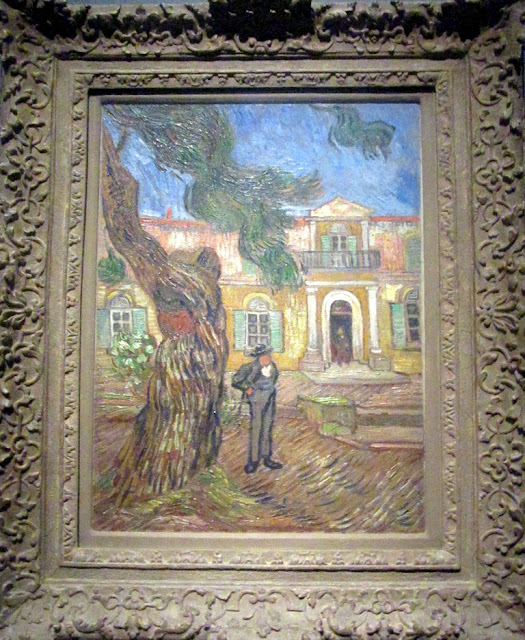
I love the way Van Gogh made his canvases dance with color, enhanced by spirited brushstrokes no one has since duplicated, and A Corner of the Asylum and the Garden with a Heavy, Sawed-Off Tree and especially Hospital at Saint-Remy rank with the greatest paintings I've ever seen, by anyone. (See below.)

And particularly in being a work on paper, Corridor in the Asylum is beguilingly fascinating.

All told, Van Gogh's Bedrooms has about 20 Grade "A" paintings by Vincent van Gogh, with a good handful being holdings of the Art Institute of Chicago. In my mind, simply one great Van Gogh is worth anyone's time and attention, but this isn't the most exhaustive of exhibitions.

And while I was ecstatic to spend a couple hours exploring it, as promoted around The Bedroom trilogy I'm not sure I'd recommend specific trips from New York, London, New Zealand or even Naperville, especially if one has seen any of the versions previously. (They're all brilliant, and wondrous to see together, but not all that different from one another.)

But it is all that is shown--in multiple contexts--beyond The Bedroom that makes this exhibition a dream come true, and a compelling testament to one of the most singular artists ever to have lived.

Vincent van Gogh, A Corner of the Asylum and the Garden with a Heavy, Sawed-Off Tree, 1889.
Museum Folkwang, Essen
Vincent van Gogh, Hospital at Saint-Remy, 1889. Hammer Museum, Los Angeles.
Vincent van Gogh, View of the Asylum with a Pine Tree, 1889. Musee d'Orsay, Paris.
Vincent van Gogh, Houses at Auvers, 1890. Toledo Museum of Art.
Vincent van Gogh, Entrance to the Public Gardens in Arles, 1888. The Phillips Collection, Washington, DC.