Showing posts with label Opera. Show all posts

Thursday, January 16, 2014

Superb Singing Makes for a Grand(age) 'Madama Butterfly' -- Chicago Opera Review

Opera Review

Madama Butterfly
by Giocomo Puccini
Original production direction by Michael Grandage
Revival direction by Louisa Muller
Lyric Opera of Chicago
Thru January 26
@@@@1/2

I think I like opera more the less I go.

About a decade ago, already an aficionado of musical theater, I decided to explore opera and eventually became a full season subscriber to the Lyric Opera of Chicago for 5 seasons.

While I saw, and enjoyed, many magnificent works and productions, I never came to “feel” opera on an emotional level like I do with the best of Broadway, rock 'n roll and jazz. But getting to 8 operas a season was also a bit much, both in terms of effort and experience, and I think it may have been somewhat counterproductive in acclimating to the operatic art form.

In more recent years, I've gone to an opera or two each season, typically picking more dilettante-friendly operas by the likes of Puccini, Mozart, Verdi and Richard Strauss, plus the Lyric's lavish stagings of musicals like Show Boat and Oklahoma.

On Tuesday night, for the first time in the Lyric's 2013-14 season, I went to such an opera: Puccini's Madama Butterfly. Although this was somewhat chosen for me—my friend Paolo bought tickets for us to go as a birthday present—and I had seen it twice before at the Lyric, my memory is such that it felt new and exciting.

And entirely lovely, if not exactly uplifting. But then, most operas—which often tend to be melodramatic—do not end on a happy note.

I am not enough of an opera buff to provide much of a critical assessment, and this one still didn't quite get me in the gut, but I enjoyed everything I saw and heard.

While even from the upper balcony, it was hard to perceive Patricia Racette as a teenage Japanese girl—i.e. the titular Butterfly—her singing was exquisite (flawless as far as I could tell, and per Paolo, better than the star who sang the role during the production's October run at Lyric), as was Stefano Secco as Pinkerton, the U.S. Navy officer who marries and then desserts her as she yearns for him with an unwavering yen.

Although the story is rather simple—and the basis for Broadway's Miss Saigon—I appreciate Madama Butterfly as being an ideal opera for novices, not just due to Giocomo Puccini's lush score, but because unlike other operas I've seen, the libretto by Giuseppe Giacosa and Luigi Illica isn't cluttered or complicated by too many characters.

The current Lyric production is based on one originally staged by noted British theatrical director MichaelGrandage for the Houston Grand Opera, and employs rather minimalistic scenery. Though devoid of the splendiferous spectacle of more lavish productions—even of Madama Butterfly, which I can't specifically recall but which Paolo scenically prefers—I liked how this staging echoed the sense of simplicity and serenity found in Japanese art.

At a couple of junctures, the pacing got a bit too slow for my tastes, and given the relatively small cast of characters, Madama Butterfly doesn't have many of the vibrant choral pieces that I particularly enjoy. Still a handful of collective songs were powerfully rousing and Racette's take on Butterfly's aria near the beginning of Act II—"Un Bel Di" = one beautiful day—was wondrous, along with much else.

As I intimated above, this shouldn't be mistaken for a scholarly or expert review, but it is a recommendation.

Whether you're an avowed opera lover, a complete beginner or, like me, a dabbler, this rendition of Madama Butterfly should delight your senses and further your appreciation of the art form.

And especially as there were more empty balcony seats than I ever recall at the Civic Opera House, especially for a Puccini opera, the Lyric needs to expand—and lower the average age—of its audience base.

So if you have ever thought it might be nice to take in an opera, there's no need to—à la Butterfly—continue to wait for your ship to come in. The 4 remaining performances of Madama Butterfly should provide the perfect opportunity.  

Thursday, February 23, 2012

'Show Boat' Rolls Along Splendidly in Opera Voyage -- Opera / Theater Review

Photo Credit: Alex Garcia / Chicago Tribune
Opera / Theater Review

Show Boat
Lyric Opera of Chicago
Thru March 17
@@@@1/2

Originally produced on Broadway in 1927 and oft cited as the show that redefined musical theater, Show Boat is the oldest of the great musicals I feel I should see--excluding the Gilbert & Sullivan works more commonly classified as light opera--and likely the most celebrated of those that, until Wednesday night, I never had.

Even without a point of comparison, the glorious new production by the Lyric Opera of Chicago, under the direction of renowned director Francesca Zambello, provided an undoubtedy robust introduction to the watershed work composed by Jerome Kern with book & lyrics by Oscar Hammerstein II (based on a novel by Edna Ferber).

In the Director's Note in the program, Zambello states that without Show Boat, which she dubs "the beginning of our musical theater history," we could not have "found a bridge from opera to our own American art form." She goes on to explain that she considers this production innovative for the way it marries "the worlds of opera singers, musical theater performers and dramatic actors."

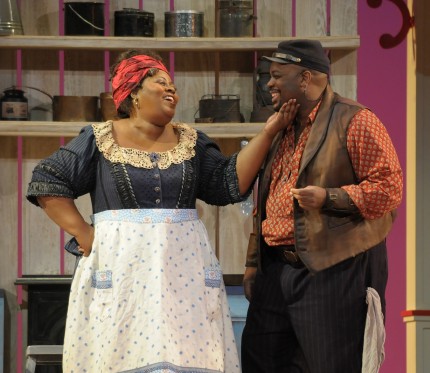
Noted opera baritone Nathan Gunn plays the male lead, Gaylord Ravenal, bass Morris Robinson is Joe--he does a fabulous rendition of "Old Man River"--soprano Alyson Cambridge is Julie and another soprano, Angela Renee Simpson plays Queenie. The female lead, Magnolia Hawks, is played by Ashley Brown, best known for playing Mary Poppins on Broadway (and in Chicago on the first national tour). She is joined by a number of performers I've often seen on Chicago theatrical stages, including Ross Lehman (Captain Andy), Cindy Gold (Parthy), Bernie Yvon (Frank) and Ericka Mac (Ellie May).

As I've explained in reviews of more traditional operas I've seen--such as this one; I've attended over 40--I very much appreciate and admire the art form, but have never come to love it or "feel it" the way I do with Broadway (or rock, for that matter). Thus, while respecting longtime Lyric patrons who may wonder why one of the world's most esteemed opera companies is presenting a "musical," I am far from a purist who disdains the notion and instead very much endorse it.

This was my first trip to the Civic Opera House this season and while realizing that there are many other venues around town where one can see musicals, yet only a very few that present opera, in the name of marketing the operatic form to a wider--and younger--audience, I would fully be in favor of expanding what gets presented as an "opera production."

It's hard to believe that it's been 10 years since I saw a wonderful production of Sondheim's Sweeney Todd at the Lyric and that Show Boat is the first true musical they've done since. (They did do Gilbert & Sullivan's Pirates of Penzance some years back.) Having just seen South Pacific last week as a touring Broadway production, that's just one of the obvious musicals ready for an opera production; I'd also strongly suggest the Lyric do Les Miserables.

That said, while it was largely inconsequential to my enjoyment of a well-staged (though the sets weren't quite astonishing), exquisitely costumed and wonderfully sung performance, it seemed slightly strange for many of the songs to be sung in operatic voices yet for others not to be--most notably Magnolia's numbers sung by Brown, who has a great voice but isn't an opera singer.

There's traditionally a difference between "opera singing" and "Broadway singing" and there's an argument to be made for either one holding forth when an opera company stages a Broadway show. But the hybrid, while never really unpleasant, just seemed a bit curious.

Nonetheless, unless you're an opera lover who only loves the classics by Mozart, Verdi, Puccini and the like, there's no reason not to take in this ebullient production of a legendary American creation--dealing with racial issues, including miscegenation, but also offering much literal and figurative bi-racial harmony, Show Boat was decades ahead of its time in many regards--and certainly shouldn't be missed if you're a musical theater lover.

I was going to say that tickets start at just $34 for weeknight performances, but the Lyric may be utilizing a dynamic pricing model as in checking on tickets for next Tuesday night, seats at the back of the upper balcony (for which I paid $34) now seem to be $54. (You can check tickets here; scroll to the bottom)

Photo Credit: Dan Rest
According to Wikipedia, Show Boat was last revived on Broadway in 1994, followed by a tour that landed at Chicago's Auditorium Theatre for an extended run in 1996. I wasn't as keyed into musicals at that point and didn't attend, but since becoming an ardent theatergoer in 2000, I haven't heretofore noticed any local opportunities to see the show, at any level. With a huge cast, lush orchestral score and the requirement of something approximating a riverboat, this can't be an easy or inexpensive show to produce.

All the more reason this unique production--with a full opera orchestra conducted by John DeMain and dozens of performers on stage combining to delight on the show's buoyant chorus numbers as well as beautiful ballads such as "Make Believe," "Can't Help Lovin' That Man" and "Bill"--shouldn't be missed as it rolls alongside the Chicago River. (Act II takes place mostly in Chicago and ends in 1927, which only adds to the charm of seeing Show Boat in the opera house, which was built just 2 years later.)

Tuesday, October 19, 2010

Sleek Scenery, Sexy Soprano Serve to Make Shakespearean Opera Sizzle -- Opera Review: Macbeth at Lyric Opera of Chicago

Opera Review

Macbeth
by Giuseppe Verdi
Lyric Opera of Chicago
Thru October 30, 2010
@@@@1/2

Shakespeare and opera are two art forms for which reverent appreciation has always outdistanced my acute enjoyment.

I have attended numerous performances of both, in attempts to indoctrinate myself, but to date had not rendered the previous statement untrue. Perhaps it is incumbent on me to do more homework ahead of time, but I've just never experienced the same kind of emotional connection to opera or Shakespeare as I regularly do upon viewing performances in rock, jazz, musical theater and other dramatic realms.

So although I still try to attend 1-2 operas per season at the Lyric, going to one based on a work of Shakespeare--and a play of his I've never read or seen at that--probably didn't seem like a great prescription for rapture.

But not only did I figure that seeing Macbeth as an opera would at least introduce me to a famous story I've never really known, the photos and clips I saw on the Lyric's website just looked really cool.

Photo Credit: Robert Kusel
As such, I got myself a typical nosebleed seat and went last night. And while still largely devoid of innate operatic devotion, I enjoyed Macbeth more than most operas I've experienced.

Directed by Barbara Gaines, the founder and artistic director of the Chicago Shakespeare Theater who was helming her first opera, the production's scenery was inspired by Frank Gehry's Pritzker Pavilion at Millennium Park.

I love Gehry's architecture and appreciated the stage interpretation. I don't have any other Macbeths to compare it too, but liked what I saw. It also didn't hurt that unlike the "fat ladies" long associated with opera, as Lady Macbeth German soprano Nadja Michael was also quite sleek and sexy, even as seen through binoculars from six stories up.

While I am not astute enough to intelligently evaluate the comparative vocal abilities of opera singers, I definitely had no complaints about anything I heard from Micheal, Thomas Hampson as Macbeth or anyone onstage. And Verdi's score seemed to keep me engaged a good bit more than most.

Photo Credit: Dan Rest
I recognize that Shakespeare's genius is as much, if not more, in his language as in his storylines, but often it is a bit dense for me. So I didn't mind my introduction to Macbeth being devoid of it, especially as the narrative was superior to most operatic plotlines.

Even as a basic outline for operatic purposes, the scenario Shakespeare penned over 400 years ago still has great relevance as a tale of one's lust for power, the extent he (and his wife) will go to realize it and the consequences (real & emotional) that accompany its attainment.

So even if I still wasn't entirely captivated emotionally by the music or singing, considerable entertainment, enjoyment and enlightenment conspired to make my night at the opera quite enriching, and my initial exploration of Shakespeare's Macbeth a royal success.