Showing posts with label Rock. Show all posts

Tuesday, April 25, 2017

Meet The Wildhearts, Possibly the Best Band You Don't Know (at least to my ears) -- Spotify Playlist included

I used to work in an office where the iTunes libraries of willing employees could be accessed by anyone on the network.

Given the breadth of my tastes--even simply within a mainstream rock vein--I usually found considerable musical congruency with my colleagues, but in any collection there were invariably numerous artists I'd never even heard of, let alone heard or knew well.

So while I often bemoan the seeming sparsity of new rock acts that excite me--which in itself may be a fallacy born simply from obliviousness--the truth seems to be that, for years on end, I could quite exuberantly discover and enjoy quality rock artists and albums that have long existed without my awareness and affinity.

In no way do I presume that "less famous" artists I cherish beyond The Beatles, Stones, Who, Led Zeppelin, Bruce Springsteen, U2, Pearl Jam and other somewhat ubiquitous--at least at one point--rock acts are better, or even more worthy of my attention, than those you cherish.

But my life has been greatly enriched by personal favorites beyond the famous to the point that in 2006 I created a 6-CD  Hidden in the Isles box set compilation of UK bands much bigger at home than they ever became in the U.S.

Some of my favorite acts--across the '60s, '70s, '80s, '90s and '00s--that I included were The Move, The Jam, The Undertones, The Waterboys, Blur, Ash, Stereophonics, Maxïmo Park and The Fratellis.

And with the caveat that levels of popularity or familiarity to others is always imprecise--thus I assume many music fans know some of these names, even if they never sold a ton of records--The Replacements, Dinosaur Jr., Bob Mould, Social Distortion, Jason & the Scorchers, Alejandro Escovedo, The Smoking Popes and Willie Nile are just a few of the great-if-not-huge American rock artists I've enjoyed, collected and seen numerous times over the years. (I also specifically appreciate being turned onto Australia's Hoodoo Gurus.)

Which brings me to the acute topic of this blog post: The Wildhearts.

There is still no musical artist I've discovered in the 21st century that I've liked more.

This doesn't mean they arose after 2000; they didn't.

The Wildhearts--see AllMusic.com and Wikipedia--formed in 1989 and released their debut album, Earth vs. The Wildhearts in 1993.

Many of their songs that I now love precede the turn of the century.

And whether from acts that debuted post-Y2K--Arcade Fire, Maximo Park, The Fratellis, The Killers, The White Stripes (their first album came out in 1999, but 2001's White Blood Cells really broke them) and even Coldplay--or that I loved long before this millennium--Springsteen, Green Day, Foo Fighters, Wilco, Radiohead--there has been "current" music put out that I've liked as much or more than The Wildhearts' 21st century output.

Having cited some of my favorite "under the radar" artists a few paragraphs up, I also wouldn't say The Wildhearts outrank any or all as "my favorite band you may not know"--with #1 being The Jam.

But I can tell you the very day I first came to know and love The Wildhearts:
March 26, 2004, when I ventured to Milwaukee's Eagles Ballroom to see the then-hot The Darkness and was so blown away by the unknown opening act that mid-set I made my way to the merch table to buy The Wildhearts' latest CD, Riff After Riff.
And with apologies to the similarly beloved Willie Nile--who I first came across in 2008 or so--there isn't any artist I've come to know since whose best work I like any more than that of The Wildhearts.

Now to some of you, this might sound vaguely familiar or even be old news.

As this blog attests, I am rather passionate about sharing my passions and though I haven't previously written a post specifically about The Wildhearts--they've only been sporadically active in recent years--I have included them in various lists (such as my most-read-ever The 100 Best Alternative Rock Bands of the Past 25 Years post from 2012). 

And after first coming to know of the Wildhearts, I bought whatever CDs were available in America (and more on trips to London), gathered much more of their output through peer-to-peer sites--I would've said Napster but 2004 seems late for that--and put together a compilation CD called Meet the Wildhearts that I shared with the few friends I thought might care.

If a "musical album" can merely be considered anything that fills up to 80 minutes on a compact disc, Meet the Wildhearts would still be my favorite album of the 21st century. That's how much I like their sound that I'd best describe as Cheap Trick meets Metallica, though without any such exactitude.

I included a Wildhearts song on my Hidden in the Isles box set--"29x the Pain," in which singer/songwriter/guitarist Ginger Wildheart cites a litany of his musical loves and influences, including The Replacements, Hüsker Dü, The Ramones, Cheap Trick, Jason & the Scorchers and many more--and have at least once sang the band's praises on Facebook.

But my fervor only recently became inflamed anew--as it does every few years--and I have a number of music-loving friends who perhaps have never heard me effuse about the Wildhearts.

So babble on, revisited.

While the best of the Wildhearts--beautifully melodic, often humorous, but with a thunderous edge--has never stopped thrilling me, some of their output can be too heavy and not melodic enough for my tastes. The bulk of new material since I became aware of the band's existence in 2004 hasn't delighted me like that which preceded it.

And while Ginger (born David Walls but known predominantly by his stage moniker) has remained rather prolific in releasing solo material, Wildhearts music and work with various projects such as Hey! Hello!, I've never been aware of The Wildhearts playing in Chicago. (After seeing them at the Eagles Ballroom with the Darkness, I made a point of catching them at Milwaukee Summerfest, but have never seen them nor noticed a reasonable opportunity since.)

Though they seem to have a devoted fan base, I don't believe The Wildhearts were ever all that popular in England, and their activity seems rather intermittent. (Ginger has long and openly battled depression, and I think had substance abuse issues in the past; three other band members have seemed fairly constant, but he's been the mainstay in some different lineups.)

Anyway, last year, via the power of YouTube, I noticed that The Wildhearts has played a brief run of shows in England, and they still sounded good. (Check out the clip below and simply search "Wildhearts 2016" to find more.)


And although when I looked in December, their Spotify representation was far from complete--prompting me to order 3 more CDs, including one from Japan--it now seems almost all their albums are on there.

So, except for a couple prime B-sides and outtakes--"Friend for Five Minutes," "The Bullshit Goes On"--I can now compile for you my original Meet the Wildhearts collection, plus almost a full album's worth of more great stuff.

Enjoy.

I know I will.
---

Meet the Wildhearts - a Spotify playlist compiled by Seth Arkin
Listen below or click here to find it on Spotify. (Or just search for "Meet the Wildhearts" on Spotify)

Sunday, July 19, 2015

My 100 All-Time Favorite Artists of Popular Music - 2015 Edition

A meaningless exercise, perhaps even for me.

For not only could the order of my favorite rock artists--as well as a few from blues, country and R&B genres, with eligibility including rap, pop, folk and funk, though not Broadway, classical or jazz--vary on a different day, let alone month or year, but at any point in time I might rather hear, or even see in concert, an artist nearer (or even beyond) the end of the list than ones closer to the top.

But having compiled such lists around this time in 2005 and 2010, even if largely just for my own point of reference I thought I'd put together a new ranking of my favorite artists.

To be clear, this list is based on my tastes, preferences and listening habits--undoubtedly influenced in part by acts I've seen live, perhaps repeatedly--and is not intended as a critical assessment of importance, impact, influence, originality or other barometers of artistic merit.

For example, I would stipulate the Beatles are the greatest and most important, popular music artist in history, but in terms of fervent, active fandom, I like, listen to and see Bruce Springsteen more. (Of course, The Beatles broke up before I was 2, so I couldn't see them live, though I have seen Paul McCartney and Ringo Starr several times.)

Unlike the 2005 & 2010 editions, I've decided to include bands and any solo acts or other bands that derived from them as a single entry. This gets a bit awkward in the case of, say, Peter Gabriel + Genesis but not Genesis led by or looping in Phil Collins, or in not including Led Zeppelin as a subset of The Yardbirds.

Like everything, it's imperfect, but who cares?

Again, this is a list of my 100 favorites, with another 25 cited, and is in no way exhaustive of every artist I like and/or admire, nor meant to disrespect anyone I didn't include.

While hoping some may enjoy reading though my selections, I firmly believe that the only such list that should really matter to you is your own.

So if you would have undeniably esteemed acts like The Stooges (+ Iggy Pop), Leonard Cohen, Otis Redding, The White Stripes, the Supremes, James Brown, Janis Joplin, Frank Zappa, Lynyrd Skynyrd, The Grateful Dead, Madonna, the Beastie Boys, Public Enemy, the Eagles, the Smiths, etc., etc., etc., in your top 100--or even top 10--by all means, make your own list and share it with me. (Of minor note, in 2012 I made a 100 Best Alternative Bands of the Last 25 Years list that was intended in a more universal critical vein, though was obviously based on my opinion and tastes as well.)

But with a few substantive changes since 2005 and 2010--the top 10 is shuffled, Arcade Fire came from nowhere to #34, System of a Down is newly ranked at #61, lesser-known personal favorites like the Stereophonics and the Wildhearts sank quite a bit, Liz Phair and the Flaming Lips dropped precipitously, Blur was absent in 2005, #58 in 2010 and #36 now, the Ramones remained at #15 from 5 years ago but were #44 in 2005, Jimi Hendrix climbed into the top 20, Elvis Presley rose from the dead--here are:

My 100 All-Time Favorite Artists of Popular Music
(All photos by Seth Arkin; please do not re-post without attribution)

1. Bruce Springsteen
2. The Beatles (+ solo, Wings)
3. Led Zeppelin (+ Robert Plant)
4. Nirvana
5. The Rolling Stones
6. The Who (+ Pete Townshend)
7. U2
8. R.E.M.
9. The Kinks (+ Ray Davies)
10. The Jam (+ Paul Weller)

11. Pearl Jam
12. The Smashing Pumpkins (+ Zwan, Billy Corgan)
13. David Bowie
14. The Clash
15. The Ramones
16. The Replacements (+ Paul Westerberg)
17. AC/DC
18. Tom Petty & the Heartbreakers
19. Cheap Trick
20. Jimi Hendrix

21. Rush
22. Midnight Oil
23. Radiohead
24. Bob Dylan
25. Foo Fighters
26. Dinosaur Jr.
27. Van Halen
28. Queen
29. Green Day
30. Bob Seger

31. Elvis Costello
32. Pink Floyd
33. Talking Heads (+ David Byrne)
34. Arcade Fire
35. Neil Young (+ CSNY, Buffalo Springfield)
36. Blur
37. Aerosmith
38. The Police (+ Sting)
39. Johnny Cash
40. Creedence Clearwater Revival (+ John Fogerty)

41. Stereophonics
42. Guns 'n' Roses
43. Hüsker Dü/Bob Mould/Sugar
44. Soundgarden
45. Willie Nile
46. The Wildhearts
47. The Killers
48. Wilco
49. Steely Dan
50. Simon & Garfunkel/Paul Simon

51. Elton John
52. Eric Clapton/Cream/Derek & the Dominoes/Yardbirds
53. Peter Gabriel/(early) Genesis
54. Billy Joel
55. Warren Zevon
56. The Zombies
57. The Cure
58. Stevie Wonder
59. Maxïmo Park
60. Garbage

61. System of a Down
62. Metallica
63. The Waterboys
64. Fleetwood Mac
65. Alejandro Escovedo
66. Van Morrison (+ Them)
67. Sex Pistols
68. The Doors
69. The Cars
70. Velvet Underground/Lou Reed

71. John Mellencamp
72. Depeche Mode
73. Nine Inch Nails
74. Elvis Presley
75. Red Hot Chili Peppers
76. The Beach Boys
77. The Byrds (+ Roger McGuinn)
78. Smoking Popes
79. Bob Marley
80. BoDeans

81. The Pretenders
82. Stevie Ray Vaughan
83. Buddy Guy
84. Prince
85. Santana
86. Blondie
87. Black Sabbath/Ozzy Osbourne
88. Chuck Berry
89. Buddy Holly
90. Coldplay

91. Supertramp
92. Manic Street Preachers
93. Steve Winwood (all incarnations)
94. Ash
95. Jane's Addiction
96. Oasis
97. Jason and the Scorchers
98. The Flaming Lips
99. Liz Phair
100. Sly and the Family Stone

The Next 25

Rage Against the Machine (+ Tom Morello)
Dire Straits
The Stooges (+ Iggy Pop)
Love
ZZ Top
Bad Religion
The Bangles
The Monkees
New Order/Joy Division
The Miracles/Smokey Robinson
The White Stripes
Def Leppard
The Pixies
The Eagles
Jackson Browne
Material Issue
Boston
Social Distortion
Alice Cooper
Buzzcocks
Leonard Cohen
Electric Light Orchestra
Rod Stewart/The Faces/Jeff Beck Group
The Smiths

Friday, August 08, 2014

Revitalized by the Resurrection of Death -- A Pioneering Punk Band, a Great Documentary and the Beauty of Life's Surprises

I am much more a fan of individuality and self-expression than I am conformity and conservatism.

I'm glad I never attended a school that required me to wear a uniform, and uncaring if my penchant for wearing black concert t-shirts well into my 40s gets me pegged as forever unhip (or worse).

But I have never felt inclined to get an earring (or any other piercings), a tattoo or even a haircut--or lack thereof--much different than all my other haircuts.

Aside from t-shirts, I have always been most comfortable in off-brand polos, jeans, khakis and shorts.

So even when music-centric style-distinguishers may have meant something, I never would have been described as New Wave, Metal, Goth, Punk, Grunge, Hip-Hop, Country or anything else, despite liking many of these genres and more.

In the early-90s, I lived in L.A. and worked at an advertising agency with a bunch of rather unique individuals, though none were really defined by their way of dress. 

An artist named Mark Vallen, who was about a decade or so older than me, had previously been a devout follower--and through his gift for illustration, a chronicler--of L.A.'s early punk scene, whose acts included the Germs, X, Fear, Deadbeats, Dickies, Weirdos, Circle Jerks, Black Flag and Perry Farrell, well before his Jane's Addiction days.

You can see many of Mark's punk portraits on his Art-for-a-Change website, which also features a terrific blog combining activism and art, often including powerful & poignant works by Vallen himself.

On his site, Mark writes of having "frequented the legendary Masque, L.A.'s infamous first punk club" (where he saw several of the aforementioned bands) and changing his appearance "almost daily, from mismatched thriftstore clothes and shaved head to black leather motorcycle jacket and modified mohawk haircut."

When I met him at the ad agency, he was significantly more sedate in his dress if not his passions. Already a fan of the "big" punk bands--Ramones, Clash, Sex Pistols--and fascinated by what I knew of the rise of punk and L.A.'s storied place in it, I was gifted a terrific mix tape by Mark (I wish I still had it) and asked him this question:
"Could I have gone to an early L.A. punk club looking essentially as I do now?"
(in 1991-92, as with 2014, meaning with a normal haircut, t-shirt, jeans, no piercings/tattoos)
Mark's answer was: "No."

Perhaps I could have paid my money and gotten in, but there was a strong likelihood that I would have been harassed, outcast, pushed around, beaten up and asked or encouraged to leave.

This didn't completely shock me, but I was, and remain, struck by the dichotomy that "the punks"--one of the most celebrated groups of non-conformists the world has ever seen--would essentially insist on conformity.

I couldn't help think about this story since becoming aware, just this past Wednesday, of the existence--circa 1973-1978--of a band that played music in the vein of the Ramones, Damned, Buzzcocks, Germs, Black Flag and other pioneer punk icons BEFORE any of those bands existed or at least recorded.

Comprised of three brothers from Detroit--David, Bobby and Dannis Hackney--the band was called Death.

As you can see by the accompanying photos, the brothers are African-American and didn't dress "punk." But perhaps that's because they preceded the term. 

Undoubtedly there are many great bands that I am oblivious to--particularly from they heyday of punk, when relatively few bands rose above the din and became known to the mainstream, even in retrospect.

My friend Dave, who went to college in So Cal in the late 70s, just cited some L.A. punk favorites I never knew: Alleycats, Plugz, Agent Orange, Suburban Lawns.

And though the vast musical knowledge of my friend Todd--who leads a band called Hop on Pop, which you can hear on Spotify--prompted me to join a Facebook group called What Are You Listening To?, largely because there's nothing I like more than learning of music I should know, he and other members post about so many artists unknown to me that it's hard to follow up on any.

But Wednesday, one of Todd's posts to What Are You Listening To? said simply this:

------------------------------------------------------------------
DEATH - FOR THE WHOLE WORLD TO SEE
FIVE FUCKING STARS!!! Kick your ASS!!!
That is all.
------------------------------------------------------------------

My attention caught, I noted that Comments cited and proclaimed a documentary titled A Band Called Death, which Todd echoed as being his initiation to the long-forgotten band. 

I started my exploration by looking up Death on AllMusic.com and learned that although their first album--...For the Whole World to See--was released in 2009, it consists of 7 songs recorded within a couple years of the band's formation in 1973.

Not finding the album on Spotify, I bought the MP3 version on Amazon.
Hearing the first song, "Keep on Knocking," was one of those "Holy Shit!" moments that, as a music lover, you live for.
Though not precisely, it sounded akin to the Ramones' first album--oft considered the first true punk record--or songs by the Buzzcocks or "New Rose" by the Damned. But seemingly, staggeringly, it pre-dates any of those.

Liking the rest of ...For the Whole World to See--though it includes a couple less thrashy tunes--I found that the A Band Called Death documentary (released in 2012 and more widely in 2013) is available via Netflix instant streaming.

So I watched it.

If you care, you deserve to have the same revelatory experience as I did, so I will reveal only that two of the three Hackney brothers are still alive, that they were well-aware and oft-reminded how abnormal it was for them to play hard-edged rock and not R&B, soul or other "black music" despite living in Motown, that their choice of band name was unpopular and detrimental to their career and that cited influences included the Beatles, Jimi Hendrix, The Who, Alice Cooper and Queen (with other proto-punk Detroit-area acts like The Stooges and MC5 unmentioned but quite possibly apt).

And that Death is now reborn.

Though the documentary directed by Mark Christopher Covino and Jeff Howlett is really terrific and certainly seems to have amplified the resurrection of Death, as the film depicts it was a series of odd coincidences--and a second generation of Hackney musicians--that brought Death back to life within the past 6 years.

Perhaps I should have heard of ...For the Whole World to See in 2009 when it supposedly got some good reviews, but thanks to Todd, I'm glad I have now. (I won't elaborate here, but for me such catalysts are prime examples of how the Internet and Facebook are supposed to abet one's existence.)

Having played it constantly, I can tell you that many of the tracks are excellent well beyond the novelty of discovery.

"Politicians in Their Eyes," which Death recorded in 1975 and wound up self-publishing as a 45 with "Keep on Knocking" on the B-side, shows that not only was the band stylistically ahead of its time, but that the Hackney brothers were writing strident condemnations of politics, war and other social  injustices well before Joe Strummer or Johnny Rotten started doing so.

I've now also bought the second album of old Death songs, 2011's Spiritual / Mental / Physical--it too is good, but in a more-of-what-made-the-first-one-great vein--and I expect I'll soon feel compelled to do likewise with III, released earlier this year.

Though I'll never stop hoping to hear new music that really gets me excited, the truth is that anything old that you don't know can seem entirely new. In that vein, in just a matter of days, the music of Death--plus their story and entire existence--has brought me considerable joy on multiple levels.

Even if this sounds a whole lot like the story of another lost-to-history Detroit musician as told in another 2012 documentary--one that got a lot more attention and an Academy Award--I assure you that though Rodriguez and Searching for Sugar Man are extraordinary and heart-warming in their own right, A Band Called Death is just as incredible. 

And a remarkable reminder that many of the most amazing and rewarding people, places, things, etc., that we can come across are those that don't conform to the expectations of others. Or even ourselves.  

Who knew Death could be so life-affirming?

---
The following articles on Death may also be of interest, but I suggest seeing the movie first:
New York Times (2009)   |    Movie Review on RogerEbert.com (not by Roger)   |   Wikipedia

And here's a YouTube audio-only clip of "Keep on Knocking":

Sunday, May 06, 2012

The Best Debut Albums in Rock History (as posted on Pinterest and inspired in part by Twitter)

Click the image above to see my Pinterest board of the Best Rock Debut Albums
This year's Rock and Roll Hall of Fame induction ceremony was held last month in Cleveland and broadcast last night on HBO.

Inductees included Guns 'n Roses, Red Hot Chili Peppers and Beastie Boys. (You may wish to read this piece I wrote about Rock Hall omissions as well as one I'll soon post on the passing of Adam Yauch of the Beastie Boys.)

Green Day did the honor of inducting Guns 'n Roses, who sounded great on "Sweet Child o' Mine" and "Paradise City" in spite of Axl Rose's silly decision to avoid the ceremony; Izzy Stradlin was also not present. In doing so, Green Day's Billie Joe Armstrong cited GNR's Appetite For Destruction as the best debut album ever.

Although I don't find the proclamation that outrageous, my friend Dave and I instantly started discussing other debuts that might outrank Appetite. Subsequently I noticed the topic being hashed about on Twitter (#GreatestDebutAlbum), led by a Billboard editor named Bill Werde.

This morning I posted several of my Best Rock Debut Album choices on a Pinterest board I created. I recently started using Pinterest to gain some awareness of it--you can see all the boards I've made to date--but I wish there was greater functionality beyond simply, as I understand it so far, pinning photos of things you like (or within a given topic) to an online bulletin board.

For instance, in this category I would have wanted to reorder and possibly rank the album cover images, but I can't. So even the photo above is fictitious. The debut albums that first came to mind are really at the bottom of my board, not the top.

But the Pinterest board now includes 52 of what I consider to be the best first albums in rock history. A full deck, so to speak, compiled with the help of Dave, Twitter and some lists I came across on NME, Rolling Stone and Amazon. 

For the most part, these represent my tastes, and thus are mostly in a classic and modern rock vein. The Twitter discussion included some wider-ranging nominations; I'm not suggesting these don't have merit but didn't want to include albums I've never really listened to, except in a few cases where I accept Dave's commendations.

Take a look and let me know what you might include, instead of or in addition to my choices.

Like with any sort of list I make, there were a number of mental gray areas. I didn't overlook, but consciously left off, debut albums from favorite artists such as Bruce Springsteen, U2, Nirvana, Radiohead, The Kinks and others because while they each had moments of greatness, the first releases from these acts were considerably lesser than what came later--and in many cases were not breakthrough albums. But though perhaps the same could be said about The Beatles' Please Please Me and The Jam's In The City, I deemed those worthy of inclusion.

While I ignored preceding EPs, I did mandate that only true debut albums be considered, not simply the first album that got an artist noticed. Elton John released an album before the great self-titled one; Green Day had two before Dookie; Jane's Addiction had a small-label, self-titled debut before Nothing's Shocking, etc. Personal favorites such as Smoking Popes and Ash also had albums before the first ones I came to know and love. (I used AllMusic.com and Wikipedia as my discography sources.)

In a similar vein, I didn't count solo debuts if the artist was previously in a substantive group. Thus no Peter Gabriel, Neil Young, Paul Simon, Paul McCartney, John Lennon, George Harrison, etc. (plus, some of these legends released lesser solo albums before their first highly acclaimed one). I considered including Michael Jackson's Off the Wall, but this reasoning would seemingly disqualify it.

In considering the greatness of a debut album, it also gets a bit tricky as to whether one should merely weigh the merits of the record against all rock albums or more so consider how strongly it stands within the context of the artist's work.

For example, although The Clash as a group outranks both Van Halen and Guns 'n Roses on my list of all-time favorite artists, and The Clash is a fantastic debut, it's not my favorite Clash album--London Calling is. Yet Van Halen and Appetite for Destruction are clearly my favorite albums by two bands I love. I think they're more accomplished and definitive debuts, though not necessarily better albums than The Clash.

I'd also have a hard time arguing that The Doors isn't filled with stronger music beginning to end than Liz Phair's Exile in Guyville, but--and its timing in my life abets this--I think of the latter as a more audacious initial artistic statement. Odd as it sounds, I perceive a difference between "the best albums that happen to be debuts" and the "best debut albums." (I struggle with similar logic in considering Nirvana's Nevermind--not their debut, Bleach was--their sole representation among the 10 Best Albums of All-Time, even though I actually believe In Utero to be greater artistically.)

With all that said, while referencing you to the 52 Best Rock Debut Albums I've pinned on Pinterest, here are:

My 10 Favorite Debut Albums in Rock History

10. Sex Pistols - Never Mind the Bollocks
9. The Beatles - Please Please Me
8. R.E.M. - Murmur
7. Pearl Jam - Ten
6. The Clash - The Clash
5. Guns 'n Roses - Appetite for Destruction
4. Led Zeppelin - Led Zeppelin
3. Van Halen - Van Halen
2. Jimi Hendrix Experience - Are You Experienced?
1. The Ramones - The Ramones

Tuesday, March 06, 2012

With Powerfully Targeted 'Wrecking Ball,' The Boss Employs Constructive Force -- Album Review: Bruce Springsteen

Album Review

Bruce Springsteen
Wrecking Ball
@@@@1/2

Even without considering the plethora of rock critics--and those of us that like to pretend--who will weigh in on Bruce Springsteen's new album, Wrecking Ball, most through outlets with viewership that dwarfs mine, I realize the inconsequence of my writing this review.

39 years after the release of his debut, Greetings from Asbury Park, N.J., "The Boss" isn't exactly an unknown entity. He's one of the most legendary of living rock stars, and into his 60s, remains one of the most active.

Wrecking Ball stands as his 6th album of new material to be released in the past 10 years, which has also brought multiple tours, live albums & DVDs, celebrated reissues of his two best albums--Born to Run and Darkness on the Edge of Town--and considerable unearthing of previously unreleased material, including The Promise, which hit stores in 2010 but was originally slated to come between BTR and Darkness.

So if you wanted to explore Springsteen's oeuvre, old or new, or even better, his legendary live shows with the E Street Band, it's not like you haven't had ample opportunity. And if you've chosen to consciously avoid him, you're not likely to suddenly see the light this far down the road.

Thus, as Wrecking Ball comes out today after considerable hype and ample opportunities to have already heard all the songs online--you can even stream the whole album at BruceSpringsteen.net through day's end--I am guessing most people fall into one of four camps.
1) Faithful Springsteen fanatics, of which there are still many, who will buy the album regardless what anyone else thinks and explore its songs until their merits are readily apparent

2) Casual Springsteen fans who will likely ignore or dismiss the album because there is nothing--except possibly "We Take Care of Our Own"--that clearly echoes the classic sounds of "Born to Run," "Badlands," "Cadillac Ranch" or "Born in the USA." This camp might also include some who like Bruce but disdain him railing against the devastating malfeasance of greedy bankers.

3) Those who avowedly dislike Bruce and have already decided the new album must suck.

4) Anyone oblivious to Springsteen and his music. 
Admittedly part of the first camp, I think Wrecking Ball is really good but can't envision anything I say will motivate anyone not already so inclined to buy it. Even though I wouldn't call it a radical departure, with traces to past songs that a diehard will discern, it doesn't really sound, in full, like any previous Springsteen album. This is, perhaps a bit deceptively, one of Bruce's great strengths; rather than try to recreate past glories, he consistently ventures in new directions. 

Other than "We Take Care of Our Own," there are probably no songs here that I would include in a comprehensive 25-track Springsteen compilation playlist, and even my 2000-2012 Boss playlist would be heavier with songs from The Rising and Magic. Which is to say that even if rock music still spawned radio hits, Wrecking Ball isn't chock full of obvious singles. And yet...
There is nothing on it that I don't like, much that I do, and I appreciate the statement Bruce is trying to make.
After four decades of mining his considerable talent and delighting huge crowds around the world, Bruce himself is obviously part of the 1%. He is aware of this and at a recent press conference, when asked about the burdens of the economic crisis, he knowingly joked, "I’m terribly burdened, and at night when I’m sleeping in my big house, it’s killing me."

But unlike some detractors--such as former Chicago Sun-Times rock critic Jim DeRogatis, who penned this harsh review--I don't feel that Springsteen's wealth or not-inconsequential ticket prices (though I'd argue they are consistently lower than comparable acts) disqualifies him from earnestly offering commentary such as:
Gambling man rolls the dice, workingman pays the bill
It’s still fat and easy up on banker’s hill
Up on banker’s hill, the party’s going strong
Down here below we’re shackled and drawn
In fact, I think Springsteen's success and stature only add to the power of his venom. The uber-wealthy can dismiss the Occupy protesters as jealous whiners, but when Warren Buffett says the rich are undertaxed, the resonance is harder to ignore. Say what you want about his potency, but Bruce is rallying against his own financial interests, rendering his social commentary--in my eyes at least--legitimate and laudable.

Though there has always been a workingman, Main Street bent to his work, in becoming demonstrably anti-Bush, pro-Obama in the past decade, Bruce has clearly cost himself some fans. So I see this album as a continuation of his empathetic, liberal tendencies and neither crassly opportunist nor disingenuous. And given my constant whining about the dearth of socially commentative artistry, even at risk of seeming a sycophant to some, I'm going to cheer when--perhaps not coincidentally--my hero swings his mighty axe at Wall Street transgressors and empathizes with the "Jack of All Trades" who must constantly adapt just to survive.

No, this isn't a punk album with withering musicality to match the message, but not so unlike The Clash's London Calling--without scaling quite the same heights--Wrecking Ball appeals as a album to be heard in full, elevated as a whole by the stylistic diversity yet thematic kinship of the songs.

"We Take Care of Our Own" sounds a bit reminiscent of "Badlands," but actually reminds more of "Born in the U.S.A." as its anthemic chorus is actually a tease, inverted by the angry verses that take America very much to task.

"Easy Money," "Shackled and Drawn" and "Death to My Hometown" are folky stomps likely derived from Springsteen's Seeger Sessions forays, but though the latter seemingly alludes to "My Hometown" of Born in the U.S.A., musically "Jack of All Trades" is much more similar, with guest guitarist and fellow megastar-cum-rebel Tom Morello raging in a more low-key fashion than typical.

On "Death to My Hometown," of which I'll include a clip at bottom, Bruce is at his most lyrically strident, slyly suggesting an insurgency against those who wreaked havoc on the world. 
Sing it hard and sing it well
Send the robber barons straight to hell
The greedy thieves who came around
And ate the flesh of everything they found
Whose crimes have gone unpunished now
Who walk the streets as free men now

They brought death to our hometown...
Nicely juxtaposed amidst the tales of social injustice, "You've Got It" is a charmingly simple love song while "This Depression" openly expresses the need for emotional sustenance amidst tough times. And though Bruce and the band have been playing "Land of Hope and Dreams" live since 1999, the initial studio version fits in well here and provides a great opportunity to hear the late Clarence Clemons wailing away on his saxophone for the last time.

For those of us who listen to our Boss rather intently, it's also interesting to note how album closer "We Are Alive" answers the question "Is there anybody alive out there?"--posed in "Radio Nowhere," which opened 2007's Magic, and exhorted by Bruce in almost every concert since--with an emphatic, if a tad wearisome, "Yes."

Although the rest of the E Street Band only shows up sporadically on the album--whose liner notes are highlighted by a touching tribute from Bruce to Clarence, taken from his eulogy and ending with "Clarence doesn't leave the E Street Band when he dies. He leaves when we die."--several of the songs should transition well to the concert stage. Though I won't say at this point that I would rather hear any of these tunes than "Backstreets," "Jungleland" or "Rosalita," I would also be disappointed if several of them aren't sprinkled into the setlists, and wouldn't mind the inclusion of any of Wrecking Ball's 11 songs.

So take this review for what it's worth; I'm such a Springsteen fan that I am uncertain of my own objectivity. But whereas I felt his last album, Working on a Dream, was subpar (though not awful) and several of his recent releases have been overrated by Rolling Stone--including probably this one, which they gave 5 stars--this is a quality work by a great artist. I was wavering between awarding @@@@ and @@@@1/2, but this feels like an album that should only grow with time.

As I end with a clip of a performance of "Death to My Hometown" by Bruce and the E Street Band--joined by Morello--on Late Night with Jimmy Fallon, I thought I would throw out that few rock artists have ever been as prolific and productive as Springsteen past age 50. It seems one could only argue Bob Dylan, Neil Young, Paul McCartney and Leonard Cohen as having anywhere near Bruce's output this late in their careers. Wrecking Ball only adds to his legacy--he was inducted in the Rock 'n' Roll Hall of Fame in 1999--and though you probably made your mind up long ago one way or the other, I really think you will enjoy it.


Tuesday, February 14, 2012

No Lie, The New (Old) Van Halen Album Is Surprisingly Good -- Album Review: Van Halen - A Different Kind of Truth

Album Review

Van Halen
A Different Kind of Truth
@@@@

If the Grammy Awards were to add a category recognizing the "Most Surprisingly Stellar Album," Van Halen's A Different Kind of Truth would seem to be a shoo-in next February.

Although I am an avid fan of the music the band originally made with David Lee Roth as its lead singer--I also liked the early "Van Hagar" years--and was delighted by the hits-laden reunion shows with Roth (but sans bassist Michael Anthony) in 2007-08, when I heard that they were releasing a new album I presumed it would be a train wreck, and that was before I saw the album cover.

Van Halen, in any incarnation, has not released great new music since at least 1991, and that's probably being generous by a few years. Roth left the band after 1984--both the year and album of the same name--and even in the heyday was always more of a charismatic cad than a traditionally gifted singer or lyricist. While Eddie Van Halen still had lightning in his fingers on the last tour, I wasn't expecting him, at 57, to rediscover any great inspiration as a composer.

And in fact, the first thing I read about A Different Kind of Truth was that several songs recycled old demos that preceded the first (self-titled) Van Halen album in 1978. This also didn't stir great expectations.

Of course, I still fully intended to get the album upon its release. (It came out last week.)

But I suspected I would hear hokey-jokey, half-sung lyrics over humdrum Van Halen music, without even the lift Michael Anthony's backing vocals used to provide, as he is seemingly still banished from Eddie's good graces and supplanted by Eddie's (and Valerie Bertinelli's) son Wolfgang. For those not up on Van Halen, Eddie's brother, Alex Van Halen, rounds out the foursome on drums, as he always has.

In many regards, my suspicions about A Different Kind of Truth have proven true. There are no particularly catchy guitar riffs or hooks. None of the songs rank with their best hits of old, at least in terms of being radio friendly. "Runnin' With the Devil," "Ain't Talkin' 'Bout Love," "Dance the Night Away," "And The Cradle Will Rock," "Unchained," "Jump" and "Panama" all outshine anything you'll hear here.

And while DLR proves to be a lech with a gift for creating--and/or borrowing--such witticisms as "mousewife to momshell," "suburban garage-a-tois" and "my karma just ran over your dogma," other than espousing his support for unions--albeit amidst the otherwise banal but relatively catchy first single "Tattoo"--he, not surprisingly, never really says much of substance.

Yet much to my surprise, the album works. Though lacking any tunes that truly rise above the rest, all 13 of the songs rock really hard and Eddie's guitar work is quite simply dazzling. I recently reminded myself how solid the early VH records were from top-to-bottom, and while lacking any ear candy hits, the new work is chock full of strong "album cuts." Most of the songs feature a guitar solo that kind of just shows up, blows your mind and reminds you that this guy pretty much reinvented how the instrument can be played.

In fact, I interpret the album's third cut "You and Your Blues"--with lyrics such as "ain't goin' down to the crossroads"--as Eddie's rebuttal to Page, Beck, Clapton and all the blues-based players he was probably compared to coming up. Either he's chiding them--through Roth--for aping Albert King, Buddy Guy, et al or simply saying that he was otherwise inspired. But there's no denying Eddie Van Halen created a sound all his own, and his playing sounds glorious here.

Not shockingly, it drives much that sparkles about the new album. The lyrics of "China Town" aren't much, but the music--including Alex and Wolfie rather notably--is propulsive. Although Roth isn't bad on this album--he's solid vocally and a good foil for Eddie--many of the songs find me waiting for him to shut up and give way to the Van Halen boys. For example "Stay Frosty" starts as a quirky allusion to "Ice Cream Man," with Roth showcasing the goofy charm that Hagar never could match, but the song really goes into overdrive when he stops singing.

While I don't expect A Different Kind of Truth to stand as my "Album of the Year," it's certainly been a surprise treat in just a week of listening. No, there isn't much here I truly hope to hear in concert, but I also wouldn't dread any 3 or 4 tracks making the setlist when I see Van Halen on April 1 at Allstate Arena (they're also playing the United Center on Feb. 24).

In several ways, VH's return to form reminds me of AC/DC's Black Ice a few years back (even the cover art locomotive evokes AC/DC "Rock and Roll Train" concert imagery). It won't go down as the best album in the storied career of a classic hard rock band, but it's plenty good enough to remind you why they were--and even still are--so great.

Sunday, January 08, 2012

[ Re-Post ] Of Heroes, Fame, Changes, Modern Love and Aladdinsanity -- Celebrating the Brilliance of David Bowie on His 65th Birthday

(Originally written and posted on 1/8/11, when he turned 64. Revised only per his age.)

As far as rock 'n roll birthdays go, January 8 is much more famous for being that of Elvis Presley, in 1935. But 12 years later, a baby christened David Robert Jones was born in London.

While I consider myself an Elvis fan--if not quite a fanatic--and appreciate his immense impact on music, culture and celebrity, the man who would in 1967 rename himself David Bowie (so as to avoid confusion with The Monkees' Davy Jones) has been much more significant to me.

And while he has not recorded or toured since having heart surgery in 2004, David Bowie remains alive, seemingly well and quite vital.

I first "got into" Bowie in the early '80s, before the Let's Dance phenomenon, probably based on hearing "Rebel Rebel," "Space Oddity," "Changes" and "Suffragette City" on rock radio stations like The Loop in Chicago. But I am living proof that it is possible to have been a big fan of David Bowie for a long time without really having a clue as to the depth and breadth of his brilliance.

The first album of his I bought was ChangesOneBowie, and to this day it probably remains the Greatest Hits collection (of anyone) for which I have the most affection. The CD version--which has since been supplanted by other compilations--was expanded and dubbed ChangesBowie, but the original record I had contained the following tracks:

1. Space Oddity 2. John, I'm Only Dancing 3. Changes 4. Ziggy Stardust 5. Suffragette City 6. Jean Genie 7. Diamond Dogs 8. Rebel Rebel 9. Young Americans 10. Fame 11. Golden Years

I imagine that even for passing Bowie fans, this seems like a pretty stalwart collection of songs. Add to it my instant fondness for 1983's Let's Dance album when it was released--along with four excellent songs, including the title track, "Modern Love," "China Girl" and "Cat People (Putting Out Fire)," the record introduced me to Stevie Ray Vaughan, who played guitar on it--and reaching back to discover his remarkable Ziggy Stardust album, I had a rather substantive appreciation for David Bowie by the time I was 15.

Or so I thought.

Yes, the July 1983 Time cover story drew my attention to Bowie's chameleon-like stylistic changes throughout the '70s. Sure, I came to know a number of other songs, such as "Heroes," "Ashes to Ashes," "Panic in Detroit" and "Under Pressure," his outstanding collaboration with Queen. And, after being a smidgen too young to attend the Let's Dance Tour, I saw Bowie for the first time on May 26, 1990 at Dodger Stadium, soon after my relocation to L.A.

But it wasn't until years later, likely revolving around the next time I saw Bowie in January 2004--I attended 2 of his 3 shows at the Rosemont Theater plus one a few months later in Milwaukee--that I decided to delve a good bit deeper into Bowie's oeuvre.

And I continue to dig until this day. Somewhat similar to explorations of The Kinks prior and Steely Dan since, I came to realize that Bowie's greatness goes exponentially beyond his greatest hits. And in saying this, I'm not even alluding to how he introduced the idea of a rock star adopting an alternate persona, how his ever-changing fashion stylings presaged the MTV-era or how he rather successfully transitioned into acting. I'm really only referencing his music itself. 

Back when CDs were still the norm--at least apart from illegal downloads--I bought nearly all of Bowie's back catalog and came to hear many of his albums in full for the first time. To give you a sense of the stature of his output from 1970-1980, AllMusic.com awards 5 or 4-1/2 stars to nine studio albums during that span, and two "lesser lights," Diamond Dogs and Young Americans, also have a number of superb songs.

So that's eleven substantive releases in the same number of years, and almost all of his material is so good it's hard to cite my favorite albums. The early output, including Hunky Dory, Ziggy and Aladdin Sane is sensational. I can't argue with anyone who cites 1976's Station to Station as his best record. And his German "triptych" recorded with Brian Eno in Berlin--Low, Heroes and Lodger--are just as rewarding as his more accessible albums. A friend of mine picks 1980's Scary Monsters as his favorite.

And though Bowie's output slid after Let's Dance--some would say with--I really liked both 2002's Heathen and 2003's Reality. So while it certainly wouldn't be wrong to start any exploration with a greatest hits compilation--the 2-disc Best of Bowie seems fairly comprehensive--realize, like I did way down the line, far past his 1996 Hall of Fame induction, that Bowie's legacy goes way beyond the rather remarkable surface.

No wonder my Bowie collection imported into iTunes would keep me audibly occupied for nearly a full day. And although I initially intended to accompany this post with 10 videos mixing more popular songs with some lesser-known gems, I couldn't help but go to 15, and could easily pick a completely different selection every bit as good.

So in response to The Beatles' legendary query, "Will you still need me ... when I'm 64?", my answer when it comes to David Bowie, is a resounding, "Yes." (And even 65, as I thought I should re-post this today.)

Happy Birthday, Mr. Bowie.

To celebrate, I give the rest of you 15 choice cuts from throughout his career, with a compilation video at the very bottom that allows you to run all the songs in sequence. (I put the videos below a "continuation jump" so click below left to see them if you can't.)

Wednesday, December 28, 2011

The Best of 2011: The Best Albums I Heard

As I recently posted, I attended many tremendous concerts in 2011. Coming soon, I'll also post about the best musicals I saw, several of which were similarly outstanding.

So I can't say that this was truly a bad year for music, at least on a personal level. But in the realm of recorded music, especially in the rock genre, 2011 was far from a watershed year. 

This is in stark contrast to 1991. As commemorated by several anniversary re-releases, 20 years ago there was an avalanche of great, even groundbreaking albums.

Many have become such classics that it's unnecessary to cite the artist when mentioning works like Nevermind, Ten, Achtung Baby, Out of Time, Badmotorfinger, Use Your Illusion and Blood Sugar Sex Magik.

1991 also brought Metallica's biggest (and possibly best) album, debuts from The Smashing Pumpkins and Blur, swan songs from Queen and the Pixies, personal favorites from Dinosaur Jr. and Material Issue and key era and/or career-defining works by My Bloody Valentine, Matthew Sweet, Spin Doctors, Primal Scream, Jesus Jones, Fishbone and Teenage Fanclub. I won't pretend that rap has ever done much for me, but should recognize Ice-T, P.M. Dawn and Public Enemy as also having important releases in 1991. Even Michael Jackson and Prince put out albums that some consider their last true vestiges of greatness. And though I avoided it, Garth Brooks' Ropin the Wind was the year's top seller.

2011 has Adele.

Sure, I'll manage--after much exploration in recent weeks--to give you a Top 10 list plus several other albums I've liked from this year. But right now, the only one I'm perceiving as a classic is Adele's 21. Though not exactly in my wheelhouse--and as a consequence, I came to the Adele party way late--it is clearly the best album I've heard this year.

You might find it hard to believe--I do, as 21 is the best selling album in many a year and spawned two giant hits--but I hadn't knowingly heard an Adele song until this month. But now that I "get it," even well beyond chanteuses who have had breakthrough success in recent years--Dido, Duffy, Norah Jones, the late Amy Winehouse--I perceive Adele as a transcendent vocal talent, possibly along such exalted lines as Billie Holiday and Judy Garland and Barbra Streisand. And she's still only 23, so hopefully her voice can fully recover from recent throat surgery, enabling her career to further evolve & flourish.

With all due respect to still-great rock bands like Wilco, Foo Fighters and the now retired R.E.M., no rock artist put out an album in 2011 that showcased comparable greatness. Sure, it's a different world now, ruled not only by Adele but women like Taylor Swift, Lady Gaga, Katy Perry, Beyonce and Rihanna, but if guitar-driven rock wants to remain a relevant musical form, somebody soon is gonna have to blow my mind like it's 1991 again.

But just because 2011 seemingly wasn't a classic year for rock albums--and admittedly, this list represents my tastes, which is why you won't find the Jay-Z/Kanye West collaboration or some other highly regarded releases in various realms--doesn't mean there wasn't some good stuff. I very much enjoy & recommend the albums below and hopefully some will continue to grow on me. Though after the top slot, the order in which these are ranked is largely inconsequential.

The Best Albums of 2011 

1. Adele – 21

2. Foo Fighters – Wasting Light

3. The Nightwatchman – World Wide Rebel Songs

4. Wild Flag - Wild Flag

5. Wilco – The Whole Love

6. Willie Nile – The Innocent Ones

7. The Black Keys – El Camino

8. The Decemberists – The King is Dead

9. Red Hot Chili Peppers – I’m With You

10.  Florence & the Machine - Ceremonials


Honorable Mention 

Lindsey Buckingham – Seeds We Sow

Fleet Foxes – Helplessness Blues

Smoking Popes – This Is Only A Test

R.E.M. – Collapse Into Now

Smith Westerns – Dye It Blonde

The Cars – Move Like This

Yuck - Yuck

My Morning Jacket – Circuital 

The Bangles – Sweetheart of the Sun 

Paul Simon – So Beautiful or So What

Radiohead - The King of Limbs

Friday, September 02, 2011

Videos of My 11 Favorite Pearl Jam Songs -- Now on Booth Reviews

On Sunday, I'm heading up to Alpine Valley to see Pearl Jam as they celebrate their 20th anniversary with the "destination weekend." I wrote a bit about the fest and the band on Booth Reviews, accompanied by videos of my 11 favorite Pearl Jam songs. You can access the post by clicking here or on the image below.


Sunday, August 28, 2011

For Your Reading and Listening Pleasure: The 11 Most Essential Rock 'n' Roll Albums -- Now on Booth Reviews

After a bit of a hiatus from posting Top 11 lists on the Booth Reviews blog on ChicagoNow.com, I have put up a new post positing the 11 rock albums I consider most essential in starting a music collection (and I even cited the next 11). Click here or on the image to access it.


Sunday, June 05, 2011

Rock, American Style -- My Top 11 Stateside Bands of the 1960s, Now on Booth Reviews

Click here or on the image to see my selections.

Wednesday, April 20, 2011

Foo For The Soul: 'Wasting Light' Burns Bright, Even If Its Permanence Remains to Be Seen -- Album Review

Album Review

Foo Fighters
Wasting Light
@@@@

I have loved Foo Fighters since I first heard the first song ("This Is A Call") on their first album--actually a Dave Grohl solo project, as he played all the instruments--back in 1995.

Since then, I have bought every album they've released and seen them live numerous times. They are easily among the Top 10 concert acts I've ever seen and stand--along with Pearl Jam, Green Day and R.E.M.--as one of the last of the great American rock bands (at least among those of considerable stature, longevity and ongoing activity).

Like those other three bands, over the years they have released more than enough stellar songs to fill satisfying concert setlists and compilation discs (and/or iPod playlists), and have never put out any albums that I haven't found at least worthwhile--and better than much else that crosses my earwaves. But also similarly, much of the Foos' recorded output has somewhat blended together in my memory.

Foo Fighters "Live On Letterman" dressed as The Beatles;
see full-length concert performance here
To wit, Grohl and his now mostly static-for-some-time bandmates have put out seven studio albums, but except for the first two and the new one--which I've been playing frequently over the past week--I would be hard pressed to tell you which songs were on which record. 2002's One By One, 2005's In Your Honor and 2007's Echoes, Silence, Patience & Grace have all been solid, or even good, but not spectacular to the point of standing out from one another.

Released in the U.S. on Tuesday, April 12, Wasting Light has gone straight to #1 on the Billboard album chart--a Foo Fighters first in America; the album also hit #1 in 11 other countries and no less a source than the BBC calls them Britain's Favourite Rock Band--and has been accompanied by many highly laudatory reviews.

Adding it to my collection was a no-brainer, but after the first few listens, I wasn't sure it was really anything special, relatively speaking. But its depth and quality have quickly grown on me. While I can't be certain that I will care too much about the entire record a few years from now, and don't think it quite rivals Foo Fighters or The Colour and The Shape, at this point I enjoy it as much as any of their albums since those first two.

More powerfully enjoyable than groundbreakingly brilliant--a good summation of the band overall--Wasting Light is infused with (per David Fricke's likewise 4 out of 5 review in Rolling Stone) more overt references to Nirvana and Kurt Cobain's suicide than Grohl has heretofore surfaced. (I doubt anyone reading this doesn't already know, but Grohl was the drummer in Nirvana before revealing his skills as a singer/songwriter/guitarist with Foo Fighters.)

This provides a depth of emotion that sometimes seems a bit lacking in the Foos arena-rock sound, and though new songs like "Arlandia" and "Back and Forth" are still a good bit glossier than early screamers "I'll Stick Around" and "Monkey Wrench," one senses a bit more of Grohl's heart & soul blasting through than has been consistently apparent over the past decade. And knowing "I Should Have Known" is unabashedly about Cobain--and features Krist Novoselic on bass--gives it a resonance even more powerful than the song itself.

While lead single "Rope" doesn't elevate much over other recent Foo singles like "The Pretender" or "Wheels," it is one of at least 7 songs on Wasting Light--of 11 total--that I would classify as very good or better, with even the filler fulfillingly solid. Bob Mould's guest spot on "Dear Rosemary" is a highlight and "Bridge Burning" and "Walk," respectively, open and close the set in strong fashion.

Although Foo Fighters and producer Butch Vig--he of Nevermind fame--haven't created a classic anywhere near the level of that Nirvana masterpiece, or even their own initial CDs, they've nonetheless put together a thoroughly engaging album that should rank as one of the year's best, sound great in concert and hopefully grow even more memorable over time.

To paraphrase AC/DC, for those who always rock, I salute Foo.

(Below is a video of Foo Fighters playing their new album, Wasting Light, live in its entirety.)

Sunday, April 10, 2011

Big in the U.K., Not So Much in the U.S. -- My Favorite "Hidden In the Isles" Bands, Now on Booth Reviews

My post for Booth Reviews today touches on one of my favorite topics: bands from the British Isles who have been highly popular in England but never really "cracked the American market" to any substantive degree. Click here or on the image below to see 11 of my all-time favorites in this realm.

Monday, March 14, 2011

Though Still Quite Worthwhile For Fans, 'Collapse Into Now' Falls Well Short of Band's R.E.M.arkable Then

Album Review

R.E.M.
Collapse Into Now
@@@1/2

I believe R.E.M. belong in the very upper echelon of best rock bands ever (as you can see here), with their recorded output having been a greater part of the equation than live performances.

So although the erstwhile Athens, Georgia group's 15th studio album, Collapse Into Now, undoubtedly ranks among the bottom third of their remarkable discography, I highly doubt there will be 10 other albums released in 2011 that I care about, listen to or like as much.

Although there is too much proof to the contrary to argue that R.E.M.'s creative brilliance hasn't subsided sharply--whether causally or coindentally--since drummer Bill Berry left the band in 1997, Peter Buck, Michael Stipe and Mike Mills are still putting out high quality music 30 years after the release of their first single, "Radio Free Europe." Not only has R.E.M.'s quantity of new material outdistanced contemporaries like U2, The Cure and Depeche Mode over the last decade, so too has their quality in sum.

And while Collapse Into Now fails to truly compete with R.E.M.'s best albums, I genuinely like it better than The King of Limbs, the latest release from Radiohead (even though I gave both records @@@1/2; see my review of King of Limbs).

So in comparison with nearly everyone but themselves, R.E.M. circa 2011 remain quite worthy of your bandwidth, and there is no reason why longtime fans shouldn't purchase and enjoy Collapse Into Now. Although in harkening to the past, the album seems to echo New Adventures In Hi-Fi (the band's last album with Berry) far more than their truly adventurous early discs--in truth, the latest album by The Decemberists, The King Is Dead, on which Buck plays guitar, sounds more like early R.E.M. than anything here--new songs like "Discoverer," "All The Best," "It Happened Today" (featuring a guest appearance by Eddie Vedder) and especially, "Mine Smell Like Honey," should resonate with the faithful.

But were I asked to put together a 20-song "Best of R.E.M." playlist, only the last song above would even merit consideration, and not necessarily make the cut. This is, of course, a testament to the band's past greatness, but doesn't suggest that the uninitiated start with the latest album nor that those who fell off the R.E.M. bandwagon years ago will hear 'Collapse' as a return to glory (although 2008's Accelerate was the band's best post-Berry release, and though the new one isn't quite as good, it's close).

In listening to not only the new album several times, but many of the ones I love--Murmur, Reckoning, Fables of the Reconstruction, Life's Rich Pageant, Document, Out of Time--it seems that what's been left behind is the unbridled sense of "let's try anything." While Stipe's rich vocals always provided a unifying element, even before he began enunciating, there is true stylistic divergence between "Begin The Begin," "Fall On Me," "The Flowers of Guatemala," "What If We Give It Away," "Swan Swan H," and much of what came before or since--and all those songs were all on the same album (1986's Life's Rich Pageant).

While none of the songs on Collapse Into Now are bad, and that's a greater achievement than it may seem, neither do any of them brim with the brilliant originality of "It's The End of the World As We Know It (And I Feel Fine)," "Losing My Religion," "Man on the Moon," or "What's The Frequency, Kenneth?" Given that Mills-sung songs like "(Don't Go Back To) Rockville," "Superman" and "Texarkana" used to shake things up a bit, it's strange that he hasn't contributed lead vocals for several albums.

The college kids of Chronic Town are now graying fifty-somethings, and although Buck/Mills/Stipe remain professionals who take their craft seriously, they seem to have lost some of the playfulness that took their collective (along with Berry) sonic imaginations to levels few others have ever reached.

Of course, despite my long treatise the other day on how songwriting singers  named Paul (but not only) seem to suffer when they leave bands to go solo, maybe the reality is really that even musical geniuses (together or apart) only have a finite amount of sheer ingenuity in them. For whatever combination of factors may be to blame, most rock songwriters' best work has come before the age of 35, even if they remain active far beyond.

With Collapse Into Now, R.E.M. has nothing to apologize for--except perhaps their decision not to tour behind the album--but anyone hoping that Accelerate would push them into a higher gear, one being both R.E.M.iniscent of the past and, not coincidentally, nothing like anything they've ever done before, should just enjoy the 'Now' while R.E.M.aining grateful for all that was "then."

Sunday, March 13, 2011

Rock of the Irish -- Now on Booth Reviews

Click image or here to see my piece on Booth Reviews about Irish music.

Saturday, March 12, 2011

A Rock 'n Roll Thesis: The Power of Paul is Greater in Groups

If you should have a son and hope that he may grow up to become a skilled and successful rock 'n roll singer and songwriter, you really might want to name him Paul.

Buy him a guitar, encourage his interest in music, indoctrinate him with a sense of wry, witty wordplay and by all means, let him join a band.

And, should he enjoy considerable success and/or acclaim within that band (or at least a duo) and then come to you one day saying that the band is splitting and he's going solo, talk him out of it.

Strongly.

And, should young Paul plan on being a solo act from the very beginning, tell him to instead consider a career in acting--where Messrs. Newman, Scofield, Sorvino, Giamatti, Dooley, Walker, Rudd, Bettany, Hogan, Reubens, Robeson and Reiser have all made quite a name for themselves--or even painting, where Cezanne, Gauguin, Signac, Seruisier, Klee and Delvaux have all demonstrated a great Pa(u)lette.

For other than accomplished singer/songwriter Pauls in an easy listening vein--Anka, Williams--the only semi-successful singing Pauls known primarily as solo artists (that I can come up) with are Paul Davis ("65 Love Affair," "Cool Night") and Paul Young ("Come Back and Stay," "Everytime You Go Away").

But this story isn't about Paul Young. Nor is it about Pauls considered virtuosos at guitar (Gilbert), synthesizer (Hardcastle) or DJing (Oakenfold).

No, this rock 'n' roll thesis is about singer, songwriter Pauls who were clearly a principal--and often the primary--force behind the best rock band ever, the best British band never to make it big in America, the best duo ever, the best indie band ever and some other highly successful groups. And yet, despite reaching heights that will forever rank them high among my favorite musicians ever, and even enjoying considerable success and longevity as solo artists (and/or in subsequent bands)--typically for many more years than with their original group--their artistry never consistently, and in sum quite rarely, reached the strata that they enjoyed as part of their prevailing joint entity.

Indeed, as I will elucidate, The Power of Paul is Greater in Groups. As illustrated by...

Paul McCartney - Sir Paul has now been a solo artist (and/or a Wing) for more than four times longer than he was a Beatle. While his post-Beatles career often seems to be derided for its pop fluffiness, it is also highlighted by masterworks like "Maybe I'm Amazed," Band on the Run and "Live and Let Die." I also find his current string of albums since 1997--Flaming Pie, Run Baby Run, Driving Rain, Chaos and Creation in the Backyard, Memory Almost Full and Electric Arguments (released under The Fireman pseudonym) to be consistently stellar, or even better.

I never mind hearing a selection of non-Beatles songs when seeing McCartney live, but when he pulls out "Eleanor Rigby," "Penny Lane," "Day Tripper," "Hello Goodbye," "We Can Work It Out," "Can't Buy Me Love," "Helter Skelter," "Get Back," "Yesterday," "Hey Jude," "Let It Be" and myriad other Beatles classics he wrote (despite official credit to Lennon/McCartney), he reminds that he is probably the greatest songwriter rock 'n' roll has ever known. To me the only argument is not Bob Dylan, Ray Davies, Pete Townshend or Brian Wilson, but John Lennon. And while I won't debate anyone who argues that John was "the best Beatle," to me, his distinction over Paul is very slight. In fact, I think, Paul's up & down solo career has prompted some decay in how his stature within the Beatles is viewed, but if you think about it, Lennon's solo career was just as up & down, if not more.

Paul Simon - Yes, Simon has had a marvelous solo career, with numerous Grammy's for Graceland, classics like "50 Ways to Leave Your Lover" and "Me and Julio Down by the Schoolyard" and six albums AllMusic.com gives 5 or 4-1/2 stars (plus Rhythm of the Saints, which it gives 4 and that I really like). He has remained an outstanding songwriter, but I much prefer his string of hits with Simon & Garfunkel to the bulk of what came since. And it seems I'm not alone. On his own, Simon seems to play theaters, such as he's booked into on his upcoming tour. On S&G reunion tours, he and Artie play basketball arenas for multiple nights, or fill up Central Park. Supposedly, they were supposed to tour and hit Wrigley Field in 2010, but it was canceled due to problems with Garfunkel's vocal cords.

So again, the work done by a Paul after his initial group (or in this case, duo) incarnation is nothing to sneeze at, but IMHO has not quite recaptured the heights of "Mrs. Robinson," "The Sounds of Silence," "The Boxer," "Cecilia," and the rest of the Simon & Garfunkel canon, even though Simon wrote virtually everything in it.

Paul Weller - If you are a fan of The Clash and Elvis Costello but have never heard of The Jam--as most Americans didn't during their 1977-82 run or in large part since--the band Paul Weller started while still in his teens is probably the best rock artist of which you are unaware. From what I've read, they were every bit as popular in their native England as the Clash, Police or Costello during the same span and in my mind, they were every bit as good (at least in consistency, if not quite matching the high water marks of the other three). Weller wrote virtually all the Jam songs and seemingly decided the group's direction, taking them from punk to Motown-influences in a span of just 6 years, never with a major dip in quality. Some of my favorite Jam songs include "Going Underground," "In the Crowd," "Eton Rifles," "Man About Town," "Down in the Tube Station at Midnight," and "It's Too Bad." (Start with The Jam - Greatest Hits, but all six studio albums are great, especially All Mod Cons and "Setting Sons."

Despite phenomenal early success, Weller's ambitions grew beyond the Jam, and he disbanded the group in 1982 to form Style Council. Though the duo had some success, I don't like any of their stuff as much as that of The Jam. And while "The Modfather," as Weller is reverently referred, has subsequently put together a stellar and successful career as a solo artist, including many first-rate albums like 2010's Wake Up the Nation--which was my 4th favorite of last year-- here too the pattern plays out. For it's not that these Pauls have been failures after their initial joint successes; quite the contrary and I've continued to support them. It's just that in my mind, they never consistently reached the same pinnacle. And the same thing can be said about...
Paul Westerberg - Given that R.E.M. far surpassed their indie roots in a way that The Replacements never did--despite the latter also eventually getting signed to a major label--I consider the Westerberg-led 'Mats' the best indie band ever (their Minneapolis brethren Husker Du are a close second). And Westerberg's masterful, witty songwriting supplied the brilliance that the band's legendary drinking, discord and debauchery could never completely debunk. Tunes like "Hold My Life," "Unsatisfied," "Never Mind," "Alex Chilton," "Little Mascara," and "I'll Be You," were some of the best of the '80s, even if you've never heard any of them. (Start here but explore much further).

After the Replacements disbanded, literally on-stage at Grant Park on July 4, 1991, Westerberg initially showed the same sort of brilliance in his two contributions to the Singles soundtrack: "Dyslexic Heart" and "Waiting on Somebody." Although Westerberg has now put out numerous solo albums, including under the pseudonym Grandpaboy, almost all of which have some merit--Mono is my favorite--and several fine songs, give me his Replacements output any day. For whatever reason, even though the last official Replacements album, All Shook Down, was said to be largely a Westerberg solo effort, without the band name--at least--behind him, his writing just hasn't had the same consistent wit or appeal. 

Paul Rodgers - Long considered one of rock's great vocalists, Rodgers doesn't quite hold to my "Paul Thesis" in the same way the first four do. He isn't quite one of my personal favorites on a level like the others, he was in two successful bands--Free and Bad Company--before subsequent inconsistency and although he did co-write most of the major songs for the aforementioned groups, he wasn't composing on his own to the extent of McCartney (after the early collaborative John & Paul days), Simon, Weller or Westerberg.

But after having success with Free, whose "All Right Now" remains an FM staple, and forming Bad Company, whose first album is considered a classic, Rodgers' subsequent output, whether in Bad Company or since, has been largely mediocre. He's stayed relatively active, from forming so-so 1980's supergroup, The Firm, with Jimmy Page, to touring with Queen in the '00s as a substitute for Freddie Mercury, to releasing a smattering of solo albums to revisiting Bad Company. But you'd be hard pressed to find anyone who'd suggest his best work has consistently come after 1975. 

Paul Smith - I'll excuse you for going, "Who?" but Smith is the lead singer for one of my favorite British bands of the last decade, Maximo Park. I even chose their 2005 debut, A Certain Trigger, as My Favorite Album of the '00s. Even though their next two albums weren't quite as good, hopefully they're still a going concern. But they skipped out on a 2009 stateside tour and Smith released a solo album called Margins in late 2010. I never bothered to seek it out and you can't even find a review of it on AllMusic.com nor readily purchase it in America. Hopefully he pays attention to the Paul Thesis. 

Paul Kelly - I hadn't heard of him until my friend Dave cited him when I queried about additional famous singing Pauls, but after Dave mentioned Paul Kelly & the Messengers, I liked what I found on YouTube enough to order two albums (already liking Comedy very much). Although AllMusic indicates that the Australian Kelly has released solid solo albums since disbanding the Messengers in 1992, Dave wasn't familiar with of any of them and I get the sense that the group phase was Kelly's commercial apex.

Paul Kantner - Although Kantner did release a well-regarded solo album in 1970 called Blows Against The Empire, he is the only member to have remained constant throughout both Jefferson Airplane and Jefferson Starship, for whom he wrote and sang several songs. So it seems safe to assume he too is better off in a group setting.

Paul Carrack - The journeyman singer is the voice on "How Long" by Ace, "Tempted" by Squeeze and "The Living Years" by Mike and the Mechanics. He's also been a member and session vocalist for other groups in a career of 40 years, but "Don't Shed A Tear" is likely the only solo song of his you might know.

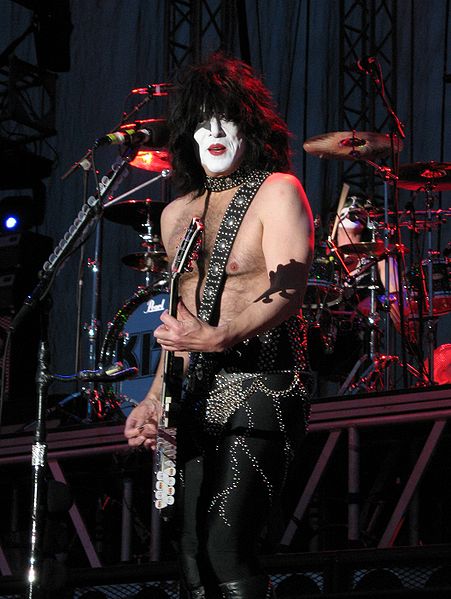
Paul Stanley - The man born Stanley Harvey Eisen has been almost exclusively the lead singer of KISS, but in addition to a 1978 solo album (released at the same time as those of his bandmates), Paul Stanley also released an album called Live To Win on his own in 2006. I never heard of it until looking him up just now, and if nothing else, it seems to prove that he does better with his makeup on.

Paul Hewson - Better known as Bono, he hasn't ever really strayed from the confines of U2 other than to write & record "Silver & Gold" for the Sun City anti-apartheid benefit album. Well that, and to occasionally save the world.

Paul Simonon - I only know of one song on which The Clash bassist sang, but "Guns of Brixton"--which he also wrote--is a pretty good one. Plus, he was the subject of the greatest photo in rock history, the one that made the cover of London Calling. He's done stints in Gorillaz and Damon Albarn's other supergroup, The Good, the Bad and the Queen, but nothing solo of which I'm aware.

So, as you can see, the Power of Paul is indeed greater in groups.

Still, I'm not really claiming that this proves anything; I am merely pointing out the coincidence that at least four of my favorite singer-songwriters are named Paul and have followed roughly similar career regressions. Plus, that almost all successful singing Pauls can be found within bands, rather than without.

Despite my abiding thesis about the Pauls--particularly McCartney, Simon, Weller and Westerberg--I realize that the trajectory of tremendous group output (and often success) followed by a substantial but lesser solo career is not limited to songwriting singers named Paul.

David Byrne, Sting and John Fogerty all became strong solo acts yet never quite equaled their work within Talking Heads, The Police or Creedence Clearwater Revival, despite their being the chief songwriters within those groups. And I'm sure you can think of others who fit the profile.

In fact, I find it a bit harder to come up with solo careers that were better than the (noteworthy) groups left behind, with Peter Gabriel (Genesis), Neil Young (Buffalo Springfield and CSNY) and Van Morrison (Them) being the only real obvious examples. You can argue amongst yourselves whether Lou Reed (Velvet Underground), Ozzy Osbourne (Black Sabbath) and Morrissey (The Smiths) were better alone or within the bands that made them famous; I lean toward the latter. Rod Stewart doesn't count, because although he had some great solo records, the best came during the period that he was also the frontman for The Faces. And because I'm focusing on rock performers, I'll leave Beyonce out of the equation, although she seems more popular on her own than with Destiny's Child (I don't know enough to make a qualitative judgment).

So I guess my rock 'n roll thesis is best stated as:
Singing Pauls are almost always better in bands, and should never leave a successful one behind, but that's likely a bad decision whatever your name may be.